
Recent from talks
Vibrio vulnificus
Knowledge base stats:
Talk channels stats:
Members stats:
Vibrio vulnificus
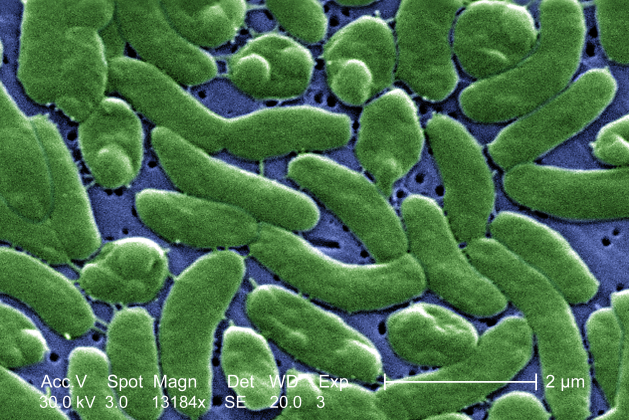
Vibrio vulnificus is a species of Gram-negative, motile, curved rod-shaped (vibrio), pathogenic bacteria of the genus Vibrio. Present in marine environments such as estuaries, brackish ponds, or coastal areas, V. vulnificus is related to V. cholerae, the causative agent of cholera. At least one strain of V. vulnificus is bioluminescent. Increasing seasonal ocean temperatures and low-salt marine environments like estuaries favor a greater concentration of Vibrio within filter-feeding shellfish; V. vulnificus infections in the Eastern United States have increased eightfold from 1988–2018.
Infection with V. vulnificus leads to rapidly expanding skin infections by entering a wound causing cellulitis or even sepsis. V. vulnificus is also a source of foodborne illness. It was first isolated as a source of disease in 1976.
Vibrio vulnificus is a species of gram-negative, motile, curved rod-shaped (bacillus), pathogenic bacteria of the genus Vibrio. Present in marine environments such as estuaries, brackish ponds, or coastal areas, V. vulnificus is related to V. cholerae, the causative agent of cholera. The most harmful strains of V. vulnificus documented have been observed in three different forms. The first is in an anti-phagocytic polysaccharide capsule that protects the bacteria. By encapsulating the bacteria, phagocytosis, and opsonization can not occur, thus allowing the bacteria to continue throughout the organism it is in. The second way that V. vulnificus has been most harmful is with some of the toxins that it creates. These toxins are not part of the infection that V. vulnificus causes but instead they are part of a secondary infection in the gastrointestinal tract that most certainly will lead to systemic infection. Lastly, V. vulnificus has been seen to cause more harm in patients who have higher levels of iron.
The genome size of V. vulnificus is approximately 5.3 Mbp. The genome is organized into two circular replicons, similar to that of V. cholerae, which also has a large and a small chromosome. However, the genome of V. vulnificus is at least one megabase bigger.
Natural transformation is a bacterial adaptation for DNA transfer between individual cells. V. vulnificus was found to become naturally transformable during growth on chitin in the form of crab shells. The ability to now carry out transformation experiments in the laboratory should facilitate molecular genetic analysis of this opportunistic pathogen.[citation needed]
V. vulnificus has a capsule, made of polysaccharides, and is thought to protect against phagocytosis. The capsule also aids the bacteria in escaping opsonization. Different strains of the bacteria are capable of shifting through the unencapsulated and encapsulated forms. Mouse models have shown that the unencapsulated forms are avirulent. These same strains, however, are shown to have a higher predisposition to shift to the virulent encapsulated form when taken up by oysters. Varying levels of oxygen determine the amount of capsular production. Aerobic conditions increase the expression of wza, wzb, and wzc genes, increasing the production of the capsule. Out of the two genotypes the strain commonly found in the environment showed a higher level of capsular production than the one found in human infections. Under anaerobic conditions the capsule appears translucent, while it is normally supposed to be a more opaque color.
V. vulnificus creates less biofilm under anaerobic conditions, when in most bacteria the opposite is the case. Genotypes that are found more in the environment show this correlation more than the genotypes found in human infection. Environmental strains such as temperature change also play a role in the formation of biofilms, with lower temperatures increasing the production. Strains found in human infection showed more biofilm formation at temperatures of 24 °C than environmental strains, showing these strains are adapted for their environments.
Like all gram-negative bacteria, V. vulnificus has LPS (lipopolysaccharide as the major component of its outer membrane). However, the LPS the bacteria produces isn't as efficient at triggering the immune system's release of tumor necrosis factor (TNF) alpha and other cytokines that produce shock syndromes. The capsular proteins the bacteria express, however, are capable of producing an immune response contributing to shock syndrome.
Hub AI
Vibrio vulnificus AI simulator
(@Vibrio vulnificus_simulator)
Vibrio vulnificus
Vibrio vulnificus is a species of Gram-negative, motile, curved rod-shaped (vibrio), pathogenic bacteria of the genus Vibrio. Present in marine environments such as estuaries, brackish ponds, or coastal areas, V. vulnificus is related to V. cholerae, the causative agent of cholera. At least one strain of V. vulnificus is bioluminescent. Increasing seasonal ocean temperatures and low-salt marine environments like estuaries favor a greater concentration of Vibrio within filter-feeding shellfish; V. vulnificus infections in the Eastern United States have increased eightfold from 1988–2018.
Infection with V. vulnificus leads to rapidly expanding skin infections by entering a wound causing cellulitis or even sepsis. V. vulnificus is also a source of foodborne illness. It was first isolated as a source of disease in 1976.
Vibrio vulnificus is a species of gram-negative, motile, curved rod-shaped (bacillus), pathogenic bacteria of the genus Vibrio. Present in marine environments such as estuaries, brackish ponds, or coastal areas, V. vulnificus is related to V. cholerae, the causative agent of cholera. The most harmful strains of V. vulnificus documented have been observed in three different forms. The first is in an anti-phagocytic polysaccharide capsule that protects the bacteria. By encapsulating the bacteria, phagocytosis, and opsonization can not occur, thus allowing the bacteria to continue throughout the organism it is in. The second way that V. vulnificus has been most harmful is with some of the toxins that it creates. These toxins are not part of the infection that V. vulnificus causes but instead they are part of a secondary infection in the gastrointestinal tract that most certainly will lead to systemic infection. Lastly, V. vulnificus has been seen to cause more harm in patients who have higher levels of iron.
The genome size of V. vulnificus is approximately 5.3 Mbp. The genome is organized into two circular replicons, similar to that of V. cholerae, which also has a large and a small chromosome. However, the genome of V. vulnificus is at least one megabase bigger.
Natural transformation is a bacterial adaptation for DNA transfer between individual cells. V. vulnificus was found to become naturally transformable during growth on chitin in the form of crab shells. The ability to now carry out transformation experiments in the laboratory should facilitate molecular genetic analysis of this opportunistic pathogen.[citation needed]
V. vulnificus has a capsule, made of polysaccharides, and is thought to protect against phagocytosis. The capsule also aids the bacteria in escaping opsonization. Different strains of the bacteria are capable of shifting through the unencapsulated and encapsulated forms. Mouse models have shown that the unencapsulated forms are avirulent. These same strains, however, are shown to have a higher predisposition to shift to the virulent encapsulated form when taken up by oysters. Varying levels of oxygen determine the amount of capsular production. Aerobic conditions increase the expression of wza, wzb, and wzc genes, increasing the production of the capsule. Out of the two genotypes the strain commonly found in the environment showed a higher level of capsular production than the one found in human infections. Under anaerobic conditions the capsule appears translucent, while it is normally supposed to be a more opaque color.
V. vulnificus creates less biofilm under anaerobic conditions, when in most bacteria the opposite is the case. Genotypes that are found more in the environment show this correlation more than the genotypes found in human infection. Environmental strains such as temperature change also play a role in the formation of biofilms, with lower temperatures increasing the production. Strains found in human infection showed more biofilm formation at temperatures of 24 °C than environmental strains, showing these strains are adapted for their environments.
Like all gram-negative bacteria, V. vulnificus has LPS (lipopolysaccharide as the major component of its outer membrane). However, the LPS the bacteria produces isn't as efficient at triggering the immune system's release of tumor necrosis factor (TNF) alpha and other cytokines that produce shock syndromes. The capsular proteins the bacteria express, however, are capable of producing an immune response contributing to shock syndrome.
Recent media