Hubbry Logo
Vickers hardness testVickers hardness testMain
Open search
Vickers hardness test
Community hub
Vickers hardness test
logo
8 pages, 0 posts
0 subscribers
Be the first to start a discussion here.
Vickers hardness test
from Wikipedia

A Vickers hardness tester

The Vickers hardness test was developed in 1921 by Robert L. Smith and George E. Sandland at Vickers Ltd as an alternative to the Brinell method to measure the hardness of materials.[1] The Vickers test is often easier to use than other hardness tests since the required calculations are independent of the size of the indenter, and the indenter can be used for all materials irrespective of hardness. The basic principle, as with all common measures of hardness, is to observe a material's ability to resist plastic deformation from a standard source. The Vickers test can be used for all metals and has one of the widest scales among hardness tests. The unit of hardness given by the test is known as the Vickers Pyramid Number (HV) or Diamond Pyramid Hardness (DPH). The hardness number can be converted into units of pascals, but should not be confused with pressure, which uses the same units. The hardness number is determined by the load over the surface area of the indentation and not the area normal to the force, and is therefore not pressure.

Implementation

[edit]
Vickers test scheme
The pyramidal diamond indenter of a Vickers hardness tester
An indentation left in case-hardened steel after a Vickers hardness test. The difference in length of both diagonals and the illumination gradient, are both classic indications of an out-of-level sample. This is not a good indentation.
This is a good indentation.

It was decided that the indenter shape should be capable of producing geometrically similar impressions, irrespective of size; the impression should have well-defined points of measurement; and the indenter should have high resistance to self-deformation. A diamond in the form of a square-based pyramid satisfied these conditions. It had been established that the ideal size of a Brinell impression was 38 of the ball diameter. As two tangents to the circle at the ends of a chord 3d/8 long intersect at 136°, it was decided to use this as the included angle between plane faces of the indenter tip. This gives an angle from each face normal to the horizontal plane normal of 22° on each side. The angle was varied experimentally and it was found that the hardness value obtained on a homogeneous piece of material remained constant, irrespective of load.[2] Accordingly, loads of various magnitudes are applied to a flat surface, depending on the hardness of the material to be measured. The HV number is then determined by the ratio F/A, where F is the force applied to the diamond in kilograms-force and A is the surface area of the resulting indentation in square millimeters.[citation needed]
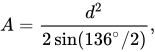
which can be approximated by evaluating the sine term to give,
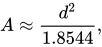
where d is the average length of the diagonal left by the indenter in millimeters. Hence,[3]

,

where F is in kgf and d is in millimeters.

The corresponding unit of HV is then the kilogram-force per square millimeter (kgf/mm2) or HV number. In the above equation, F could be in N and d in mm, giving HV in the SI unit of MPa. To calculate Vickers hardness number (VHN) in kilogram-force using SI units for the input parameters, one needs to convert the force applied from N to kilogram-force by dividing by 9.806 65 (standard gravity). This leads to the following equation:[4]

where F is in Newtons and d is in millimeters.

Vickers hardness numbers are reported as xxxHVyy, e.g. 440HV30, or xxxHVyy/zz if duration of force differs from 10 s to 15 s, e.g. 440HV30/20, where:

  • 440 is the hardness number,
  • HV names the hardness scale (Vickers),
  • 30 indicates the load used in kgf.
  • 20 indicates the loading time if it differs from 10 s to 15 s
Examples of HV values for various materials[5]
Material Value
316L stainless steel 140HV30
347L stainless steel 180HV30
Carbon steel 55–120HV5
Iron 30–80HV5
Martensite 1000HV
Diamond 10000HV

Precautions

[edit]

When doing the hardness tests, the minimum distance between indentations and the distance from the indentation to the edge of the specimen must be taken into account to avoid interaction between the work-hardened regions and effects of the edge. These minimum distances are different for ISO 6507-1 and ASTM E384 standards.

Standard Distance between indentations Distance from the center of the indentation to the edge of the specimen
ISO 6507-1 > 3·d for steel and copper alloys and > 6·d for light metals 2.5·d for steel and copper alloys and > 3·d for light metals
ASTM E384 2.5·d 2.5·d

Vickers values are generally independent of the test force: they will come out the same for 500 gf and 50 kgf, as long as the force is at least 200 gf.[6] However, lower load indents often display a dependence of hardness on indent depth known as the indentation size effect (ISE).[7] Small indent sizes will also have microstructure-dependent hardness values.

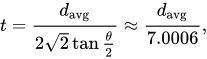
For thin samples indentation depth can be an issue due to substrate effects. As a rule of thumb the sample thickness should be kept greater than 2.5 times the indent diameter. Alternatively indent depth, , can be calculated according to:

Conversion to SI units

[edit]

To convert the Vickers hardness number to SI units the hardness number in kilograms-force per square millimeter (kgf/mm2) has to be multiplied with the standard gravity, , to get the hardness in MPa (N/mm2) and furthermore divided by 1000 to get the hardness in GPa.


Vickers hardness can also be converted to an SI hardness based on the projected area of the indent rather than the surface area. The projected area, , is defined as the following for a Vickers indenter geometry:[8]

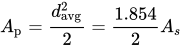
This hardness is sometimes referred to as the mean contact area or Meyer hardness, and ideally can be directly compared with other hardness tests also defined using projected area. Care must be used when comparing other hardness tests due to various size scale factors which can impact the measured hardness.

Estimating tensile strength

[edit]

If HV is first expressed in N/mm2 (MPa), or otherwise by converting from kgf/mm2, then the tensile strength (in MPa) of the material can be approximated as σu ≈ HV/c , where c is a constant determined by yield strength, Poisson's ratio, work-hardening exponent and geometrical factors – usually ranging between 2 and 4.[9] In other words, if HV is expressed in N/mm2 (i.e. in MPa) then the tensile strength (in MPa) ≈ HV/3. This empirical law depends variably on the work-hardening behavior of the material.[10]

See also

[edit]

References

[edit]

Further reading

[edit]
[edit]
Revisions and contributorsEdit on WikipediaRead on Wikipedia
from Grokipedia
The Vickers hardness test is a standardized method for determining the hardness of metallic materials by pressing a square-based pyramid indenter into the surface under a controlled and measuring the lengths of the resulting indentation diagonals to calculate the resistance to plastic deformation. Developed in 1921 by Robert L. Smith and George E. Sandland at Vickers Ltd. in the as an alternative to the Brinell hardness test, it provides a versatile approach applicable to a broad spectrum of loads, from microindentation forces as low as 1 to macro loads up to 120 kgf, accurate assessment of both soft and hard materials including thin sections, coatings, and case-hardened surfaces. The principle of the test involves applying a specified to the indenter—a four-sided with a square base and a face-to-opposite-face angle of 136°—for a dwell time of 10 to 15 seconds, after which the is removed and the indentation is examined optically to measure the two diagonals, ensuring they do not differ by more than 10%. The hardness number (HV) is then derived from the HV = (1.8544 × F) / d², where F represents the test in kilograms-force (kgf) and d is the of the diagonal lengths in millimeters; equivalent SI formulations use newtons (N) for . This method yields a value independent of the indenter size, distinguishing it from other tests like Brinell or Rockwell, and it is particularly valued for its precision in microhardness applications where indentation sizes are below 0.02 mm. Governed by international standards such as ISO 6507 (divided into parts for test methods, verification, , and tables of hardness values) and ASTM E92 (covering both Vickers and Knoop hardness for metallic materials), the test ensures through requirements for indenter , machine verification, and environmental conditions like flat, polished test surfaces free of defects. Widely used in industries including , automotive, and for , , and material characterization, the Vickers test's scalability and minimal specimen preparation needs make it indispensable for evaluating gradients, such as in heat-treated components or weld zones.

Introduction

Definition and Purpose

The Vickers hardness test is an testing method that employs a square-based indenter to produce an impression on the surface of a under a specified test force, with determined by measuring the diagonals of the resulting indentation. This approach allows for precise assessment of a material's resistance to localized plastic deformation. The primary purpose of the Vickers test is to quantify the hardness of materials across a broad spectrum, from soft metals to hard ceramics and cemented carbides, providing a reliable indicator of their mechanical properties for applications in and processes across metallic materials, ceramics, and composites. It is particularly valuable for evaluating thin coatings, small components, or microstructural features where other methods may be less effective. The test encompasses macrohardness variants using forces from 1 to 100 kgf and microhardness variants with forces less than 1 kgf (typically 1 gf to 1 kgf), making it versatile for both bulk and localized measurements. These procedures are standardized internationally under ISO 6507 for metallic materials and ASTM E384 for microindentation . The resulting hardness value, denoted as the Vickers Pyramid Number (HV), is load-independent for valid indentations, as it is calculated from the indentation's surface area rather than its depth alone. Developed in 1921 by Robert L. Smith and George E. Sandland at Ltd. as an alternative to the Brinell method, the test has become a cornerstone for hardness evaluation in .

Historical Development

The hardness test was developed in 1921 by engineers Robert L. Smith and George E. Sandland at Ltd. in the , specifically to provide a more precise method for assessing the of metals compared to the existing Brinell test. The Brinell method, which relied on a ball indenter, suffered from limitations such as large indentation sizes that damaged samples and deformation of the indenter itself under high loads, particularly for harder materials; in response, Smith and Sandland introduced a durable diamond pyramid indenter to produce smaller, more accurate impressions suitable for a broader range of applications. The test's foundational description appeared in a 1922 publication in the Proceedings of the , where the inventors highlighted its optical measurement approach for versatility across different material scales and hardness levels. Named after the company, the method quickly gained recognition for its adaptability, earning a from the for improving hardness measurement accuracy. By the 1930s, the test saw widespread adoption for microhardness applications, particularly with lower loads evaluated at institutions like the National Physical Laboratory, enabling detailed analysis of thin layers and small features in metals. The 1980s marked a shift toward , with the integration of digital microscopes and load control systems enhancing precision and in testing setups. More recently, the 2023 edition of ISO 6507-1 incorporated updates for digital measurement traceability and guidance on advanced verification, reflecting ongoing refinements for modern instrumentation. Post-1950 advancements have extended the Vickers method into instrumented indentation techniques, particularly for nano-scale testing, where load-displacement data allows for deriving not just but also in thin films and microstructures; this evolution, building on early microhardness work, gained prominence in the and through developments like depth-sensing indenters.

Principle

Indenter Geometry

The Vickers indenter is a square-based constructed from a single-crystal , designed to produce precise and repeatable indentations during testing. The features four polished faces meeting at a vertex, with the angle between opposite faces specified as 136° ± 0.5°, ensuring the indenter maintains its sharpness and geometry under repeated use. This choice provides exceptional resistance to wear, as the 's exceeds that of any , allowing the indenter to retain its form across thousands of indentations without significant degradation. The indenter's geometry adheres to strict specifications outlined in international standards, including a tip effectively rounded to a maximum line of junction length of 0.0005 mm for low-force applications, equivalent to a tip radius less than 0.2 μm in practical implementations. The four faces are highly polished to eliminate surface defects and preserve sharp edges, while the angle between opposite edges is 148.11° ± 0.76°. Calibration of the indenter must comply with ISO 6507-2, verifying the pyramid axis alignment with the holder axis to within 0.5° and confirming the absence of defects that could distort measurements. When pressed into an isotropic material, the indenter produces a rhombic indentation with equal-length diagonals, facilitating accurate optical of the impression size. The 136° face was specifically selected for its optical advantages, as it approximates the geometry of a Brinell indentation at a depth-to-diameter of 0.375, optimizing diagonal visibility under without requiring complex adjustments. This fixed- design ensures that hardness values remain consistent across a wide range of applied loads, from macro-scale forces to micro-scale, by normalizing the independently of indentation depth. The pyramidal shape enables the creation of very small indentations, down to a few microns in diagonal length, making it ideal for microhardness testing on thin films, small components, or surface layers where larger indenters would be impractical.

Indentation and Hardness Concept

The Vickers hardness test measures a material's as its resistance to localized deformation under an applied load from a indenter, providing a quantitative assessment of surface integrity. When the indenter is pressed into the material, it induces a controlled deformation that results in a permanent square pyramidal impression; the size of this impression, particularly its diagonal length, is inversely related to the material's , as harder materials resist penetration more effectively and produce smaller indents. In the physical process, a vertical load is applied to the indenter, causing the material to first respond elastically under stress below its yield point. As the load increases, the material exceeds this threshold, transitioning to deformation where permanent shape change occurs within a localized zone beneath the surface. Upon load removal, elastic recovery partially rebounds the deformed material, but the residual impression's diagonal dimension predominantly captures the plastic deformation extent, as elastic effects are minimized in the measurement. The core principle underlying Vickers hardness (HV) calculation is that it represents the applied load divided by the surface area of the indentation, yielding a value proportional to the material's mean contact pressure during testing; this approach assumes isotropic material behavior, where properties are uniform in all directions. Unlike tensile or compressive tests that evaluate bulk mechanical response, the Vickers method specifically probes surface properties and exhibits high sensitivity to microstructural elements, such as grain boundaries, phase distributions, and defects, which can significantly influence local deformation resistance. A notable aspect of the test is the indentation size effect (ISE), observed particularly at low loads, where apparent increases as indentation size decreases due to factors like surface stress gradients and lack of full plasticity. This effect is commonly addressed through correction models, such as Meyer's law, which empirically relates load dependence to indentation to derive a load-independent "true" value.

Equipment and Procedure

Tester Components and Setup

The Vickers hardness tester consists of several key components designed to apply controlled loads and measure indentations precisely. The core element is the indenter mount, which holds a pyramid indenter with a square base and opposite face angles of 136 degrees, ensuring consistent geometry for indentation across various materials. The load application system typically employs dead weights for macro-scale testing (loads greater than 1 kgf) or electromagnetic mechanisms and load cells for micro-scale applications (loads from 1 gf to 1 kgf), allowing precise force selection in ranges up to 120 kgf as specified in relevant standards. An integrated , often with 10-50x magnification, facilitates the measurement of indentation diagonals, while modern units incorporate digital imaging systems for enhanced accuracy. The sample stage, usually an XY positioning platform, enables precise alignment of the specimen under the indenter, with manual or motorized controls in automated variants. Setup begins with machine using certified reference blocks covering values such as HV 100 to 800, performed through indirect verification to confirm load accuracy and indenter alignment per established protocols. The tester must be placed on a level, vibration-free table to minimize errors, and should be cleaned to ensure clear visualization of indentations. Load selection is configured via weight stacks for macro tests or electromagnetic coils for tests, with a dwell time of 10-15 seconds applied after force loading to allow complete deformation. Variants of the tester include manual models, where operators position samples and measure indentations optically, and automated systems that use motorized stages and software for positioning and data capture. Micro-Vickers testers, adhering to ASTM E384, operate at loads below 1 kgf for fine-scale analysis of thin coatings or microstructures. Modern automated units integrate software for , automating diagonal measurements to reduce operator variability. Additionally, portable and in-situ Vickers-style testers, often based on ultrasonic contact impedance principles with a diamond tip, have been developed since the for field applications on large components without transport.

Sample Preparation and Testing Steps

Proper sample preparation is essential for accurate Vickers hardness testing to ensure the indentation is well-defined and measurable without distortion. The test surface must be flat, smooth, and clean, free from oxides, contaminants, or irregularities that could affect optical measurement of the indent. For macrohardness testing (loads >1 kgf), the surface is typically ground to achieve this, while microhardness testing (loads ≤1 kgf) requires mechanical or to a fine finish with a roughness of Ra < 0.2 μm. Specimens are prepared through a sequence of grinding and steps, often starting with coarser abrasives and progressing to finer ones to minimize subsurface damage. The minimum sample thickness should be at least 1.5 times the expected diagonal length of the indentation according to ISO 6507, or 10 times the indentation depth per ASTM E384, to prevent anvils or substrate effects from influencing the result. For thin films or coatings, low loads are used to avoid penetration into the substrate, and preparation may involve non-destructive methods like gentle to preserve the layer integrity, particularly for welds where localized gradients are assessed. The testing procedure begins with securely positioning the prepared sample on the tester's stage, ensuring stability to avoid movement during loading. The appropriate test load is selected based on the material and scale—ranging from 1 to 120 kgf according to applicable standards such as ASTM E384 (for loads up to 1 kgf) and ASTM E92 (for macro loads), with common macro loads like 10 kgf (98 N) for larger indents, or loads from 1 for precise localized measurements—while adhering to ISO 6507 guidelines for force application. The diamond indenter is aligned over the test location, and the load is applied gradually over 2–8 seconds (nominal 7 seconds) to reach the final value without impact. The load is then held for a dwell time of 10–15 seconds (nominal 14 seconds) to allow full plastic deformation, though longer times up to 30 seconds may be specified for certain materials. After dwell, the load is removed, revealing the square pyramidal indent. Measurement follows immediately using an integrated , where the lengths of the two diagonals (d1 and d2) are observed and recorded to the nearest 0.1 μm, ensuring the average diagonal is at least 20 μm for reliable . In manual setups, the operator focuses and measures directly; automated testers enhance precision by using software for positioning and , reducing operator . Typically, 5–10 indents are made per sample for statistical reliability, with results averaged. Key precautions during testing include maintaining minimum spacing between indents—at least 3 times the average diagonal for steels and , or 6 times for softer metals like aluminum per ISO 6507—to prevent stress interactions, and positioning indents no closer than 2.5–3 times the diagonal from the sample edge to avoid boundary effects. Indentations near edges or in anisotropic regions should be avoided, and for coated or welded samples, preparation focuses on exposing the without altering the microstructure.

Calculation and Analysis

Hardness Value Computation

The Vickers hardness number (HV) is computed as the quotient of the applied load and the surface area of the indentation produced by the diamond pyramid indenter. The is given by HV=1.8544×Fd2HV = \frac{1.8544 \times F}{d^2} where FF is the applied load in (kgf) and dd is the average length of the two diagonals of the square indentation in millimeters (mm). The resulting HV value has units of kgf/mm². The constant 1.8544 arises from the of the indenter, which is a square-based with a face-to-face angle of 136°, or equivalently, an angle of 68° from the pyramid axis to each face. The surface area AA of the indentation is related to the diagonal dd by A=d2/1.8544A = d^2 / 1.8544, derived from the projected area formula for the : A=d2/(2sin68)A = d^2 / (2 \sin 68^\circ), where sin680.9272\sin 68^\circ \approx 0.9272 and thus 2sin681.85442 \sin 68^\circ \approx 1.8544. This geometric factor ensures that the hardness represents the load per unit surface area of the permanent indentation. To compute HV, the lengths of the two diagonals (d1d_1 and d2d_2) are measured optically using a microscope after the load is removed and the indentation is fully developed. The average diagonal is then calculated as d=(d1+d2)/2d = (d_1 + d_2)/2, provided that the difference d1d2|d_1 - d_2| is less than 10% of dd to ensure a valid square-shaped impression; otherwise, the test is invalid and must be repeated. The HV value is obtained by substituting FF and dd into the formula, either manually or via integrated software in modern testers. For example, with an applied load F=10F = 10 kgf and average diagonal d=0.2d = 0.2 mm, HV ≈ 463 kgf/mm². The computation is valid for indentation diagonals in the range of 0.02 to 0.5 mm, corresponding to typical test loads from 0.1 to 100 kgf, where the hardness value is independent of load for diagonals greater than 20 μm. At very low loads (e.g., micro- or nano-scale), an indentation size effect (ISE) may occur, leading to apparently higher hardness values; in such cases, corrections can be applied using methods like the Oliver-Pharr approach, which analyzes load-displacement data to account for elastic recovery and pile-up effects.

Unit Conversions and Standards

The Vickers hardness number (HV), traditionally expressed in units of kgf/mm², is converted to SI units of megapascals (MPa) using the relation HV (MPa) = HV (kgf/mm²) × 9.80665. This conversion factor arises from the definition of 1 kgf as 9.80665 N, based on standard , combined with the area scaling from mm² to . For practical approximations, HV in GPa is often taken as HV (kgf/mm²) / 1000, reflecting the near-equivalence of the conversion factor to 10. International standards ensure reproducibility and accuracy in Vickers hardness testing. The ISO 6507 series governs the method, with the 2023 edition of ISO 6507-1 specifying procedures for metallic materials across test force ranges of 1–98 N (microhardness), 1.9–49 N (low-force), and 49–980 N (conventional). The accompanying ISO 6507-2:2018 provides for verification and calibration of testing machines, incorporating digital methods for diagonal measurement to enhance precision. In the United States, ASTM E384-22 covers microindentation using Vickers indenters for forces from 1 to 1000 gf, with revisions emphasizing automated image analysis and statistical reporting. ASTM E92-23 addresses standard and low-force Vickers testing for metallic materials, updating requirements for indenter alignment and load application. Certified reference blocks used for calibration must have hardness values within a tolerance of ±2%. Compliance with these standards requires detailed test reports that document the applied load, dwell time (typically 10–15 seconds), and the two diagonal lengths (d values) of the indentation. Uncertainty in measurements is evaluated according to to the Expression of Uncertainty in Measurement (GUM), accounting for contributions from , displacement, and environmental factors through principles. Although legacy kgf/mm² units remain common in industrial applications for their familiarity, SI units (MPa or GPa) are mandated for official and legal in the since the 2010 amendments to Directive 80/181/EEC, promoting consistency with the . As of 2025, updates in testing practices, aligned with ISO 6507, increasingly emphasize automated validation through AI-driven image recognition and real-time uncertainty assessment to support high-throughput testing. For instrumented variants that record full load-depth curves, the ISO 14577 series (latest 2015 edition for Part 1) provides complementary standardization, focusing on and modulus determination beyond traditional optical methods.

Estimating Mechanical Properties

The Vickers hardness test enables the estimation of key mechanical properties, such as (UTS) and yield strength, through established empirical correlations derived from extensive experimental data on metals. For steels, particularly annealed and heat-treated varieties, UTS in MPa is approximately 3 × HV, where HV is the Vickers hardness number; this approximation holds with an error margin of about ±15% across a range of microstructures, though more precise linear models like UTS ≈ 3.734 × HV - 99.8 MPa better account for variations in strain-hardening potential. For aluminum alloys, a comparable relation applies, with UTS ≈ 2.95 × HV, applicable to wrought and heat-treated forms but showing greater scatter due to alloy-specific effects. Yield strength estimation follows similar principles, often leveraging Tabor's foundational relation from indentation mechanics, which posits that Vickers hardness approximates three times the yield stress (HV ≈ 3Y, with Y in consistent units, typically adjusted to MPa via HV × 9.807 / 3). For ferritic steels, this refines to yield strength ≈ 2.8 × HV, reflecting the material's dislocation-mediated deformation behavior and validated through irradiation and microstructural studies. These correlations facilitate non-destructive property inference in and design. A practical example in involves mild components, where a measured HV of 200 indicates an UTS of roughly 600 MPa, aiding root-cause determination in fractured parts by linking gradients to overload or . However, such estimations are inherently empirical and material-specific, limited to ductile metals like steels and aluminum; they lack reliability for composites, very hard/brittle materials, or those with heterogeneous microstructures, as does not fully capture anisotropic or strain-rate-dependent behaviors. Standard references like ASTM E384 emphasize these constraints, noting that correlations serve as indicators rather than substitutes for direct . Recent advancements in additively manufactured metals highlight gaps in traditional correlations, with post-2010 studies revealing deviations due to porosity and rapid solidification effects; updated models for alloys like AlSi10Mg incorporate defect correlations to refine UTS predictions, underscoring the need for process-specific calibrations.

Applications

Suitable Materials and Industries

The Vickers hardness test is suitable for a wide range of materials, including metals such as steels, aluminum, titanium, and their alloys, as well as ceramics, thin coatings, and composites. It particularly excels in evaluating hardness gradients, such as in case-hardened parts, where micro-Vickers variants allow precise measurements across varying material properties without excessive deformation. The test's versatility stems from its broad hardness scale, typically ranging from HV 1 to over 3000, enabling assessment from soft to extremely hard substances. Representative examples illustrate this range: exhibits a Vickers hardness of approximately 10,000 HV, demonstrating the test's capability for ultra-hard materials, while soft polymers can yield values below HV 10, highlighting its applicability to low-hardness substances like certain elastomers. In modern contexts, the test is increasingly used for emerging materials, such as 3D-printed alloys like or aluminum-based components, where it verifies mechanical integrity post-fabrication. In industries, the Vickers test supports in ISO 9001-certified processes by ensuring material consistency and compliance with standards like ISO 6507 and ASTM E384. It is commonly applied in for testing turbine blades and heat-treated components to confirm durability under extreme conditions. In the automotive sector, it evaluates gears and case-hardened steels for wear resistance. The employs micro-Vickers for semiconductors and thin coatings to assess and reliability. Biomedical applications include hardness profiling of implants made from or ceramics to ensure and strength. Additionally, micro-Vickers is vital for weld inspections and heat-affected zones in structural components. As of 2025, its role has expanded to components, such as laser-welded aluminum-copper joints for interconnects, where it measures hardness variations to prevent failure in high-demand assemblies.

Specific Testing Scenarios

One prominent application of the Vickers hardness test involves measuring case depth in carburized steels through a series of traverse indents along a cross-section, where hardness gradients from the hardened surface to the softer core are profiled to determine effective case depth, typically defined as the distance where hardness drops to 50 HV above the core value. This method adheres to standards like IS 6416, ensuring precise evaluation of efficacy in components requiring wear resistance. In weld hardness profiling, the test follows ASTM E384 guidelines, employing microindentations across the weld metal, , and base material to map variations in hardness that could indicate or cracking risks, with loads selected to avoid substrate influence. For assessing adhesion, low loads below 50 gf are applied to generate controlled interfacial stresses, where the onset of around the indent reveals strength without penetrating the substrate significantly. In aerospace applications, the Vickers test verifies the hardness of components, which typically exhibit values of 300-350 HV in annealed conditions, ensuring compliance with structural integrity requirements for turbine blades and airframes. Within the automotive sector, it evaluates gear tooth hardness post-case hardening, targeting surface values exceeding 600 HV to confirm durability against fatigue and wear in transmission systems. For microelectromechanical systems () devices, nano-Vickers variants apply loads under 1 mN to measure hardness at nanoscale features, preventing damage to delicate structures like sensors and actuators. Adaptations include instrumented Vickers testing, which records load-depth curves during indentation to derive not only hardness but also via the Oliver-Pharr method, providing insights into viscoelastic behavior from unloading slopes. High-temperature setups extend measurements to 1000°C using specialized fixtures like heated anvils and inert atmospheres to evaluate creep resistance in superalloys, maintaining indenter stability under .

Advantages, Limitations, and Comparisons

Benefits and Precautions

The hardness test offers a wide measurement range, typically from 1 HV to 3000 HV, enabling assessment of materials from soft metals to hard ceramics and coatings. This versatility stems from adjustable test loads spanning 1 gf (0.001 kgf) to 120 kgf, allowing both micro- and macro-scale evaluations without changing indenters. Its square pyramidal indenter produces small, precise indentations, making it particularly suitable for thin sections under 0.1 mm thick, such as coatings or small components, where it minimizes substrate influence and provides reliable depth profiling. The simple geometry ensures consistent results across operators and machines, as calculations depend solely on indentation diagonals rather than indenter size. For macro tests with higher loads, the method remains effectively non-destructive, leaving indentations too small to compromise structural integrity in most applications. Precautions are essential to maintain accuracy, starting with ensuring the test surface is to the indenter axis, with tilt limited to less than 1° to prevent distorted indentations. At low loads (below 1 kgf), the indentation size effect (ISE) can cause apparent increases due to surface effects; involves using higher loads where possible or applying correction models based on load-depth relationships. Samples must meet a minimum thickness of at least 1.5 times the indentation diagonal (per ISO 6507) to avoid anvil effects or backside deformation, with ASTM E384 recommending 10 times the indentation depth for micro tests. Environmental controls, including stable temperatures with variations not exceeding 5°C and minimal vibration, are required to stabilize the testing machine and prevent load fluctuations. Common error sources include operator mismeasurement of diagonals, necessitating optical systems with ±0.5 μm resolution for micro-scale accuracy, and indenter , which demands every 100 tests or upon detecting edge chipping. The test excels over Rockwell methods for micro-scale applications due to its finer resolution and adaptability to thin or coated samples. advancements, including AI-driven image , have reduced variability to under 1% by automating diagonal detection and flagging anomalies in real-time. The durable indenter's longevity—lasting thousands of cycles—supports through minimal replacement and low material waste.

Comparisons with Other Tests

The Vickers hardness test differs from the Brinell test primarily in the indenter material and indentation size. While the Brinell method employs a or ball that can deform under high loads on harder materials, the Vickers test uses a square-based indenter, which resists deformation and produces consistent results across a broader range of material hardness. This indenter also creates smaller indentations, making Vickers suitable for thinner samples or regions where larger Brinell indents (typically 2-6 mm in diameter) would be impractical. The Vickers hardness value (HV) is calculated from the diagonal of the square indent, contrasting with Brinell's use of indentation diameter, and conversion between the scales (HB and HV) is facilitated by standardized tables; for values below 450, HB approximates HV within a few units. In comparison to the Rockwell hardness test, Vickers relies on optical of indentation size after load removal, whereas Rockwell directly measures the permanent depth of indentation under minor and major loads, enabling faster testing without . This optical approach gives Vickers an edge in microhardness applications and for detecting gradients in materials like coatings or case-hardened parts, where Rockwell's depth-based method may lack sufficient resolution. Rockwell is preferred in high-volume production settings for its speed, but it offers multiple scales (e.g., HRC for harder steels) tailored to material types, reducing versatility compared to the unified HV scale; conversions between HRC and HV are approximate and material-dependent per ASTM guidelines. The and Knoop tests both serve microhardness needs with indenters, but Knoop uses an elongated rhombus-shaped to produce a shallow, rectangular indent, which is advantageous for assessing anisotropic materials like thin films or composites where directional properties matter. assumes more isotropic behavior due to its square indent geometry, yielding a value less sensitive to orientation but potentially less precise in highly anisotropic cases; studies show Knoop values are generally lower than for hard ceramics at equivalent loads. A distinctive feature of the Vickers method is its single HV scale that spans macro- and microindentation regimes, from loads of 1-120 kgf for bulk materials to under 1 kgf for microstructures, unlike Rockwell's array of scales or Brinell's load-specific adjustments. This unification simplifies comparisons and conversions to SI units (e.g., HV in MPa via multiplication by 9.80665), which is more straightforward than Brinell's HB scale due to the latter's variable ball sizes. For nanoscale applications, Vickers contrasts with nanoindentation techniques using a Berkovich tip, a three-sided pyramid equivalent in projected area-to-depth ratio to the Vickers indenter but designed for loads below 200 mN to probe thin films or surface layers without substrate effects. While traditional Vickers excels in standard micro-to-macro ranges, nanoindentation with Berkovich provides higher for hardness mapping in like , though both methods correlate well for bulk equivalents due to geometric similarity.

References

Add your contribution
Related Hubs
User Avatar
No comments yet.