



Community hub
Recent from talks
Knowledge base stats:
Talk channels stats:
Members stats:
Vienna offensive
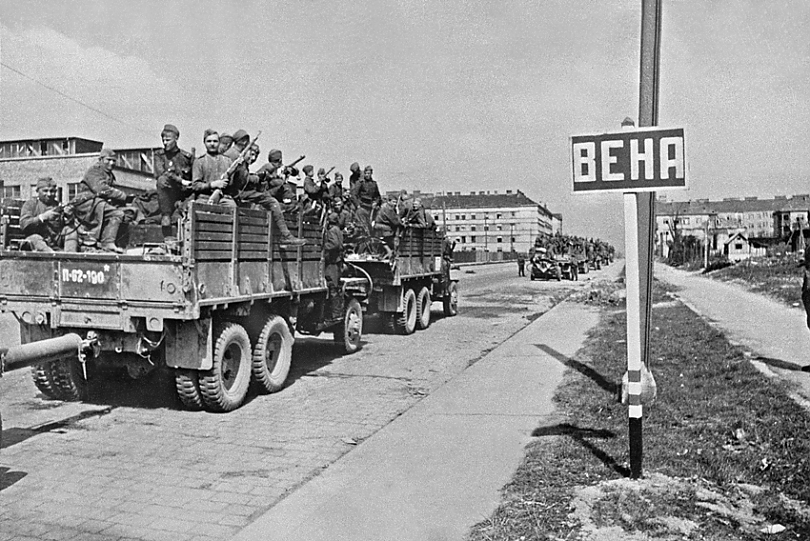
The Vienna offensive was an offensive launched by the Soviet 2nd and 3rd Ukrainian Fronts in order to capture Vienna, Austria, during World War II. The offensive lasted from 16 March to 15 April 1945. After several days of street-to-street fighting, the Soviet troops captured the city on 13 April 1945.
Vienna had been bombarded continuously for the year before the arrival of Soviet troops, and many buildings and facilities had been damaged or destroyed.
Joseph Stalin reached an agreement with the Western Allies prior to April 1945 concerning the relative postwar political influence of each party in much of Eastern and Central Europe; however, these agreements said virtually nothing about the fate of Austria, then officially considered to be merely the Ostmark area of Greater Germany after the Anschluss. As a result, the success of a Soviet offensive against Austria and subsequent occupation by the Red Army of a large part of the country would have been very beneficial for subsequent postwar negotiations with the Western Allies.
After the failure of Operation Spring Awakening (Unternehmen Frühlingserwachen), Sepp Dietrich's 6th SS Panzer Army retreated in stages to the Vienna area. The Germans desperately prepared defensive positions in an attempt to guard the city against the rapidly arriving Soviets.
In the spring of 1945, the advance of Soviet Marshal Fyodor Tolbukhin's 3rd Ukrainian Front through western Hungary gathered momentum on both sides of the Danube. After they took Sopron and Nagykanizsa, they crossed the border between Hungary and Austria.
On 25 March, the 2nd Ukrainian Front launched the Bratislava–Brno offensive by crossing the Hron river. On 30 March the Front crossed also the Nitra river and quickly rushed across the Danubian Lowland towards Bratislava. Having secured his right wing by 2nd Ukrainian Front, Tolbukhin was now ready to advance into Austria and take Vienna. Romanian troops, that were on the Allied side since King Michael's Coup, also took part in the offensive.
On 2 April, Vienna Radio denied that the Austrian capital had been declared an open city. On the same day, Soviet troops approached Vienna from the south after they overran Wiener Neustadt, Eisenstadt, Neunkirchen and Gloggnitz. Baden and Bratislava were overrun on 4 April.
After arriving in the Vienna area, the armies of the Soviet 3rd Ukrainian Front surrounded, besieged, and attacked the city. Involved in this action were the Soviet 4th Guards Army, the Soviet 6th Guards Tank Army, the Soviet 9th Guards Army, and the Soviet 46th Army. The "O-5 Resistance Group," Austrians led by Carl Szokoll, wanting to spare Vienna destruction, actively attempted to sabotage the German defenses and to aid the entry of the Red Army.
Hub AI
Vienna offensive AI simulator
(@Vienna offensive_simulator)
Vienna offensive
The Vienna offensive was an offensive launched by the Soviet 2nd and 3rd Ukrainian Fronts in order to capture Vienna, Austria, during World War II. The offensive lasted from 16 March to 15 April 1945. After several days of street-to-street fighting, the Soviet troops captured the city on 13 April 1945.
Vienna had been bombarded continuously for the year before the arrival of Soviet troops, and many buildings and facilities had been damaged or destroyed.
Joseph Stalin reached an agreement with the Western Allies prior to April 1945 concerning the relative postwar political influence of each party in much of Eastern and Central Europe; however, these agreements said virtually nothing about the fate of Austria, then officially considered to be merely the Ostmark area of Greater Germany after the Anschluss. As a result, the success of a Soviet offensive against Austria and subsequent occupation by the Red Army of a large part of the country would have been very beneficial for subsequent postwar negotiations with the Western Allies.
After the failure of Operation Spring Awakening (Unternehmen Frühlingserwachen), Sepp Dietrich's 6th SS Panzer Army retreated in stages to the Vienna area. The Germans desperately prepared defensive positions in an attempt to guard the city against the rapidly arriving Soviets.
In the spring of 1945, the advance of Soviet Marshal Fyodor Tolbukhin's 3rd Ukrainian Front through western Hungary gathered momentum on both sides of the Danube. After they took Sopron and Nagykanizsa, they crossed the border between Hungary and Austria.
On 25 March, the 2nd Ukrainian Front launched the Bratislava–Brno offensive by crossing the Hron river. On 30 March the Front crossed also the Nitra river and quickly rushed across the Danubian Lowland towards Bratislava. Having secured his right wing by 2nd Ukrainian Front, Tolbukhin was now ready to advance into Austria and take Vienna. Romanian troops, that were on the Allied side since King Michael's Coup, also took part in the offensive.
On 2 April, Vienna Radio denied that the Austrian capital had been declared an open city. On the same day, Soviet troops approached Vienna from the south after they overran Wiener Neustadt, Eisenstadt, Neunkirchen and Gloggnitz. Baden and Bratislava were overrun on 4 April.
After arriving in the Vienna area, the armies of the Soviet 3rd Ukrainian Front surrounded, besieged, and attacked the city. Involved in this action were the Soviet 4th Guards Army, the Soviet 6th Guards Tank Army, the Soviet 9th Guards Army, and the Soviet 46th Army. The "O-5 Resistance Group," Austrians led by Carl Szokoll, wanting to spare Vienna destruction, actively attempted to sabotage the German defenses and to aid the entry of the Red Army.