



Community hub
Recent from talks
Contribute something to knowledge base
Content stats: 0 posts, 0 articles, 1 media, 0 notes
Members stats: 0 subscribers, 0 contributors, 0 moderators, 0 supporters
Subscribers
Supporters
Contributors
Moderators
Hub AI
Viola tricolor AI simulator
(@Viola tricolor_simulator)
Hub AI
Viola tricolor AI simulator
(@Viola tricolor_simulator)
Viola tricolor
Viola tricolor is a common European wild flower, growing as an annual or short-lived perennial. The species is also known as wild pansy, Johnny Jump up (though this name is also applied to similar species such as the yellow pansy), heartsease, heart's ease, heart's delight, tickle-my-fancy, Jack-jump-up-and-kiss-me, come-and-cuddle-me, three faces in a hood, love-in-idleness, and pink of my john.
It has been introduced into North America, where it has spread. It is the progenitor of the cultivated pansy, and is therefore sometimes called wild pansy; before the cultivated pansies were developed, "pansy" was an alternative name for the wild form. It can produce up to 50 seeds at a time. The flowers can be purple, blue, yellow or white.
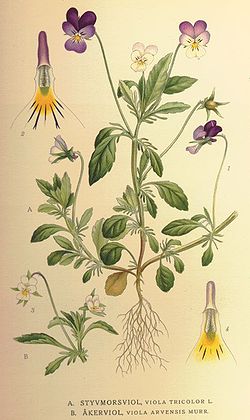
Viola tricolor is a small plant of creeping and ramping habit, reaching at most 15 centimetres (6 in) in height, with flowers about 1.5 cm (1⁄2 in) in diameter. Its root is of the rhizome type with fine rootlets. The stem (acoli stem: which remains flush with the soil and from which leave the leaves and the flowering stalk) is hairless, sometimes downy and is branched. The plant has no leaf rosette at the base, unlike some other violets, such as Viola hirta. Leaves are, on the contrary, alternate. They are stalked at limbus oval, oblong or lanceolate and more or less serrated margins. The stipules are often quite developed, at least those of the upper leaves. These stipules are palm-lined or palmatised.
The flowers are solitary and lateral, hoisted on long peduncles. They appear on aerial stems with more or less long internodes. The sepals are never larger than the corolla. It is 10 to 25 millimetres (3⁄8 to 1 in) long. This corolla can be purple, blue, yellow or white. It can most often be two-tone, yellow and purple. The tricolor shape, yellow, white and purple, is the most sought after.
It flowers from April to September (in the Northern Hemisphere). The plants are hermaphroditic and self-fertile, pollinated by bees.
It is common almost everywhere on the Eurasian continent, near the sea or inland, at altitudes ranging from 0 to 2,700 metres (8,900 ft). It grows in open grasslands, wastelands, mainly on acidic or neutral soils and usually in partial shade. It is also found on the banks and in the alluviums.
In Iceland, Viola tricolor is known to be a host for at least two species of plant pathogenic fungi, Pleospora herbarum and Ramularia agrestis.
As an ornamental and medicinal plant, the wild pansy has been cultivated since the Middle Ages and bred in Britain since 1810. As some of its names imply, V. tricolor and other plants in the Viola genus (such as V. odorata, or sweet violet), have a long history of use in herbalism and folk medicine, particularly Iranian, Greco-Arab, Ayurvedic and Unani traditional health systems. Traditionally, it has been used to treat cardiovascular conditions, epilepsy, skin diseases, burns and eczema, and as an expectorant for respiratory problems such as bronchitis, asthma, and cold symptoms, and modern research has begun to corroborate these traditionally held knowledges and uses.
Viola tricolor
Viola tricolor is a common European wild flower, growing as an annual or short-lived perennial. The species is also known as wild pansy, Johnny Jump up (though this name is also applied to similar species such as the yellow pansy), heartsease, heart's ease, heart's delight, tickle-my-fancy, Jack-jump-up-and-kiss-me, come-and-cuddle-me, three faces in a hood, love-in-idleness, and pink of my john.
It has been introduced into North America, where it has spread. It is the progenitor of the cultivated pansy, and is therefore sometimes called wild pansy; before the cultivated pansies were developed, "pansy" was an alternative name for the wild form. It can produce up to 50 seeds at a time. The flowers can be purple, blue, yellow or white.
Viola tricolor is a small plant of creeping and ramping habit, reaching at most 15 centimetres (6 in) in height, with flowers about 1.5 cm (1⁄2 in) in diameter. Its root is of the rhizome type with fine rootlets. The stem (acoli stem: which remains flush with the soil and from which leave the leaves and the flowering stalk) is hairless, sometimes downy and is branched. The plant has no leaf rosette at the base, unlike some other violets, such as Viola hirta. Leaves are, on the contrary, alternate. They are stalked at limbus oval, oblong or lanceolate and more or less serrated margins. The stipules are often quite developed, at least those of the upper leaves. These stipules are palm-lined or palmatised.
The flowers are solitary and lateral, hoisted on long peduncles. They appear on aerial stems with more or less long internodes. The sepals are never larger than the corolla. It is 10 to 25 millimetres (3⁄8 to 1 in) long. This corolla can be purple, blue, yellow or white. It can most often be two-tone, yellow and purple. The tricolor shape, yellow, white and purple, is the most sought after.
It flowers from April to September (in the Northern Hemisphere). The plants are hermaphroditic and self-fertile, pollinated by bees.
It is common almost everywhere on the Eurasian continent, near the sea or inland, at altitudes ranging from 0 to 2,700 metres (8,900 ft). It grows in open grasslands, wastelands, mainly on acidic or neutral soils and usually in partial shade. It is also found on the banks and in the alluviums.
In Iceland, Viola tricolor is known to be a host for at least two species of plant pathogenic fungi, Pleospora herbarum and Ramularia agrestis.
As an ornamental and medicinal plant, the wild pansy has been cultivated since the Middle Ages and bred in Britain since 1810. As some of its names imply, V. tricolor and other plants in the Viola genus (such as V. odorata, or sweet violet), have a long history of use in herbalism and folk medicine, particularly Iranian, Greco-Arab, Ayurvedic and Unani traditional health systems. Traditionally, it has been used to treat cardiovascular conditions, epilepsy, skin diseases, burns and eczema, and as an expectorant for respiratory problems such as bronchitis, asthma, and cold symptoms, and modern research has begun to corroborate these traditionally held knowledges and uses.
Recent media
Recent media