
Recent from talks
Visby-class corvette
Knowledge base stats:
Talk channels stats:
Members stats:
Visby-class corvette
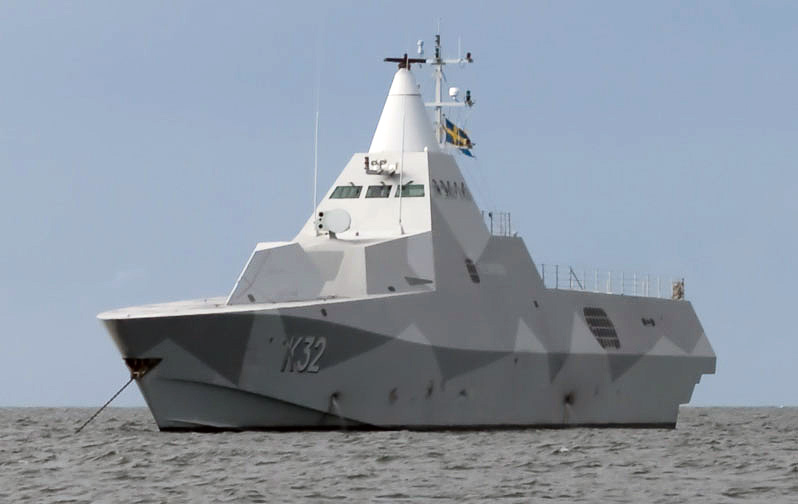
The Visby class is a class of five stealth corvettes in service with the Swedish Navy. It is the latest class of corvette adopted by the navy after the Göteborg and Stockholm-class corvettes. Its design emphasizes low visibility radar cross-section and infrared signature, and the class has received widespread international attention because of its capabilities as a stealth ship. The first ship in the class is named after Visby, the main city on the island of Gotland.
The Visby ships were designed by Swedish Defence Materiel Administration (FMV) and built by Saab Kockums AB in Karlskrona. The first ship of the class was launched in 2000, but production then suffered repeated delays. The fifth and final ship was delivered in 2015.
The hull is constructed with a sandwich design consisting of a PVC core with a carbon fibre and vinyl laminate (see also the Oceanic-Creations spin-off). There are multiple advantages to using composite materials in ship hulls. Good conductivity and surface flatness mean a low radar signature, while good heat insulation lowers the infrared signature and increases survivability in case of fire. The composite sandwich used is also non-magnetic, which lowers the magnetic signature. Composites are also very strong for their relative weight, and less weight means a higher top speed and better maneuverability. The composite weighs roughly 50% less than the equivalent strength steel.
Visby's angular tumblehome design reduces its radar signature. Jan Nilsson, one of the designers, told BBC News Online: "We are able to reduce the radar cross-section by 99%. That doesn't mean it's 99% invisible, it means that we have reduced its detection range." The 57 mm cannon barrel can be folded into the turret to reduce its cross-section.
Much of the design was based on the experiences learned from the experimental ship HSwMS Smyge. The class was originally designed to be divided into two subcategories where the last ship was optimized for surface combat and 4 others for submarine hunting; however, this was changed due to cutbacks.
A helicopter, such as the Agusta Westland A109M selected by Sweden, can land, take off, and refuel on the upper deck. A helicopter hangar was originally planned but was considered to be too cramped and was removed.
The ships took an exceptionally long time from launch to delivery and the construction has been fraught with repeated delays. In 2008, the only weapons system that had been integrated and tested in HSwMS Visby was the gun.
Finally, on 16 December 2009, the next two of the corvettes, HSwMS Helsingborg and HSwMS Härnösand, were delivered to the Swedish Navy by the Swedish Defence Materiel Administration (known as the FMV, or Försvarets materielverk). The two ships were equipped with underwater and surface/air sensors fully integrated. However, the only weapon that had been integrated and test-fired on the ships was still the Bofors 57 Mk3 gun. It is known as the standard 4 by the FMV.
Hub AI
Visby-class corvette AI simulator
(@Visby-class corvette_simulator)
Visby-class corvette
The Visby class is a class of five stealth corvettes in service with the Swedish Navy. It is the latest class of corvette adopted by the navy after the Göteborg and Stockholm-class corvettes. Its design emphasizes low visibility radar cross-section and infrared signature, and the class has received widespread international attention because of its capabilities as a stealth ship. The first ship in the class is named after Visby, the main city on the island of Gotland.
The Visby ships were designed by Swedish Defence Materiel Administration (FMV) and built by Saab Kockums AB in Karlskrona. The first ship of the class was launched in 2000, but production then suffered repeated delays. The fifth and final ship was delivered in 2015.
The hull is constructed with a sandwich design consisting of a PVC core with a carbon fibre and vinyl laminate (see also the Oceanic-Creations spin-off). There are multiple advantages to using composite materials in ship hulls. Good conductivity and surface flatness mean a low radar signature, while good heat insulation lowers the infrared signature and increases survivability in case of fire. The composite sandwich used is also non-magnetic, which lowers the magnetic signature. Composites are also very strong for their relative weight, and less weight means a higher top speed and better maneuverability. The composite weighs roughly 50% less than the equivalent strength steel.
Visby's angular tumblehome design reduces its radar signature. Jan Nilsson, one of the designers, told BBC News Online: "We are able to reduce the radar cross-section by 99%. That doesn't mean it's 99% invisible, it means that we have reduced its detection range." The 57 mm cannon barrel can be folded into the turret to reduce its cross-section.
Much of the design was based on the experiences learned from the experimental ship HSwMS Smyge. The class was originally designed to be divided into two subcategories where the last ship was optimized for surface combat and 4 others for submarine hunting; however, this was changed due to cutbacks.
A helicopter, such as the Agusta Westland A109M selected by Sweden, can land, take off, and refuel on the upper deck. A helicopter hangar was originally planned but was considered to be too cramped and was removed.
The ships took an exceptionally long time from launch to delivery and the construction has been fraught with repeated delays. In 2008, the only weapons system that had been integrated and tested in HSwMS Visby was the gun.
Finally, on 16 December 2009, the next two of the corvettes, HSwMS Helsingborg and HSwMS Härnösand, were delivered to the Swedish Navy by the Swedish Defence Materiel Administration (known as the FMV, or Försvarets materielverk). The two ships were equipped with underwater and surface/air sensors fully integrated. However, the only weapon that had been integrated and test-fired on the ships was still the Bofors 57 Mk3 gun. It is known as the standard 4 by the FMV.
Recent media