



Community hub
Recent from talks
Knowledge base stats:
Talk channels stats:
Members stats:
Visigothic Code
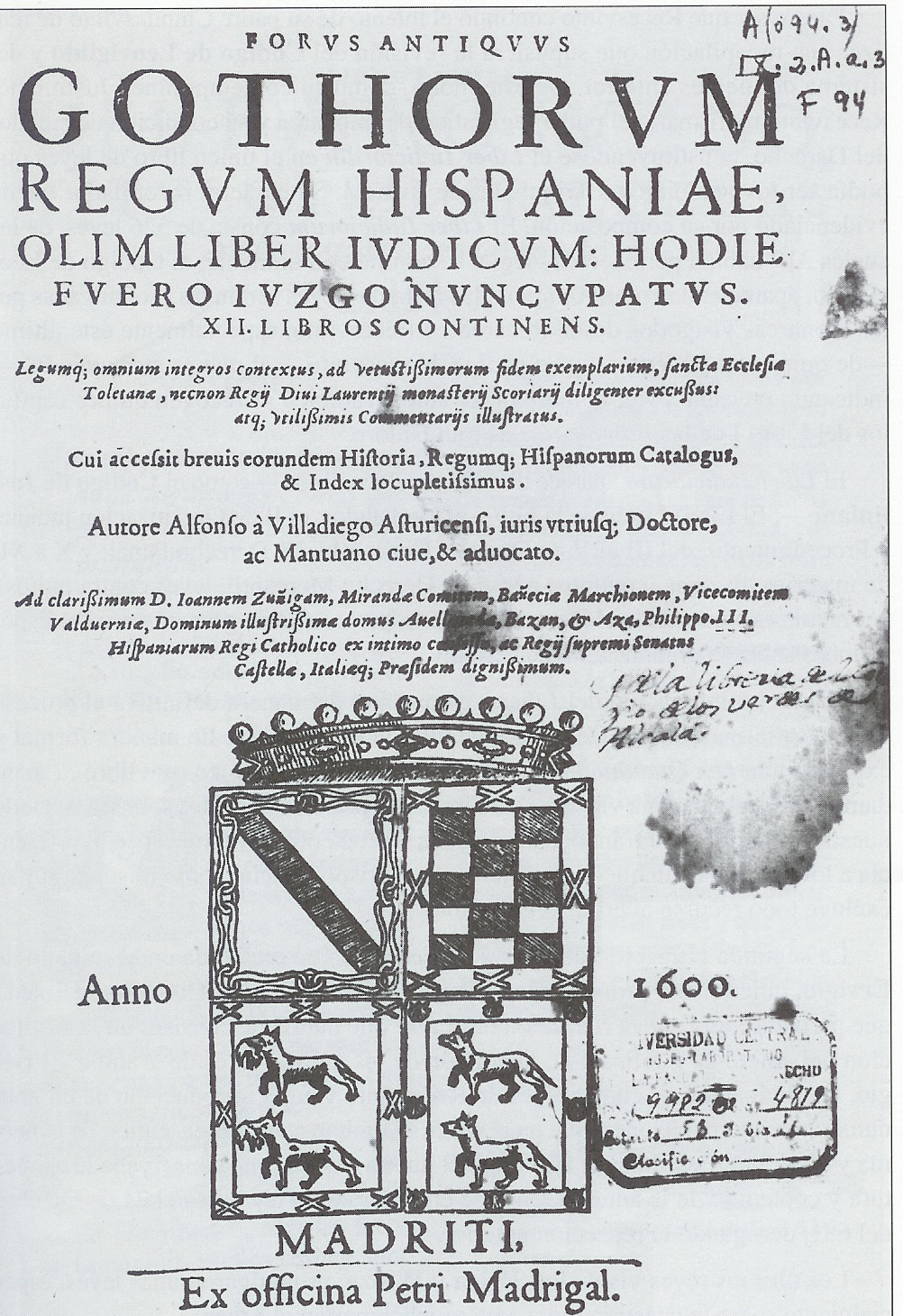
The Visigothic Code (Latin: Forum Iudicum, Liber Iudiciorum, or Book of the Judgements; Spanish: Fuero Juzgo), also called Lex Visigothorum (English: Law of the Visigoths), is a set of laws begun by king Chindasuinth (642–653 AD) of the Visigothic Kingdom in his second year of rule (642–643) that sought to provide common legal status between his Visigothic and Spanish-Roman subjects. In 654 his son, king Recceswinth (649–672; sole ruler from 653-672), published the enlarged law code, which was the first law code that applied equally to the conquering Goths and the general population, of which the majority had Roman roots, and had lived under Roman laws.
The code abolished the old tradition of having different laws for Romans (leges romanae) and Visigoths (leges barbarorum), and under it all the subjects of the Visigothic kingdom would stop being romani and gothi instead becoming hispani. In this way, all subjects of the kingdom were gathered under the same jurisdiction, eliminating social and legal differences, and allowing greater assimilation of the populations. The Code "fused Roman law and Germanic law and was binding on both [Visigothic and Spanish-Roman] populations." The Code also enshrined much law regarding the Catholic Church, probably "imparted to it by the Council of Toledo of 447". Unfortunately, according to translator S.P. Scott, the code was written in "monkish Latin, a barbarous jargon, extremely difficult to translate, and vastly different from the polished idiom of Tacitus and Cicero".
During the first centuries of Visigothic rule, Romans were ruled by different laws than Goths were. The earliest known Visigothic laws are the Code of Euric, which were compiled by roughly 480 A.D. The first written laws of the Visigothic kingdom were compiled during the rule of king Alaric II and were meant to regulate the lives of Romans, who made up the majority of the kingdom and were based on the existing Roman imperial laws and their interpretations. The Breviarium (Breviary of Alaric) was promulgated during the meeting of Visigothic nobles in Toulouse on February 2, 506.
During the reign of King Leovigild an attempt was made to unite the laws regulating the lives of Goths and those who had previously been Roman subjects, into a revised law code, Codex Revisus. In 589, at the Third Council of Toledo, the ruling Visigoths and Suebi, who had long practiced Arianism, converted to Latin Catholicism. Now that the formerly Roman population and the Goths shared the same faith, King Reccared issued laws that equally applied to both populations.
The code of 654 was enlarged by the novel legislation of Recceswinth (for which reason it is sometimes called the Code of Recceswinth) and later kings Wamba, Erwig, Egica, and perhaps Wittiza. Recceswinth's code was edited by Braulio of Zaragoza, since Chindasuinth's original code had been hastily written and promulgated.
During the Twelfth Council of Toledo in 681, King Erwig asked that the law code be clarified and revised. Some new laws were added, out of which 28 dealt with Jews.
The laws were far-reaching and long in effect: in 10th-century Galicia, monastic charters make reference to the Code. The laws govern and sanction family life and by extension political life: marriage, the transmission of property to heirs, safeguarding the rights of widows and orphans. Particularly with the Visigoth's Law Codes, women could inherit land and title, were allowed to manage land independently from their husbands or male relations, dispose of their property in legal wills if they had no heirs, could represent themselves and bear witness in court by age 14 and arrange for their own marriages by age 20.
The laws combined the Catholic Church's Canon law, and as such have a strongly theocratic tone.
Hub AI
Visigothic Code AI simulator
(@Visigothic Code_simulator)
Visigothic Code
The Visigothic Code (Latin: Forum Iudicum, Liber Iudiciorum, or Book of the Judgements; Spanish: Fuero Juzgo), also called Lex Visigothorum (English: Law of the Visigoths), is a set of laws begun by king Chindasuinth (642–653 AD) of the Visigothic Kingdom in his second year of rule (642–643) that sought to provide common legal status between his Visigothic and Spanish-Roman subjects. In 654 his son, king Recceswinth (649–672; sole ruler from 653-672), published the enlarged law code, which was the first law code that applied equally to the conquering Goths and the general population, of which the majority had Roman roots, and had lived under Roman laws.
The code abolished the old tradition of having different laws for Romans (leges romanae) and Visigoths (leges barbarorum), and under it all the subjects of the Visigothic kingdom would stop being romani and gothi instead becoming hispani. In this way, all subjects of the kingdom were gathered under the same jurisdiction, eliminating social and legal differences, and allowing greater assimilation of the populations. The Code "fused Roman law and Germanic law and was binding on both [Visigothic and Spanish-Roman] populations." The Code also enshrined much law regarding the Catholic Church, probably "imparted to it by the Council of Toledo of 447". Unfortunately, according to translator S.P. Scott, the code was written in "monkish Latin, a barbarous jargon, extremely difficult to translate, and vastly different from the polished idiom of Tacitus and Cicero".
During the first centuries of Visigothic rule, Romans were ruled by different laws than Goths were. The earliest known Visigothic laws are the Code of Euric, which were compiled by roughly 480 A.D. The first written laws of the Visigothic kingdom were compiled during the rule of king Alaric II and were meant to regulate the lives of Romans, who made up the majority of the kingdom and were based on the existing Roman imperial laws and their interpretations. The Breviarium (Breviary of Alaric) was promulgated during the meeting of Visigothic nobles in Toulouse on February 2, 506.
During the reign of King Leovigild an attempt was made to unite the laws regulating the lives of Goths and those who had previously been Roman subjects, into a revised law code, Codex Revisus. In 589, at the Third Council of Toledo, the ruling Visigoths and Suebi, who had long practiced Arianism, converted to Latin Catholicism. Now that the formerly Roman population and the Goths shared the same faith, King Reccared issued laws that equally applied to both populations.
The code of 654 was enlarged by the novel legislation of Recceswinth (for which reason it is sometimes called the Code of Recceswinth) and later kings Wamba, Erwig, Egica, and perhaps Wittiza. Recceswinth's code was edited by Braulio of Zaragoza, since Chindasuinth's original code had been hastily written and promulgated.
During the Twelfth Council of Toledo in 681, King Erwig asked that the law code be clarified and revised. Some new laws were added, out of which 28 dealt with Jews.
The laws were far-reaching and long in effect: in 10th-century Galicia, monastic charters make reference to the Code. The laws govern and sanction family life and by extension political life: marriage, the transmission of property to heirs, safeguarding the rights of widows and orphans. Particularly with the Visigoth's Law Codes, women could inherit land and title, were allowed to manage land independently from their husbands or male relations, dispose of their property in legal wills if they had no heirs, could represent themselves and bear witness in court by age 14 and arrange for their own marriages by age 20.
The laws combined the Catholic Church's Canon law, and as such have a strongly theocratic tone.