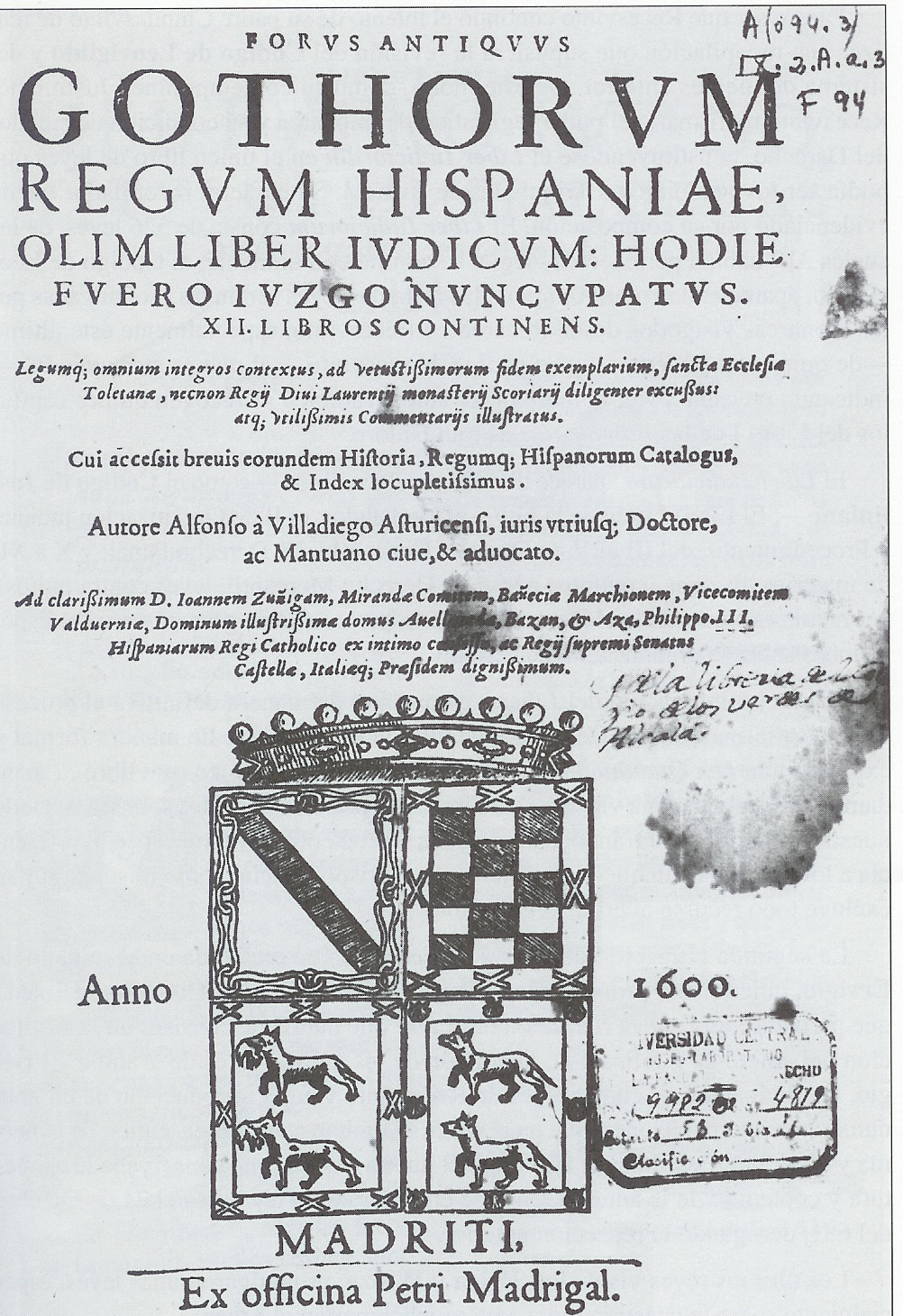

Visigothic Code
View on Wikipedia

The Visigothic Code (Latin: Forum Iudicum, Liber Iudiciorum, or Book of the Judgements; Spanish: Fuero Juzgo), also called Lex Visigothorum (English: Law of the Visigoths), is a set of laws begun by king Chindasuinth (642–653 AD) of the Visigothic Kingdom in his second year of rule (642–643) that sought to provide common legal status between his Visigothic and Spanish-Roman subjects.[1] In 654 his son, king Recceswinth (649–672; sole ruler from 653 to 672), published the enlarged law code, which was the first law code that applied equally to the conquering Goths and the general population, of which the majority had Roman roots, and had lived under Roman laws.[2]
The code abolished the old tradition of having different laws for Romans (leges romanae) and Visigoths (leges barbarorum), and under it all the subjects of the Visigothic kingdom would stop being romani and gothi instead becoming hispani. In this way, all subjects of the kingdom were gathered under the same jurisdiction, eliminating social and legal differences, and allowing greater assimilation of the populations.[3] The Code "fused Roman law and Germanic law and was binding on both [Visigothic and Spanish-Roman] populations."[4] The Code also enshrined much law regarding the Catholic Church, probably "imparted to it by the Council of Toledo of 447".[5] Unfortunately, according to translator S.P. Scott, the code was written in "monkish Latin, a barbarous jargon, extremely difficult to translate, and vastly different from the polished idiom of Tacitus and Cicero".[6]
The first law codes
[edit]During the first centuries of Visigothic rule, Romans were ruled by different laws than Goths were. The earliest known Visigothic laws are the Code of Euric, which were compiled by roughly 480 A.D. The first written laws of the Visigothic kingdom were compiled during the rule of king Alaric II and were meant to regulate the lives of Romans, who made up the majority of the kingdom and were based on the existing Roman imperial laws and their interpretations. The Breviarium (Breviary of Alaric) was promulgated during the meeting of Visigothic nobles in Toulouse on February 2, 506.[7]
During the reign of King Leovigild an attempt was made to unite the laws regulating the lives of Goths and those who had previously been Roman subjects, into a revised law code, Codex Revisus. In 589, at the Third Council of Toledo, the ruling Visigoths and Suebi, who had long practiced Arianism, converted to Latin Catholicism. Now that the formerly Roman population and the Goths shared the same faith, King Reccared issued laws that equally applied to both populations.[8]
Visigothic code
[edit]
The code of 654 was enlarged by the novel legislation of Recceswinth (for which reason it is sometimes called the Code of Recceswinth) and later kings Wamba, Erwig, Egica, and perhaps Wittiza. Recceswinth's code was edited by Braulio of Zaragoza, since Chindasuinth's original code had been hastily written and promulgated.[10]
During the Twelfth Council of Toledo in 681, King Erwig asked that the law code be clarified and revised. Some new laws were added, out of which 28 dealt with Jews.[11]
The laws were far-reaching and long in effect: in 10th-century Galicia, monastic charters make reference to the Code.[12] The laws govern and sanction family life and by extension political life: marriage, the transmission of property to heirs, safeguarding the rights of widows and orphans. Particularly with the Visigoth's Law Codes, women could inherit land and title, were allowed to manage land independently from their husbands or male relations, dispose of their property in legal wills if they had no heirs, could represent themselves and bear witness in court by age 14 and arrange for their own marriages by age 20.[13]
The laws combined the Catholic Church's Canon law, and as such have a strongly theocratic tone.
The code is known to have been preserved by the Moors,[citation needed] as Christians were permitted the use of their own laws, where they did not conflict with those of the conquerors, upon the regular payment of jizya tribute. Thus it may be presumed that it was the recognized legal authority of Christian magistrates while the Iberian Peninsula remained under Muslim control. When Ferdinand III of Castile took Córdoba in the thirteenth century, he ordered that the code be adopted and observed by his subjects, and had it translated, albeit inaccurately, into the Spanish language, as the Fuero Juzgo. The Occitan language translation of this document, Llibre Jutge, is among the oldest literary texts in that language (c. 1050). In 1910 an English translation of the code by Samuel Parsons Scott was published,[14] but it received severe criticism.[15]
Contents
[edit]The following is a list of the books and titles which form the Visigothic Code.[citation needed]
- Book I: Concerning Legal Agencies
- Title I: The Lawmaker
- Title II: The Law
- Book II: Concerning the Conduct of Causes
- Title I: Concerning Judges, and Matters to be Decided in Court
- Title II: Concerning Causes
- Title III: Concerning Constituents and Commissions
- Title IV: Concerning Witnesses and Evidence
- Title V: Concerning Valid and Invalid Documents and How Wills Should be Drawn Up
- Book III: Concerning Marriage
- Book IV: Concerning Natural Lineage
- Title I: Concerning the Degrees of Relationship
- Title II: Concerning the Laws of Inheritance
- Title III: Concerning Wards and Their Guardians
- Title IV: Concerning Foundlings
- Title V: Concerning Such Property as is Vested by the Laws of Nature
- Book V: Concerning Business Transactions
- Title I: Ecclesiastical Affairs
- Title II: Concerning Donations in General
- Title III: Concerning the Gifts of Patrons
- Title IV: Concerning Exchanges and Sales
- Title V: Concerning Property Committed to the Charge of, or Loaned to, Another
- Title VI: Concerning Pledges and Debts
- Title VII: Concerning the Liberation of Slaves, and Freedmen
- Book VI: Concerning Crimes and Tortures
- Title I: Concerning the Accusers of Criminals
- Title II: Concerning Malefactors and their Advisors, and Poisoners
- Title III: Concerning Abortion
- Title IV: Concerning Injuries, Wounds, and Mutilations, Inflicted upon Men
- Title V: Concerning Homicide
- Book VII: Concerning Theft and Fraud
- Title I: Concerning Informers of Theft
- Title II: Concerning Thieves and Stolen Property
- Title III: Concerning Appropriators and Kidnappers of Slaves
- Title IV: Concerning Custody and Sentencing
- Title V: Concerning Forgers of Documents
- Title VI: Concerning Counterfeiters of Metals
- Book VIII: Concerning Acts of Violence and Injuries
- Title I: Concerning Attacks, and Plunder of Property
- Title II: Concerning Arson and Incendiaries
- Title III: Concerning injuries to Trees, Gardens, or Growing Crops of any Description
- Title IV: Concerning Injury to Animals, and Other Property
- Title V: Concerning the Pasturage of Hogs and Concerning Strays
- Title VI: Concerning Bees, and the Damage They Cause
- Book IX: Concerning Fugitives and Refugees
- Title I: Concerning Fugitives, and Those who Conceal, and Assist Them in Their Flight
- Title II: Concerning Those who Refuse to go to War, and Deserters
- Title III: Concerning Those who Seek Sanctuary in a Church
- Book X: Concerning Partition, Limitation, and Boundaries
- Title I: Concerning Partition, and Lands Conveyed by Contract
- Title II: Concerning the Limitations of Fifty and Thirty Years
- Title III: Concerning Boundaries and Landmarks
- Book XI: Concerning the Sick and the Dead and Merchants who Come from Beyond
- Title I: Concerning Physicians and Sick Persons
- Title II: Concerning Those who Disturb Sepulchres
- Title III: Concerning Merchants who Come from Beyond Seas
- Book XII: Concerning the Prevention of Official Oppression, and the Thorough Extinction of Heretical Sects
- Title I: Concerning the Exercise of Moderation in Judicial Decisions, and the Avoiding of Oppression by Those Invested with Authority
- Title II: Concerning the Eradication of the Errors of all Heretics and Jews
- Title III: Concerning New Laws against the Jews, in which Old Ones are Confirmed, and New Ones are Added
See also
[edit]Notes
[edit]- ^ See "Chindaswinth," in Encyclopedia.com (from The Columbia Encyclopedia, 6th ed.)
- ^ See"Recceswinth," in Encyclopedia.com (from The Columbia Encyclopedia, 6th ed.) See also "Liber Judiciorum," in Britannica" https://www.britannica.com/topic/Liber-Judiciorum.
- ^ O'Callaghan, Joseph (1975). A History of Medieval Spain. Ithaca, NY: Cornell University Press. p. 49. ISBN 9780801492648.. See also, "Chindaswinth," note 1 above and "Recceswinth," note 2 above.
- ^ "Recceswinth," note 2 above.
- ^ "The Visigothic Code," (book review) American Law Review, vol.45, p.478 (1911).
- ^ The Visigothic Code (Forum Judicum, p. xxiv, S.P. Scott, trans. (1910), https://www.gutenberg.org/files/72551/72551-h/72551-h.htm
- ^ Visigothic Spain 409–711
- ^ Law and Society in the Visigothic Kingdom
- ^ "11th century Occitan translation of the Liber Iudiciorum". www.cervantesvirtual.com.
- ^ King, 148–149.
- ^ Law and Society in the Visigothic Kingdom
- ^ Fletcher 1984, ch. 1, note 56
- ^ Klapisch-Zuber, Christine; A History of Women: Book II Silences of the Middle Ages, The Belknap Press of Harvard University Press, Cambridge, Massachusetts, London, England. 1992, 2000 (5th printing). Chapter 6, "Women in the Fifth to the Tenth Century" by Suzanne Fonay Wemple, pg 74. According to Wemple, Visigothic women of the Iberian Peninsula and the Aquitaine could inherit land and title and manage it independently of their husbands, and dispose of it as they saw fit if they had no heirs, and represent themselves in court, appear as witnesses (by the age of 14), and arrange their own marriages by the age of twenty
- ^ The Visigothic Code (Forum Judicum (1910) available at https://www.gutenberg.org/files/72551/72551-h/72551-h.htm
- ^ Kearley, Timothy (1975). Roman Law, Classical Education, and Limits on Classical Participation in America into the Twentieth Century. Fort Collins, CO: Veterrimus Publishing. ISBN 978-1-7361312-1-3., pages 168-172.
Sources
[edit]- King, P. D. "King Chindasvind and the First Territorial Law-code of the Visigothic Kingdom." in Visigothic Spain: New Approaches. ed. Edward James. Oxford: Clarendon Press, 1980. pp 131–157.
- Lear, Floyd Seyward (1951). "The Public Law of the Visigothic Code". Speculum. 26 (1): 1–23. doi:10.2307/2852081. ISSN 0038-7134. JSTOR 2852081.
External links
[edit]- Lex Visigothorum Deprecated link archived 2012-12-10 at archive.today - Latin text
- Visigothic Code - Forum Iudicum. 1908 English Translation of Full Text by Samuel Parsons Scott
- Information on the Visigothic Code as part of the leges Visigothorum and its manuscript tradition on the Bibliotheca legum regni Francorum manuscripta website, A database on Carolingian secular law texts (Karl Ubl, Cologne University, Germany, 2012).
- Visigothic Symposia 1 'Law and Theology' - New research on the Visigothic Code
Visigothic Code
View on GrokipediaHistorical Context
Formation of the Visigothic Kingdom
The Visigoths, a West Germanic people originating from the Gothic tribes east of the Roman Empire, crossed the Danube River into Roman territory in 376 CE to escape Hunnic pressure, marking the beginning of their integration into the late Roman world.[8] Under King Alaric I, they rebelled against Roman mistreatment, culminating in the sack of Rome in 410 CE, which demonstrated their military prowess but did not lead to permanent conquest in Italy.[9] By 418 CE, under King Wallia, the Visigoths allied with Roman general Flavius Constantius and defeated the Alans and Vandals in Hispania, earning federate status and settlement rights in Aquitaine (southwestern Gaul) as a buffer against other barbarians, with Toulouse as their initial capital.[10] This foederati arrangement allowed them to govern semi-autonomously while nominally serving Rome, establishing the rudiments of a kingdom amid the Western Empire's collapse. Following the Empire's fall in 476 CE, Visigothic kings like Euric (466–484 CE) asserted full independence, expanding into much of Gaul and northern Hispania through conquests that incorporated Roman administrative structures.[11] However, the Battle of Vouillé in spring 507 CE decisively altered their trajectory: Frankish King Clovis I, recently converted to Catholicism, defeated and killed Visigothic King Alaric II near Poitiers, expelling the Visigoths from Aquitaine and confining their core territories to Hispania.[12] [13] This defeat, motivated partly by Clovis's appeal to Catholic Gallo-Romans against Arian Visigoths, prompted a southward migration, with the royal court relocating to Narbonne and later Toledo as the political center in Iberia.[14] In Hispania, the Visigoths initially controlled fragmented territories alongside Suebi, Basques, and Byzantine enclaves, but King Leovigild (r. 568–586 CE) achieved near-unification through relentless campaigns, subduing the Suebi Kingdom in Galicia by 585 CE and establishing direct rule over much of the peninsula.[15] Leovigild's reforms, including the Codex Revisus for legal equality between Goths and Hispano-Romans, centralized authority, founded cities like Reccopolis, and projected imperial ambitions rivaling Byzantium, solidifying the [Visigothic Kingdom](/page/Visigothic Kingdom) as a cohesive Hispano-Gothic state by the late 6th century.[15] This consolidation under Catholic conversion after 589 CE laid the institutional foundation for subsequent legal codifications.[11]Pre-Code Legal Traditions
Prior to the promulgation of the Liber Iudiciorum in 654, the Visigothic Kingdom in Hispania operated under a dual legal framework rooted in personal law, whereby ethnic identity determined applicable jurisdiction: Visigoths were subject to Germanic customary traditions partially codified in royal edicts, while Hispano-Roman subjects adhered to abbreviated compilations of late Roman imperial law.[16] This separation preserved ethnic distinctions in adjudication, with Gothic iudices handling cases among Goths and Roman magistrates or counts overseeing Roman disputes, though inter-ethnic conflicts often invoked Gothic oversight.[17] The foundational Visigothic code for the Goths was the Codex Euricianus, issued by King Euric (r. 466–484) around 475–483, marking the earliest extant written Germanic law in Latin, drafted with assistance from the Roman jurist Leo of Narbonne.[18] Surviving only in fragments—approximately 50 articles preserved through later interpolations in texts like the Formulae Visigothicae and canon law collections—the code addressed inheritance (favoring male agnatic lines with provisions for maternal claims), contracts, property transfers, and penal matters, blending tribal customs such as wergild payments for homicides with Roman procedural elements like written deeds.[17] It emphasized royal authority over customary assemblies and excluded Romans from its scope, reflecting Arian Visigothic identity amid conquests in Roman Gaul and Hispania.[19] For the Roman population, comprising the majority in urban centers and rural estates, the Breviarium Alaricianum (or Lex Romana Visigothorum), promulgated by King Alaric II on February 2, 506, served as the primary legal text.[20] This abridgment, compiled by a panel of Roman jurists (prudentes), condensed the Theodosian Code (438), Gregorianus and Hermogenianus codes, and select post-Theodosian novellae into 167 titles, augmented by Vulgar Latin interpretationes to simplify and adapt rulings for non-elite use under Gothic sovereignty.[20] It omitted Justinianic influences (post-506) and prioritized practical vulgar law over classical Justinian Corpus principles, covering civil procedure, family law (e.g., patria potestas limits), and delicts, while affirming Gothic kings' appellate role.[21] Subsequent monarchs incrementally eroded ethnic legal divides. King Liuvigild (r. 568–586) revised Euric's code into the lost Codex revisus, incorporating new edicts on fiscal matters, penal uniformity, and social integration, including the repeal of bans on intermarriage between Goths and Hispano-Romans to equalize status and promote assimilation.[19] These measures, enacted amid military consolidation and Arian-Catholic tensions, introduced territorial elements—applying certain rules regardless of ethnicity—and foreshadowed the Liber Iudiciorum's unification by expanding Gothic law's reach while drawing on Roman administrative precedents.[22] Liuvigild's reforms thus bridged customary fragmentation toward a proto-unified system, though full territorial application awaited his successors.[19]Transition to Catholicism
The Visigoths entered the Iberian Peninsula as Arian Christians in the 5th century, maintaining doctrinal separation from their Catholic Hispano-Roman subjects, which reinforced parallel legal systems under personal law principles.[23] This religious divide, rooted in Arianism's denial of the consubstantiality of the Son with the Father, limited full integration despite earlier efforts at tolerance.[22] King Liuvigild (r. 568–586) pursued partial reconciliation by convening mixed councils and promoting a semi-Arian creed, but sustained unity eluded him amid rebellions and resistance from Catholic clergy.[23] His son, Reccared I (r. 586–601), converted personally to Catholicism in late 587 or early 588, influenced by Catholic advisors and strategic considerations for kingdom cohesion.[24] Reccared then suppressed Arian opposition, confiscating churches and compelling clerical recantations.[23] In May 589, Reccared summoned the Third Council of Toledo, attended by 62 bishops (mostly Catholic, with some converted Arians) and Gothic nobility, to formalize the shift.[23] The king professed Nicene faith, anathematized Arius and Arian leaders, and secured conciliar endorsement; the assembly adopted the filioque clause in the creed and decreed Catholicism's exclusivity, mandating Arian clergy's rebaptism or reconsecration.[22] Enforcement followed swiftly, with Arian texts burned and holdouts exiled or executed.[23] The conversion bridged religious schisms, aligning Gothic rulers with the majority population and bolstering royal authority through episcopal alliances, as evidenced by subsequent Toledo councils' growing influence on governance.[2] This unity eroded justifications for ethnically segmented laws, enabling Catholic kings Chindasuinth (r. 642–653) and Recceswinth (r. 653–672) to initiate and promulgate the Liber Iudiciorum in 654 at the Eighth Council of Toledo—the first such code in a fully Catholic realm, which distanced itself from "antiqua" Arian-era precedents and incorporated biblical justifications, particularly against Jews in Book XII, to affirm institutional Catholic legitimacy.[2][4]Development and Editions
Initiation under Chindasuinth (642–653)
Chindasuinth ascended to the Visigothic throne in 642 following a coup against his predecessor Tulga, marking the start of efforts to centralize royal authority amid ongoing ethnic legal divisions in the kingdom.[25] In his second year of rule, around 642–643, he initiated the compilation of a comprehensive legal code known as the Lex Visigothorum (Law of the Visigoths), later termed the Liber Iudiciorum (Book of Judgments), to supplant the prior dual system where Goths followed customary Germanic laws derived from earlier codes like that of Euric, while Hispano-Romans adhered to the Breviary of Alaric (506), a condensed Roman law. [26] The primary objective was legal unification, eliminating distinctions based on ethnic origin and applying a single set of laws to all free subjects, thereby fostering cohesion in a kingdom recently unified under Catholicism since 589 and reducing potential sources of division exploited by nobility or external threats. Chindasuinth commissioned a team of jurists, including the influential Bishop Braulio of Zaragoza, to gather, revise, and systematize precedents from Roman imperial edicts, Visigothic customs, and emerging canon law, emphasizing royal prerogative in lawmaking as divinely sanctioned.[27] This process reflected Chindasuinth's broader authoritarian reforms, which included purging disloyal nobles—executing or exiling up to 700—and extracting oaths of fealty to consolidate monarchical power against aristocratic factions.[25] By the Eighth Council of Toledo in 653, convened under Chindasuinth's auspices, elements of the code were advanced enough for ecclesiastical endorsement, aligning secular law with Catholic doctrine on issues like oaths and heresy, though scholarly debate persists on the extent of his direct authorship versus oversight.[28] Only fragmentary texts from this initial phase survive, indicating an incomplete but foundational draft that his son Recceswinth would finalize and promulgate in 654, expanding it to twelve books covering civil, criminal, and ecclesiastical matters. [26] The initiation under Chindasuinth thus laid the groundwork for a code that prioritized uniformity and royal absolutism, influencing Iberian legal traditions for centuries despite later revisions.Promulgation by Recceswinth (654)
Recceswinth, who ruled as Visigothic king from 649 to 672 and assumed sole rule after his father Chindasuinth's death in 653, completed and promulgated the Liber Iudiciorum in 654.[2] This code built upon the legal compilation initiated by Chindasuinth around 642, expanding it into a comprehensive corpus of 12 books containing over 500 laws, including approximately 300 drawn from ancient sources, 100 newly enacted by Chindasuinth, and 90 added by Recceswinth.[2] The promulgation occurred at the Eighth Council of Toledo, convened in the Praetorian Church of Saints Peter and Paul, where the bishops endorsed the code through 12 canons that paralleled its 12 books, thereby infusing it with ecclesiastical authority.[29][2] The Liber Iudiciorum marked a pivotal shift by establishing a single legal framework applicable to all free subjects of the Visigothic kingdom—Goths, Hispano-Romans, and others—irrespective of ethnic origin, superseding the ethnic-specific codes like the Breviary of Alaric for Romans and prior Gothic customs.[30] Drafted in Latin rather than Gothic, it drew extensively from Roman legal traditions while incorporating Germanic elements, and explicitly prohibited the use or possession of alternative codes, imposing fines of 30 pounds of gold for violations to enforce uniformity.[30] Recceswinth articulated the code's purpose as restraining monarchical authority, maintaining domestic tranquility, curbing abuses of power, safeguarding property rights, distinguishing royal from state treasury assets, and reinstating sanctuary protections, all aimed at stabilizing the realm amid post-Chindasuinth political tensions.[2] Structural revisions under Recceswinth included erasing references to pre-Catholic Arian kings to underscore the regime's orthodox legitimacy following the conversion to Catholicism under Reccared I in 589, thereby aligning the legal narrative with the kingdom's religious identity.[2] Book XII, for instance, incorporated stringent measures against Jewish practices, such as 18 laws restricting private rituals, prohibiting Jewish ownership of Christian slaves, barring Jewish testimony against Christians, and mandating reports of Jewish ceremonies under penalty of property confiscation and exile, reflecting efforts to enforce Catholic homogeneity.[30] This edition's emphasis on universal application and episcopal oversight in judicial matters positioned the code as a tool for fostering a cohesive Catholic public sphere across Iberia and southern Gaul.[30][2]Revisions under Erwig (681) and Later Kings
In 681, King Erwig (r. 680–687) promulgated a revised edition of the Liber Iudiciorum, which involved clarifying ambiguous provisions from Recceswinth's 654 code, amending existing laws, and incorporating new statutes. This recension was presented for ratification at the Twelfth Council of Toledo on January 9, 681, where bishops endorsed the changes to strengthen royal authority and ecclesiastical alignment. Among the additions were six laws authored by Erwig himself, three from his predecessor Wamba, and revisions to approximately eighty prior laws, with a focus on enhancing punitive measures such as flogging (equated to monetary fines at a rate of ten lashes per gold solidus) and reinforcing Catholic orthodoxy.[31] A core component of Erwig's overhaul consisted of twenty-eight anti-Jewish novellae, which escalated prior restrictions by mandating compulsory baptism for Jews, imposing severe penalties—including scourging, enslavement, or exile—for reverting to Judaism or circumcising converts, and prohibiting Jews from owning Christian slaves, holding public office, or intermarrying with Christians. These laws also required Jews to wear distinctive clothing, barred synagogue construction or repair, and ordered the confiscation of Jewish property used in religious rites, aiming to eradicate Jewish cultural and economic influence within the realm. Such measures reflected a concerted effort to enforce religious uniformity, building on conciliar decrees but intensifying enforcement through secular law, though their implementation varied due to resistance and evasion documented in contemporary hagiographies.[32][33][34] Subsequent monarchs introduced further amendments, though none produced a comprehensive new edition comparable to Erwig's. King Egica (r. 687–702) enacted revisions around 693, primarily extending anti-Jewish edicts with prohibitions on Jewish commercial activities, additional forced baptisms, and oaths of loyalty from Jewish communities, amid accusations of crypto-Judaism fostering unrest; however, the extent of a full recodification remains debated, with only a handful of surviving laws attributed to him. Wittiza (r. 702–710) added minor provisions, including one documented law on procedural matters, potentially moderating some economic restrictions on converts, though chroniclers later accused him of leniency toward Jews. King Roderic (r. 710–711), the final Visigothic ruler before the 711 Muslim invasion, made no recorded alterations to the code. These incremental changes preserved the Erwigian framework as the operative legal text until the kingdom's collapse.[35][36]Structure and Organization
Division into Books
The Liber Iudiciorum, also known as the Visigothic Code, is systematically divided into twelve books, each further subdivided into titles (tituli) and individual laws or chapters (tituli containing leges).[37][18] This organizational structure, promulgated under King Recceswinth in 654, reflects a comprehensive codification effort aimed at unifying legal norms across the kingdom.[38] The division allows for topical grouping, with laws distinguished as either antiquae (older, often anonymous provisions derived from prior codes) or novae (new royal enactments).[39] Book I functions primarily as a theoretical preface, outlining foundational principles of governance, the authority of law over the king and people, and the role of legal agencies rather than enacting specific rules.[35] Books II through V address procedural, familial, and inheritance matters: Book II covers judicial processes and the conduct of causes; Book III regulates marriage; Book IV deals with lineage and succession; and Book V concerns inheritance and wills.[18] Books VI to VIII focus on economic and contractual obligations, including sales, leases, pledges, and debts.[18] Books IX to XI shift to penal law: Book IX addresses injuries to persons; Book X covers property crimes; and Book XI treats offenses against the state, such as treason.[18] Book XII concludes with provisions on preventing official abuses and suppressing heresy, emphasizing ecclesiastical enforcement and royal oversight.[18] This progression from civil to criminal and public order topics demonstrates an intent to create a holistic legal framework applicable to both Goths and Romans.[37] Later revisions under kings like Ervig in 681 maintained this book structure while adding or amending specific laws.[37]Sources and Compilation Methods
The Liber Iudiciorum was compiled by systematically gathering prior legal materials, including Visigothic royal edicts from the Codex Euricianus of King Euric (c. 475 AD), which provided early Germanic customary law, and the Breviarium Alarici (506 AD), an abridgment of Roman law for subjects in the kingdom.[38] Additional Visigothic sources encompassed formularies, laws of King Swinthila (r. 621–631), and writings of Isidore of Seville, alongside non-Visigothic influences such as Justinian's Corpus Iuris Civilis and Burgundian codes.[38] Initiated by King Chindasuinth (r. 642–653) in 642, the compilation aimed to collect all historical laws to curb noble claims of ignorance and ensure uniform application, replacing separate ethnic legal personalities with a single code for Goths and Romans.[38] King Recceswinth (r. 649–672) completed the effort, incorporating approximately 300 ancient laws (leges antiquae), 100 new provisions from Chindaswinth, and 90 from his own reign, organized topically into 12 books at the Eighth Council of Toledo in 653–654.[38] Germanic elements persisted through wergeld-based fines scaled by social status, while Roman procedural influences appeared in references to the Digest, and ecclesiastical integration drew from Toledo and Seville councils, with Book XII invoking biblical texts for regulations on Jewish life.[38][35] Later revisions under Erwig (681) and Egica (694) added laws via similar methods of selection, adaptation, and supplementation, preserving the foundational compilation approach despite evolving content.[38]Key Provisions and Legal Features
Unification of Roman and Germanic Law
The Visigothic Code, promulgated by King Recceswinth in 654, marked a pivotal shift by establishing a unified legal system applicable to both Visigoths and Hispano-Romans, supplanting the prior regime of personality-based laws that applied distinct codes to each ethnic group.[40][16] Previously, Romans in the kingdom followed the Breviary of Alaric, a condensed adaptation of late Roman imperial law issued in 506, while Visigoths adhered to their customary Germanic laws as codified in the Code of Euric from around 475–484, which emphasized tribal customs like wergild compensation for offenses.[40] This separation reinforced ethnic divisions within the realm, hindering administrative cohesion after the Visigoths' conquest of Hispania.[40] The Code's unification drew predominantly from Roman legal frameworks, particularly in civil procedure, property rights, and contractual obligations, reflecting the kingdom's inheritance of Roman administrative infrastructure and the prevalence of Roman subjects.[26] Germanic influences persisted in select areas, such as residual provisions for oaths and familial vendettas tempered by royal oversight, but these were subordinated to a more centralized, Roman-inspired structure of fixed penalties and judicial appeals, diminishing traditional tribal autonomy.[26] Recceswinth's prologue explicitly articulated the intent to forge "one law for all," binding Goths and Romans alike under the monarch's authority, a measure reinforced by the kingdom's recent Catholic unification under earlier kings like Reccared in 589.[2] This synthesis facilitated ethnic integration by eroding legal privileges tied to Gothic nobility, promoting a territorial law of the land that aligned with the monarchy's centralizing ambitions amid threats from external powers like the Byzantines and internal factions.[40] Subsequent revisions under Erwig in 681 further harmonized the Code with conciliar decrees from the Fourth Council of Toledo (633), embedding canon law to enforce religious uniformity, though core civil unification remained anchored in Roman-Germanic amalgamation.[16] The result was a pragmatic code of approximately 500 laws, organized into 12 books, that balanced inherited traditions to sustain governance over a diverse population until the Muslim conquest in 711.[2]Civil and Property Law
The civil and property law provisions of the Visigothic Code, primarily outlined in Books IV, V, and X, established rules for business transactions, ownership, and succession that applied uniformly to Goths and Hispano-Romans, marking a departure from earlier ethnic-based legal pluralism.[18] These sections drew on Roman legal traditions for procedural formalities, such as the requirement for written evidence or witnesses in sales and contracts, while incorporating Germanic elements like equal inheritance rights for male and female heirs.[18] Fraud, duress, or violence rendered agreements void, with remedies including restitution or penalties equivalent to double the value involved.[18] Contracts and sales were governed by strict validity criteria under Book V, Title IV. Sales required vendors of questionable character to provide a freeborn surety, and fraudulent underpayment entitled the seller to double compensation.[18] Exchanges were treated equivalently to purchases if free from coercion, but disputed property could not be alienated until resolution.[18] Lease agreements for land, formalized in writing, bound lessees to annual rent payments, with non-compliance incurring double penalties; permanent partitions of family property, once witnessed, were irrevocable even without documentation.[18] Inheritance and succession emphasized direct lineage under Book IV, Title II, mandating equal shares among legitimate children regardless of gender, a provision advancing women's property rights beyond typical Germanic customs.[18] Posthumous children inherited equally, and testators without heirs could dispose of estates freely, though parents were limited to one-third of property in gifts to individual children to preserve familial shares.[18] Collateral heirs succeeded only in the absence of direct descendants, and disinheritance required grave cause, such as parricide, which forfeited claims to the victim's estate.[18] Slavery featured prominently as chattel property, with Book V regulating sales and liabilities; masters bore responsibility for slaves' acts unless unauthorized, and sales of fugitive slaves abroad triggered redemption obligations upon return.[18] Land tenure addressed historical divisions, fixing Gothic and Roman allotments under Book X, Title I, VIII, prohibiting Gothic claims to Roman thirds without royal grant, while preserving ancient landmarks to prevent encroachment.[18] Mortgages and debts involved judicial pledges, with forgery of related documents punishable by property loss or enslavement.[18]Criminal Law and Punishments
The criminal law of the Visigothic Code, encompassed in Books VI ("Concerning Crimes and Torts"), VII ("Concerning Theft, Fraud, and Fugitives"), and VIII ("Concerning Acts of Violence and Injuries") of the Liber Iudiciorum, prescribed penalties for offenses ranging from homicide and theft to adultery, rape, and arson, with provisions reflecting Roman, Germanic, and ecclesiastical influences.[18] These books contained over 100 laws detailing crimes against persons, property, and social order, emphasizing restitution, physical punishment, and deterrence, while distinguishing penalties based on the offender's rank—nobles often faced fines or exile, whereas slaves and commoners endured harsher corporal measures.[18] Book VI alone comprised 51 laws, many revised under King Erwig in 681 to incorporate additional restrictions, such as enhanced penalties for religious infractions.[35] Punishments prioritized proportionality to status and intent, incorporating Germanic wergeld systems (composition payments scaled to the victim's worth) alongside Roman-inspired corporal sanctions. Capital punishment applied to grave offenses like intentional homicide, parricide, nighttime theft when caught in the act, and arson, often executed by burning or other means specified to the crime.[18] Mutilation featured prominently, including scalping for certain rapes or Jewish ritual offenses, blinding for abortion by free women, and hand amputation for forgery of royal documents or counterfeiting.[18] Fines, denominated in solidi or pounds of gold, demanded multiples of the victim's value—e.g., ninefold restitution for theft by freemen—while flogging (100–300 lashes) served as an alternative or supplement, equated monetarily at 10 lashes per gold solidus.[18][35] Enslavement or exile punished lesser or status-adjusted crimes, such as accidental homicide or heresy, with exile sometimes substituting capital penalties in later revisions under Erwig to temper severity.[18] Torture, termed tormenta, was regulated and confined to evidentiary purposes in capital cases, limited to three days under judicial oversight, primarily for slaves or low-status freemen suspected of shielding masters or committing felonies; accusers faced severe reprisal—including execution or enslavement—if torture proved the accused innocent.[18] Nobles enjoyed exemptions from both torture and certain mutilations, underscoring hierarchical protections.[18] Perjury incurred doubled damages for nobles or 100 lashes and enslavement for commoners, while false accusations mandated ninefold restitution or slavery.[18]| Crime Category | Examples | Key Punishments |
|---|---|---|
| Homicide | Intentional killing; parricide; accidental death | Death for intentional or parricide; 100 solidi fine or exile for accidental.[18] |
| Sexual Offenses | Adultery; rape of free women | Fines (e.g., 5 lbs gold for adultery), 100–200 lashes, exile, enslavement, or burning (if involving slaves); 6 oz gold + 50 lashes or scalping + 300 lashes for rape (by status).[18] |
| Theft and Robbery | Day/night theft; animal theft; kidnapping slaves/children | Ninefold restitution + 100 lashes (freemen); sixfold + lashes or slavery (slaves); death if caught at night; fourfold + lashes for kidnapping.[18] |
| Violence and Property Crimes | Arson; wounds/injuries; forgery | Death by fire (arson); retaliation or 100 solidi (broken bones); hand loss or slavery + lashes (forgery).[18] |
| Religious/State Offenses | Heresy; aiding Jews in rituals; treason (implied in forgery/royal crimes) | Perpetual exile + property loss (heresy); 100 lashes + scalping/exile (Jewish offenses); half property forfeiture or hand loss (high treason via forgery).[18] |
Ecclesiastical and Family Law
The Visigothic Code devoted Books IV and V to family matters, emphasizing the regulation of matrimony, kinship ties, and succession under a framework blending Roman civil law principles with Visigothic customs and emerging Catholic doctrine following the Third Council of Toledo in 589. Book IV, titled "Concerning Matrimony and Paternal Power," outlined impediments to marriage based on degrees of consanguinity, prohibiting unions between ascendants and descendants up to the seventh degree, as well as between siblings or affines within similar proximities, to safeguard lineage purity and align with conciliar prohibitions on incest.[18] Marriage contracts mandated mutual consent of the spouses, though paternal authority over daughters remained paramount, requiring a father's approval for validity; dowries were obligatory, serving as both economic security and symbolic commitment, with failure to provide one rendering the union illicit. Adultery provisions imposed harsh penalties, permitting a husband to kill the adulterous wife and her paramour if caught in flagrante delicto, though subsequent revisions under Erwig in 681 moderated such retributive justice by mandating judicial oversight to prevent vigilantism. Divorce was narrowly permitted only in cases of impotence, captivity, or enslavement, reflecting the code's subordination of family law to ecclesiastical norms against dissolution, with remarriage barred for the innocent party until the other's death or presumption thereof. Illegitimate children from adulterous or servile unions were generally barred from inheritance but could claim support, underscoring the code's prioritization of legitimate paternal lines while allowing limited paternal discretion in recognition.[18] Book V addressed legal succession and inheritance, instituting partible distribution among direct heirs—sons and daughters sharing equally in parental estates, a departure from stricter male primogeniture in some contemporaneous Germanic codes, thereby granting women autonomous property management rights independent of marital status. Widows enjoyed usufructuary rights over a portion of the estate for life or until remarriage, typically one-third plus innovations (terza and melioramenta), ensuring economic protection while incentivizing fidelity to the deceased husband's lineage; brothers and sisters inherited collaterally only after exhausting direct descendants, with escheat to the fisc if no kin existed within seven degrees.[41] These rules promoted familial stability and economic equity, though enforcement relied on episcopal courts for disputes involving church oversight. Ecclesiastical provisions permeated the code, particularly in Books II, VI, and XII, integrating canon law to bolster the church's institutional authority amid the Visigoths' Catholic conversion. Bishops held quasi-judicial powers, adjudicating cases involving clergy, orphans, widows, and church property, with immunities shielding ecclesiastical lands from secular taxation and lay interference; violations, such as alienating church assets, incurred fines or excommunication equivalents like perpetual exile. Heresy and apostasy faced severe sanctions—flagellation, confiscation, or death by burning for relapsed offenders—enforcing orthodoxy post-589, while protections extended to synodal decisions, mandating royal enforcement of conciliar decrees.[39] The code's prologue invoked divine sanction for royal legislation, positioning the monarchy as defender of the faith, with bishops as co-authors in revisions, thus embedding causal interdependence between throne and altar in governance.[18]Implementation and Enforcement
Judicial Procedures
The Liber Iudiciorum outlined judicial procedures primarily in Book II, which covered the roles of judges, the conduct of trials, witnesses, advocates, and evidentiary requirements.[18] Judges, termed iudices, included royal officials such as counts and viscounts for secular matters, while bishops handled ecclesiastical cases; any individual formally invested with judicial authority bore the official title of judge, regardless of prior status.[42] These officials were required to adjudicate both civil and criminal causes without delay, under penalty of fines or removal for corruption, such as exacting unjust bonds or prolonging proceedings.[18] Trials commenced with a formal claim by the plaintiff, to which the defendant could not refuse to respond, even if the accusation was novel; failure to appear or defend triggered default judgment.[42] Court sessions demanded orderly conduct, prohibiting clamor, tumult, or interruptions to ensure solemn deliberation; violations incurred corporal punishment or fines scaled to the offender's status.[18] Procedures emphasized an inquisitorial inquest before a multitude of witnesses, diverging from purely accusatorial Germanic traditions by integrating Roman-style evidentiary scrutiny.[43] Evidentiary proof relied on rational means: witness testimony, written documents, or voluntary confessions, with no provision for ordeals or compurgation as divine judgment mechanisms, marking a shift toward formalized Roman-influenced processes over earlier folk-right customs.[44] Witnesses (testes) were rigorously qualified, following Roman precedents: they required free birth, unimpeachable reputation, and exclusion of categories like slaves, actors, or those with criminal convictions; Jews were barred from testifying against Christians, and the number of witnesses varied by dispute value, often requiring three or more for validity.[43] Perjury carried severe penalties, including mutilation or death for aggravated cases, to safeguard testimonial integrity.[18] Advocates (causidici) represented parties but faced strictures against frivolous suits or suborning false evidence, with judges empowered to appoint defenders for the indigent or absent.[35] Judgments were pronounced publicly, with appeals possible to higher authorities like the king or metropolitan bishops in ecclesiastical disputes, enforcing uniformity under the code's universal application to Hispano-Romans and Goths alike.[18]Role of the Church and Monarchy
The Visigothic Code, known as the Liber Iudiciorum, was promulgated by King Recceswinth in 654 CE during the Eighth Council of Toledo, illustrating the intertwined authority of the monarchy and the Church in its creation and dissemination.[2] Recceswinth's revision aimed to unify laws across ethnic lines, abolishing prior codes like the Breviary of Alaric and imposing fines of 30 pounds of gold for their retention, thereby centralizing enforcement under royal decree.[30] The monarchy asserted that the king appointed judges to adjudicate all cases (Book II, Title I, Law XIII), ensuring impartial application without the presence of bishops unless specified, while the code itself bound the sovereign to its provisions, restraining arbitrary royal power.[45][40] Bishops played a supervisory role in judicial enforcement, acting as overseers of judges' integrity, particularly in cases affecting the poor, and reviewing potentially unjust decisions (Book II, Title I, Laws XXII and XXVIII).[39] In ecclesiastical matters, they held exclusive authority to impose penalties such as exile and penance for offenses like the mutilation of slaves (Book VI, Title V, Law I), and they enforced disciplinary measures against clergy, including fines for non-compliance with summons or failure to defend the realm (Book IX, Title II, Law VIII).[39] Bishops could delegate representation in trials, underscoring their elevated status, and escalate unresolved issues to the king, reflecting a hierarchical system where church officials complemented royal appointees.[39] The alliance between monarchy and Church facilitated enforcement through mutual reinforcement: kings convened councils that shaped legislation, while bishops influenced royal policies via conciliar participation, as seen in laws protecting ecclesiastical rights (Book V, Title I, Law II).[39] Subsequent revisions, such as Erwig's in 681 CE, expanded provisions like anti-Jewish measures (Book XII, Title III), with bishops expected to apply them rigorously alongside royal judges, though enforcement varied due to potential reluctance or bribery.[30] This collaboration extended to appeals, where cases could reach the king, ensuring a unified framework despite the distinct spheres of secular and spiritual authority.[30]Social and Ethnic Application
The Liber Iudiciorum, promulgated in 654 by King Recceswinth, marked a pivotal shift toward legal unification in the Visigothic Kingdom by establishing a single code applicable to all free subjects regardless of ethnic origin, thereby abrogating prior ethnic-specific laws such as the Lex Romana Visigothorum for Hispano-Romans and customary Germanic norms for Visigoths.[35][18] This universality extended to both Germanic settlers and the Roman majority, fusing elements of Roman provincial law with Visigothic customs into a common framework that bound nobles, clergy, and commoners alike, including the monarchy itself.[35] The code's prologue emphasized its role in eliminating distinctions based on "foreign nations" or prior legal books, promoting a unified Hispano-Visigothic identity under Catholic orthodoxy.[45] Socially, the code preserved hierarchical distinctions among free persons, with nobles (principes or seniores) afforded privileges such as exemptions from certain compulsory military levies beyond their obligation to furnish one-tenth of their slaves for service, reflecting their landed wealth and status. Free men and women (liberi) enjoyed protections against enslavement, including prohibitions on parents selling children except in dire necessity, and safeguards for freedmen (libertini), who retained obligations to former masters but gained partial civil rights through manumission via oral declaration, charter, or will.[42][46] Slaves (servi), comprising war captives, debtors, and born bondsmen, faced severe corporal punishments like flogging or decalvatio (shaving and marking) for offenses such as theft or abduction, often administered by owners, though their testimony was admissible in court absent free witnesses, underscoring their subordinate yet legally recognized position.[35][47][43] Despite ethnic unification for the majority, the code imposed discriminatory measures on Jews as a religious minority, confining them to separate communal governance under rabbinical authority while barring them from public office, intermarriage with Christians, and ownership of Christian slaves to prevent perceived spiritual contamination.[42] Book XII outlined over a dozen provisions, such as prohibiting Jews from reading non-Christian texts publicly or employing Christian servants, with penalties including enslavement or exile for violations, reflecting the kingdom's Catholic zeal post-conversion in 589.[48][30] These laws, expanded under later kings like Erwig in 681, targeted Jewish economic roles like trade and usury, compelling baptism in some cases and exemplifying the code's integration of religious coercion into ethnic-legal policy.[49][30]Influence and Legacy
Impact on Iberian Medieval Law
Following the Umayyad conquest of the Visigothic Kingdom in 711, the Liber Iudiciorum retained significant authority in the northern Christian polities, serving as a foundational legal text amid the fragmentation of Iberian governance.[50] In the Kingdom of León, it informed judicial assemblies and charter practices throughout the 10th and 11th centuries, where provisions were cited to resolve disputes over land tenure and inheritance. This continuity reflected the code's role in preserving a unified legal tradition for Hispano-Roman and Gothic populations, even as local customs and Frankish influences emerged in border regions.[44] Adaptations of the Liber Iudiciorum proliferated in these kingdoms, blending its Roman-Visigothic framework with emerging medieval practices. Compiled around 1000 in León by Bonhom, the Liber iudicum popularis selectively drew from the Visigothic code to address procedural and substantive issues in secular courts, emphasizing its utility for everyday adjudication.[44] In Castile and León, the code underpinned territorial law until the 13th century, when King Ferdinand III commissioned its translation into Castilian as the Fuero Juzgo circa 1241, facilitating broader accessibility and integration with royal legislation.[35] Alfonso X the Learned further promulgated this version in 1255, incorporating its principles—such as on property rights and penal sanctions—into his Siete Partidas (promulgated 1265), though the latter introduced greater Romanist elements.[51] The code's influence extended variably across Iberia, with sustained application in León and Toledo's successor territories as a supplemental framework amid fueros and customary norms.[50] In the Crown of Aragon, particularly Catalan counties, early medieval manuscripts and judicial references indicate ongoing consultation for civil and ecclesiastical matters into the 11th century, despite competition from Carolingian capitularies.[52] Provisions on family law, including inheritance and marital contracts, persisted in shaping social relations, while criminal elements informed punitive practices until supplanted by inquisitorial procedures. Overall, the Liber Iudiciorum provided a causal bridge from late antique unification to medieval pluralism, its empirical endurance evident in over 100 surviving manuscripts from the 8th to 13th centuries, though scholarly assessments note its selective rather than wholesale adoption due to evolving feudal structures.[53]Transmission and Manuscripts
The Liber Iudiciorum was transmitted following the collapse of the Visigothic Kingdom in 711 CE through its preservation and active use in the nascent Christian polities of northern Iberia, including Asturias, León, and Catalonia, where it served as a foundational legal text amid the Reconquista.[37] Copies were produced primarily in ecclesiastical centers, ensuring continuity despite the Islamic conquest of the peninsula's core territories.[44] Its practical application is evidenced by citations in early medieval charters from Asturias-León and Navarre, indicating textual stability and adaptation in judicial contexts rather than mere archival storage.[54] Revisions under kings Ervig (r. 680–687) and Egica (r. 687–702) formed the basis for most surviving versions, with the Ervigian redaction influencing later compilations like the Liber iudicum popularis (or Vulgata), compiled around 1000 CE in Barcelona, which integrated Visigothic law with Frankish and local elements for broader applicability.[37] This popular version facilitated dissemination in Catalonia and Aragon, blending ethnic-specific laws into a unified framework suitable for post-Visigothic societies.[44] Surviving manuscripts, predominantly from the 8th to 12th centuries, are held in European libraries and archives, reflecting scribal activity in scriptoria like those in Girona and Urgell. Notable examples include:- Vatican Reg. Lat. 1024, an 8th-century codex containing one of the earliest copies, likely originating from northern Spain.[55]
- Paris BnF Lat. 4667, dated to 827 CE and copied in Girona in Visigothic minuscule, preserving an incomplete Ervigian version (Books 1–11 fully, partial Book 12) prefaced by Isidore of Seville's Sententiae (Book 3, chapters 49–57) and the Chronica Regum Visigothorum, underscoring ecclesiastical framing for authority.[56]
- A 1080–1090 CE manuscript in the Diocesan and Capitular Archives of Urgell, comprising fragments that highlight the code's enduring role in Catalan legal identity.[57]