
Recent from talks
Vusamazulu Credo Mutwa
Knowledge base stats:
Talk channels stats:
Members stats:
Vusamazulu Credo Mutwa
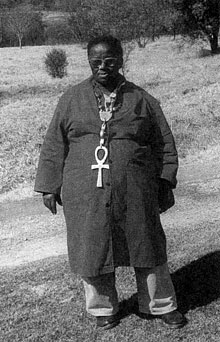
Vusamazulu Credo Mutwa /ˈkreɪdoʊ ˈmʊtwə/ (21 July 1921 – 25 March 2020) was a Zulu sangoma (traditional healer) from South Africa. He was known as an author of books that draw upon African mythology, traditional Zulu folklore, extraterrestrial encounters and his own personal encounters. His last work was a graphic novel called the Tree of Life Trilogy based on his writings of his most famous book, Indaba my Children. In 2018 he was honoured with an USIBA award presented by the South African Department of Arts and Culture, for his work in indigenous wisdom.
Credo was a sanusi (common spelling isanuse) which is a type of Zulu diviner or sangoma. The term stems from a more historic time and is not widely used today, even in a traditional setting.
Credo lived with his wife Virginia in Kuruman, Northern Cape, where they ran a hospice clinic.
His father was a widower with three surviving children when he met his mother. His father was a builder and a Christian and his mother was a young Zulu girl. Caught between Catholic missionaries on one hand, and a stubborn old Zulu warrior, Credo Mutwa's maternal grandfather, his parents had no choice but to separate. Credo was born out of wedlock, which caused a great scandal in the village and his mother was thrown out by her father. Later, he was taken in by one of his aunts.
He was subsequently raised by his father's brother and was taken to the South Coast of Natal (present day KwaZulu-Natal), near the northern bank of the Mkomazi River. He did not attend school until he was 14 years old. In 1935, his father found a building job in the old Transvaal province and the whole family relocated to where he was building.
After falling severely ill, he was taken back to KwaZulu-Natal by his uncle. Where modern medicine had failed, his grandfather, a man whom his father despised as a heathen and demon worshipper, helped him back to health. At this point, Credo began to question many of the things about his people the missionaries would have them believe. "Were we Africans really a race of primitives who possessed no knowledge at all before the white man came to Africa?" he asked himself. His grandfather instilled in him the belief that his illness was a sacred calling that he was to become a sangoma, a healer. He underwent thwasa (sangoma training and initiation) with his grandfather and mother's sister, a young sangoma named Mynah.
In 1974, Credo obtained a piece of land on the Oppenheimer gardens in Soweto in order to create an African cultural village to preserve cultural heritage and his own teachings. He created traditional dwellings imaginatively representing building patterns from across Africa, while human and mythological figures brought to life African folk-lore, beliefs and traditions as seen through his artistic vision. At the time, as the locals were steeped in Christianity, they were suspicious of the cultural village.
Credo believed that the great unrest in Johannesburg and the popularisation of communism in the black struggle drew Africans away from their traditional roots. Unlike most political activists, he actually supported a separation between white and black in order to preserve black traditional tribal customs and way of life. In 1976, students partially burnt down the cultural village after he was misquoted on Afrikaans radio, as they saw the village promoting tribalism and separate development. Parts of the village was burnt again in the mid-1980s during a strike against the West Rand city council.
Hub AI
Vusamazulu Credo Mutwa AI simulator
(@Vusamazulu Credo Mutwa_simulator)
Vusamazulu Credo Mutwa
Vusamazulu Credo Mutwa /ˈkreɪdoʊ ˈmʊtwə/ (21 July 1921 – 25 March 2020) was a Zulu sangoma (traditional healer) from South Africa. He was known as an author of books that draw upon African mythology, traditional Zulu folklore, extraterrestrial encounters and his own personal encounters. His last work was a graphic novel called the Tree of Life Trilogy based on his writings of his most famous book, Indaba my Children. In 2018 he was honoured with an USIBA award presented by the South African Department of Arts and Culture, for his work in indigenous wisdom.
Credo was a sanusi (common spelling isanuse) which is a type of Zulu diviner or sangoma. The term stems from a more historic time and is not widely used today, even in a traditional setting.
Credo lived with his wife Virginia in Kuruman, Northern Cape, where they ran a hospice clinic.
His father was a widower with three surviving children when he met his mother. His father was a builder and a Christian and his mother was a young Zulu girl. Caught between Catholic missionaries on one hand, and a stubborn old Zulu warrior, Credo Mutwa's maternal grandfather, his parents had no choice but to separate. Credo was born out of wedlock, which caused a great scandal in the village and his mother was thrown out by her father. Later, he was taken in by one of his aunts.
He was subsequently raised by his father's brother and was taken to the South Coast of Natal (present day KwaZulu-Natal), near the northern bank of the Mkomazi River. He did not attend school until he was 14 years old. In 1935, his father found a building job in the old Transvaal province and the whole family relocated to where he was building.
After falling severely ill, he was taken back to KwaZulu-Natal by his uncle. Where modern medicine had failed, his grandfather, a man whom his father despised as a heathen and demon worshipper, helped him back to health. At this point, Credo began to question many of the things about his people the missionaries would have them believe. "Were we Africans really a race of primitives who possessed no knowledge at all before the white man came to Africa?" he asked himself. His grandfather instilled in him the belief that his illness was a sacred calling that he was to become a sangoma, a healer. He underwent thwasa (sangoma training and initiation) with his grandfather and mother's sister, a young sangoma named Mynah.
In 1974, Credo obtained a piece of land on the Oppenheimer gardens in Soweto in order to create an African cultural village to preserve cultural heritage and his own teachings. He created traditional dwellings imaginatively representing building patterns from across Africa, while human and mythological figures brought to life African folk-lore, beliefs and traditions as seen through his artistic vision. At the time, as the locals were steeped in Christianity, they were suspicious of the cultural village.
Credo believed that the great unrest in Johannesburg and the popularisation of communism in the black struggle drew Africans away from their traditional roots. Unlike most political activists, he actually supported a separation between white and black in order to preserve black traditional tribal customs and way of life. In 1976, students partially burnt down the cultural village after he was misquoted on Afrikaans radio, as they saw the village promoting tribalism and separate development. Parts of the village was burnt again in the mid-1980s during a strike against the West Rand city council.
Recent media