Hubbry Logo
WP SuspensionWP SuspensionMain
Open search
WP Suspension
Community hub
WP Suspension
logo
8 pages, 0 posts
0 subscribers
Be the first to start a discussion here.
WP Suspension
WP Suspension
from Wikipedia
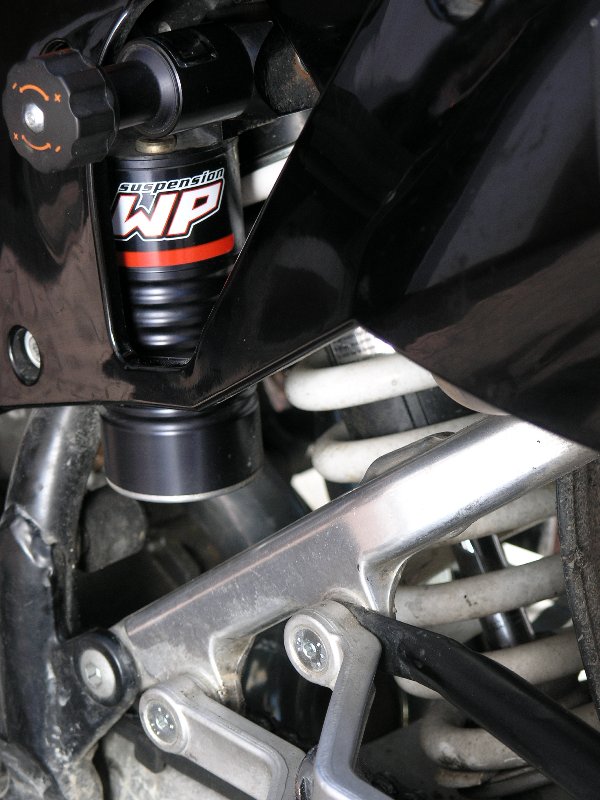
WP rear shock unit
WP rear shock unit on a KTM 950 Adventure in 2007

Key Information

WP Suspension GmbH is a manufacturer of components for motorcycle suspension systems based in Austria. The company was founded in 1977 by Wim Peters in Malden, Netherlands[1] and is amongst the largest manufacturers of suspension components for motorcycles.[2] It is today a wholly owned subsidiary of India's Bajaj through KTM AG.

Company history

[edit]

Dutch motocross rider Wim Peters had a serious crash in a race in 1975, needing over a year for recovery from injuries. The trained mechanical engineer used this downtime to improve the suspension elements of his motocross machine. Though the parts were originally intended only for his own use, Peters' success with his components was noticed by other racers, and he founded the company in 1977 to deal with demand.[2]

A visual characteristic of the brand are the white coil springs on the coilover suspension struts, which also led to the original brand name, White Power. The white coating of the springs was originally due to the chosen supplier being a hospital bed manufacturer, and white was the only colour they had available.[1][2] Racing success at the end of the 1970s and into the 1980s established the brand's reputation.[2][3]

In the 1980s the company developed from an aftermarket producer to an original equipment manufacturer for KTM[4][5] in 1983, and later for Husaberg and BMW Motorrad.[2][3]

In 1983 WP re-introduced the upside-down fork (USD) into mass production.[2] Originally invented by BMW, and used on the R 12 model, this kind of setup had largely fallen into disuse between 1945 and 1983. The USD fork has since become the standard configuration for all performance-oriented motorcycles.

In 1984 WP supplied suspension components to KTM's first Motocross World Championship victory in the 250cc class with Heinz Kinigadner.[3][6]

After bankruptcy in 1991 and the subsequent refounding, the brand name WP Suspension replaced the name White Power.[2][3]

In 1994 WP supplied suspension components to the B194 car by Benetton which propelled Michael Schumacher to his first Formula 1 world championship title.[2][3][6]

KTM subsidiary

[edit]

From 1997 KTM Power Sports gradually took over the company. Wim Peters remained connected with WP, initially as managing director and later as consultant until his departure in 2004. Beginning in 2009, production was moved to Munderfing, Austria, and suspension components are no longer produced in the former main factory in Malden, Netherlands.[2] In the 2010s, WP expanded their manufacturing portfolio to include frames, exhaust systems, and oil and water coolers for motorcycles and was briefly renamed WP Performance Systems GmbH.[1][6] As of 2020, the non-suspension activities have been sold off or transferred to other divisions within the parent company, with WP again concentrating solely on the development and manufacture of motorcycle suspension systems.

See also

[edit]

References

[edit]
[edit]
Revisions and contributorsEdit on WikipediaRead on Wikipedia
from Grokipedia
WP Suspension GmbH is an Austrian manufacturer of high-performance suspension systems and components for motorcycles, renowned for its racing-derived technologies tailored to off-road and street riding. Founded in 1977 by Dutch rider Wim Peters, the company originated from Peters' efforts to develop superior suspension following a 1975 racing crash that exposed limitations in existing designs, quickly earning acclaim among professional riders like Gerrit Wolsink. The company's early innovations included the introduction of the first series-production upside-down fork in 1984 on the KTM GS 500, which significantly improved handling and stability, and helped secure the 1984 for rider Heinz Kinigadner. WP became a primary supplier to KTM starting in 1983, with the Austrian firm acquiring a shareholding in 1997 and majority ownership in 1999, while Peters served as managing director until 2004. Facing in 1991, WP was restructured and relocated its production to Munderfing, , near KTM's Mattighofen headquarters in 2009, enabling annual output supporting approximately 288,000 motorcycles. Today, fully owned by Pierer Mobility AG—the parent group of KTM, Husqvarna, and —WP provides original equipment manufacturing (OEM) and aftermarket solutions across these brands, as well as custom components for professional racing. Its technologies have powered successes beyond , including support for Michael Schumacher's 1994 and 1995 Formula 1 titles with the Bennetton-Ford team, and has supported elite riders such as Antonio Cairoli (nine-time world champion) and current rider Prado (multiple world champion) in their successes.

History

Founding and Early Development

WP Suspension was founded in 1977 by Dutch motocross rider and mechanical engineer Wim Peters in Malden, , under the name White Power Suspension. Motivated by a 1975 racing crash that highlighted deficiencies in contemporary suspension, Peters developed improved systems, earning early acclaim from riders like Gerrit Wolsink. The company name derived from the distinctive white-colored springs used in its products, chosen for their visibility and sourced affordably from a supplier that primarily painted components in white. This emphasis on visible, high-contrast components was intended to aid riders in off-road conditions by making suspension parts easier to spot during maintenance and racing. In the late , White Power Suspension focused on developing basic shock absorbers and forks tailored for off-road motorcycles. These early components prioritized durability and adjustability to meet the demands of rugged terrain, establishing the company as an aftermarket innovator in technology. By refining designs based on feedback from European riders, the firm laid the groundwork for more advanced systems while maintaining a commitment to performance-oriented engineering. The company entered the European market prominently during the 1980s, capitalizing on the rising popularity of and enduro racing. Growth was fueled by demand for customizable suspension solutions that allowed riders to fine-tune damping and spring rates for specific track conditions, positioning White Power as a preferred choice among competitive off-road enthusiasts. In 1983, it initiated a long-term partnership with KTM, transitioning into an role. To address emerging negative connotations associated with the name "White Power," the company rebranded to WP Suspension in following a period of financial restructuring after . This shift preserved the brand's technical legacy while broadening its appeal in international markets.

Partnership and Acquisition by KTM

In , WP Suspension established a significant with KTM by becoming the original equipment manufacturer for the Austrian company's off-road motorcycles, supplying shocks as standard components across their lineup. This collaboration marked a major breakthrough for WP, elevating its reputation from an aftermarket specialist to a key supplier in professional racing and production bikes, as KTM's adoption showcased WP's innovative designs in high-performance environments. The partnership deepened through joint efforts in the late and early , focusing on advanced suspension technologies tailored for competitions. WP and KTM collaborated on shared testing and refinements, notably contributing to KTM's successes in world championships, such as the 1984 250cc win by Heinz Kinigadner using WP's newly introduced upside-down forks. These joint initiatives enhanced WP's engineering expertise while integrating KTM's racing feedback to optimize and handling for off-road demands. Starting in 1997, KTM acquired a shareholding in WP Suspension, achieving majority ownership in 1999 and transforming it into a , with founder Wim Peters retained as managing director until 2004. This acquisition, which built on years of close collaboration, allowed KTM to internalize WP's specialized knowledge. Following the acquisition, WP experienced immediate benefits, including expanded production capacity to meet KTM's growing demand and access to the company's established global distribution network, which accelerated WP's market penetration beyond . These changes positioned WP for enhanced scalability, enabling faster iteration on suspension systems for KTM's diverse portfolio while maintaining its focus on performance-oriented innovations.

Expansion and Modern Operations

Following the full integration as a KTM majority in 1999, WP Suspension expanded its operations significantly in the to support growing demand for suspension components. In 2009, the company relocated its primary production facility from Malden, , to Munderfing, , positioning it adjacent to KTM's main plant in for streamlined collaboration and logistics. This move scaled manufacturing capacity, enabling WP to supply OEM and aftermarket parts to approximately 288,000 motorcycles annually by enhancing production efficiency and proximity to key assembly lines. The original site in Malden retained roles in assembly, , and during the transition period. In 2012, WP became part of Pierer Mobility AG (formerly KTM Industries AG), the listed parent company of the KTM Group, which solidified its role within a broader of brands. This integration allowed WP to extend its supply chain to sister brands including and , optimizing component sharing across the group's off-road and street portfolios while maintaining focus on high-performance suspensions. By the 2020s, WP continued to grow its global dealer network, emphasizing aftermarket distribution to support international expansion. The 2020s presented challenges for WP as part of Pierer Mobility AG, amid global disruptions from the and semiconductor shortages that affected the motorcycle industry. These issues contributed to group-wide revenue declines, with Pierer reporting a drop to €1.879 billion in 2024 from €2.661 billion in 2023, prompting adaptations such as inventory reductions and production adjustments at subsidiaries like WP. In late 2024, Pierer Mobility entered proceedings and initiated , including staff reductions across the group—totaling over 500 jobs by mid-2025—to address excess capacity and financial pressures. As of 2025, WP operates within this restructured framework, with estimated annual revenue around $138 million, focusing on resilient and core manufacturing in .

Products and Applications

Core Suspension Components

WP Suspension's core components encompass front forks and rear shock absorbers designed primarily for motorcycles, emphasizing lightweight construction, precise damping control, and adaptability to varying riding conditions. These elements form the foundation of the company's product lineup, drawing from heritage to deliver reliable performance in off-road and applications. The designs prioritize reduced unsprung weight and enhanced handling through advanced valving and material choices, allowing for seamless integration into vehicle . Front forks from WP include upside-down models, which position the stronger, stiffer outer tubes at the bottom for improved rigidity and reduced flex during high-speed impacts. A notable variant is the AER technology, an air-sprung system that replaces traditional coil springs with pressurized air contained in a sealed inner cartridge, significantly lowering overall weight by up to 1.5 kg per fork while enabling straightforward damping optimization through air pressure adjustments. Conventional telescopic forks remain available for broader compatibility, featuring sliding inner tubes within outer legs to absorb compression forces via hydraulic circuits. Rear shock absorbers primarily consist of mono-shock units, such as those in the XACT series, which utilize a single damper to manage the vehicle's rear suspension . The XACT PRO 8946, for instance, incorporates a progressive system that delivers increasing resistance in the final third of compression , ensuring bottom-out prevention without compromising initial compliance. Similarly, the XACT PRO 8950 employs a linked system with Supertrax , linking compression and rebound circuits for balanced response and enhanced traction on uneven terrain. Key materials in WP components include high-strength aluminum alloys for fork lowers and shock bodies, often CNC-milled for precision and weight savings of approximately 20-30% over alternatives. is selectively used in high-stress elements like shafts and fasteners within premium lines such as XPLOR PRO, offering superior strength-to-weight ratios and corrosion resistance. Seal and bushing technologies feature low-friction designs, including seals and polymer bushings, which minimize and extend service life by reducing wear in dusty or wet environments. Customization is a hallmark of WP's rebuildable designs, permitting users to tailor performance via external adjusters for preload, compression, and damping to accommodate different rider weights and styles—typically ranging from 50-120 kg. For example, forks like the XACT PRO 7535 offer fully adjustable compression and settings, while shocks provide spring preload tuning to maintain sag between 25-35% of total travel. These features ensure components can be serviced and recalibrated, promoting longevity and personalized handling.

Vehicle and Market Applications

WP Suspension has primarily served the off-road and motorcycle segments since the 1980s, acting as the exclusive (OEM) for forks and shocks on KTM, Husqvarna, and models. This partnership, initiated in 1983 with KTM, has equipped a wide range of competition and trail bikes, including the KTM 450 SX-F, Husqvarna TC 250, and MC 85, providing components like mono-shocks optimized for high-performance riding. In the 2000s, WP expanded into street and adventure bike markets through collaborations with premium manufacturers, notably supplying suspension systems for Motorrad's GS series and F800GS models. These applications integrated WP's adjustable forks and shocks into adventure touring bikes, enhancing handling for long-distance and mixed-terrain use, as seen in the Adventure. WP maintains a strong presence in aftermarket and racing sectors, offering upgrade kits such as the XACT PRO and XPLOR PRO series for enduro, supercross, and custom builds across brands like , Kawasaki, and Yamaha. In the European off-road segment, WP holds a dominant position, benefiting from its role as the primary OEM supplier for leading brands like KTM. As of 2025, WP continues to advance technologies like Supertrax for enhanced traction in the latest models.

Technology and Innovations

Key Engineering Features

WP Suspension employs advanced hydraulic valving systems in its forks and shocks to precisely control compression and , ensuring optimal performance across diverse riding conditions. The proprietary Cone Valve technology features a conical design that facilitates turbulence-free oil flow through the , enhancing sensitivity, reducing breakaway torque, and providing consistent response without the limitations of traditional shim stacks. This system is often integrated with closed cartridge kits, which minimize oil volume to prevent under high-pressure demands, while adjustable settings for compression and allow riders to fine-tune behavior for specific terrains. In rear shock applications, linkage designs such as the Linked Damping System leverage the motorcycle's swing arm geometry to progressively increase force, optimizing traction and reserve capacity during compression. Spring technologies in WP products balance compliance and support through both coil and air-based systems, tailored to absorb impacts from varied terrain. Coil springs provide reliable, linear or progressive force, with progressive rate variants featuring coils of increasing pitch that deliver softer initial compliance for small bumps before stiffening to prevent bottoming on larger obstacles. In contrast, the AER air spring technology replaces traditional coil setups with pressurized air chambers, drastically reducing overall weight by up to 1 kg per while enabling straightforward adjustments to spring rate via air for customized preload and progression. This air system maintains consistent characteristics and simplifies maintenance, making it particularly suitable for off-road applications where weight savings enhance handling. Material selection and treatments in WP suspensions prioritize durability and lightweight performance, with aluminum alloys forming the core of forks and shock bodies for their high strength-to-weight ratio. Components undergo CNC milling to achieve precise geometries that minimize mass without compromising structural integrity. Corrosion-resistant coatings, such as hard and Kashima treatments, are applied to aluminum surfaces; these processes create a protective oxide layer infused with , enhancing wear resistance, reducing , and providing superior protection against environmental degradation in harsh conditions like and water exposure. Basic performance metrics underscore the robustness of WP systems for demanding use. Off-road forks typically offer 200-300 mm of travel, exemplified by models like the XACT PRO 7543 with 278 mm of suspension stroke to accommodate rough terrain. Load capacities support rider weights from approximately 40 kg to over 100 kg (including gear), with spring rates scaled accordingly—such as 4.7 N/mm for lighter riders up to 5.6 N/mm or higher for heavier ones—to ensure proper sag and prevent excessive deflection under dynamic loads. These features contribute to WP's application in high-stakes environments, including KTM racing motorcycles where reliability under extreme stress is paramount.

Racing and Performance Developments

WP Suspension has played a pivotal role in MotoGP through its partnership with KTM, supplying advanced suspension systems for factory teams since 2017, including contributions to race-winning setups that enhance handling and stability at high speeds. In Supercross and disciplines, WP has developed 48 mm APEX forks integrated into KTM factory racing bikes to provide superior control and rider feedback during aggressive track maneuvers. These semi-active electronic suspensions, featuring real-time adaptability, allow for dynamic adjustments to compression and based on and speed. Key innovations from racing include WP's Cone Valve technology, a patented damping system that delivers progressive resistance without abrupt stiffening, enabling seamless fork designs optimized for high-impact jumps and corners. This adaptive has been refined through motorsport demands, as seen in the XPLOR Pro suspension line introduced in the early 2020s, which incorporates Cone Valve elements for applications like rally and enduro events, offering enhanced traction and reduced rider over rough . WP's racing involvement has directly supported KTM's dominance in the , with suspension systems contributing to multiple titles across the and , including nine-time champion Antonio Cairoli's successes from 2007 to 2017 and ' 2021 MXGP crown. In 2023 alone, WP-equipped riders secured all three MXGP category championships: Jorge Prado in MXGP, Andrea Adamo in MX2, and Courtney Duncan in WMX, demonstrating the technology's edge in competitive track conditions through iterative testing and valving optimizations. In 2025, WP introduced Pro Components upgrades, including the XPLOR PRO 6500 cartridge kit and 6746 shock, for the KTM 390 Enduro R and Adventure R models, enhancing performance for dual-sport and off-road use. Additionally, WP suspension powered Daniel Sanders to victory in the 2025 , underscoring its reliability in extreme rally conditions. These advancements build on track-validated data from professional events, prioritizing reliability and performance in extreme environments.

References

Add your contribution
Related Hubs
User Avatar
No comments yet.