Hubbry Logo
KTM 950 AdventureKTM 950 AdventureMain
Open search
KTM 950 Adventure
Community hub
KTM 950 Adventure
logo
8 pages, 0 posts
0 subscribers
Be the first to start a discussion here.
KTM 950 Adventure
KTM 950 Adventure
from Wikipedia
KTM 950 Adventure
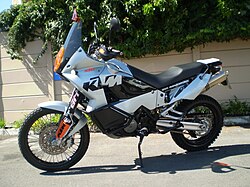
2004 Grey-Black KTM 950 Adventure
ManufacturerKTM
Also calledKTM LC8 Adventure
Production2003–2006
SuccessorKTM 990 Adventure
ClassDual-sport motorcycle
Engine942 cc (57.5 cu in) 75° V-twin[1]
Bore / stroke100 mm × 60 mm (3.94 in × 2.36 in)
Compression ratio11.5:1
Top speed215km/h
Power102 bhp (76 kW) @ 8,000 rpm
Torque97 N⋅m (72 lbf⋅ft) @ 6,000 rpm
Ignition typeDenso CDI
Transmission6 gears
Frame typeOpen cradle, chrome-molybdenum steel tubes with Aluminium subframe
SuspensionFront: WP USD 4860 MXMA (damping and rebound adjustable) 48 mm (1.9 in) diameter

Rear: WP Progressive Damping System (PDS) shock absorber with adjustable hydraulic preload, rebound, separate low and high speed compression damping.
BrakesFront: 2 x Brembo perforated brake disks, 300 mm (12 in) floating calipers
Rear: 1 x Brembo disk 240 mm (9.4 in) with floating caliper.
TiresFront: 90/90 R21
Rear: 150/70 R18
Rake, trail26.6°/ 119 mm (4.7 in)
Wheelbase1,570 mm (62 in) ± 10 mm (0.39 inch)
Seat height2003/2004: 880 mm (35 in),

2003/2004 S: 915 mm (36.0 in),
2005/2006: 860 mm (34 in),

2005/2006 S: 895 mm (35.2 in)
Weight206 kg (454 lb) (dry)
Fuel capacity22 L (4.8 imp gal; 5.8 US gal) (including 4 L (0.88 imp gal; 1.1 US gal) reserve)
Oil capacity3.3 L (0.73 imp gal; 0.87 US gal)
Fuel consumption6.4 L/100km (43 to 24 MPG)

The KTM 950 Adventure is a Dual-sport motorcycle produced in Austria by KTM. The bike is powered by a liquid cooled, four-stroke, DOHC 942 cc 75° V-twin engine, producing around 102 bhp (76 kW).

History

[edit]

The story of KTM 950 Adventure started in 1992. That year, a one-off special called the Bepono, built for the German BoTT series by two engineering students by combining a pair of cylinders from a KTM LC4 single on a special crankcase, was displayed on the KTM stand at the IFMA Show in Cologne.

Although, this was just a teaser. The second time around in 1996, the Stuttgart-based design office Kraft Technik, commissioned by KTM to produce a design for a V-twin Hard Enduro, possibly using the 60-degree V-twin RSV900 Rotax engine they were developing for Aprilia. Unfortunately, the Italians refused to share it with their Austrian neighbors. An alternative was the Swedish Folan 60-degree V-twin engine, however that co-venture was aborted after KTM was successful on the stock market.[2]

Early-1998, as the company grew in strength and the need to expand its single-cylinder range with a twin-cylinder product line, a new V-twin became a priority. Accordingly, KTM chief engineer Wolfgang Felber studied twin-cylinder engine formats and vehicle concepts.

KTM LC8 engine

By August 1998, the design team settled on a 75-degree V-twin design, with emphasis on light weight and compact build. To do so, KTM assumed the entire R&D process in-house, and hired Claus Holweg as Project Manager from their Austrian neighbors Rotax.

Within a year, the new 'LC8' engine line had its first dyno run on August 11, 1999.

After the successful engine development, KTM worked on the design of the body of 950 Adventure.

KTM Adventure prototype

Development and management departments of KTM put designers and model-makers together to establish a concept vehicle. The prototype's design was completed by KISKA GmbH, design partner of KTM, and presented at Munich Motorcycle show in 2000.

After the critical votes, KTM CEO Stefan Pierer rejected the first draft of the Adventure except for a few details, chassis, and engine.

KTM's designers were innovative in defining their design, using strained and broken lines with an angular fairing. For valuable real-world experience, the engineering team asked rally pilot Fabrizio Meoni to assist.

Early-2001, engineers fabricated a frame house with ratings defined by Meoni. February 2001, he initiated a series of real-world evaluations in Tunisia.

Later that year, Fabrizio Meoni won Rallye des Pharaons 2001 following superior victory on the Dakar in 2002, confirming the 950 Adventure was ready to market.

The 950 Adventure was formally presented in at the 2003 Intermot Motorcycle show. Production of the LC8 began in February 2003.

2006, KTM stopped producing 950 Adventure. The successor was KTM 990 Adventure with slightly different displacement and fuel injectors instead of carburetors.

Suspension

[edit]

Front and rear suspensions were made by White Power ('WP') in the Netherlands, a subsidiary of KTM. Front suspensions (also known as forks) allow compression adjustment at the bottom as well as damping adjustments at the top of the forks. Spring pre-load can be adjusted by on the top cap of the forks.

Rear suspension (shock absorber) has re-bound adjustment at the bottom of the shock. High/low speed dampening are adjustable using a clicker dial and a 14mm hex at the top (High/Low speed dampening are referring to speed of compressing the spring, not speed of the motorcycle).

Rear shock on all adventure models of 950 and 990 have hydraulic pre-load adjustment accessible with a knob on the left side of the motorcycle. KTM 950 Super Enduro R version has a mechanical large nut compressing the spring instead.

Suspension travel

[edit]

Front and rear suspension travel was changed by KTM during the production run. Seat height and ground clearance were subsequently affected.

Year model Suspensions travel Seat height, unloaded Ground clearance, unloaded
2003 950 Adventure 230 mm (9.1 in) 880 mm (35 in) 281 mm (11.1 in)
2003 950 Adventure S 265 mm (10.4 in) 915 mm (36.0 in) 316 mm (12.4 in)
2004 950 Adventure 230 mm (9.1 in) 880 mm (35 in) 281 mm (11.1 in)
2004 950 Adventure S 265 mm (10.4 in) 915 mm (36.0 in) 316 mm (12.4 in)
2005 950 Adventure 210 mm (8.3 in) 860 mm (34 in) 261 mm (10.3 in)
2005 950 Adventure S 245 mm (9.6 in) 895 mm (35.2 in) 296 mm (11.7 in)
2006 950 Adventure 210 mm (8.3 in) 860 mm (34 in) 261 mm (10.3 in)
2006 950 Adventure S 245 mm (9.6 in) 895 mm (35.2 in) 296 mm (11.7 in)
2007 990 Adventure 210 mm (8.3 in) 860 mm (34 in) 261 mm (10.3 in)
2007 990 Adventure S 265 mm (10.4 in) 915 mm (36.0 in) 316 mm (12.4 in)
2008 990 Adventure 210 mm (8.3 in) 860 mm (34 in) 261 mm (10.3 in)
2008 990 Adventure S 265 mm (10.4 in) 915 mm (36.0 in) 316 mm (12.4 in)
2009 990 Adventure 210 mm (8.3 in) 880 mm (35 in) 261 mm (10.3 in)
2009 990 Adventure R 265 mm (10.4 in) 920 mm (36 in) 316 mm (12.4 in)
2010 990 Adventure 210 mm (8.3 in) 880 mm (35 in) 261 mm (10.3 in)
2010 990 Adventure R 265 mm (10.4 in) 920 mm (36 in) 316 mm (12.4 in)
2011 990 Adventure 210 mm (8.3 in) 880 mm (35 in) 261 mm (10.3 in)
2011 990 Adventure R 245 mm (9.6 in) 905 mm (35.6 in) 301 mm (11.9 in)
2006 950 Super Enduro R 250 mm (9.8 in) front
255 mm (10.0 in) rear
965 mm (38.0 in) 330 mm (13 in)
2008 950 Super Enduro R 250 mm (9.8 in) front
255 mm (10.0 in) rear
965 mm (38.0 in) 330 mm (13 in)

[3]

Modifications

[edit]
Year 950 Adventure 950 Adventure S Changes[4]
2003 Grey-Black Orange N\A
2004 Grey-Black, Black, Orange Blue-Orange colors of Rally Raid Gauloises Team with 'GO !!!!!!!!!!!' slogan
  • Darker windscreen fairing
  • Front fender is painted evenly with the dominant color of the body
  • Tank protection at the bottom
  • Wheels' rims are black
2005 Black, Orange Blue-Orange, but 'GO !!!!!!!!!!!' slogan removed
  • Engine: The multipurpose shaft, The clutch is modified to reduce mechanical noise
  • Carburettor is equipped with electric heaters (to reduce freezing in cold weather)
  • Suspension travel is reduced by 20mm (from 230 to 210 mm and from 265 to 245mm on S model)
  • Front wheel is more resistant to off-road use
  • Rear rim pass from 4.00" to 4.25"
  • Rear caliper pistons have thermal protection
  • Saddle shape is re-designed and different foam for better comfort
  • Thermal protection of the exhaust manifold before the cylinder was lengthened
  • A splash protection (protecting the electric element placed in front of the air-box) was added under the frame behind the steering column
  • A new fan shroud cooling to direct the exhaust air for less heat on the left knee of the driver

See also

[edit]

References

[edit]
Revisions and contributorsEdit on WikipediaRead on Wikipedia
from Grokipedia
The KTM 950 Adventure is an Austrian-manufactured produced by KTM from 2003 to 2006, powered by a 942 cc liquid-cooled 75° that delivers 98 horsepower at 8,000 rpm and 95 Nm of at 6,500 rpm, with long-travel and a tubular chromoly frame optimized for adventure touring and off-road capability. Developed as KTM's first production twin-cylinder adventure bike, the 950 Adventure drew directly from the company's rally racing heritage, incorporating approximately 75% of components from the LC8 used in the KTM 950 Rally, which secured victory in the 2002 piloted by Fabrizio Meoni. This model marked a pivotal shift for KTM in the adventure segment, blending high-performance off-road prowess with road-friendly ergonomics to appeal to long-distance travelers and dual-sport enthusiasts. Available in standard and "S" variants with seat heights ranging from 860 mm to 915 mm depending on the model and production year, the Adventure S offered enhanced off-road focus with 265 mm front suspension travel via 48 mm WP inverted forks, and 265 mm rear travel from a WP-PDS monoshock, all supported by 21-inch front and 18-inch rear wire-spoke wheels. The bike's included a powder-coated chromium-molybdenum tubular , dual 300 mm front disc brakes, a single 240 mm rear disc, and a 22-liter , contributing to a dry weight of 198 kg and a ground clearance of 316 mm. Power was transmitted through a six-speed gearbox with a wet multi-plate clutch and , enabling a top speed exceeding 200 km/h while maintaining versatility for rugged terrain. The 950 Adventure's significance lies in its role as a benchmark for the adventure bike category, influencing subsequent KTM models like the 990 Adventure introduced in 2006 with an enlarged 999 cc and . It earned praise for its rally-inspired durability, with riders logging tens of thousands of miles across diverse conditions, though it is known for higher maintenance demands and inconsistent reliability, with common issues including water pump failures, clutch slave cylinder problems, fuel pump issues, bearing wear, and electronic components. Engines can reach high mileage (100,000+ km) with meticulous care, but owner reports indicate that it generally requires more frequent repairs than the BMW F800GS (2008), which is regarded as more reliable for long-term use, while the KTM excels in performance and off-road capability. Despite production ending after four years, the model remains iconic among enthusiasts for redefining dual-sport and solidifying KTM's in adventure motorcycling.

History and Development

Origins and Design Phase

Development of the KTM 950 Adventure began in early as part of KTM's strategic expansion into the adventure motorcycle segment, driven by the company's longstanding successes in the with single-cylinder models and the growing market demand for a more powerful V-twin dual-sport bike capable of both off-road prowess and long-distance touring. The initial concept was presented at the 2000 Motorcycle Show. This initiative marked a shift from KTM's traditional single-cylinder focus, with the project prioritizing a new twin-cylinder to compete in the burgeoning adventure touring category. A pivotal decision was the adoption of a 75-degree V-twin layout for the LC8 , chosen in August 1998 for its inherent balance, compact dimensions, and ability to deliver smooth power across a wide rev range suitable for rugged terrain and extended highway runs. Led by in-house R&D head Wolfgang Felber and Claus Holweg, the team completed the prototype in just 12 months, achieving its first dyno run on August 11, 1999, after overcoming initial setbacks such as rejected partnership proposals from and Folan for alternative powerplants. Key challenges during the design phase included integrating the liquid-cooled LC8 engine into a lightweight, compact trellis frame without compromising off-road durability, particularly in terms of vibration control and heat management under extreme conditions. Early prototypes underwent rigorous testing in desert environments, including frame evaluations in in early 2001 and competitive validation through rally events like the Pharaohs Rally, where reliability was proven ahead of the model's full evolution. The project drew benchmarks from the series, which dominated the adventure market, but KTM engineers emphasized a lighter overall weight and enhanced off-road capability to differentiate the 950 Adventure as a more agile alternative for rally-inspired riding.

Launch and Production Timeline

The KTM 950 Adventure debuted at the 2003 Intermot trade show in , , as the manufacturer's flagship adventure motorcycle, building on the success of its rally-derived LC8 engine. Production commenced in February 2003 at KTM's primary facility in , , with the model entering full series manufacturing that year. Initial 2003 models were equipped with a carbureted 942cc and offered in two variants: a standard version with an 880 mm seat height and an "S" model featuring taller 915 mm suspension for enhanced off-road capability. For 2004, minor refinements included expanded color options—black, orange, or silver for the standard model and blue with special graphics for the "S"—along with the addition of a centerstand to improve maintenance accessibility. The 2005 update focused on road-oriented improvements, reducing suspension travel and seat height to 860 mm on the standard model and 895 mm on the "S" for greater accessibility and comfort, while internal engine adjustments enhanced smoothness and reliability. Production of the 950 Adventure concluded in , transitioning to the successor 990 Adventure, which featured an increased engine bore to 999cc and to meet tightening emissions standards like Euro 3 while aligning with market demand for higher performance.

Design and Engineering

Engine and Drivetrain

The KTM 950 Adventure is powered by a 942 cc liquid-cooled, four-stroke, DOHC 75° from KTM's LC8 family, featuring a bore of 100 mm and a of 60 mm. This short- design emphasizes high-revving performance while delivering strong low-end suitable for adventure riding. The engine produces 98 hp (73 kW) at 8,000 rpm and 70 lb-ft (95 N⋅m) of at 6,500 rpm, providing robust power for both on-road and off-road conditions. Models from 2003 to 2006 utilize dual 43 mm Keihin constant velocity carburetors for fuel delivery, which contribute to the engine's responsive characteristics. The incorporates a 6-speed with a dog- engagement and chain final drive, ensuring direct power transfer to the rear wheel. The factory wet multi-plate provides reliable engagement, though aftermarket slipper clutches became popular upgrades for improved downshifting control in later owner modifications. Key features of the LC8 engine include an integrated oil cooler for enhanced thermal management during extended rides and a single to minimize vibrations inherent in the V-twin configuration. These elements, combined with the engine's compact layout, support its durability in demanding adventure scenarios.

Chassis and Suspension

The KTM 950 Adventure employs a tubular chromium-molybdenum steel , a trellis-style that emphasizes lightweight strength and durability suitable for dual-sport applications. This powder-coated frame integrates the as a stressed member to enhance overall structural integrity. The rear subframe is configured with mounting points that facilitate the attachment of luggage systems, supporting the motorcycle's adventure-oriented capabilities. The front suspension utilizes 48 mm upside-down White Power s (model 4860 MXMA), featuring full adjustability for spring preload, compression , and , with 230 mm of wheel travel on the standard model. These forks incorporate an air chamber for fine-tuning and use SAE 5 fork oil to maintain performance across varied terrains. The rear suspension consists of a White Power Progressive System (PDS) monoshock, adjustable for preload, low-speed and high-speed compression, and , delivering 230 mm of wheel travel; the PDS design provides progressive characteristics to manage impacts from rough off-road conditions without excessive bottoming. On the 950 Adventure S variant, suspension travel increases to 265 mm front and 260 mm rear for enhanced off-road prowess. Braking is handled by dual 300 front discs paired with floating calipers, and a single 240 rear disc with a floating caliper, offering robust tailored to the bike's 50/50 on- and off-road balance; (ABS) was not available on original models.

Specifications

Dimensions and Capacities

The KTM 950 Adventure measures 2,300 in overall length, 950 in width, and has a of 1,570 , providing a stable platform for both on-road stability and off-road maneuverability. Its seat height varies between 860 mm and 915 mm depending on the model variant and optional adjustments, with ground clearance ranging from 281 mm to 316 mm to suit riding demands. The has a dry weight of 198 kg (437 lb) and a wet weight of approximately 220 kg when fully fueled and in running condition. Key capacities include a 22 L (5.8 US gal) with a 4 L reserve, and an capacity of 3.3 L, with the frame designed to accommodate auxiliary cells for extended touring. It rolls on 21-inch front and 18-inch rear spoked wheels, fitted with tubeless-capable tires sized 90/90-21 front and 150/70-18 rear, enhancing versatility across terrains. Ergonomically, the bike promotes an upright riding position with wide handlebars, adjustable levers, and footpegs positioned to facilitate standing for off-road control.

Performance Characteristics

The KTM 950 Adventure demonstrates impressive straight-line performance, achieving a top speed of 210 km/h (131 mph) and accelerating from 0 to 100 km/h in approximately 3.3 seconds, thanks to its potent 942 cc delivering strong mid-range power. These figures position it as a capable while retaining the agility needed for adventure riding (noting slight variations between standard and S variants due to weight and gearing differences). Fuel efficiency varies with riding conditions, typically ranging from 15 to 18 km/L (), influenced by the bike's response and load; with its 22-liter , this yields a practical range of 300 to 350 km per fill-up. In terms of handling, the 950 excels with excellent low-speed that aids off-road climbing, drawing from its engine's broad curve peaking at 95 Nm around 6,000 rpm. It remains stable at highway speeds, supported by its balanced , and is noted for agile cornering on twisty roads, where its narrow profile and flickable nature shine both on pavement and dirt trails (with the S variant offering enhanced off-road handling due to increased suspension travel). Braking performance benefits from high-quality components, including twin 300 mm front discs and a single 240 mm rear disc, offering a progressive feel and a 100 to 0 km/h stopping distance of around 40 meters in dry conditions. Real-world testing highlights the bike's versatility, with reviewers praising its ability to tackle diverse terrains; the ground clearance ranging from 281 mm (standard) to 316 mm (Adventure S) allows clearance of obstacles up to approximately 12 inches, making it suitable for light off-road without compromising on-road composure.

Variants

Standard 950 Adventure

The KTM 950 Adventure standard model was introduced in as the entry-level variant in KTM's adventure motorcycle lineup, designed to prioritize long-distance touring comfort through street-oriented and a more accessible riding position compared to its off-road-focused sibling. Derived from the rally-proven 950R that secured victory at the , this base model balanced dual-sport capability with enhanced road usability, featuring a large upright fairing for wind protection and twin fuel tanks for extended range. Key distinctions from the Adventure S included softer suspension tuning optimized for road stability, with WP 48mm upside-down forks and a PDS rear shock providing 230mm of travel at both ends, as opposed to the S model's longer 265mm setup for rougher terrain. The standard variant equipped a 21-inch front wire-spoke shod with a 90/90-21 for reliable pavement grip and straight-line composure, paired with an 18-inch rear carrying a 150/70-18 . height measured 880 mm (2003–2004) or 860 mm (2005–2006). Standard equipment emphasized practical touring features, including twin headlights integrated into the fairing for reliable visibility, an analog/digital instrument cluster displaying speed, RPM, fuel level, , trip meters, and ambient temperature, along with protective plastic handguards to shield riders from wind and light debris. A center stand was included as standard from 2004 onward, aiding and stability, while the 2003 models often featured it as an optional accessory. The model shared the 942cc liquid-cooled LC8 with the S variant for consistent power delivery. Production of the standard 950 Adventure spanned 2003 to 2006, during which it served as KTM's accessible entry into the adventure segment before evolving into the 990 series. At launch, it carried a suggested retail price of approximately €12,000 in 2003 European markets, positioning it as a premium yet competitive option against rivals like the Adventure.

950 Adventure S

The KTM 950 S was introduced in concurrently with the standard 950 , positioning it as the more rugged, off-road-oriented variant designed for demanding terrain. The "S" denotes "Super," emphasizing its enhanced prowess for riding beyond paved roads, drawing from KTM's rally racing heritage to deliver superior ground clearance and durability. Distinguishing it from the base model, the Adventure S incorporates a 21-inch front wheel shod with a 90/90 tire, which boosts terrain clearance to 316 mm for navigating rough paths and obstacles more effectively. Its WP suspension is stiffer and features extended travel—265 mm at the front via 48 mm upside-down forks and 260 mm at the rear with a progressive damping system (PDS) monoshock—both fully adjustable for optimized performance in off-road scenarios. The seat height was 915 mm (2003–2004) or 895 mm (2005–2006) to accommodate the taller setup, while standard equipment includes a robust skid plate and engine guards to shield vital components from impacts. Additional upgrades enhance its rally-ready character, such as prominent orange frame accents for the KTM styling and a bash plate for reinforced undercarriage protection. An optional rally-style fairing offers improved wind deflection during high-speed off-road travel, reducing rider fatigue in harsh conditions. Favored by enthusiasts for rally-inspired expeditions across diverse landscapes, the Adventure S carries a dry weight of 198 kg.

Modifications and Upgrades

Factory Updates

In 2004, the KTM 950 Adventure saw minor cosmetic changes, including new color options and the addition of a centerstand as standard on the S model. The 2005 model year introduced internal engine refinements for smoother and quieter operation, along with a new stepped seat and additional foam that reduced effective seat height by 20 mm (to 860 mm on the standard model) for improved rider comfort and a lower center of gravity. The 2006 model marked the end of 950 Adventure production, with no major mechanical updates; the lineup transitioned to the 990 Adventure with increased displacement and fuel injection. KTM issued service actions and recalls for early models, including a rear brake system recall (NHTSA 07V-065) for 2004-2006 models involving replacement of brake components to address potential air buildup and reduced braking effectiveness, and a technical bulletin for fuel pump vent modifications on 2004-2006 models to improve fuel flow and prevent starvation issues. Common concerns like clutch slave cylinder leaks were addressed through updated seals in service, though not part of a formal recall.

Aftermarket Customizations

Aftermarket customizations for the KTM 950 Adventure allow owners to tailor the motorcycle for enhanced performance, durability, and touring functionality, often addressing limitations in the original design for more demanding off-road or long-distance use. Engine modifications are among the most sought-after upgrades, with carburetor rejetting kits and tuning services enabling adjustments for altitude, improved throttle response, and power gains typically ranging from 5 to 10 horsepower depending on the setup. Exhaust systems, such as the Akrapovič Evolution Line, provide significant weight savings of 6.4 kg over the stock system while delivering an additional 5 hp and a more aggressive sound profile for better flow and reduced backpressure. Big-bore kits from manufacturers like Cylinder Works or Athena increase displacement to around 990 cc, replicating the factory evolution to the 990 model by boosting torque and top-end power through larger pistons and cylinders, though these require professional installation to maintain reliability. Suspension upgrades focus on adapting the bike for varied rider heights and terrain. Progressive fork springs from Hyperpro improve compliance and handling on rough surfaces by offering variable rates that prevent bottoming out under load. Remote reservoir shocks, available from aftermarket suppliers, enhance cooling and for extreme off-road conditions, allowing finer tuning of rebound and compression. Lowering kits, including 25 mm front fork spring sets, make the bike more accessible for shorter riders without compromising geometry when paired with rear adjustments. Accessories expand the Adventure's touring potential, with crash bars and pannier racks from Touratech providing robust protection and luggage capacity for extended trips—their stainless steel systems mount directly to the frame for stability under heavy loads. GPS mounts and auxiliary LED lighting kits further support navigation and night riding, integrating seamlessly with the cockpit for better visibility during remote adventures. To address common durability concerns, reinforced subframe braces like the SubStraight ADV from TripleClamp Moto prevent cracking at stress points around the rear mounts, a frequent issue under luggage weight or impacts. LED headlight conversions, such as plug-and-play H4 bulbs from Ledperf, significantly improve forward illumination and overall visibility compared to the original halogens, reducing glare while increasing lumens output. Enthusiast communities, including forums like ADVrider, offer detailed guides and user experiences for these modifications. A full adventure setup incorporating , suspension enhancements, protection gear, and typically costs between €2,000 and €5,000, varying by brand and installation.

Reliability and maintenance

The BMW F800GS (introduced in 2008) is generally regarded as more reliable and less maintenance-intensive than the KTM 950 Adventure (2004 model year). The KTM 950 Adventure has higher maintenance demands, with commonly reported issues including water pump seal and shaft failures, clutch slave cylinder leaks due to heat exposure, fuel pump wear leading to starvation, bearing failures, and electrical problems. With meticulous maintenance, the engine can exceed 100,000 km, but reliability is often described as inconsistent and demanding. The BMW F800GS has reported issues such as wheel bearings, fuel pump failures, stator problems, and recalls including the front axle assembly due to insufficient wall thickness and coolant hose replacements. Owners often report better long-term reliability, easier servicing, and fewer breakdowns in high-mileage examples. Enthusiast forum consensus, particularly on ADVrider, favors the BMW for dependability on extended adventures, while the KTM excels in performance and off-road capability at the cost of more frequent repairs.

References

Add your contribution
Related Hubs
User Avatar
No comments yet.