


Community hub
Recent from talks
Contribute something
Nothing was collected or created yet.
W Hydrae
View on Wikipedia| Observation data Epoch J2000.0 Equinox J2000.0 | |
|---|---|
| Constellation | Hydra |
| Right ascension | 13h 49m 01.998s |
| Declination | −28° 22′ 03.49″ |
| Apparent magnitude (V) | 7.7 - 11.6[2] |
| Characteristics | |
| Spectral type | M7.5e-M9ep[3] |
| Apparent magnitude (J) | -1.7[4] |
| Variable type | Mira |
| Astrometry | |
| Parallax (π) | 10.18±2.36 mas[5] |
| Distance | 320+98 −59 ly (98+30 −18 pc)[5] |
| Details | |
| Mass | 2.14+1.07 −0.71[6] M☉ |
| Radius | 436+134 −80[7][a] R☉ |
| Luminosity | 9,290+2,460 −1,940[6] L☉ |
| Temperature | 3,000[6] K |
| Other designations | |
| W Hya, CCDM J13491-2822A, HD 120285, RAFGL 1650, CPD-27° 4792, HIP 67419, SAO 181981, AAVSO 1343-27, IRAS 13462-2807, GC 18659, TYC 6728-19-1. | |
| Database references | |
| SIMBAD | data |

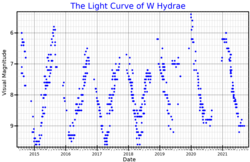
W Hydrae is a Mira-type variable star in the constellation Hydra. The star is nearly located within the Solar neighborhood, at 320 light years from the Solar System. It has a visual apparent magnitude range of 5.6 to 10. In the near-infrared J band it has a magnitude of -1.7,[4] is the 7th brightest star in the night sky, and is even brighter than Sirius.
Water masers and dust
[edit].jpg)
The star also shows signs of intense water emissions, indicative of the presence of a wide disk of dust and water vapour.[8] Such emissions cover a zone spanning between 10.7 Astronomical Units (within Saturn's orbital zone) and 1.2 parsecs (or nearly 247,500 Astronomical Units, as far away as the Oort Cloud in Solar System).
Notes
[edit]- ^ Radius calculated using a distance of 98+30
−18 parsecs and an angular diameter of 41.4 milliarcseconds (0.041 arcsec). 98 • 0.041 = diameter of 4.06 AU, which is multiplied by 107.5 to convert from AU to R☉.
References
[edit]- ^ "Download Data". aavso.org. AAVSO. Retrieved 1 October 2021.
- ^ "GCVS Query=W Hya". General Catalogue of Variable Stars @ Sternberg Astronomical Institute, Moscow, Russia. Retrieved 2012-08-22.
- ^ Samus, N. N.; Durlevich, O. V.; et al. (2009). "VizieR Online Data Catalog: General Catalogue of Variable Stars (Samus+ 2007-2013)". VizieR On-line Data Catalog: B/GCVS. Originally Published in: 2009yCat....102025S. 1. Bibcode:2009yCat....102025S.
- ^ a b "V* W Hya". SIMBAD Astronomical Database. Retrieved 2012-08-21.
- ^ a b Vlemmings, W. H. T.; Van Langevelde, H. J.; Diamond, P. J.; Habing, H. J.; Schilizzi, R. T. (2003). "VLBI astrometry of circumstellar OH masers: Proper motions and parallaxes of four AGB stars". Astronomy & Astrophysics. 407: 213–224. arXiv:astro-ph/0305405. Bibcode:2003A&A...407..213V. doi:10.1051/0004-6361:20030766. S2CID 11505142.
- ^ a b c Takeuti, Mine; Nakagawa, Akiharu; Kurayama, Tomoharu; Honma, Mareki (2013). "A Method to Estimate the Masses of Asymptotic Giant Branch Variable Stars". Publications of the Astronomical Society of Japan. 65 (3): 60. Bibcode:2013PASJ...65...60T. doi:10.1093/pasj/65.3.60.
- ^ Ohnaka, K.; Wong, K. T.; Weigelt, G.; Hofmann, K.-H. (November 2024). "Contemporaneous high-angular-resolution imaging of the AGB star W Hya in vibrationally excited H 2 O lines and visible polarized light with ALMA and VLT/SPHERE-ZIMPOL". Astronomy & Astrophysics. 691: L14. arXiv:2411.09759. doi:10.1051/0004-6361/202451977. ISSN 0004-6361.
- ^ Zubko & Elitzur, Moshe (2000). "Water and Dust Emission from W Hydrae". The Astrophysical Journal. 544 (2): 137–140. arXiv:astro-ph/0009440. Bibcode:2000ApJ...544L.137Z. doi:10.1086/317317. S2CID 17702515.
External links
[edit]- AAVSO Variable Star of the Month. April 2008: W Hya
- W Hya[permanent dead link] at AAVSO (chart #8585EPX)


 | This variable star–related article is a stub. You can help Wikipedia by adding missing information. |