
Recent from talks
Wadiasaurus
Knowledge base stats:
Talk channels stats:
Members stats:
Wadiasaurus
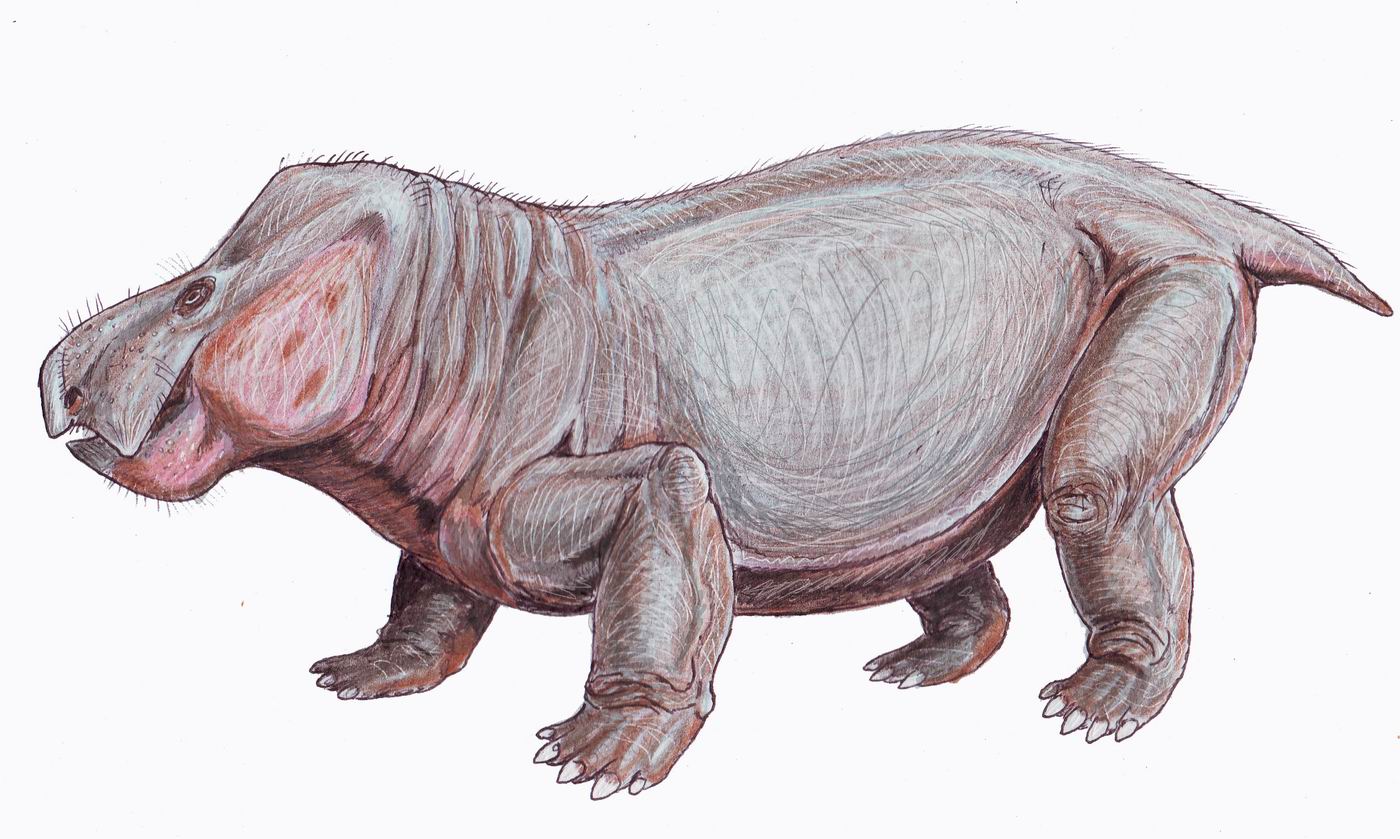
Wadiasaurus (Wadia is of Islamic origin and means "guardianship," and "sauros" means lizard) is an extinct genus of dicynodont from the family Kannemeyeria, that lived in herds from the early to Middle Triassic. Substantial fossorial evidence of W. indicus was recovered from Yerrapalli Formation of the Pranhita-Godavari valley, India, and it is so far the only Kannemeyeriid known for certain from India. The Kannemeyeriiformes underwent a significant diversification during the middle Triassic, with roughly 40 known species distributed worldwide. All Kannemeyeriiformes were medium to large bodied, graviportal herbivores with relatively erect posture and gait. Wadiasaurus indicus is currently the only known species of Wadiasaurus.
Wadiasaurus indicus is represented by a collection of well-preserved fossil material recovered from the Yerrapalli formation in India. In a single bone bed, at least 700 cranial and postcranial elements amounting to more than 23 monotypic individuals of varying age were excavated. A taphonomic study of the bone assemblage reveals that a herd of Wadiasaurus, including some juveniles and young animals, were trapped in the soft muds of a floodplain and buried in a small area. The bones were disarticulated and dissociated, which indicates some form of post mortem disturbance, though there was no evidence of any transportation from a great distance (no sign of rolling, abrasion, or maceration). The delicate elements of the skull and iliac elements were preserved, inferring small-scale transportation, likely from weathering of the surrounding region.
The skull is moderately large with a length of 400mm and triangular. The skull roof is comparatively narrow and flat but the snout is curved downward anteriorly and descends laterally (almost vertically) to form the maxillary flanges. The external naris is laterally directed and is moderately large. The orbit is elliptical and relatively large, looking mainly outward and slightly forward; it is situated laterally near the mid-length of the skull. The interorbital region is not broad (about 28% of the skull length), and the temporal fenestra is long and narrow. The parietal is high and narrow anteriorly but widens posteriorly almost up to the occipital margin. In the palate the premaxilla is long and narrow; the interpterygoid vacuity (open space on the palate) is wide. The occiput faces sharply downward and backward, thus making an acute angle with the rest of the skull, and is characterized by a broad wing-like squamosal.
The scapular blade of Wadiasaurus is long, narrow, and slender, and with the coracoid plate it form an outward, open-notched glenoid fossa that faces caudolaterally with sharply defined upper and lower lips. The scapular side of the glenoid fossa is slightly concave whereas the coracoid side is slightly convex. Although the pro-coracoid is not preserved in Wadiasaurus, it is small and subtriangular in Lystrosaurus, a related dicynodont. The coracoid's lateral surface in Wadiasaurus is concave and its ventral margin has an unfinished and wavy appearance that suggests a cartilaginous extension of the coracoid to the interclavicle. The ventro-lateral surface of the coracoid was the site of attachment of the muscles M. coracobrachialis and M. biceps. Medially, the cranial edge of the coracoid was the site of M. triceps attachment.
In the humerus, there is a large entepicondylar foramen that obliquely pierces the ventral surface of the humeral shaft, and it has a large, raised, asymmetric area on the ventral humeral surface for articulation with the ulna and radius. A triangular, raised trochlea continues on the dorsal surface which suggests greater ulnar extension compared to related dicynodonts.
The radius is stout and rod-like with expanded proximal and distal ends and a narrow midshaft region. The ulna of Wadiasaurus is also stout but craniocaudally compressed. It is characterized by a prominent wedge-shaped olecranon process, whose cranial face has the site of insertion of M. triceps. In Wadiasaurus, the olecranon is completely ossified and fused with the ulna in contrast to that of Stahleckeriaand, which are other Triassic dicynodonts, where the olecranon process remained as a separate ossified entity from the ulna.
The manus is broad, robust, and short with blunt and stout claws, and exhibits a phalangeal formula of 2-3-3-3-3. The phalanges of Wadiasaurus are short and broad compared with those of Diictodon. The terminal phalanx is a short but broad claw with a ventral curvature and a boss on its plantar side.
The iliac blade of Wadiasaurus is wide, subtriangular and concave laterally. The dorsal edge of the iliac blade is highly convex, smooth, and asymmetric, and its caudal end is almost at a 45-degree angle to the horizontal plane. The ilium has a short, constricted neck above the acetabulum. The medial iliac surface has connection points for the expanded distal ends of the sacral ribs. At least five facets are distinctly visible in Wadiasaurus.
Hub AI
Wadiasaurus AI simulator
(@Wadiasaurus_simulator)
Wadiasaurus
Wadiasaurus (Wadia is of Islamic origin and means "guardianship," and "sauros" means lizard) is an extinct genus of dicynodont from the family Kannemeyeria, that lived in herds from the early to Middle Triassic. Substantial fossorial evidence of W. indicus was recovered from Yerrapalli Formation of the Pranhita-Godavari valley, India, and it is so far the only Kannemeyeriid known for certain from India. The Kannemeyeriiformes underwent a significant diversification during the middle Triassic, with roughly 40 known species distributed worldwide. All Kannemeyeriiformes were medium to large bodied, graviportal herbivores with relatively erect posture and gait. Wadiasaurus indicus is currently the only known species of Wadiasaurus.
Wadiasaurus indicus is represented by a collection of well-preserved fossil material recovered from the Yerrapalli formation in India. In a single bone bed, at least 700 cranial and postcranial elements amounting to more than 23 monotypic individuals of varying age were excavated. A taphonomic study of the bone assemblage reveals that a herd of Wadiasaurus, including some juveniles and young animals, were trapped in the soft muds of a floodplain and buried in a small area. The bones were disarticulated and dissociated, which indicates some form of post mortem disturbance, though there was no evidence of any transportation from a great distance (no sign of rolling, abrasion, or maceration). The delicate elements of the skull and iliac elements were preserved, inferring small-scale transportation, likely from weathering of the surrounding region.
The skull is moderately large with a length of 400mm and triangular. The skull roof is comparatively narrow and flat but the snout is curved downward anteriorly and descends laterally (almost vertically) to form the maxillary flanges. The external naris is laterally directed and is moderately large. The orbit is elliptical and relatively large, looking mainly outward and slightly forward; it is situated laterally near the mid-length of the skull. The interorbital region is not broad (about 28% of the skull length), and the temporal fenestra is long and narrow. The parietal is high and narrow anteriorly but widens posteriorly almost up to the occipital margin. In the palate the premaxilla is long and narrow; the interpterygoid vacuity (open space on the palate) is wide. The occiput faces sharply downward and backward, thus making an acute angle with the rest of the skull, and is characterized by a broad wing-like squamosal.
The scapular blade of Wadiasaurus is long, narrow, and slender, and with the coracoid plate it form an outward, open-notched glenoid fossa that faces caudolaterally with sharply defined upper and lower lips. The scapular side of the glenoid fossa is slightly concave whereas the coracoid side is slightly convex. Although the pro-coracoid is not preserved in Wadiasaurus, it is small and subtriangular in Lystrosaurus, a related dicynodont. The coracoid's lateral surface in Wadiasaurus is concave and its ventral margin has an unfinished and wavy appearance that suggests a cartilaginous extension of the coracoid to the interclavicle. The ventro-lateral surface of the coracoid was the site of attachment of the muscles M. coracobrachialis and M. biceps. Medially, the cranial edge of the coracoid was the site of M. triceps attachment.
In the humerus, there is a large entepicondylar foramen that obliquely pierces the ventral surface of the humeral shaft, and it has a large, raised, asymmetric area on the ventral humeral surface for articulation with the ulna and radius. A triangular, raised trochlea continues on the dorsal surface which suggests greater ulnar extension compared to related dicynodonts.
The radius is stout and rod-like with expanded proximal and distal ends and a narrow midshaft region. The ulna of Wadiasaurus is also stout but craniocaudally compressed. It is characterized by a prominent wedge-shaped olecranon process, whose cranial face has the site of insertion of M. triceps. In Wadiasaurus, the olecranon is completely ossified and fused with the ulna in contrast to that of Stahleckeriaand, which are other Triassic dicynodonts, where the olecranon process remained as a separate ossified entity from the ulna.
The manus is broad, robust, and short with blunt and stout claws, and exhibits a phalangeal formula of 2-3-3-3-3. The phalanges of Wadiasaurus are short and broad compared with those of Diictodon. The terminal phalanx is a short but broad claw with a ventral curvature and a boss on its plantar side.
The iliac blade of Wadiasaurus is wide, subtriangular and concave laterally. The dorsal edge of the iliac blade is highly convex, smooth, and asymmetric, and its caudal end is almost at a 45-degree angle to the horizontal plane. The ilium has a short, constricted neck above the acetabulum. The medial iliac surface has connection points for the expanded distal ends of the sacral ribs. At least five facets are distinctly visible in Wadiasaurus.
Recent media