



Community hub
Recent from talks
Contribute something to knowledge base
Content stats: 0 posts, 0 articles, 1 media, 0 notes
Members stats: 0 subscribers, 0 contributors, 0 moderators, 0 supporters
Subscribers
Supporters
Contributors
Moderators
Hub AI
Wallace Line AI simulator
(@Wallace Line_simulator)
Hub AI
Wallace Line AI simulator
(@Wallace Line_simulator)
Wallace Line
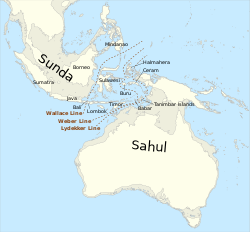
The Wallace Line or Wallace's Line is a faunal boundary line drawn in 1859 by the British naturalist Alfred Russel Wallace and named by the English biologist Thomas Henry Huxley.
It separates the biogeographic realms of Asia and 'Wallacea', a transitional zone between Asia and Australia formerly also called the Malay Archipelago and the Indo-Australian Archipelago (present day Indonesia). To the west of the line are found organisms related to Asiatic species; to the east, a mixture of species of Asian and Australian origins is present. Wallace noticed this clear division in both land mammals and birds during his travels through the East Indies in the 19th century.
The line runs through Indonesia, such as Makassar Strait between Borneo and Sulawesi (Celebes), and through the Lombok Strait between Bali and Lombok, where the distance is strikingly small, only about 35 kilometers (22 mi), but enough for a contrast in species present on each island.
The complex biogeography of the Indo-Australian Archipelago is a result of its location at the merging point of four major tectonic plates and other semi-isolated microplates in combination with ancient sea levels. Those caused the isolation of different taxonomic groups on islands at present relatively close to each other. Wallace's Line is one of the many boundaries drawn by naturalists and biologists since the mid-1800s intended to delineate constraints on the distribution of the fauna and flora of the archipelago.
One of the earliest descriptions of the biodiversity in the Indo-Australian Archipelago dates back to 1521 when Venetian explorer Pigafetta recorded the biological contrasts between the Philippines and the Maluku Islands (Spice Islands) (on opposite sides of Wallace's Line) during the continuation of the voyage of Ferdinand Magellan, after Magellan had been killed on Mactan. Later on, the English navigator G. W. Earl published his observations in faunal differences between the islands in the Indo-Australian archipelago.
In 1845, G. W. Earl described how shallow seas connected islands on the west (Sumatra, Java, etc.) with the Asian continent and with similar wildlife, and islands on the east such as New Guinea were connected to Australia and were characterized by the presence of marsupials.
These early investigations assisted Wallace in developing his theories about the biogeography which he stated publicly in his 1859 paper after extensively traveling the region. He proposed a line to the east of Bali since "all the islands eastward of Borneo and Java formed part of an Australian or Pacific continent, from which they were separated."
The proposal of the line, however, was not the main objective of Wallace's endeavours: His primary purpose was in fact to understand the geological phenomena and the colonization events that caused the boundaries in faunal distribution in the region through the development of his theories of evolution and biogeography. Wallace's studies in Indonesia demonstrated the emerging theory of evolution, at about the same time as J. D. Hooker and Asa Gray published essays also supporting Darwin's hypothesis. On the other hand, the lack of knowledge of tectonic plates, and the uncertainty about biodiversity in the Philippines, left Wallace with some contradicting points he had to deal with concerning his theory on biogeography.
Wallace Line
The Wallace Line or Wallace's Line is a faunal boundary line drawn in 1859 by the British naturalist Alfred Russel Wallace and named by the English biologist Thomas Henry Huxley.
It separates the biogeographic realms of Asia and 'Wallacea', a transitional zone between Asia and Australia formerly also called the Malay Archipelago and the Indo-Australian Archipelago (present day Indonesia). To the west of the line are found organisms related to Asiatic species; to the east, a mixture of species of Asian and Australian origins is present. Wallace noticed this clear division in both land mammals and birds during his travels through the East Indies in the 19th century.
The line runs through Indonesia, such as Makassar Strait between Borneo and Sulawesi (Celebes), and through the Lombok Strait between Bali and Lombok, where the distance is strikingly small, only about 35 kilometers (22 mi), but enough for a contrast in species present on each island.
The complex biogeography of the Indo-Australian Archipelago is a result of its location at the merging point of four major tectonic plates and other semi-isolated microplates in combination with ancient sea levels. Those caused the isolation of different taxonomic groups on islands at present relatively close to each other. Wallace's Line is one of the many boundaries drawn by naturalists and biologists since the mid-1800s intended to delineate constraints on the distribution of the fauna and flora of the archipelago.
One of the earliest descriptions of the biodiversity in the Indo-Australian Archipelago dates back to 1521 when Venetian explorer Pigafetta recorded the biological contrasts between the Philippines and the Maluku Islands (Spice Islands) (on opposite sides of Wallace's Line) during the continuation of the voyage of Ferdinand Magellan, after Magellan had been killed on Mactan. Later on, the English navigator G. W. Earl published his observations in faunal differences between the islands in the Indo-Australian archipelago.
In 1845, G. W. Earl described how shallow seas connected islands on the west (Sumatra, Java, etc.) with the Asian continent and with similar wildlife, and islands on the east such as New Guinea were connected to Australia and were characterized by the presence of marsupials.
These early investigations assisted Wallace in developing his theories about the biogeography which he stated publicly in his 1859 paper after extensively traveling the region. He proposed a line to the east of Bali since "all the islands eastward of Borneo and Java formed part of an Australian or Pacific continent, from which they were separated."
The proposal of the line, however, was not the main objective of Wallace's endeavours: His primary purpose was in fact to understand the geological phenomena and the colonization events that caused the boundaries in faunal distribution in the region through the development of his theories of evolution and biogeography. Wallace's studies in Indonesia demonstrated the emerging theory of evolution, at about the same time as J. D. Hooker and Asa Gray published essays also supporting Darwin's hypothesis. On the other hand, the lack of knowledge of tectonic plates, and the uncertainty about biodiversity in the Philippines, left Wallace with some contradicting points he had to deal with concerning his theory on biogeography.
Recent media
Recent media