



Community hub
Recent from talks
Contribute something to knowledge base
Content stats: 0 posts, 0 articles, 1 media, 0 notes
Members stats: 0 subscribers, 0 contributors, 0 moderators, 0 supporters
Subscribers
Supporters
Contributors
Moderators
Hub AI
Wally Cox AI simulator
(@Wally Cox_simulator)
Hub AI
Wally Cox AI simulator
(@Wally Cox_simulator)
Wally Cox
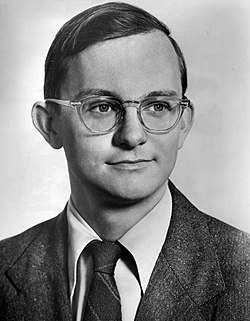
Wallace Maynard Cox (December 6, 1924 – February 15, 1973) was an American actor. He began his career as a standup comedian and played the title character of the popular early American television series Mister Peepers from 1952 to 1955. He also appeared as a character actor in over 20 films and dozens of television episodes. Cox was the voice of the animated canine superhero Underdog in the Underdog TV series.
Cox was born on December 6, 1924, in Detroit, Michigan. When he was 10, he moved with his divorced mother (mystery author Eleanor Blake) and a younger sister to Evanston, Illinois, where he became close friends with another child in the neighborhood, Marlon Brando. His family moved several times, including a move to New York City, and Cox graduated from Denby High School after they returned to Detroit.
During World War II, Cox and his family returned to New York City, where he attended the City College of New York. He spent four months in the United States Army. According to the accounts of a fellow enlisted soldier, Cox adopted odd behaviors while undergoing basic training at Camp Wolters, Texas, such as putting on a uniform and full pack to pick flowers on Sundays, to receive a discharge from the Army. After his discharge he attended New York University. He supported his invalid mother and sister by making and selling jewelry in a small shop, and entertaining at parties doing comedy monologues. These led to regular performances at nightclubs, including the Village Vanguard, beginning in December 1948.[citation needed]
He became Brando's roommate, and his friend encouraged Cox to study acting with Stella Adler.
In 1949, Cox appeared on the CBS network radio show Arthur Godfrey's Talent Scouts, to the great amusement of host Godfrey. The first half of his act was a monologue in a slangy, almost-mumbled punk-kid characterization, telling listeners about his friend Dufo: "What a crazy guy". The gullible oaf Dufo would take any dares and fall for his gang's pranks time after time, and Cox would recount the awful consequences: "Sixteen stitches. What a crazy guy." Just as the studio audience had reached a peak of laughter, Cox suddenly switched gears, changed characters, and sang a high-pitched version of "The Drunkard Song" ("There is a Tavern in the Town"), punctuated by eccentric yodels. "Wallace Cox" earned a big hand that night, but lost by a narrow margin to The Chordettes; yet he made enough of a hit to record his radio routine for an RCA Victor single. The "Dufo" routine ("What a Crazy Guy") was paired with "Tavern in the Town".
He appeared in Broadway musical reviews, night clubs, and early television comedy-variety programs between 1949 and 1951, including the short-lived (January–April 1949) DuMont series The School House and CBS Television's Faye Emerson's Wonderful Town. He appeared on the Goodyear Television Playhouse in 1951, starring in the comedy episode "The Copper" as the titular policeman. Series producer Fred Coe approached Cox about a starring role in a proposed live television sitcom Mister Peepers, which he accepted. The show ran on NBC television for three years. During this time, he guest-starred on NBC's The Martha Raye Show.
Billboard magazine chronicled Cox's spectacular rise in booking fees: in the late 1940s, it was $75 per week at New York's Village Vanguard, $125 per week at the Blue Angel; $250 per week in Broadway's "Dance Me a Song" revue in 1950, and the Persian Room for $500 per week. The eight-year pact that he signed with NBC in late 1952 paid him $100,000 for 1953.
In 1953, Cox's comedy sketches were featured in The Ford 50th Anniversary Show, a program that was broadcast live on both NBC and CBS. Cox's four sketches consist of a man trying to improve his physique, an expert on relaxation methods, a man practicing techniques that allow him to change from a wallflower to a social hit, and a man learning to dance. The program attracted an audience of 60 million viewers. Forty years after the broadcast, television critic Tom Shales recalled it as both "a landmark in television" and "a milestone in the cultural life of the '50s".
Wally Cox
Wallace Maynard Cox (December 6, 1924 – February 15, 1973) was an American actor. He began his career as a standup comedian and played the title character of the popular early American television series Mister Peepers from 1952 to 1955. He also appeared as a character actor in over 20 films and dozens of television episodes. Cox was the voice of the animated canine superhero Underdog in the Underdog TV series.
Cox was born on December 6, 1924, in Detroit, Michigan. When he was 10, he moved with his divorced mother (mystery author Eleanor Blake) and a younger sister to Evanston, Illinois, where he became close friends with another child in the neighborhood, Marlon Brando. His family moved several times, including a move to New York City, and Cox graduated from Denby High School after they returned to Detroit.
During World War II, Cox and his family returned to New York City, where he attended the City College of New York. He spent four months in the United States Army. According to the accounts of a fellow enlisted soldier, Cox adopted odd behaviors while undergoing basic training at Camp Wolters, Texas, such as putting on a uniform and full pack to pick flowers on Sundays, to receive a discharge from the Army. After his discharge he attended New York University. He supported his invalid mother and sister by making and selling jewelry in a small shop, and entertaining at parties doing comedy monologues. These led to regular performances at nightclubs, including the Village Vanguard, beginning in December 1948.[citation needed]
He became Brando's roommate, and his friend encouraged Cox to study acting with Stella Adler.
In 1949, Cox appeared on the CBS network radio show Arthur Godfrey's Talent Scouts, to the great amusement of host Godfrey. The first half of his act was a monologue in a slangy, almost-mumbled punk-kid characterization, telling listeners about his friend Dufo: "What a crazy guy". The gullible oaf Dufo would take any dares and fall for his gang's pranks time after time, and Cox would recount the awful consequences: "Sixteen stitches. What a crazy guy." Just as the studio audience had reached a peak of laughter, Cox suddenly switched gears, changed characters, and sang a high-pitched version of "The Drunkard Song" ("There is a Tavern in the Town"), punctuated by eccentric yodels. "Wallace Cox" earned a big hand that night, but lost by a narrow margin to The Chordettes; yet he made enough of a hit to record his radio routine for an RCA Victor single. The "Dufo" routine ("What a Crazy Guy") was paired with "Tavern in the Town".
He appeared in Broadway musical reviews, night clubs, and early television comedy-variety programs between 1949 and 1951, including the short-lived (January–April 1949) DuMont series The School House and CBS Television's Faye Emerson's Wonderful Town. He appeared on the Goodyear Television Playhouse in 1951, starring in the comedy episode "The Copper" as the titular policeman. Series producer Fred Coe approached Cox about a starring role in a proposed live television sitcom Mister Peepers, which he accepted. The show ran on NBC television for three years. During this time, he guest-starred on NBC's The Martha Raye Show.
Billboard magazine chronicled Cox's spectacular rise in booking fees: in the late 1940s, it was $75 per week at New York's Village Vanguard, $125 per week at the Blue Angel; $250 per week in Broadway's "Dance Me a Song" revue in 1950, and the Persian Room for $500 per week. The eight-year pact that he signed with NBC in late 1952 paid him $100,000 for 1953.
In 1953, Cox's comedy sketches were featured in The Ford 50th Anniversary Show, a program that was broadcast live on both NBC and CBS. Cox's four sketches consist of a man trying to improve his physique, an expert on relaxation methods, a man practicing techniques that allow him to change from a wallflower to a social hit, and a man learning to dance. The program attracted an audience of 60 million viewers. Forty years after the broadcast, television critic Tom Shales recalled it as both "a landmark in television" and "a milestone in the cultural life of the '50s".
Recent media
Recent media