Hubbry Logo
Walther WA 2000Walther WA 2000Main
Open search
Walther WA 2000
Community hub
Walther WA 2000
logo
8 pages, 0 posts
0 subscribers
Be the first to start a discussion here.
Walther WA 2000
Walther WA 2000
from Wikipedia

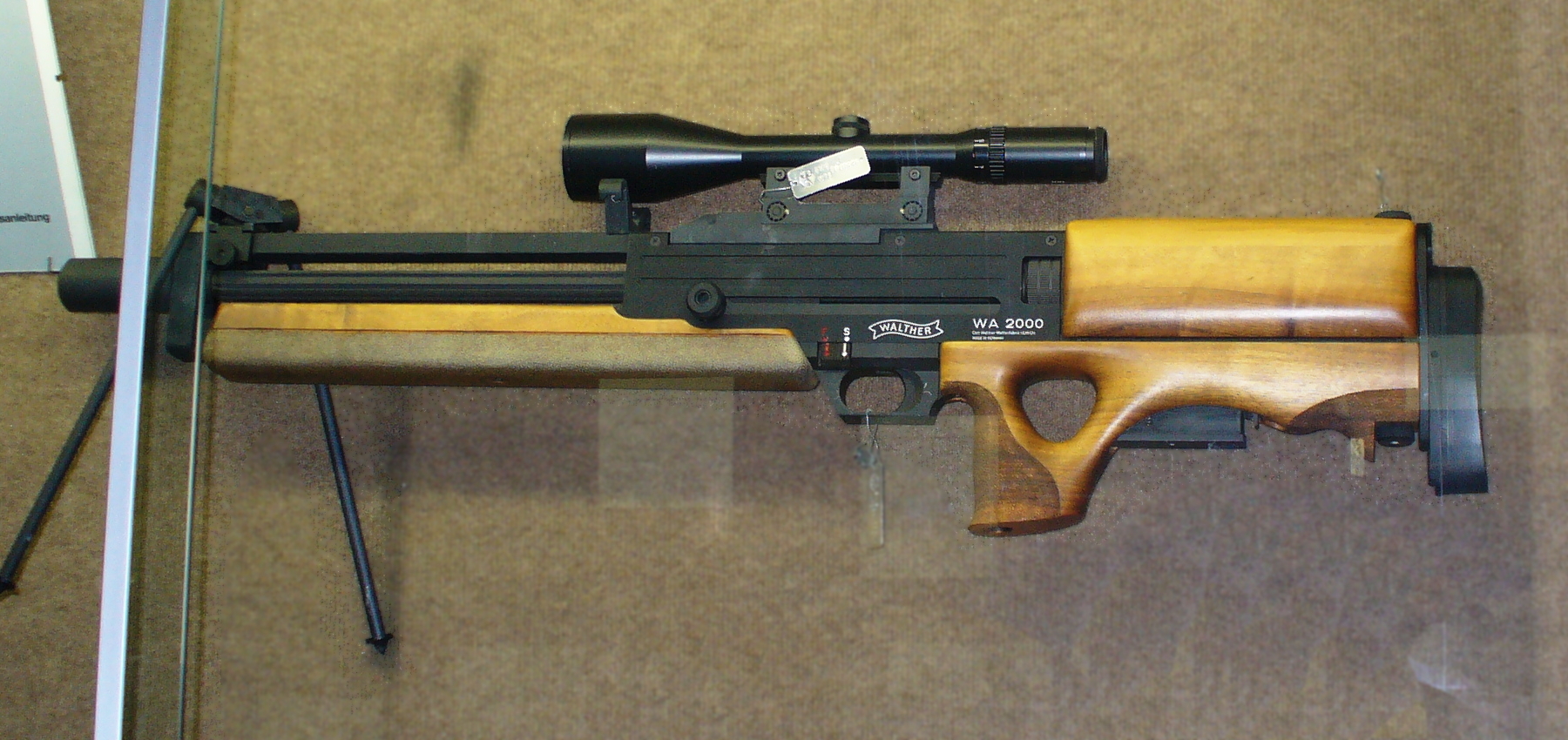
The Walther WA 2000 is a semi-automatic bullpup sniper rifle produced by the Carl Walther GmbH Sportwaffen company from 1978[2] to 1988. The WA2000 was introduced to the markets in 1981[3][4] and was produced in three different calibers.[5] Production of the rifle was limited and it was shortly stopped because it was too expensive to achieve widespread sales and not robust enough for military use as a sniper rifle.[7][8] Only 176 were built due to its high manufacturing cost, making it one of the rarest and most sought-after production firearms ever made; and extremely valuable, common auction prices in the United States start at $50,000.[9]

Key Information

Design

[edit]

The WA 2000 was designed in the late 1970s and early 1980s,[1] in response to the Munich massacre at the 1972 Summer Olympics.[1][10]

The barrel is clamped at the front and rear so that it does not twist on firing, while the rest of the barrel is free from any contact with the furniture to prevent further distortions or movement disturbing the gun's aim. Furthermore, the barrel is fluted to dampen vibrations and aid cooling. The barrel is set in line with user's shoulder to reduce recoil and the bolt mechanism sits behind the handgrip in a 'bullpup' arrangement. All stock furniture is fully adjustable, and when firing the .300 Winchester Magnum and using the standard Schmidt and Bender x2.5 to x10 sight, the rifle's accuracy is considerable.

— Chris McNab[11]

The bullpup design was chosen to shorten weapon-length, whilst mostly preserving the accuracy and ballistic-performance of an otherwise full-length rifle. The WA 2000 had a quick-detachable scope mount with a weight of 0.96 kg (2.1 lb).[5] The rifle did not have iron sights. The most commonly used optical sight was a Schmidt & Bender 2.5–10× telescopic sight.[12] Without scope the rifle has an unloaded weight of 6.95 kg (15.3 lb) and a loaded weight of 7.35 kg (16.2 lb).[5]

The .300 Winchester Magnum round was chosen as the primary caliber because of its long range accuracy and its precision at all ranges. The entire rifle is designed around the barrel. The WA 2000 fires from a closed bolt and uses a bolt with seven locking lugs. It has either a single-stage trigger[13] or a two-stage trigger[14] with a trigger pull of 1.2 to 1.4 kg (2.65 to 3.1 lb).[5] The rifle uses single stack box magazines with a 6-round capacity, which weigh 0.4 kg (0.88 lb) when loaded.[5]

Variants

[edit]

The WA 2000 was primarily chambered in .300 Winchester Magnum, but also had the option of being chambered in 7.62×51mm NATO, and 7.5×55mm Swiss.[1]

Only 176 total rifles were produced, and in two different variants. The two variants can be differentiated by the type of flash suppressor used: the first, the older model, uses a "can" type flash suppressor; whereas the second generation and newer model uses the more conventional "flash-hider/compensator" design. The second generation incorporated several changes improving the rifle's accuracy, making it more suited to its intended job.[15]

Production

[edit]

The rifle was produced from 1982 until November 1988.[15][6] The rifle was used by some German police units, but production was stopped because it was too expensive to achieve widespread sales.[1] It was never adopted by a military unit due to its cost and not being robust enough for field service.[7] The final retail cost for a base rifle in the 1980s was in the range of $9,000 to $12,500, and the rifle's current value ranges from $40,000 for the first generation to $75,000 for the second generation.[15]

See also

[edit]

References

[edit]
[edit]
Revisions and contributorsEdit on WikipediaRead on Wikipedia
from Grokipedia
The Walther WA 2000 is a semi-automatic developed by the German firearms manufacturer [Carl Walther GmbH](/page/Carl Walther GmbH), introduced in 1982 and produced until 1988, with only 176 units ever manufactured. Designed primarily for precision police operations in the wake of the 1972 Munich Olympics terrorist attack by , it emphasized exceptional accuracy, ergonomic adjustability, and rapid semi-automatic fire while maintaining a compact profile through its innovative layout. Its rarity and meticulous handcrafted construction earned it the nickname "Cadillac of sniper rifles," though its high production costs limited widespread adoption beyond select German police units. The rifle's development stemmed from a need for a specialized counter-terrorism weapon capable of engaging threats at ranges up to 700 meters with sub-minute-of-angle accuracy. Walther engineers built the WA 2000 from the ground up, incorporating a gas-operated, rotating-bolt action with a free-floating, fluted barrel to minimize vibrations and enhance shot-to-shot consistency. Available in three calibers—.300 Winchester Magnum for long-range performance, 7.62x51mm NATO (.308 Winchester) for standard use, and 7.5x55mm Swiss for specialized applications—it utilized a 6-round detachable box magazine and featured a fully adjustable trigger with pull weights between 2.6 and 3.1 pounds. The bullpup configuration allowed a full-length 25.6-inch (650 mm) barrel within an overall length of approximately 35.6 inches (905 mm), weighing about 15.3 pounds (6.95 kg) unloaded without optics. Notable for its customization, the WA 2000 included an adjustable wooden with riser and buttpad, a bipod mount, and no , relying instead on high-end Schmidt & Bender 2.5-10x56mm variable optics that could be quickly detached for maintenance. Two production series were made: the initial Series 1 and an improved Series 2, which refined the gas , reduced , and boosted accuracy through better barrel harmonics. Despite its technical sophistication, the rifle saw limited field use due to its expense—original prices exceeded $9,000 per unit—and was eventually overshadowed by more cost-effective alternatives. Today, surviving examples command prices up to $75,000 on the collector's market, underscoring its status as a pinnacle of precision firearms engineering.

Development

Background and Conception

The development of the Walther WA 2000 was initiated in the late 1970s by , a renowned German firearms manufacturer, as part of broader efforts to enhance precision capabilities in West Germany's law enforcement following heightened counter-terrorism needs. The catalyst was the tragic 1972 Munich Olympics massacre, where terrorists killed two Israeli athletes and took nine , exposing critical shortcomings in German police weaponry—such as the reliance on standard-issue battle rifles like the G3, which lacked the necessary accuracy for scenarios in urban settings. This event prompted the formation of specialized units like and underscored the demand for dedicated precision tools to prevent similar failures. Conceived specifically as a semi-automatic sniper rifle for counter-terrorism operations, the WA 2000 prioritized exceptional accuracy and controlled fire over high-volume suppressive capabilities, targeting elite police marksmen rather than military infantry. The design emphasized a bullpup configuration to achieve compactness for maneuverability in confined urban environments, allowing a long barrel for velocity and range without excessive overall length. It was engineered for sub-MOA precision at distances up to 700 meters, with an unloaded weight of approximately 7 kilograms to aid mobility, and was available in calibers such as 7.62×51mm NATO and .300 Winchester Magnum. These specifications reflected a focused response to the evolving security landscape in post-World War II West Germany, where precision firepower was seen as essential for minimizing collateral damage in domestic operations.

Prototyping and Initial Testing

The initial prototypes of the Walther WA 2000 were developed in the late at the company's facility in , marking the start of a focused effort to create a precision semi-automatic in bullpup configuration. These early models incorporated a gas-operated system, but the first iteration encountered significant reliability issues with the gas blowback mechanism, particularly in maintaining consistent operation within the compact bullpup layout. To address this, engineers iterated on the design, refining the gas piston and to improve cycling and reduce malfunctions under varied conditions. Extensive testing took place at the facility, encompassing recoil management trials and accuracy evaluations to validate the rifle's performance as a police sniper weapon. was mitigated through a combination of the rifle's heavy construction—approaching 16 pounds unloaded—and an integrated , allowing for controlled follow-up shots during evaluations. Accuracy tests demonstrated sub-MOA groupings at extended ranges, with factory targets confirming the free-floating barrel's contribution to precision shooting up to 800 meters. Key challenges during this phase involved optimizing the gas system's reliability in the form, where the shortened receiver length complicated piston travel and gas flow, as well as integrating adjustable cheekpiece and buttpad components into the for enhanced ergonomics without compromising structural integrity. Collaboration with optics manufacturer Schmidt & Bender played a crucial role in early trials, ensuring seamless integration of high-magnification scopes such as the 2.5-10x56mm model directly onto the rifle's receiver mount. This partnership facilitated zeroing and tracking tests, confirming the platform's suitability for rapid, precise engagements in counter-terrorism scenarios. Iterative improvements from these prototypes ultimately led to the production-ready design introduced in 1982.

Design

Configuration and Features

The Walther WA 2000 features a configuration, positioning the action and magazine behind the trigger group to achieve an overall length of 905 mm while incorporating a full-length barrel, which enhances maneuverability in confined spaces compared to traditional rifles of similar . The rifle weighs 6.95 kg when unloaded without , contributing to its stability during firing despite the compact design. The barrel is a cold hammer-forged heavy contour design measuring 650 mm in length (fluted in the first series) for the chambering, with integrated options to mitigate and muzzle rise. The stock is wooden, including an adjustable cheekpiece and a rubberized buttpad that allows for length-of-pull customization to ensure ergonomic fit for various shooters. It also incorporates a folding bipod mounted on the forend for prone stability and a quick-detachable system, typically fitted with a Schmidt & Bender variable optic. Standard equipment includes a 6-round detachable single-stack box compatible with the rifle's gas-operated action, along with ambidextrous controls such as the cheekpiece adjustment and a two-stage trigger adjustable for pull weight between 1.2 and 1.4 kg. The safety selector and release are positioned for efficient operation by either hand, enhancing usability in field conditions.

Operating System

The Walther WA 2000 employs a short-stroke gas operating with a mechanism to facilitate semi-automatic fire. The gas , positioned below the barrel, captures propellant gases through a dedicated port to drive the bolt carrier rearward after ignition, unlocking the bolt via rotation for extraction and ejection. This design draws influences from established short-stroke systems but incorporates refinements for enhanced precision, including optimized port placement to reduce barrel vibrations and ensure consistent cycling. The features seven locking lugs that engage an extension on the match-grade barrel, providing a robust closed-bolt lockup that supports accurate and minimizes movement during firing. A buffer integrated into the bolt carrier assembly absorbs excess energy from the operating cycle, promoting reliable function while dampening rearward forces to maintain shooter stability. (Note: Small Arms Review is a credible firearms .) To enhance field reliability, the WA 2000 incorporates safety-oriented features such as a bolt catch that retains the bolt in the open position after the magazine is emptied, aiding rapid reloading, and a spring-loaded dust cover over the ejection port to the action from contaminants and reduce malfunction risks in adverse conditions. The configuration positions this operating system compactly behind the , optimizing weight distribution without compromising .

Accuracy and Ergonomics

The Walther WA 2000 demonstrated exceptional precision capabilities, with its barrel design enabling consistent performance for long-range engagements. The , which contacts the receiver only at the chamber and muzzle, minimizes external influences on barrel harmonics during firing, contributing to sub-MOA accuracy potential at ranges up to 700 when paired with match-grade . This configuration was central to the rifle's reputation as a high-end police sniper system, prioritizing shot-to-shot consistency over rapid fire. The rifle's stock featured comprehensive adjustability to accommodate diverse shooter anatomies, including a wooden piece for proper eye alignment with the optic and an adjustable rubber butt pad for customizable . These elements allowed users to achieve a stable cheek weld and shoulder fit, enhancing overall comfort and repeatability during extended sessions. The thumb-hole integrated into the stock further supported natural hand positioning, reducing torque on the rifle. A Schmidt & Bender 2.5–10× variable was standard, mounted on a quick-detach rail system that facilitated precise zeroing and swaps for mission-specific needs. This optic provided clear magnification for target identification and holdover calculations at varying distances, with the rifle's layout ensuring the scope aligned closely with the bore for minimal error. emphasized user comfort in demanding environments, with a contoured, textured featuring a thumb hole to promote a secure, fatigue-resistant hold during prolonged aiming. The controls, including the and trigger, were positioned for intuitive access, supporting effective operation even under stress. Barrel fluting, as incorporated in the design, aided in managing heat buildup without affecting precision.

Variants and Calibers

First Generation

The first generation of the Walther WA 2000 represented the initial production model of this semi-automatic sniper rifle, introduced in 1982 as a precision tool for specialized applications. Primarily chambered in , with production conversion kits available for and , the rifle was optimized for long-range engagements, leveraging the cartridge's ballistic performance to achieve consistent accuracy at distances up to 700 meters. This caliber choice prioritized terminal effectiveness and flat trajectory, making it suitable for scenarios requiring hits on distant, small targets. A key distinguishing feature was the large, can-style cylindrical integrated with a , which significantly mitigated and minimized for improved shot-to-shot stability. This design element was essential for maintaining sight picture during rapid semi-automatic fire, enhancing the rifle's usability in dynamic operational environments. The overall configuration emphasized ergonomic handling and optical integration, with a quick-detach mount for scopes but no provision for . The first generation comprised a smaller portion of total production, estimated at around 35 units based on serial number analysis, with development and manufacturing focused specifically on meeting the precision sniping needs of police forces, particularly in urban and counter-terrorism contexts.

Second Generation

The second generation of the Walther WA 2000 introduced key refinements to enhance accuracy, balance, and usability, building on lessons from early prototypes and field evaluations. A slimmer flash hider/compensator replaced the first generation's bulky "can"-style suppressor, significantly reducing overall weight while maintaining effective muzzle control and improving handling during extended use. This variant offered full compatibility with three calibers via barrel conversions, providing options for different operational needs: the standard and most common .300 Winchester Magnum for long-range precision, the 7.62×51mm NATO for broader compatibility with military ammunition, and the rare 7.5×55mm Swiss for specialized applications, of which very few were produced. The design also eliminated the fluted barrel of earlier models to optimize barrel harmonics, minimizing vibrations and promoting consistent shot grouping in diverse environmental conditions. Further improvements included a refined gas system that reduced impulse and a fully adjustable trigger mechanism with a pull weight of 2.6 to 3.1 pounds (1.2 to 1.4 kg), enabling finer control and sub-minute-of-angle accuracy at typical distances. These updates made the second generation more responsive to user feedback, though overall production remained limited to 176 units across both generations, with the later models emphasizing these iterative enhancements.

Production

Manufacturing Process

The Walther WA 2000 was assembled at the Waffenfabrik facility in , , where skilled gunsmiths focused on to create a specialized . The design required meticulous hand-fitting to ensure seamless integration and optimal performance. These heavy-profile, match-grade barrels were fluted for heat dissipation and free-floated within the to minimize vibrations. The aluminum receiver and supporting struts were custom machined to precise tolerances, while polymer elements in the and grips underwent specialized molding and finishing, followed by extensive of internal surfaces to promote smooth of the gas-operated mechanism. This labor-intensive approach, including the layout's inherent assembly challenges, significantly elevated per-unit production costs. Quality assurance was rigorous, with each subjected to individual accuracy testing at the factory prior to shipment, verifying sub-MOA performance with match to uphold the weapon's reputation for precision.

Production Numbers and Costs

The Walther WA 2000 was manufactured in very limited quantities from until production ended in November 1988, with a total of 176 units completed during this period. Of these, only 15 rifles were imported to the , a figure attributed to stringent import regulations under the 1968 Gun Control Act and stronger demand from European and buyers. The original retail price ranged from $9,000 to $12,500 USD per unit in the , reflecting its handcrafted precision components and specialized materials; adjusted for , this equates to approximately $25,000 to $35,000 in 2025 dollars. Production was distributed across three calibers: , , and GP 11.

Operational Use

Adoption by Users

The Walther WA 2000 was primarily adopted by select units of the West German police for precision urban sniper roles, particularly in counter-terrorism operations following the 1972 Munich Olympics massacre. Procurement was highly limited, with the majority of the 176 units produced between 1982 and 1988 acquired by German law enforcement authorities, reflecting its specialized for police needs rather than broad issuance. The rifle saw no widespread military adoption, as its high unit cost—ranging from $9,000 to $12,500 in the —made it unsuitable for armed forces like the , which prioritized more robust and economical options for field service. Strict German export controls severely restricted international users, resulting in only a handful of units leaving the country, such as 15 exported to the , alongside rare civilian sales within .

Performance in Service

The Walther WA 2000 demonstrated effectiveness in training scenarios for hostage rescue operations, where its precision allowed for consistent hits at distances of 500–700 meters, aligning with its design for specialized police roles following the 1972 Olympics crisis. This capability was supported by its match-grade barrel and optical sighting system, enabling reliable in simulated counter-terrorism exercises. However, operational feedback highlighted reliability challenges, particularly the sensitivity of its gas-operated system to dirt and contaminants during extended field use, which necessitated meticulous to prevent malfunctions. The short-stroke gas mechanism, while efficient for semi-automatic cycling, proved vulnerable in dusty or adverse environments, demanding regular cleaning and careful handling to maintain functionality. Positive aspects included low perceived , mitigated by an integrated muzzle brake-compensator, which facilitated rapid follow-up shots in dynamic settings. The configuration contributed to quick , offering a compact profile that enhanced maneuverability in confined or urban environments typical of police operations. Due to its limited production of only 176 units, the WA 2000 has minimal combat records, with most documented use confined to training and exercises by German police units in the post-1980s period, where it received praise for its accuracy and handling in specialized drills.

Legacy

Reasons for Discontinuation

The production of the Walther WA 2000 ceased due to its prohibitively high manufacturing costs, which made it unviable for broad market adoption. Unit prices ranged from $9,000 to $12,500 in the 1980s, far exceeding those of comparable sniper rifles like the PSG-1, rendering the WA 2000 uncompetitive against more affordable alternatives. These costs stemmed from the rifle's bespoke engineering and premium materials, with no expenses spared in its construction, ultimately pricing it out of reach for most and budgets. The rifle's intricate design also posed significant maintenance challenges, demanding specialized care that was impractical for large-scale . This complexity limited its suitability to snipers, as it lacked the robustness required for sustained field use in harsher conditions. Consequently, the WA 2000 saw minimal uptake beyond select German units, failing to secure widespread . Low overall demand compounded these issues, resulting in just 176 units produced before manufacturing ended in November 1988. Walther faced mounting financial pressures from the project's poor returns, amid broader company diversification efforts that strained resources and marked the WA 2000 as a technical and economic setback.

Collectibility and Modern Perception

The extreme rarity of the Walther WA 2000, with only 176 units produced in total, has made it one of the most sought-after collectible firearms among enthusiasts and investors. As of 2025, well-preserved examples typically command prices between $50,000 and $100,000 USD on the collector market, driven by limited supply and high demand from private buyers. In the United States, where imported models are particularly prized due to regulatory restrictions on new imports, auction realizations for exceptional specimens have exceeded $97,000, with some private sales approaching or surpassing $100,000 for pristine, original configurations. In modern perception, the WA 2000 is revered as a pinnacle of 1980s precision engineering, embodying German craftsmanship with its meticulous hand-fitting and innovative materials that prioritized accuracy and user comfort over mass production. Among firearm enthusiasts and historians, it is frequently dubbed "the ultimate sniper rifle" for its sub-minute-of-angle precision potential and ergonomic sophistication, serving as a benchmark for what dedicated engineering can achieve in a compact platform. This status elevates it beyond a mere weapon to a status symbol in high-end collections, often displayed as a technological artifact rather than fired. The rifle's design innovations, particularly its fully adjustable cheekpiece, stock, and trigger system for individualized fit, have indirectly influenced contemporary sniper rifles by demonstrating the value of user-customizable in maintaining long-range accuracy without sacrificing compactness. Preservation efforts focus on the few surviving units, which are primarily held in institutional museums or affluent private collections to prevent wear from use. For instance, the Royal Armouries in the houses an early model used in the film . No official modern reproductions exist, as the original tooling and remain dormant since production ceased in 1988, ensuring the authenticity of extant examples while underscoring their irreplaceable status.

References

Add your contribution
Related Hubs
User Avatar
No comments yet.