Watauga Association
Watauga Association
Main page
1856377

Watauga Association

logo
Community Hub0 subscribers
Read side by side
from Wikipedia

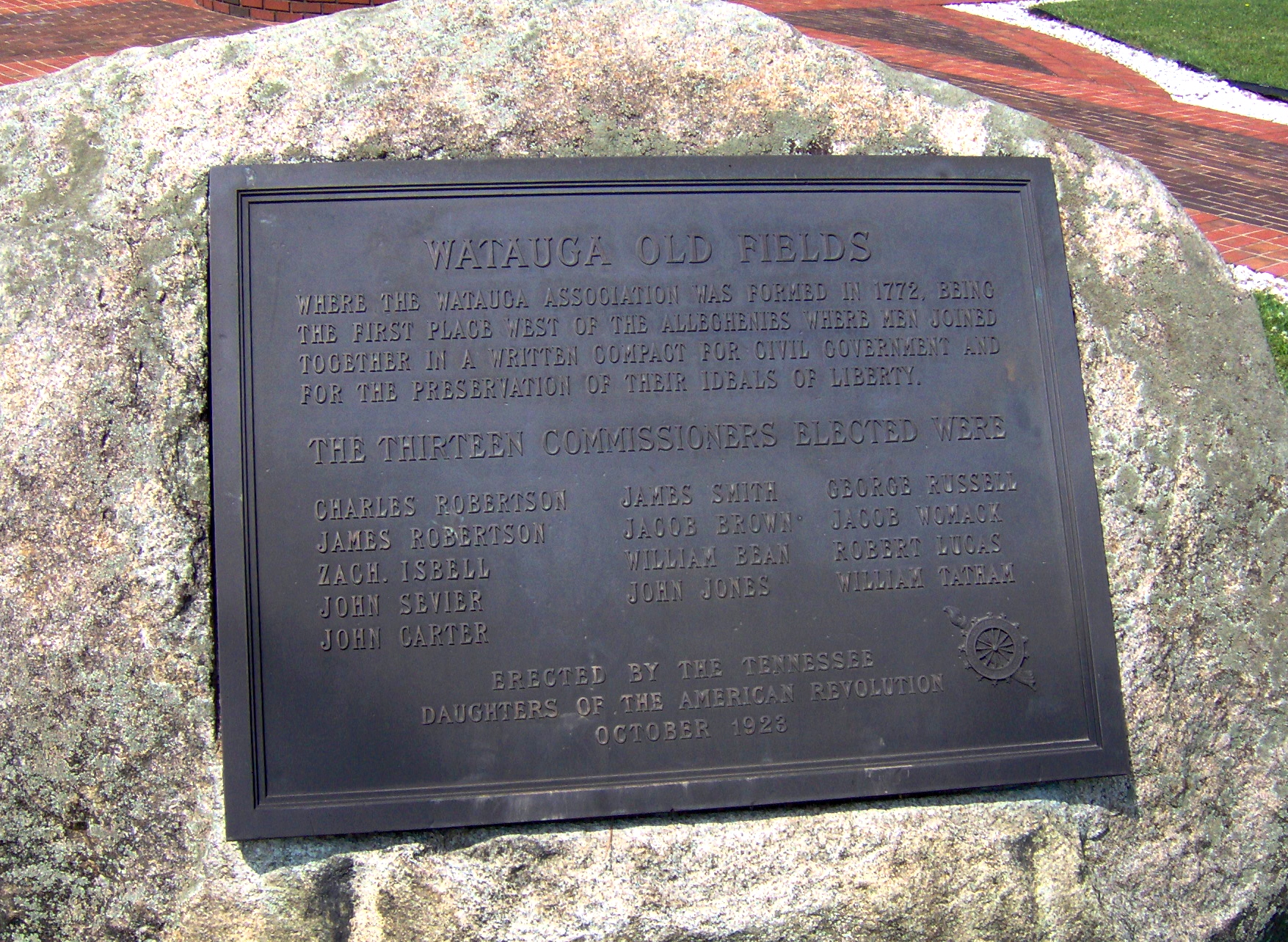
The Watauga Association (sometimes referred to as the Republic of Watauga) was a semi-autonomous government created in 1772 by frontier settlers living along the Watauga River in what is now Elizabethton, Tennessee. Although it lasted only a few years, the Watauga Association provided a basis for what later developed into the state of Tennessee and likely influenced other western frontier governments in the trans-Appalachian region. North Carolina annexed the Watauga settlement area, by then known as the Washington District, in November 1776. Within a year, the area was placed under a county government, becoming Washington County, North Carolina, in November 1777.[1] This area covers the present day Washington County, Carter County, and other areas now located in the northeast part of the state of Tennessee.

Key Information

While there is no evidence that the Watauga Association ever claimed to be outside the sovereign territory of the British Crown, historians have often cited the Association as the earliest attempt by American-born colonists to form an independent democratic government. In 1774, Virginia governor Lord Dunmore called the Watauga Association a "dangerous example" of Americans forming a government "distinct from and independent of his majesty's authority."[2] President Theodore Roosevelt later wrote that the Watauga settlers were the "first men of American birth to establish a free and independent community on the continent."[3] While no copy of the settlers' compact, known as the Articles of the Watauga Association, has ever been found, related documents tend to imply that the Watauga settlers still considered themselves British subjects, even after the initial hostilities of the American Revolution had commenced.[4]

History

[edit]
Roads of Tennessee in 1795

European settlers began arriving in the Watauga, Nolichucky, and Holston river valleys in the late 1760s and early 1770s, most migrating from Virginia via the Great Valley, although a few were believed to have been Regulators fleeing North Carolina after their defeat at the Battle of Alamance. These settlers mistakenly believed (or at least claimed to have believed) the Watauga and Nolichucky valleys were part of lands ceded to Virginia by the Cherokee in the 1770 Treaty of Lochaber, but a subsequent survey by Colonel John Donelson confirmed that these lands were still part of the Cherokee domain. As settlement on lands west of colonial boundaries violated the Royal Proclamation of 1763, the Watauga and Nolichucky settlers were ordered to leave.[5]

In May 1772, the Watauga and Nolichucky settlers negotiated a 10-year lease directly with the Cherokee, and being outside the claims of any colony, established the Watauga Association to provide basic government functions. The lease and the subsequent purchase of these lands in 1775 were considered illegal by the British Crown, and were vehemently opposed by a growing faction of the Cherokee led by the young chief Dragging Canoe. With the outbreak of the American Revolutionary War (April 1775), the settlers organized themselves into the "Washington District," loyal to the "united colonies," and formed a Committee of Safety to govern it, marking the end of the so-called "Watauga Republic".

In Spring of 1776, the Washington District Committee of Safety drafted a petition asking the colony of Virginia to annex the district. After Virginia refused, the Committee drafted a similar petition (dated July 5, 1776) asking the North Carolina Assembly to annex the district. In November of that year, North Carolina granted the petition and formally annexed the area. The Washington District was finally admitted to North Carolina as Washington County in November 1777.

The Cherokee, who were aligned with the British, launched an all-out invasion against the settlements in July 1776, but were soundly defeated.[5] In 1777, the Cherokee signed the Treaty of Long Island, ceding control of the Watauga and Nolichucky valleys to the American colonies.[6]

Structure

[edit]

Since no copy of the Articles of the Watauga Association has ever been found, most of what is known about it comes from other sources, primarily the 1776 Petition of the Inhabitants of the Washington District, commonly called the "Watauga Petition," in which the Wataugans requested annexation by North Carolina. According to the Petition, the Articles were fashioned after the laws of Virginia and were enacted by unanimous consent of the settlers. The primary reason given for the establishment of the Watauga Association was to prevent the Watauga and Nolichucky regions from becoming a haven for debtors and felons, and for conducting "public business" such as the recording of deeds and wills. Other sources, such as the later writings of Washington District Committee of Safety clerk pro tem William Tatham (1752–1819) and documents collected by historian J. G. M. Ramsey in the mid-19th century, reveal that the Articles established a five-member court (the members of which were elected), and that the Wataugans erected a courthouse and jail at Sycamore Shoals.[7]

Historians disagree over the first five magistrates of the court, although most agree that it included John Carter, James Robertson, Charles Robertson, and Zachariah Isbell. The fifth member was probably Jacob Brown. Later court members included Andrew Greer, John Roddye, and John Sevier. James Smith was probably the court's first clerk, replaced by Sevier in 1775. When Sevier was elected to the court, Felix Walker took over as clerk, with Tatham serving in his absence.[7]

Military affairs

[edit]
The area of the 1776 summer attacks by the Overhill Cherokee

Wataugan militiamen were present at multiple engagements on the frontier and throughout the American Revolution. A company of 20 Wataugans took part in the Battle of Point Pleasant in 1774 during Lord Dunmore's War, and another contingent aided in the defense of Boonesborough and Harrodsburg later in the decade.[8]

The Washington District Committee of Safety, created in 1775, consisted of John Carter, Zachariah Isbell, Jacob Brown, John Sevier, James Smith, James and Charles Robertson, William Bean, John Jones, George Russell, and Robert Lucas. The Committee acquired arms and oversaw the construction of Fort Watauga (initially named Fort Caswell and located at present day Elizabethton, Tennessee), where they thwarted one wing of the Cherokee invasion of July 1776. Wataugans took part in William Christian's punitive expedition and the Rutherford Light Horse expedition against the Overhill towns in the latter half of 1776.[6]

Even at the height of the Cherokee threat in the Spring and Summer of 1776, the Wataugans heeded a call to arms and dispatched a company of riflemen under Felix Walker to aide in the defense of Charleston in South Carolina.[1] In August 1780, a small contingent led by Col. Isaac Shelby fought in the American Patriot victory at the Battle of Musgrove Mill near present-day Clinton, South Carolina. In late September 1780, the Overmountain Men—the frontier militia that crossed the Appalachian Mountains and defeated an army of British loyalists at the Battle of Kings Mountain—mustered at Sycamore Shoals, and included 240 Wataugans under the command of Cols. John Sevier and Isaac Shelby.[9] After the battle, Sevier led a second punitive expedition against the Cherokee in which he destroyed the Chickamauga Cherokee villages near modern Chattanooga.

At least one Wataugan, William Tatham, was present at the Battle of Yorktown in 1781.[1]

Legacy

[edit]

The Articles of the Watauga Association likely influenced the Cumberland Compact (drafted in 1780), the main link between the two pacts being James Robertson, who in 1779 led a group of colonists into what is now the Nashville area. The Clarksville Compact, drafted for the Clarksville settlement in 1785, may have also been inspired by the Watauga Association (the Clarksville Compact even adopted the laws of Virginia, even though the settlement was clearly within the territory of North Carolina). In the mid-1780s, some former Wataugans (especially John Sevier) played a key role in the establishment of the failed State of Franklin.[10]

Numerous historians in the 19th and early 20th centuries romanticized the Watauga Association as the first democratic or constitutional government formed by American-born colonists. Historian Andrew C. McLaughlin, in his first major work on the history of the U.S. Constitution, wrote of the Wataugans, "one can find no more striking fact in American history, nor one more typical, than the simple ease with which those frontiersmen ... formed an association and extended the rights and privileges of self-government."[11] McLaughlin's colleague Claude Van Tyne wrote of the Wataugans, "like the Pilgrim Fathers they were without formal laws and institutions, and they made them."[12] In The Winning of the West, Theodore Roosevelt treated the Watauga Association as a microcosm of the subsequent American Revolution, writing, "the Watauga settlers outlined in advance the nation's work. They tamed the rugged and shaggy wilderness, they bid defiance to outside foes, and they successfully solved the difficult problem of self-government."[13] Recent historians point out that while the Watauga Association was one of the first constitutional governments west of the Appalachians, it was not intended as a government separate from the English colonies.[4][14]

See also

[edit]

References

[edit]
[edit]
Revisions and contributorsEdit on WikipediaRead on Wikipedia
from Grokipedia
The Watauga Association was a semi-autonomous government established in 1772 by European-American settlers in the Watauga River valley of present-day northeastern Tennessee, operating beyond the effective jurisdiction of colonial authorities in Virginia and North Carolina.[1][2] By that year, approximately seventy homesteads had been founded along the river in what became Carter County, prompting settlers to form the association to address local governance needs, including land regulation, judicial proceedings, and defense against Native American threats.[1][3] The association's structure featured five elected magistrates who handled executive, legislative, and judicial functions through a court system, drawing on Virginia's legal code while leasing land initially from the Cherokee Nation under informal agreements.[1][3] In 1775, it formalized land tenure via the Watauga Purchase, securing territory along the Watauga, Nolichucky, and Holston rivers from Cherokee leaders for a ten-year term.[4] During the American Revolution, the association's militia contributed significantly to patriot efforts, notably repelling Cherokee incursions in 1776 and participating in the Battle of Kings Mountain in 1780, which helped secure the frontier.[1][2] Facing pressures for formal annexation, residents petitioned North Carolina in 1776 for incorporation, leading to the creation of Washington District in 1777 and the association's dissolution as its functions integrated into colonial administration.[1][5] This early experiment in self-rule marked a foundational step toward Tennessee's eventual statehood, exemplifying frontier initiative in establishing order amid geographic isolation and imperial constraints.[2][6]

Origins and Formation

Early Settlement in the Watauga Valley

The Watauga Valley in northeastern Tennessee attracted European-American settlers in the late 1760s, despite the Royal Proclamation of 1763 prohibiting settlement west of the Appalachian Mountains on lands reserved for Native Americans, primarily the Cherokee.[7] Longhunters and traders had explored the region earlier in the decade, but permanent occupancy began in 1769 when William Bean, a Virginian, constructed the first cabin on Boone's Creek near its confluence with the Watauga River, accompanied by his wife Lydia Russell Bean.[6] [2] Bean's settlement marked the initial foothold, driven by the valley's fertile soil for agriculture and abundant wildlife for provisioning, as eastern lands faced soil exhaustion and population pressures.[8] Subsequent migrants from Virginia and North Carolina followed Bean into the valley through 1770 and 1771, establishing farms and informal trading posts while navigating the absence of colonial authority and proximity to Cherokee territories.[9] These early inhabitants, numbering in the dozens of families by 1772, prioritized self-reliant homesteading, with crops like corn and livestock sustaining their communities amid rudimentary log cabins and reliance on river access for transport.[10] The settlers' persistence reflected pragmatic disregard for British restrictions, as the valley's natural defenses—steep ridges and rivers—offered isolation from enforcement, fostering gradual expansion before formal organization.[11] Initial relations with the Cherokee involved sporadic trade rather than outright conflict, though the illegal nature of the encroachments sowed tensions that later necessitated negotiated leases.[12] This phase of squatter settlement laid the groundwork for communal governance, as the lack of legal courts and land titles compelled residents to adjudicate disputes informally among themselves.[5]

Establishment of the Association in 1772

By 1772, approximately seventy homesteads had been established along the Watauga River in what is now Carter County, Tennessee, by settlers primarily from Virginia and North Carolina who had migrated westward despite the Royal Proclamation of 1763 prohibiting settlement beyond the Appalachian Mountains.[13] These pioneers, facing the expiration of informal land leases from the Cherokee and lacking formal jurisdiction from any colonial government, recognized the need for organized self-governance to resolve disputes, regulate land claims, and maintain order.[2] In May 1772, on the banks of the Watauga River, the settlers convened and affirmed the Articles of the Watauga Association, creating the first semi-autonomous civil government west of the Appalachians.[14] This compact, often regarded as one of the earliest written constitutions by native-born Americans, established a committee of thirteen members to function as a court, enforcing laws adapted from the Virginia legal code and requiring unanimous consent for major decisions.[1][8] The association's framework emphasized practical administration over independence, maintaining allegiance to the British Crown while addressing local necessities such as militia organization and judicial proceedings.[15] Key figures including John Sevier and James Robertson played instrumental roles in its inception, though the body operated collectively without a single dominant leader at formation. This establishment marked a pivotal step in frontier self-rule, predating broader revolutionary sentiments and influencing subsequent attempts at regional autonomy.[10]

Governance and Structure

The Watauga Association's legal framework originated in 1772 with the drafting of articles of governance by settlers seeking to establish orderly administration amid the lack of colonial oversight in the Watauga Valley. These articles incorporated the Virginia code of laws as the foundational legal basis, adapting English common law principles to local needs for dispute resolution, land management, and civil order.[1] [2] The document, often regarded as one of the earliest written frameworks for self-government west of the Appalachians, emphasized collective agreement among freeholders and aimed to prevent anarchy by formalizing rules for association members.[5] Administrative authority vested in a court composed of five elected magistrates, who wielded combined executive, legislative, and judicial functions without separation of powers. This body adjudicated civil and criminal cases, approved land leases, regulated trade, and enacted ordinances, operating from informal sessions rather than a fixed capitol.[1] [6] A appointed clerk documented proceedings and maintained records, while a sheriff enforced judgments, collected fines, and organized posses for maintaining public safety.[1] Judicial processes mirrored Virginia county courts, including summons issuance, witness testimony, and occasional jury trials for serious offenses, though enforcement relied on communal consensus given the sparse population of approximately 70 households.[2] The framework's provisional nature reflected frontier pragmatism, lacking taxation powers or a standing militia initially, and derived legitimacy from settler petitions rather than royal charter. By 1775, amid rising tensions with Britain, the association evolved a Committee of Safety to coordinate defense, blending administrative roles with proto-revolutionary governance.[8] This structure persisted until North Carolina's annexation in 1776, which formalized Washington District courts under state law while preserving local customs.[16]

Leadership and Judicial System

The Watauga Association's leadership was centered on a committee-based structure, with John Carter emerging as the primary figure and de facto chairman from its formation in 1772. Carter, a prominent settler who had relocated to the region around 1770, oversaw administrative and governance decisions, including the drafting of articles that adopted elements of the Virginia legal code as the foundational framework. Other influential members likely included James Robertson, who may have contributed to naming the association and participated in early organizational efforts. This informal leadership emphasized practical self-rule without claims of full independence from British authority, focusing instead on local order amid frontier challenges.[1][17] By 1775–1776, the association evolved to include a Committee of Thirteen for broader coordination, with John Carter as a key member, alongside the formation of a Committee of Safety in the Washington District that incorporated leaders such as Zachariah Isbell, Jacob Brown, and John Sevier to address security and revolutionary alignment. John Sevier, who arrived in the area around 1773, gained prominence through militia roles and was later involved in judicial capacities, though the core executive functions remained under Carter's influence until North Carolina's formal jurisdiction in 1777.[18][1] The judicial system was embodied in a five-member court established in 1772, presided over by John Carter, which served as the region's first formalized judiciary west of the Appalachians and functioned both as legislators and judges. Drawing directly from the Virginia system, this panel adjudicated disputes, issued legal documents, validated land titles, and enforced rudimentary laws tailored to settler needs, such as regulating trade and resolving civil matters without trained legal expertise. Cases were handled pragmatically, reflecting the association's emphasis on equity over strict formalism, and the court continued operating post-1776 under North Carolina oversight as the Washington District court at Jonesborough, evolving into a County Court of Common Pleas and Quarter Sessions by 1778.[16][19][2]

Relations with Indigenous Peoples

Land Leases and Purchases from the Cherokee

Settlers in the Watauga Valley, having established illegal residences beyond the Proclamation Line of 1763, sought to formalize their occupancy through direct negotiations with Cherokee leaders. In May 1772, representatives from the Watauga and Nolichucky settlements secured ten-year leases for the lands they occupied, paying nominal rents in goods to Cherokee chiefs; this arrangement provided temporary legitimacy amid British prohibitions on private Indian land transactions.[2][6] These leases, while stabilizing short-term claims, proved insufficient as settlement expanded and colonial authorities ignored the frontier. In March 1775, coinciding with Richard Henderson's broader Transylvania Purchase negotiations at Sycamore Shoals on the Watauga River, Watauga leaders, including Charles Robertson, capitalized on the assembled Cherokee delegation to execute outright purchases of their occupied tracts. The primary conveyance, dated March 19, 1775, involved chiefs such as Oconostota and Attakullakulla, who deeded approximately 200,000 acres along the Watauga, Holston, and New rivers for goods valued at around £2,000, including cloth, guns, and ammunition.[4][20][21] Simultaneously, Nolichucky settler Jacob Brown negotiated parallel purchases for lands south of the French Broad River, also on March 25, 1775, for ten shillings per tract in some instances, further consolidating white control over the region. These 1775 deeds, recorded in what became Washington County's early records, bypassed royal authority and ignited later disputes, as the Cherokee lacked unified consent mechanisms and some headmen contested the sales' validity under tribal customs. Nonetheless, the transactions enabled the Watauga Association to assert proprietary rights, fostering agricultural and infrastructural development until Revolutionary War disruptions.[21]

Conflicts, Attacks, and Resulting Treaties

Tensions between Watauga settlers and the Cherokee intensified in 1776 amid the American Revolutionary War, as British agents encouraged Cherokee attacks on frontier settlements to disrupt colonial expansion. The Cherokee, viewing the Watauga leases and subsequent land purchases like the 1775 Treaty of Sycamore Shoals as encroachments, launched coordinated assaults across the region.[22][23] On July 21, 1776, approximately 300 Cherokee warriors under the leadership of Old Abram of Chilhowee attacked Fort Watauga, the primary defensive structure of the Watauga settlement near present-day Elizabethton, Tennessee. The fort was defended by 150 to 200 settlers and militia, commanded by figures including John Carter, James Robertson, and John Sevier. The siege began at daybreak, with attackers firing on settlers outside the fort, killing individuals such as James Cooper and Samuel Moore, and attempting to set the stockade ablaze using fire arrows and combustible materials. Despite the intensity, lasting up to 15 days in some accounts, the defenders repelled the assaults through marksmanship and reinforcements' approach, suffering no fatalities inside the fort while inflicting uncertain but notable losses on the Cherokee, who eventually withdrew.[24][25] In response, colonial militias from Virginia and North Carolina mounted expeditions against Cherokee villages. Colonel William Christian led a Virginia force of about 2,000 men in autumn 1776, destroying over 50 Overhill Cherokee towns and crops without major battles, compelling the Cherokee to seek peace. Similar actions by North Carolina troops further weakened Cherokee resistance.[22][26] These events culminated in the Treaty of Long Island on the Holston, signed July 20, 1777, between representatives of Virginia, North Carolina, and the Cherokee Nation. The agreement, ratified by 20 Cherokee chiefs, ceded to the colonies all Cherokee lands east of the Blue Ridge Mountains and along the Watauga River, establishing a new boundary intended to secure the frontier and formally recognize settler claims in the Watauga and Nolichucky valleys. The treaty also stipulated Cherokee neutrality in the Revolution and restrictions on warrior activities, though dissenters like Dragging Canoe rejected it, leading to prolonged Chickamauga conflicts.[23][27]

Military Engagements

Local Defense and Militia Organization

The Watauga Association's court, established in 1772, created and directed a militia to provide military defense against threats from Native American raids and frontier lawlessness.[1] This force comprised able-bodied male settlers organized into companies under elected captains, overseen by the association's five magistrates who held executive authority over defensive operations.[1] Key figures included James Robertson, who captained a company of riflemen enlisted for rapid response, and John Sevier, whose unit played a role in repelling attacks.[28] [29] To bolster defenses, settlers constructed Fort Watauga (initially Fort Caswell) between 1775 and 1776 near Sycamore Shoals on the Watauga River, using log stockades to shelter approximately 200 inhabitants during incursions.[30] The fort served as the primary stronghold for the militia, enabling coordinated resistance from elevated positions with rifle fire.[2] The militia's effectiveness was tested during the Cherokee War of 1776, when, on July 21, warriors under Chief Old Abram—numbering around 300—launched a coordinated assault on the Watauga settlements as part of a broader invasion involving up to 700 fighters across multiple fronts.[31] Settlers retreated to Fort Watauga, where the militia withstood a two-week siege marked by initial fierce exchanges and sustained pressure, ultimately repulsing the attackers through superior marksmanship and fortification without significant losses on the defender's side.[31] [25] This defense preserved the settlement and demonstrated the militia's capacity for self-reliance amid limited external support.[2]

Role in Broader Revolutionary Conflicts

The Watauga settlers demonstrated early alignment with the Patriot cause during the American Revolution, forming a committee of safety by 1775 to manage wartime functions and expressing loyalty to the united colonies amid escalating tensions with Britain.[32] On August 22, 1776, residents petitioned North Carolina for annexation and military protection while affirming support for independence, which facilitated their integration into the broader revolutionary framework as the Washington District.[2] This shift enabled organized militia responses to threats posed by British-allied Indigenous forces, extending local self-governance into coordinated defense efforts.[1] In July 1776, the Cherokee, encouraged by British agents and protesting land encroachments like the 1775 Transylvania Purchase, launched coordinated attacks on frontier settlements, including Watauga.[2] On July 21, approximately 300 Cherokee warriors under leaders like Dragging Canoe besieged Fort Watauga (also known as Fort Lee), where settlers, numbering around 70-80 defenders including women and children, repelled the assault after three hours of intense fighting through rifle fire and improvised defenses.[25] The successful defense, led by figures such as John Sevier, prevented a massacre and highlighted the settlers' militia readiness, established under the Association's court since 1772.[1] Watauga militiamen subsequently joined retaliatory expeditions, such as North Carolina's Rutherford campaign from October 17 to November 16, 1776, which destroyed over 30 Cherokee towns and neutralized the immediate threat, securing the frontier for Patriot operations.[2] By 1780, former Watauga residents, now part of North Carolina's western counties, played a pivotal role in the Overmountain campaign against British forces in the South.[33] In September, around 240 men from the Watauga-Holston area under Colonels Isaac Shelby and John Sevier joined other frontier militias, totaling approximately 900-910 Overmountain Men, who mustered at Sycamore Shoals on the Watauga River before crossing the Appalachians.[33] On October 7, 1780, they decisively defeated Major Patrick Ferguson's 1,100 Loyalist and provincial troops at the Battle of Kings Mountain, inflicting over 250 British casualties while suffering fewer than 100, in a battle often credited with disrupting Cornwallis's southern strategy and contributing to the eventual Yorktown surrender.[33] This victory underscored the frontier settlers' strategic importance, leveraging terrain knowledge and marksmanship to bolster continental Patriot momentum despite the Association's formal dissolution in 1778.[2]

Dissolution and Integration

Shift to North Carolina Jurisdiction

In response to ongoing threats from Cherokee attacks during the American Revolutionary War and the need for legal recognition of land titles and protection, the Watauga Association's inhabitants petitioned the North Carolina Provincial Congress for annexation in July 1776.[32] The petition, often called the Watauga Petition, emphasized the settlers' establishment of an orderly civil government since 1772, their loyalty to the Patriot cause, and their ability to raise militias for defense, as demonstrated in repelling Native American incursions earlier that year.[34] Signed by representatives of the Washington District—encompassing the Watauga, Nolichucky, and Holston River settlements—the document sought formal jurisdiction to secure property rights derived from leases and purchases with the Cherokee, which lacked validity without state backing.[35] North Carolina's Provincial Congress responded affirmatively in November 1776 by establishing the Washington District as an administrative entity under its authority, extending governance over lands west of the Appalachian Mountains.[2] This recognition integrated the Watauga settlements into the state's legal framework, providing courts, taxation authority, and military support while dissolving the association's independent committee-based rule.[1] The shift formalized the settlers' status as North Carolina citizens, enabling appeals to provincial forces amid escalating frontier conflicts, though it also imposed state oversight on local affairs previously managed autonomously.[5] By November 1777, North Carolina reorganized the Washington District into Washington County, further embedding the former Watauga Association territories within the state's county system and rendering the original extralegal governance obsolete.[2] This transition marked the end of de facto independence, as county officials replaced the association's ad hoc courts, aligning the region with broader colonial administration until North Carolina's cession of western lands to the federal government in 1784.[1] The annexation bolstered settler security but highlighted tensions over land speculation and Native relations, as state involvement intensified pressures on Cherokee territories.[6]

Path to Statehood in Tennessee

Following the extension of North Carolina's jurisdiction over the Watauga settlements in 1777, which organized the region into Washington County, the area's residents increasingly sought independence due to geographic isolation and neglect from the distant state capital in New Bern.[2] In April 1784, North Carolina passed an act ceding its western lands, including the former Watauga territory, to the federal government under the Articles of Confederation to alleviate state debts and promote national unity, though the cession was initially rescinded amid Revolutionary War aftermath uncertainties.[36] This prompted local leaders, led by John Sevier, to convene a convention on August 23, 1784, in Jonesborough, where delegates from Washington, Sullivan, and Greene counties declared the formation of the State of Franklin, named after Benjamin Franklin, with Sevier elected governor.[37] The State of Franklin operated semi-independently for about four years, enacting its own constitution in November 1785, establishing a bicameral legislature, and negotiating treaties, but it lacked formal recognition from Congress or other states, leading to financial instability and internal divisions.[37] Tensions escalated into armed conflict, notably the 1788 Battle of State of Franklin, where Franklin forces under Sevier clashed with North Carolina militia loyal to its reasserted authority, resulting in Franklin's capitulation by early 1789 after Congress urged reconciliation and North Carolina reimposed control.[37] With the U.S. Constitution's ratification, North Carolina definitively ceded its western territories to the federal government on December 18, 1789, enabling Congress to organize the region as the Territory of the United States South of the River Ohio (Southwest Territory) via the Territory South of the Ohio River Act of May 26, 1790, with William Blount appointed governor.[36] Under territorial governance, the former Watauga core—encompassing counties like Washington—experienced population growth to approximately 77,000 by 1795, driven by land grants and migration, fostering demands for statehood.[36] A constitutional convention convened in Knoxville on January 11, 1796, drafting a state constitution modeled on North Carolina's but with expanded suffrage and slavery protections reflective of frontier economics; voters ratified it overwhelmingly, leading to Tennessee's admission as the 16th state on June 1, 1796, with Sevier as its first governor.[36] This transition marked the culmination of self-governing experiments from the Watauga Association, resolving jurisdictional ambiguities through federal mediation and local persistence.[1]

Historical Significance and Debates

Achievements in Self-Governance

The Watauga Association established a rudimentary yet functional government in 1772, when settlers in the Watauga River valley, located in present-day northeastern Tennessee, convened to address the absence of colonial authority in the region beyond Virginia and North Carolina boundaries. Adopting the legal code of Virginia as a foundation, the association formed a court comprising five elected magistrates who exercised executive, legislative, and judicial powers, supported by a clerk for record-keeping and a sheriff for enforcement. This structure enabled the handling of civil disputes, land title registrations, and administrative matters, marking the first organized white civil government west of the Appalachian Mountains.[1][2] Key achievements included the maintenance of relative peace and order from 1772 to 1774, during which the court resolved internal conflicts through adjudication rather than vigilantism, fostering community stability in a frontier environment prone to lawlessness. The association's governance extended to organizing a militia under court direction, which provided for local defense and deterred immediate threats without reliance on distant colonial forces. These measures demonstrated effective self-reliance, as the body operated pragmatically for routine administration—issuing legal documents and regulating settler conduct—without asserting full independence from British oversight.[1][6] By 1776, the association's successes in self-rule prompted a petition to North Carolina for formal jurisdiction, leading to the creation of Washington District and the association's integration as a county in 1777, after four years of autonomous operation. This transition underscored the viability of their model, which influenced subsequent frontier governance experiments, such as the State of Franklin, by prioritizing elected local authority and codified laws over ad hoc tribal or monarchical systems.[2][1]

Criticisms and Alternative Perspectives

The Watauga Association's formation disregarded the Royal Proclamation of 1763, which forbade British subjects from settling west of the Appalachian divide or purchasing lands from Native Americans without Crown approval, rendering the settlers' initial leases from the Cherokee legally void under colonial law.[1] Virginia and North Carolina officials repeatedly ordered the Watauga and Nolichucky occupants to relocate eastward, citing these violations as threats to imperial order and Indian relations, yet the settlers persisted, organizing extralegal courts that British Governor Lord Dunmore later condemned as a "dangerous example" of unauthorized self-rule.[2] This defiance contributed to regional instability, including pre-Association lawlessness marked by unregulated land claims and disputes.[1] Cherokee leaders viewed the Watauga encroachments as predatory expansions that eroded tribal sovereignty, with war chief Dragging Canoe—son of a prominent negotiator—vociferously opposing the 1775 Sycamore Shoals land cessions, declaring the acquired territories a "dark and bloody ground" unfit for peaceful settlement due to inevitable conflict.[38] These transactions, involving roughly 300,000 acres for goods valued at about £2,000, exacerbated factional divisions within the Cherokee Nation and fueled retaliatory raids, such as the 1776 siege of Fort Watauga, where an estimated 700 warriors targeted the settlements in coordination with British-allied forces.[39] Modern analyses, drawing on primary treaty records, underscore how such deals prioritized settler interests over equitable Native consent, initiating a cycle of displacement that persisted through subsequent punitive expeditions destroying Cherokee villages.[38] Alternative interpretations challenge the Association's portrayal as a paragon of proto-democratic governance, positing it instead as a pragmatic, elite-driven committee system—elected annually by heads of household but enforcing Virginia's legal code without broader enfranchisement or a verifiable written compact—rather than a revolutionary blueprint.[6] Regional histories, often produced by state institutions with incentives to celebrate frontier exceptionalism, may overemphasize its independence while understating dependencies on colonial petitions for protection, as evidenced by the 1776 Watauga appeal to North Carolina for annexation amid existential threats.[1] Empirical review of settler petitions and court records reveals no explicit break from British allegiance until Revolutionary alignments, suggesting the Association functioned more as a temporary expedient for land defense than a causal antecedent to American constitutionalism.[2]

References

User Avatar
No comments yet.