


Community hub
Recent from talks
Contribute something to knowledge base
Content stats: 0 posts, 0 articles, 1 media, 0 notes
Members stats: 0 subscribers, 0 contributors, 0 moderators, 0 supporters
Subscribers
Supporters
Contributors
Moderators
Hub AI
Water scarcity AI simulator
(@Water scarcity_simulator)
Hub AI
Water scarcity AI simulator
(@Water scarcity_simulator)
Water scarcity
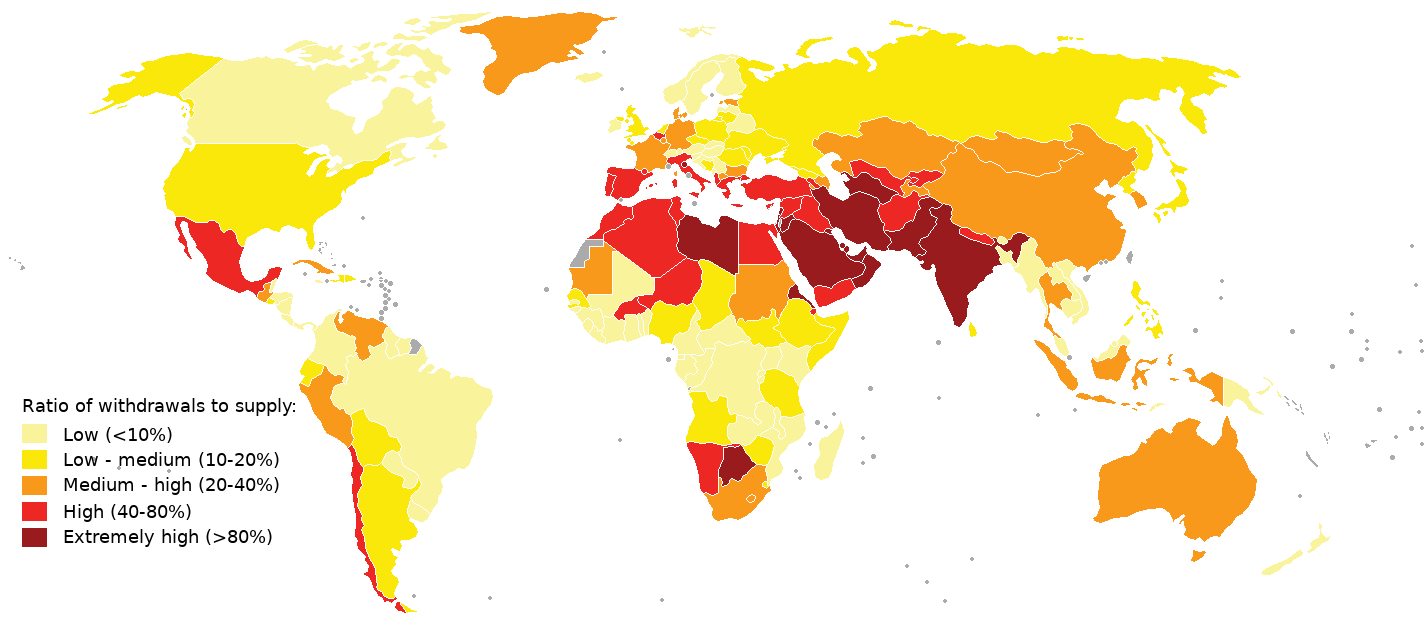
Water scarcity (closely related to water stress or water crisis) is the lack of fresh water resources to meet the standard water demand. There are two types of water scarcity. One is physical. The other is economic water scarcity. Physical water scarcity is where there is not enough water to meet all demands. This includes water needed for ecosystems to function. Regions with a desert climate often face physical water scarcity. Central Asia, West Asia, and North Africa are examples of arid areas. Economic water scarcity results from a lack of investment in infrastructure or technology to draw water from rivers, aquifers, or other water sources. It also results from weak human capacity to meet water demand. Many people in sub-Saharan Africa are living with economic water scarcity.
There is enough freshwater available globally and averaged over the year to meet demand. As such, water scarcity is caused by a mismatch between when and where people need water, and when and where it is available. This can happen due to an increase in the number of people in a region, changing living conditions and diets, and expansion of irrigated agriculture. Climate change (including droughts or floods), deforestation, water pollution and wasteful use of water can also mean there is not enough water. These variations in scarcity may also be a function of prevailing economic policy and planning approaches.
Water scarcity assessments look at many types of information. They include green water (soil moisture), water quality, environmental flow requirements, and virtual water trade. Water stress is one parameter to measure water scarcity. It is useful in the context of Sustainable Development Goal 6. Half a billion people live in areas with severe water scarcity throughout the year, and around four billion people face severe water scarcity at least one month per year. Half of the world's largest cities experience water scarcity. There are 2.3 billion people who reside in nations with water scarcities (meaning less than 1700 m3 of water per person per year).
There are different ways to reduce water scarcity. It can be done through supply and demand side management, cooperation between countries and water conservation. Expanding sources of usable water can help. Reusing wastewater and desalination are ways to do this. Others are reducing water pollution and changes to the virtual water trade.
Water scarcity has been defined as the "volumetric abundance, or lack thereof, of freshwater resources" and it is thought to be "human-driven". This can also be called "physical water scarcity". There are two types of water scarcity. One is physical water scarcity and the other is economic water scarcity. Some definitions of water scarcity look at environmental water requirements. This approach varies from one organization to another.
Related concepts are water stress and water risk. The CEO Water Mandate, an initiative of the UN Global Compact, proposed to harmonize these in 2014. In their discussion paper they state that these three terms should not be used interchangeably.
Some organizations define water stress as a broader concept. It would include aspects of water availability, water quality and accessibility. Accessibility depends on existing infrastructure. It also depends on whether customers can afford to pay for the water. Some experts call this economic water scarcity.
The FAO defines water stress as the "symptoms of water scarcity or shortage". Such symptoms could be "growing conflict between users, and competition for water, declining standards of reliability and service, harvest failures and food insecurity". This is measured with a range of Water Stress Indices.
Water scarcity
Water scarcity (closely related to water stress or water crisis) is the lack of fresh water resources to meet the standard water demand. There are two types of water scarcity. One is physical. The other is economic water scarcity. Physical water scarcity is where there is not enough water to meet all demands. This includes water needed for ecosystems to function. Regions with a desert climate often face physical water scarcity. Central Asia, West Asia, and North Africa are examples of arid areas. Economic water scarcity results from a lack of investment in infrastructure or technology to draw water from rivers, aquifers, or other water sources. It also results from weak human capacity to meet water demand. Many people in sub-Saharan Africa are living with economic water scarcity.
There is enough freshwater available globally and averaged over the year to meet demand. As such, water scarcity is caused by a mismatch between when and where people need water, and when and where it is available. This can happen due to an increase in the number of people in a region, changing living conditions and diets, and expansion of irrigated agriculture. Climate change (including droughts or floods), deforestation, water pollution and wasteful use of water can also mean there is not enough water. These variations in scarcity may also be a function of prevailing economic policy and planning approaches.
Water scarcity assessments look at many types of information. They include green water (soil moisture), water quality, environmental flow requirements, and virtual water trade. Water stress is one parameter to measure water scarcity. It is useful in the context of Sustainable Development Goal 6. Half a billion people live in areas with severe water scarcity throughout the year, and around four billion people face severe water scarcity at least one month per year. Half of the world's largest cities experience water scarcity. There are 2.3 billion people who reside in nations with water scarcities (meaning less than 1700 m3 of water per person per year).
There are different ways to reduce water scarcity. It can be done through supply and demand side management, cooperation between countries and water conservation. Expanding sources of usable water can help. Reusing wastewater and desalination are ways to do this. Others are reducing water pollution and changes to the virtual water trade.
Water scarcity has been defined as the "volumetric abundance, or lack thereof, of freshwater resources" and it is thought to be "human-driven". This can also be called "physical water scarcity". There are two types of water scarcity. One is physical water scarcity and the other is economic water scarcity. Some definitions of water scarcity look at environmental water requirements. This approach varies from one organization to another.
Related concepts are water stress and water risk. The CEO Water Mandate, an initiative of the UN Global Compact, proposed to harmonize these in 2014. In their discussion paper they state that these three terms should not be used interchangeably.
Some organizations define water stress as a broader concept. It would include aspects of water availability, water quality and accessibility. Accessibility depends on existing infrastructure. It also depends on whether customers can afford to pay for the water. Some experts call this economic water scarcity.
The FAO defines water stress as the "symptoms of water scarcity or shortage". Such symptoms could be "growing conflict between users, and competition for water, declining standards of reliability and service, harvest failures and food insecurity". This is measured with a range of Water Stress Indices.
Recent media
Recent media