



Community hub
Recent from talks
Contribute something to knowledge base
Content stats: 0 posts, 0 articles, 1 media, 0 notes
Members stats: 0 subscribers, 0 contributors, 0 moderators, 0 supporters
Subscribers
Supporters
Contributors
Moderators
Hub AI
Waterford AI simulator
(@Waterford_simulator)
Hub AI
Waterford AI simulator
(@Waterford_simulator)
Waterford
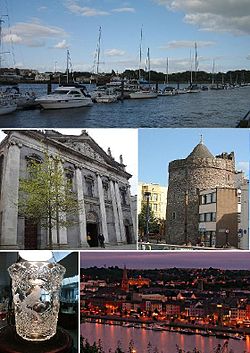
Waterford (Irish: Port Láirge [pˠɔɾˠt̪ˠ ˈl̪ˠaːɾʲ(ə)ɟə]) is a city in County Waterford in the south-east of Ireland. It is located within the province of Munster. The city is situated at the head of Waterford Harbour. It is the oldest and the fifth most populous city in the Republic of Ireland. It is the ninth most populous settlement on the island of Ireland. As of the 2022 census, 60,079 people lived in the city and its suburbs.
Historically the site of a Viking settlement, Waterford's medieval defensive walls and fortifications include the 13th or 14th century Reginald's Tower. The medieval city was attacked several times, and earned the motto Urbs Intacta Manet ('The Untaken City'), after repelling one such 15th century siege. Waterford is known for its former glassmaking industry, including at the Waterford Crystal factory, with decorative glass being manufactured in the city from 1783 until early 2009 when the factory closed following the receivership of Waterford Wedgwood plc. The Waterford Crystal visitor centre was opened, in the city's Viking Quarter, in 2010 and resumed production under new ownership. As of the 21st century, Waterford is the county town of County Waterford and the local government authority is Waterford City and County Council.
The name 'Waterford' comes from Old Norse Veðrafjǫrðr 'ram (wether) fjord'.[citation needed] The Irish name is Port Láirge, meaning "Lárag's port".
Viking raiders first established a settlement near Waterford in 853. It and all the other longphorts were vacated c. 902, the Vikings having been driven out by the native Irish. The Vikings re-established themselves in Ireland at Waterford in 914, led at first by Ottir Iarla (Jarl Ottar) until 917, and after that by Ragnall ua Ímair and the Uí Ímair dynasty, and built what would be Ireland's first city. Among the most prominent rulers of Waterford was Ivar of Waterford.
In 1167, Diarmait Mac Murchada, the deposed King of Leinster, failed in an attempt to take Waterford. He returned in 1170 with Cambro-Norman mercenaries under Richard de Clare, 2nd Earl of Pembroke (known as Strongbow); together they besieged and took the city after a desperate defence. In furtherance of the Norman invasion of Ireland, King Henry II of England landed at Waterford in 1171. Waterford and then Dublin were declared royal cities, with Dublin also declared the capital of Ireland.
Reginald's Tower, built after the Anglo-Norman invasion of Ireland on the site of an earlier fortification and retaining its Viking name, was one of the first in Ireland to use mortar in its construction.
Throughout the medieval period, Waterford was Ireland's second city after Dublin. In the 15th century, Waterford repelled sieges by two pretenders to the English throne: Lambert Simnel and Perkin Warbeck. As a result, King Henry VII gave the city its motto: Urbs Intacta Manet Waterfordia ("Waterford remains an untouched city").
After the Protestant Reformation, Waterford remained a Catholic city and participated in the confederation of Kilkenny – an independent Catholic government from 1642 to 1649. This was ended abruptly by Oliver Cromwell, who brought the country back under English rule; his son-in-law Henry Ireton finally took Waterford in 1650 after a two major sieges. In 1690, during the Williamite War, the Jacobite Irish Army was forced to surrender Waterford in the wake of the Battle of the Boyne.
Waterford
Waterford (Irish: Port Láirge [pˠɔɾˠt̪ˠ ˈl̪ˠaːɾʲ(ə)ɟə]) is a city in County Waterford in the south-east of Ireland. It is located within the province of Munster. The city is situated at the head of Waterford Harbour. It is the oldest and the fifth most populous city in the Republic of Ireland. It is the ninth most populous settlement on the island of Ireland. As of the 2022 census, 60,079 people lived in the city and its suburbs.
Historically the site of a Viking settlement, Waterford's medieval defensive walls and fortifications include the 13th or 14th century Reginald's Tower. The medieval city was attacked several times, and earned the motto Urbs Intacta Manet ('The Untaken City'), after repelling one such 15th century siege. Waterford is known for its former glassmaking industry, including at the Waterford Crystal factory, with decorative glass being manufactured in the city from 1783 until early 2009 when the factory closed following the receivership of Waterford Wedgwood plc. The Waterford Crystal visitor centre was opened, in the city's Viking Quarter, in 2010 and resumed production under new ownership. As of the 21st century, Waterford is the county town of County Waterford and the local government authority is Waterford City and County Council.
The name 'Waterford' comes from Old Norse Veðrafjǫrðr 'ram (wether) fjord'.[citation needed] The Irish name is Port Láirge, meaning "Lárag's port".
Viking raiders first established a settlement near Waterford in 853. It and all the other longphorts were vacated c. 902, the Vikings having been driven out by the native Irish. The Vikings re-established themselves in Ireland at Waterford in 914, led at first by Ottir Iarla (Jarl Ottar) until 917, and after that by Ragnall ua Ímair and the Uí Ímair dynasty, and built what would be Ireland's first city. Among the most prominent rulers of Waterford was Ivar of Waterford.
In 1167, Diarmait Mac Murchada, the deposed King of Leinster, failed in an attempt to take Waterford. He returned in 1170 with Cambro-Norman mercenaries under Richard de Clare, 2nd Earl of Pembroke (known as Strongbow); together they besieged and took the city after a desperate defence. In furtherance of the Norman invasion of Ireland, King Henry II of England landed at Waterford in 1171. Waterford and then Dublin were declared royal cities, with Dublin also declared the capital of Ireland.
Reginald's Tower, built after the Anglo-Norman invasion of Ireland on the site of an earlier fortification and retaining its Viking name, was one of the first in Ireland to use mortar in its construction.
Throughout the medieval period, Waterford was Ireland's second city after Dublin. In the 15th century, Waterford repelled sieges by two pretenders to the English throne: Lambert Simnel and Perkin Warbeck. As a result, King Henry VII gave the city its motto: Urbs Intacta Manet Waterfordia ("Waterford remains an untouched city").
After the Protestant Reformation, Waterford remained a Catholic city and participated in the confederation of Kilkenny – an independent Catholic government from 1642 to 1649. This was ended abruptly by Oliver Cromwell, who brought the country back under English rule; his son-in-law Henry Ireton finally took Waterford in 1650 after a two major sieges. In 1690, during the Williamite War, the Jacobite Irish Army was forced to surrender Waterford in the wake of the Battle of the Boyne.
Recent media
Recent media