
Recent from talks
Waterloo (song)
Knowledge base stats:
Talk channels stats:
Members stats:
Waterloo (song)
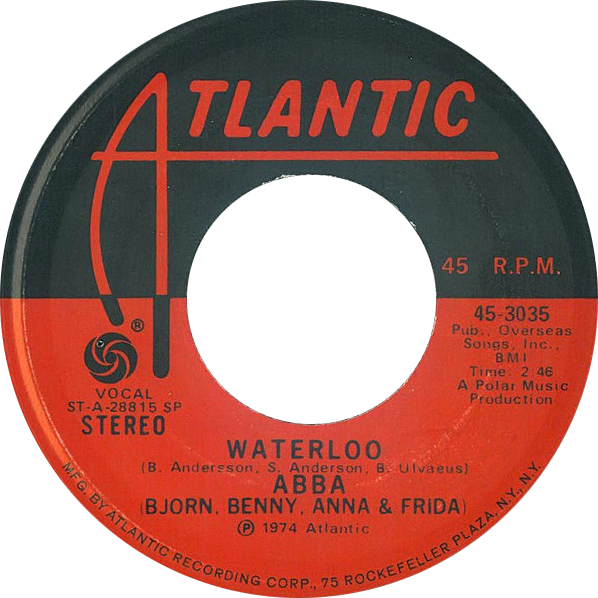
"Waterloo" is a song recorded by Swedish pop music group ABBA, with music composed by Benny Andersson and Björn Ulvaeus and lyrics written by Stikkan Anderson. It is the first single of the group's second album of the same name, and their first under the Atlantic label in the United States. This was also the first single to be credited to the group performing under the name ABBA. The title and lyrics reference the 1815 Battle of Waterloo and use it as a metaphor. The Swedish version of the single was backed with the Swedish version of "Honey, Honey", while the English version featured "Watch Out" on the B-side.
In 1974, after winning the 14th edition of the Melodifestivalen, "Waterloo" represented Sweden in the 19th edition of the Eurovision Song Contest held in Brighton, England, winning the contest and beginning ABBA's path to worldwide fame. It topped the charts in several countries, and reached the top 10 in the United States.
In 2005, at Eurovision fiftieth anniversary competition Congratulations: 50 Years of the Eurovision Song Contest, "Waterloo" was chosen as the best song in the contest's history.
On 10 February 1973, ABBA as "Agnetha, Anni-Frid, Björn and Benny" competed with "Ring Ring" in the 13th edition of the Melodifestivalen, placing third. After this good position, Benny Andersson and Björn Ulvaeus composed the music, and Stikkan Anderson wrote the lyrics, of "Waterloo" specifically for the group to enter in the 14th edition of the Melodifestivalen.
Recording of the song commenced in 1973, with instrumental backing from Janne Schaffer (who came up with the main guitar and bass parts), Rutger Gunnarsson, and Ola Brunkert. The song's production style was influenced by Phil Spector's "Wall of Sound": prior to recording "Ring Ring", engineer Michael B. Tretow had read Richard Williams's book Out of His Head: The Sound of Phil Spector, which inspired him to layer multiple instrumental overdubs on the band's recordings, becoming an integral part of ABBA's sound. Furthermore, ABBA had also originally cited the song "See My Baby Jive", by English glam rock band Wizzard, as a major influence (it was produced in the same style and has a similar structure); in the wake of their Eurovision victory, they were quoted as saying that it would not surprise them if artists such as Wizzard would consider entering the Eurovision in the future.
In 1974, the group considered submitting "Hasta Mañana" to the 14th edition of the Melodifestivalen, but decided on "Waterloo" since it gave equal weight to both lead vocalists Agnetha Fältskog and Anni-Frid Lyngstad, while "Hasta Mañana" was sung only by Fältskog.
On 9 February 1974, ABBA competed with the Swedish-language version of "Waterloo" in the Melodifestivalen final. The song won the competition with 302 points, beating the 211 points of the runner-up. As that Melodifestivalen was organised by Sveriges Radio (SR) to select its song and performer for the 19th edition of the Eurovision Song Contest, the song became the Swedish entrant, and ABBA the performers, for Eurovision.
Subsequently, the group recorded the German and French versions of the song in March and April 1974, respectively: the French version was adapted by Alain Boublil, who would later go on to co-write the 1980 musical Les Misérables, and the German version was adapted by Gerd Müller-Schwanke. During ABBA's promotional visit to Spain, in May 1974, newspaper reports said that the group would be recording a Spanish version of the song while in the country. Because it was never released, it is not certain whether the recording for this version ever existed or if it remains unreleased.
Hub AI
Waterloo (song) AI simulator
(@Waterloo (song)_simulator)
Waterloo (song)
"Waterloo" is a song recorded by Swedish pop music group ABBA, with music composed by Benny Andersson and Björn Ulvaeus and lyrics written by Stikkan Anderson. It is the first single of the group's second album of the same name, and their first under the Atlantic label in the United States. This was also the first single to be credited to the group performing under the name ABBA. The title and lyrics reference the 1815 Battle of Waterloo and use it as a metaphor. The Swedish version of the single was backed with the Swedish version of "Honey, Honey", while the English version featured "Watch Out" on the B-side.
In 1974, after winning the 14th edition of the Melodifestivalen, "Waterloo" represented Sweden in the 19th edition of the Eurovision Song Contest held in Brighton, England, winning the contest and beginning ABBA's path to worldwide fame. It topped the charts in several countries, and reached the top 10 in the United States.
In 2005, at Eurovision fiftieth anniversary competition Congratulations: 50 Years of the Eurovision Song Contest, "Waterloo" was chosen as the best song in the contest's history.
On 10 February 1973, ABBA as "Agnetha, Anni-Frid, Björn and Benny" competed with "Ring Ring" in the 13th edition of the Melodifestivalen, placing third. After this good position, Benny Andersson and Björn Ulvaeus composed the music, and Stikkan Anderson wrote the lyrics, of "Waterloo" specifically for the group to enter in the 14th edition of the Melodifestivalen.
Recording of the song commenced in 1973, with instrumental backing from Janne Schaffer (who came up with the main guitar and bass parts), Rutger Gunnarsson, and Ola Brunkert. The song's production style was influenced by Phil Spector's "Wall of Sound": prior to recording "Ring Ring", engineer Michael B. Tretow had read Richard Williams's book Out of His Head: The Sound of Phil Spector, which inspired him to layer multiple instrumental overdubs on the band's recordings, becoming an integral part of ABBA's sound. Furthermore, ABBA had also originally cited the song "See My Baby Jive", by English glam rock band Wizzard, as a major influence (it was produced in the same style and has a similar structure); in the wake of their Eurovision victory, they were quoted as saying that it would not surprise them if artists such as Wizzard would consider entering the Eurovision in the future.
In 1974, the group considered submitting "Hasta Mañana" to the 14th edition of the Melodifestivalen, but decided on "Waterloo" since it gave equal weight to both lead vocalists Agnetha Fältskog and Anni-Frid Lyngstad, while "Hasta Mañana" was sung only by Fältskog.
On 9 February 1974, ABBA competed with the Swedish-language version of "Waterloo" in the Melodifestivalen final. The song won the competition with 302 points, beating the 211 points of the runner-up. As that Melodifestivalen was organised by Sveriges Radio (SR) to select its song and performer for the 19th edition of the Eurovision Song Contest, the song became the Swedish entrant, and ABBA the performers, for Eurovision.
Subsequently, the group recorded the German and French versions of the song in March and April 1974, respectively: the French version was adapted by Alain Boublil, who would later go on to co-write the 1980 musical Les Misérables, and the German version was adapted by Gerd Müller-Schwanke. During ABBA's promotional visit to Spain, in May 1974, newspaper reports said that the group would be recording a Spanish version of the song while in the country. Because it was never released, it is not certain whether the recording for this version ever existed or if it remains unreleased.
Recent media