Recent from talks
Nothing was collected or created yet.
Wizzard
View on Wikipedia
This article needs additional citations for verification. (June 2013) |
Wizzard were an English rock band formed by Roy Wood, former member of the Move and co-founder of the Electric Light Orchestra. The Guinness Book of 500 Number One Hits states, "Wizzard was Roy Wood just as much as Wings was Paul McCartney."[1] They are most famous for their 1973 Christmas single "I Wish It Could Be Christmas Everyday".
Key Information
History
[edit]Beginnings
[edit]Not long after the release of Electric Light Orchestra's first album, Wood found himself in political disagreements with the band's manager Don Arden. Following a difference of opinion during recording of the band's second album, ELO 2, Wood walked out of the session, went down the road to a studio where the Birmingham group Mongrel (which included his former Move bandmate Rick Price, as well as drummers Charlie Grima and Keith Smart) were recording, and asked them if they would be interested in putting a band together.[2]
Wood left ELO, taking band members Bill Hunt (keyboards and french horn) and Hugh McDowell (cello) with him, as well as ELO's sound engineer, Trevor Smith. Despite press reporting a fallout between Wood and co-founder/leader Jeff Lynne, Wood denies that he and Lynne ever had a real row, blaming it on press fabrication and insisting that "We never had a real row and we're still mates now."[3][4] In fact, Wood claimed that he left the group because he foresaw a fallout between him and Lynne due to their increasing differences of opinion (which he felt were caused, indirectly, by the band's management) and wanted to avoid it.[2]
Also in the line-up were saxophone players Mike Burney and Nick Pentelow (the son of actor Arthur Pentelow). Prior to the recording of the band's second album, Introducing Eddy and the Falcons, McDowell left and was not replaced (he returned to ELO), and during the recording of the album Bill Hunt also departed and was replaced by Bob Brady (also from Mongrel). Prior to the 1975 recording of the band's final album, Main Street (released 2000), drummer Keith Smart departed the band and was not replaced.
Chart success and tours
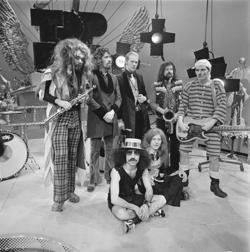
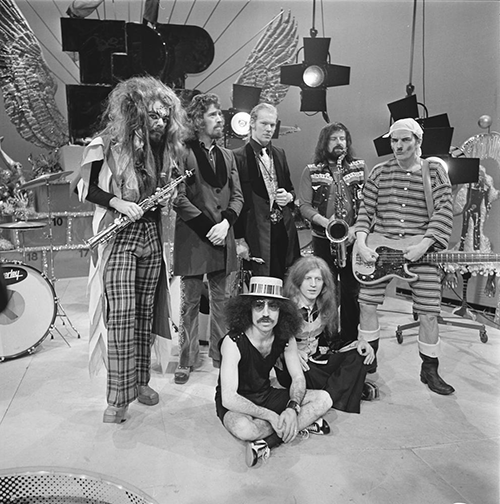
[edit]The band made their live debut at The London Rock and Roll Show at Wembley Stadium on 5 August 1972.[5] Wizzard's second appearance was at the Reading Festival later that month. With Wood's distinctive warpaint make-up and colourful costume,[6] not to mention regular appearances on BBC Television's Top of the Pops in which members and friends, including Wood's girl friend, singer Ayshea Brough, variously appeared in pantomime horses, gorilla costumes or as roller-skating angels, often wielding custard pies for good measure, Wizzard were one of the most picturesque groups of the British glam rock era. In 1973 they scored their first Top 10 hit with "Ball Park Incident", which made No. 6 for three weeks from 13 January.[7] Their biggest hit was with their second single. "See My Baby Jive", Wood's faithful and affectionate tribute to the Phil Spector-generated 'Wall of Sound', made No. 1 in the UK Singles Chart for four weeks.[8] It sold over one million copies globally, and was awarded gold disc status.[9] The follow-up, "Angel Fingers", also topped the charts for one week.[8] Wizzard's songs often included lengthy instrumental improvisations.
The band's 1973 Christmas single "I Wish It Could Be Christmas Everyday" became an annual fixture on British (and Irish) radio and television. It was reissued in 1981, and a 12" re-recording appeared in 1984.[8]
During 1973 Harvest Records released the Roy Wood solo album Boulders, which he had recorded and mixed years before forming Wizzard, and which produced a Top 20 hit in "Dear Elaine". Wood said he was bored with Boulders by the time of its release and he wanted to focus on his new music with Wizzard.[2] The subsequent heavy working schedule and strain led to health problems, and several cancelled or postponed live dates on a spring 1974 tour of the UK.[10] One highlight of 1974 was a return to the Top 10 with "Rock 'n' Roll Winter (Loony's Tune)". Release was delayed for several weeks until the end of March, so the words 'Sorry, the word 'Spring' wouldn't fit. R.W.' were added on the label after the title. Unusually for the time, this song and the B-side, "Dream of Unwin", were both recorded and released in mono. The song was dedicated to Wood's girlfriend at the time, Lynsey de Paul, who repaid the honour by recording a Wizzard-style song, "Ooh I Do", a few months later.
A tour of the US later that year failed to bring them any commercial success there, but after meeting Brian Wilson some members guested on a Beach Boys session, which resulted in the eventual release of the latter group's single "It's OK" in 1976.[10] According to Wood, the record label neglected to make a substantial push to make Wizzard a success in the U.S., preferring to focus promotion on England since the band were already very popular there.[2]
Financial difficulties
[edit]Wizzard was an expensive band to maintain, both because of the large line-up, in terms of recording costs, and Bill Hunt's propensity to smash the pianos of the venues they were playing at. Studio time was an even greater drain on the band's finances. According to Price in a radio interview, "When we finished recording 'Angel Fingers' it was rumoured that we had spent more time in the studio than Paul McCartney had with the whole of the Band on the Run album." Whether it was true or not, this meant that most of the record company's money was spent in studio time and that the members of the band had to rely on live touring work for their income. A couple of tours in the UK and one tour of the US were not enough to ensure regular wages for the band. One by one the band members found other, more lucrative, things to occupy their time.[11]
Disbanding
[edit]By autumn 1975 they had split, leaving a farewell single, "Rattlesnake Roll", which failed to chart, and a third album, Main Street, which their record label did not release as they deemed it insufficiently commercial. Wizzard had initially intended their second album to be a double, with one disc a set of rock and roll pastiches and the other disc jazz-rock.[2] The label heard the rock and roll set and decided to release that as a single album, which appeared in 1974 as Introducing Eddy & The Falcons.[10] Main Street, the jazz-rock set, languished in the vaults and was for some time presumed lost, but was finally released in 2000.
Post-Wizzard
[edit]Following the band's split in 1975, Wood and Price formed the short-lived Wizzo Band,[6] after which Wood reverted to a solo career in addition to producing records for other acts, notably a 1979 Top 10 cover version of "Duke of Earl" for British doo-wop revivalists Darts.
On 13 November 2014, saxophonist Mike Burney died, aged 76, after a long battle with cancer.[12][13] Hugh McDowell died on 6 November 2018 following a long illness, at the age of 65.[14] On 17 May 2022, bassist Rick Price died aged 77.[15] Drummer Keith Smart died on 2 September 2025, at the age of 78.[16]
Personnel
[edit]- Roy Wood - vocals, guitars, saxophone, woodwinds, strings, keyboards, percussion (1972–1975)
- Mike Burney - saxophone, clarinet, flute (1972–1975; died 2014)
- Charlie Grima - drums, percussion, vocals (1972–1975)
- Bill Hunt - keyboards, French horn (1972–1973)
- Hugh McDowell - cello, synthesisers (1972–1973; died 2018)
- Nick Pentelow - saxophone, clarinet, flute (1972–1975)
- Rick Price - bass, vocals (1972–1975; died 2022)
- Keith Smart - drums (1972–1975; died 2025)
- Bob Brady - keyboards, vocals (1974–1975)
Timeline
[edit]
Discography
[edit]Albums
[edit]| Title | Album details | Peak chart positions | Certifications | ||||||||||||||
|---|---|---|---|---|---|---|---|---|---|---|---|---|---|---|---|---|---|
| UK [8] |
AUS [17] | ||||||||||||||||
| Wizzard Brew |
|
29 | 50 | ||||||||||||||
| Introducing Eddy and the Falcons |
|
19 | — | ||||||||||||||
| Main Street |
|
— | — | ||||||||||||||
| "—" denotes releases that did not chart or were not released in that territory. | |||||||||||||||||
Compilations
[edit]| Title | Album details |
|---|---|
| See My Baby Jive |
|
| The Best of Roy Wood and Wizzard |
|
Singles
[edit]| Year | Title | Peak chart positions | Certifications | Album | |||||||||||||
|---|---|---|---|---|---|---|---|---|---|---|---|---|---|---|---|---|---|
| UK [8] |
AUS [17] |
IRL | |||||||||||||||
| 1972 | "Ball Park Incident" | 6 | 70 | 8 | non-album singles | ||||||||||||
| 1973 | "See My Baby Jive" [A] | 1 | 12 | 1 |
| ||||||||||||
| "Angel Fingers (A Teen Ballad)" [B] | 1 | 42 | 7 |
| |||||||||||||
| "I Wish It Could Be Christmas Everyday" [C] | 4 | 52[D] | 6 |
| |||||||||||||
| 1974 | "Rock 'n' Roll Winter (Loony's Tune)" | 6 | — | 13 | |||||||||||||
| "This Is the Story of My Love (Baby)" | 34 | — | — | Introducing Eddy and the Falcons | |||||||||||||
| "Are You Ready to Rock" | 8 | — | 10 | non-album singles | |||||||||||||
| 1975 | "Rattlesnake Roll" | — | — | — | |||||||||||||
| 1976 | "Indiana Rainbow" [E] | — | — | — | |||||||||||||
| 1981 | "I Wish It Could Be Christmas Everyday" (re-issue) | 41 | — | — | |||||||||||||
| "—" denotes releases that did not chart or were not released in that territory. | |||||||||||||||||
References
[edit]- ^ Rice, Jo (1982). The Guinness Book of 500 Number One Hits (1st ed.). Enfield, Middlesex: Guinness Superlatives Ltd. p. 150. ISBN 0-85112-250-7.
- ^ a b c d e Sharp, Ken (30 September 1994). "Roy Wood: The Wizzard of Rock". The Move Online. Archived from the original on 15 January 2008.
- ^ Mercury, Sunday (5 April 2009). "Wizzard and Move pop legend Roy Wood reveals his secret shyness". Birminghammail.co.uk.
- ^ Kielty, Martin (8 June 2017). "Why Roy Wood Really Left the Electric Light Orchestra". Ultimateclassicrock.com.
- ^ Tobler, tilly (1992). NME Rock 'N' Roll Years (1st ed.). London: Reed International Books Ltd. p. 75. CN 5585.
- ^ a b "Biography by Doug Stone". Allmusic. Retrieved 7 December 2008.
- ^ "Ball park incident | full Official Chart History | Official Charts Company". OfficialCharts.com.
- ^ a b c d e "Wizzard > UK Charts". Official Charts Company.
- ^ Murrells, Joseph (1978). The Book of Golden Discs (2nd ed.). London: Barrie and Jenkins Ltd. p. 339. ISBN 0-214-20512-6.
- ^ a b c Van der Kiste, John (2012). Roy Wood: The Move, Wizzard and beyond. KDP.
- ^ "Rick Price". 4 May 2006. Archived from the original on 4 May 2006. Retrieved 22 August 2019.
- ^ "Wizzard star Mike Burney dies aged 76". ITV. Retrieved 6 December 2014.
- ^ "Wizzard star Mike Burney, who also played with The Beach Boys, Sammy Davis Junior and Bob Hope has died". Birmingham Mail. 14 November 2014. Retrieved 18 December 2014.
- ^ "Hugh McDowell, ELO Cellist, Dies at 65 - Best Classic Bands". Bestclassicbands.com. 16 June 2015. Retrieved 7 November 2018.
- ^ "Rick Price". Brumbeat.net. Retrieved 16 January 2024.
- ^ "It is with great sadness that I announce the passing of my beloved partner Keith Smart who left us on 02 September 2025". Julie Mclean on Facebook. 7 September 2025. Retrieved 9 October 2025.
- ^ a b Kent, David (1993). Australian Chart Book 1970–1992 (illustrated ed.). St Ives, N.S.W.: Australian Chart Book. p. 342. ISBN 0-646-11917-6.
- "I Wish It Could Be Christmas Everyday" (on the ARIA Charts): "The ARIA Report: Week Commencing 3 January 2022". The ARIA Report. No. 1661. Australian Recording Industry Association. 3 January 2022. p. 3.
- ^ a b c d "British certifications – Wizzard". British Phonographic Industry. Retrieved 13 January 2023. Type Wizzard in the "Search BPI Awards" field and then press Enter.
External links
[edit]- Wizzard biography at Allmusic
- Wizzard discography at Discogs
- Wizzard at IMDb
- Ball Park Incident (2006 Remaster) on YouTube
- Wizzard at 45cat.com
Wizzard
View on GrokipediaHistory
Formation
Roy Wood, having co-founded the Electric Light Orchestra (ELO) in 1970, departed the group in July 1972 following the release of their self-titled debut album the previous year.[4] His exit stemmed from tensions with ELO's manager Don Arden and a desire to pursue a more experimental, free-form sound blending jazz and classical influences, which he felt constrained within the band's structure.[5] This marked a shift from Wood's earlier work with The Move, where he had established himself as a multi-instrumentalist and songwriter blending rock with orchestral elements.[1] Immediately after leaving ELO, Wood assembled Wizzard in Birmingham, recruiting former ELO members including cellist Hugh McDowell and trumpeter Bill Hunt (also on keyboards and French horn).[4] He expanded the lineup with new additions such as saxophonist Mike Burney, drummers Keith Smart and Charlie Grima (both from the Birmingham group Mongrel), bassist Rick Price (ex-The Move), and saxophonist Nick Pentelow, creating a large ensemble capable of delivering a chaotic, brass-laden sound.[4] Wizzard's first single, "Ball Park Incident," was released in November 1972 on Harvest Records (HAR 5062), featuring a raucous, brass-heavy arrangement that highlighted the band's experimental rock style with shouted vocals and retro influences.[6] The track exemplified Wood's vision of orchestral chaos, backed by the non-album B-side "The Carlsberg Special."[6] The band's live debut occurred on August 5, 1972, at Wembley Stadium during The London Rock and Roll Show, where they performed before 40,000 spectators just weeks after formation.[7] This appearance emphasized Wizzard's theatrical flair, with Wood donning warpaint and colorful costumes alongside props, setting the tone for their extravagant stage presentations.[8]Peak Success
Wizzard achieved their commercial zenith between 1973 and 1974, propelled by the release of their debut album and a string of chart-topping singles that captured the exuberant spirit of glam rock. The band's first full-length effort, Wizzard Brew, arrived in March 1973 via Harvest Records, peaking at number 25 on the UK Albums Chart.[9] This eclectic collection blended rock 'n' roll energy with orchestral flourishes, exemplified by tracks like "You Got the Jump on Me," a six-minute epic written by bassist Rick Price and featuring prominent string arrangements that underscored the band's ambitious, multi-layered sound.[10] The album's reception highlighted Wizzard's innovative approach, setting the stage for their rapid ascent in the British music scene. The period's defining moments came through blockbuster singles that dominated the UK charts. "See My Baby Jive," released in April 1973 with the Beatles-inspired B-side "Bend Over Beethoven," soared to number one, holding the top spot for four weeks and ranking as the sixth best-selling single of the year.[11] Its infectious doo-wop harmonies and Roy Wood's production flair sold over 250,000 copies in the UK alone, cementing Wizzard's pop appeal.[12] Following suit, "Angel Fingers (A Teen Ballad)," issued in August 1973 backed by "You Got the Jump on Me," also reached number one for one week, its medley of classic rock standards showcasing the band's theatrical versatility.[13] Both tracks were supported by promotional films aired on television, enhancing their visual spectacle and contributing to widespread radio play. Wizzard's live presence further amplified their success during extensive UK tours from 1973 to 1974, where they progressed from support slots to headline performances at venues like the Hammersmith Odeon and Edinburgh Odeon.[14] These shows featured a large ensemble with horns, piano, and cello, dressed in colorful costumes and warpaint, complete with elaborate stage setups including pyrotechnics and fireworks to evoke a festive, rock 'n' roll carnival atmosphere.[8] Television exposure on Top of the Pops and Christmas specials propelled their holiday single "I Wish It Could Be Christmas Everyday" to number four in November 1973, where it lingered through the festive season.[15] The track's jingly orchestration and choral arrangement became an instant yuletide staple, later certified 3× Platinum by the BPI for exceeding 1.8 million units in the UK. Multiple Top of the Pops appearances for hits like "See My Baby Jive" and "Angel Fingers" in 1973 and 1974, often in mimed performances with the full band, broadened their fanbase and solidified their status as glam rock icons.[16]Decline and Disbandment
By the mid-1970s, Wizzard faced mounting financial pressures due to the high costs of their orchestral sessions and tours, driven by the band's large ensemble and prolonged studio times that exceeded typical productions. For instance, recording the 1973 single "Angel Fingers" reportedly took longer than Paul McCartney's entire Band on the Run album, straining resources and limiting income primarily to live performances. These expenses were compounded by Harvest Records' mismanagement, including a contractual dispute over the 1973 Christmas single "I Wish It Could Be Christmas Everyday," where manager Don Arden negotiated a release with Warner Bros., only for EMI (Harvest's parent) to intervene and insist on their label. Despite strong singles performance, such as two UK No. 1 hits in 1973–1974, album sales remained modest, with only around 60,000 units sold across their catalog, failing to offset the overheads.[1][17][18] The release of Wizzard's second album, Introducing Eddy and the Falcons, in August 1974, marked a brief commercial uptick, peaking at No. 19 on the UK Albums Chart, ten places higher than their debut. However, internal tensions escalated from overwork and creative differences, with keyboardist Bill Hunt departing midway through its production, replaced by Bob Brady on vocals and keyboards. The album's rockabilly and 1950s nostalgia theme contrasted with the band's earlier glam hits, highlighting diverging visions, while exhaustion from relentless touring—including UK dates and a single US run—led to partial lineup shifts as members sought more stable opportunities. A single from the album, "This Is the Story of My Love (Baby)," charted lowly at No. 34 in 1974, underscoring the disconnect between singles success and broader expectations.[19][20][21] These challenges culminated in tour cancellations amid band exhaustion and the failure of the 1975 single "Rattlesnake Roll," intended as the lead for a third album Main Street, which did not chart and prompted its shelving. Bassist Rick Price later noted that members "found other, more lucrative, things to occupy their time" as finances dwindled. Wizzard officially disbanded in autumn 1975, with Roy Wood attributing the split to burnout from overwork and ongoing label disputes over costs and lack of US breakthrough.[1][22][21]Post-Disbandment Activities
Following the disbandment of Wizzard in 1975, frontman Roy Wood formed the Wizzo Band in 1977 as a jazz-rock ensemble featuring a large lineup of musicians, including some stylistic echoes of Wizzard's orchestral and eclectic approach in its sole studio album, Super Active Wizzo.[23] The group emphasized Wood's ambitions for more improvisational and fusion-oriented sounds, blending rock with jazz elements while retaining his signature multi-instrumental flair and whimsical arrangements reminiscent of Wizzard's glam rock experiments.[24] Although short-lived, with only one live BBC broadcast performance in 1977, the Wizzo Band represented Wood's immediate post-Wizzard creative outlet.[25] In 2000, a third Wizzard album titled Main Street was released posthumously, credited to Roy Wood & Wizzard and drawn from unfinished tapes recorded during 1976 sessions with much of the original lineup, including Wood on vocals and multi-instruments, Bill Hunt on keyboards, and Mike Burney on saxophone.[26] The project, originally shelved due to label issues and Wood's shifting priorities, captured the band's evolving sound with progressive pop and jazz-rock influences, featuring tracks like "Main Street" and "Saxmaniacs" that highlighted unfinished but evocative arrangements.[27] Its release preserved archival material from the 1970s era, offering insight into what might have been Wizzard's next chapter had the group continued.[28] Tragically, several key members have passed away in subsequent decades: bassist Rick Price died on May 17, 2022, at age 77; saxophonist Mike Burney died of cancer on November 13, 2014, at age 76; cellist Hugh McDowell succumbed to cancer on November 6, 2018, at age 65; and drummer Keith Smart died on September 2, 2025, at age 78.[29][30] Surviving members, including keyboardist Bill Hunt, have engaged in sporadic reunions centered on Christmas events to celebrate the band's enduring holiday hit "I Wish It Could Be Christmas Everyday," such as Hunt's 2024 gathering with original child choir participants.[31] The 2020s have brought renewed attention to Wizzard's catalog through reissues managed by Roy Wood, including the expanded and remastered edition of Main Street in 2020 with bonus tracks like "Human Cannonball," and holiday-focused compilations featuring the band's Christmas singles alongside rarities.[28] These efforts underscore Wood's continued stewardship of the band's legacy, making archival material accessible to new generations while highlighting Wizzard's influence on festive pop traditions.[32]Musical Style and Influences
Orchestral Glam Rock Approach
Wizzard's orchestral glam rock approach fused the energetic drive of rock music with elaborate classical arrangements, prominently featuring strings, brass, and woodwinds orchestrated by Roy Wood to produce dense, chaotic soundscapes reminiscent of a modernized Phil Spector Wall of Sound.[33] This layered production incorporated multiple overdubs of cellos, saxophones, guitars, and even four drummers simultaneously, creating a sense of orchestral overload that amplified the band's theatrical flair.[33] Wood's multi-instrumentalism—spanning guitar, saxophone, cello, and more—enabled extensive multi-tracking, often resulting in richly textured recordings that blurred the lines between rock ensemble and symphony.[34] At its core, the style drew from glam rock's glittery pop hooks and falsetto vocals but stood apart through a carnival-like exuberance and a DIY spirit evident in the band's resourceful, home-influenced recording methods, such as using ambience microphones and unconventional percussion like shakers in bass drum cases for added texture.[17] This approach yielded a playful chaos, with double-tracked arrangements and choir elements enhancing the festive, immersive quality, as heard in tracks like those on Wizzard Brew.[17] The result was a sound that prioritized joyful density over precision, evoking a rock 'n' roll big band with umpteen horns and strings piling into euphoric crescendos.[33] Thematically, Wizzard's lyrics embraced whimsy and nostalgia, often centering on themes of love and holidays with lighthearted, evocative imagery that complemented the music's exuberant tone.[33] Songs like "See My Baby Jive" captured romantic infatuation through upbeat, hook-filled narratives, while "I Wish It Could Be Christmas Everyday" evoked holiday cheer with vivid scenes of snowmen and sleigh bells.[17] Live performances amplified this theatricality, incorporating spectacle such as staged custard pie fights on television appearances to mirror the songs' party-like energy and humorous spirit.[17]Key Influences
Roy Wood's musical foundations were deeply rooted in the vibrant 1960s Birmingham beat scene, where he emerged as a key figure in local groups before co-founding The Move in 1965. Drawing from the raw energy and pop-rock songcraft of acts like The Beatles and The Who, Wood honed an eccentric style characterized by oddball character sketches and chunky mod-influenced chords, as seen in The Move's early singles such as "Night of Fear" and "I Can Hear the Grass Grow." This background instilled in him a penchant for whimsical, narrative-driven compositions that blended psychedelia with accessible pop, shaping Wizzard's playful yet ambitious songwriting approach.[33][35] A pivotal influence on Wizzard's dense, orchestral sound was Phil Spector's "Wall of Sound" production technique, which Wood emulated and expanded into chaotic, multi-layered arrangements featuring brass, strings, and rhythm sections. Tracks like "See My Baby Jive" and "Angel Fingers" paid direct homage to Spector's girl-group era, but with added rock'n'roll flair and humorous vaudeville elements reminiscent of Spike Jones's satirical big-band experiments, evident in the "sonic terrorism" of Wizzard's Wizzard Brew. Wood's admiration for Spector's maximalism stemmed from his desire to capture the exuberance of 1960s pop while infusing it with live-wire energy, as he layered guitars, saxophones, and percussion to create an immersive, celebratory density.[33][4] Wizzard's visual and theatrical flair was informed by contemporaries in the glam rock movement, including T. Rex and Slade, whose glittery aesthetics and stomping anthems emphasized spectacle and working-class bravado. However, Wood differentiated Wizzard through Beatles-inspired experimentation, incorporating brass bands and woodwind flourishes for a carnival-like twist, as heard in the honking brass of "Ball Park Incident." This fusion reflected his broader pop fanaticism, where he sought to encapsulate diverse traditions—from doo-wop to proto-heavy metal—into a singular, eccentric vision.[33] Wood's affinity for classical elements further enriched Wizzard's palette, particularly through his self-taught proficiency on cello and woodwinds, which he rapidly acquired to realize orchestral ambitions. On ELO's precursor track "10538 Overture" (co-recorded with Jeff Lynne), Wood overdubbed around 15 layers of a inexpensive Chinese cello to forge a "monster heavy-metal orchestra," blending baroque rock textures with rock drive and influencing Wizzard's string-laden tracks. This pseudo-classical integration, evoking the contrapuntal density of composers like Bach, added emotional depth and structural complexity to Wizzard's arrangements, prioritizing timeless melodies over mere novelty.[36][37]Personnel
Core Members
Roy Wood founded Wizzard in 1972 after departing from the Electric Light Orchestra, where he had co-founded the group, and became the band's driving force as lead vocalist, guitarist, saxophonist, and keyboardist. A renowned multi-instrumentalist, Wood played a pivotal role in shaping the band's sound across guitars, woodwinds, and keys, while composing the majority of their material and overseeing productions that defined their orchestral glam rock style. His creative vision was integral to every Wizzard recording during the band's 1972–1975 run. Following Wizzard's dissolution, Wood pursued a prolific solo career, releasing albums such as Boulders (1973) and maintaining an active presence in music through performances and new works into 2025.[38][1][39] Mike Burney served as Wizzard's lead saxophonist from 1972 to 1975, also contributing on clarinet and flute to create the vibrant brass arrangements that became a hallmark of the band's energetic live and studio performances. His jazz-inflected playing added depth and swing to tracks like those on Wizzard Brew, enhancing the group's festive, horn-driven aesthetic. After leaving Wizzard, Burney worked extensively as a session musician, collaborating with acts including the Beach Boys, Bob Hope, and Sammy Davis Jr. He passed away from cancer on November 13, 2014, at age 76.[40][41] Rick Price, a former member of the Move, provided bass guitar for Wizzard throughout its existence, delivering the steady rhythmic backbone that supported the band's elaborate string and brass layers. His experience from earlier Birmingham rock scenes helped anchor the group's complex arrangements during tours and recordings. Post-Wizzard, Price joined the Steve Gibbons Band, continuing his career in rock until his death from natural causes on May 17, 2022, at age 77.[6][42] Charlie Grima served as one of Wizzard's drummers from 1972 to 1975, sharing percussion duties with Keith Smart to provide the propulsive rhythms essential to the band's orchestral sound. Born in Malta on December 1, 1944, and raised in Birmingham, Grima contributed to live performances and recordings, including hits like "See My Baby Jive" and "I Wish It Could Be Christmas Everyday." After Wizzard, he continued as a session musician and performer, later authoring memoirs about his experiences. As of 2025, Grima remains active in music-related activities.[43] Drummer Keith Smart joined Wizzard in 1972 and managed the intricate, propulsive beats essential to their orchestral rock sound, often sharing percussion duties in live settings to match the band's expansive setup. His solid foundation enabled the rhythmic drive behind hits and album tracks alike. Smart remained active in the music scene until his sudden passing on September 3, 2025, at age 78.[6][44] Cellist Hugh McDowell, who had also played in ELO's early lineup, brought classical string elements to Wizzard from 1972 onward, contributing to the symphonic textures that set the band apart in the glam era. His cello work enriched the lush, multi-layered productions on albums like See My Baby Jive. McDowell died of cancer on November 6, 2018, at age 65.[30][45] Bill Hunt, another ELO alum, handled trumpet, French horn, and keyboards in Wizzard's core brass and keyboard section during the initial phase from 1972 to 1973, infusing the music with bold horn lines and harmonic support. His versatility helped realize Wood's vision for a rock orchestra. Hunt departed the band in October 1973 to pursue a career as a music teacher.[46]Timeline of Changes
Wizzard's initial lineup formed in 1972, consisting of Roy Wood on vocals, guitars, saxophone, woodwinds, strings, keyboards, and percussion; Rick Price on bass and vocals; Mike Burney on saxophone, clarinet, and flute; Keith Smart on drums; Nick Pentelow on saxophone and clarinet; Bill Hunt on keyboards and trumpet; and Hugh McDowell on cello.[6][1] This core group, augmented by drummer Charlie Grima on percussion, supported the band's debut single "Ballad of a Social Alien" and early live performances.[1] In 1973, following the release of the debut album Wizzard Brew, Hunt and McDowell departed mid-year, reducing the string and brass sections.[6] Replacements such as trombonist Graham Gallery joined for subsequent tours, helping maintain the band's orchestral sound during promotional activities for hits like "See My Baby Jive."[6] By 1974, further exits occurred, including Pentelow, as the band prepared for the second album Introducing Eddy and the Falcons.[6] Sessions for this release involved temporary additions of numerous guest musicians, expanding the ensemble to over 20 players, including additional brass, strings, and percussionists, to achieve the album's expansive, cinematic arrangements.[6][1] In 1975, ahead of the band's disbandment, the core lineup contracted significantly, with only Wood, Price, Burney, Smart, and Grima remaining active for final recordings and performances. After the official split in autumn 1975, no further changes occurred to Wizzard as an entity, though former members like Price, Grima, Smart, and Burney made occasional guest appearances in Wood's subsequent projects, including overlaps with the 1970s Wizzo Band.[47] From the 2000s through the 2020s, archival releases and reissues of Wizzard's material have consistently credited the original 1972–1973 lineup, preserving the band's historical configuration.[48] No formal reunions of the group have taken place, but Roy Wood has continued to perform select Wizzard songs live in his solo shows, often featuring holiday staples like "I Wish It Could Be Christmas Everyday."[1][49]Discography
Studio Albums
Wizzard's debut studio album, Wizzard Brew, was released in March 1973 on EMI's Harvest label and peaked at number 25 on the UK Albums Chart, spending seven weeks in the Top 75.[9] The album comprises six tracks, including the sprawling 13-minute opener "Meet Me at the Jailhouse," which exemplifies Roy Wood's dense, multi-layered arrangements blending rock, jazz, and big band elements.[10] Recorded at Philips Studios (later Phonogram Studios) in London during late 1972 and early 1973, it was produced by Wood, who handled vocals, multiple instruments, and orchestration to create a chaotic yet ambitious glam rock sound.[50] The band's second studio album, Introducing Eddy and the Falcons, arrived in August 1974 via United Artists Records and reached number 19 on the UK Albums Chart, charting for four weeks.[19] Featuring nine tracks, it adopts a conceptual framework reminiscent of Sgt. Pepper's Lonely Hearts Club Band, framing the songs as performances by a fictional 1950s rock 'n' roll group called Eddy and the Falcons, complete with narrative interludes and period-evoking production.[20] Produced by Wood, the album highlights his songwriting versatility, from upbeat rockers like "Eddy's Rock" to ballads such as "Everyday I Wonder," and includes the chart-topping single "See My Baby Jive," which propelled its commercial success.[51] Wizzard's third and final studio album, Main Street (credited to Roy Wood & Wizzard), emerged posthumously in March 2000 on Edsel Records, drawn from unreleased 1975 session tapes originally intended for a follow-up release.[52] The 8-track effort, remixed and remastered by Wood with engineer Roger Lomas at Ro-Lo Studios, shifts away from the orchestral excess of prior works toward a stripped-down, jazz-inflected rock focus, emphasizing guitar-driven songs like "The Fire in His Guitar" and "Indiana Rainbow."[52] Recorded at The Music Centre in Wembley, England, it did not achieve commercial chart placement but represents Wood's evolving production approach in a more intimate setting.[52]Compilations and Reissues
Wizzard's early compilations primarily aggregated their initial singles and non-album tracks for promotional purposes. The 1974 release See My Baby Jive on Harvest Records served as a club edition LP compilation, featuring key singles like the title track alongside B-sides and rarities to capitalize on the band's rising glam rock profile.[53] This promo-oriented collection, distributed in regions like New Zealand, highlighted Roy Wood's production style but remained limited in availability.[53] In 1996, Disky issued The Best of Roy Wood and Wizzard, a 14-track CD that blended Wizzard's hits such as "Ball Park Incident" and "Angel Fingers" with Wood's solo material, including lesser-known cuts like "You Can Dance Your Rock 'N' Roll."[54] This compilation emphasized the band's orchestral glam sound and was praised for its remastering quality, though it drew some criticism for overlapping with original albums.[55] Holiday-themed reissues centered on Wizzard's enduring Christmas single. Due to lost master tapes, a rerecorded version of "I Wish It Could Be Christmas Everyday" was released in 1981 by EMI, peaking at number 41 on the UK Singles Chart and renewing seasonal interest in the band's festive output.[56] This reissue, produced by Wood, maintained the original's brass-heavy arrangement while incorporating updated vocals. Later compilations expanded archival access. The 2006 EMI release The Wizzard! Greatest Hits and More - The EMI Years compiled 21 tracks spanning Wizzard's tenure, including rarities and B-sides with detailed liner notes on recording sessions.[57] Similarly, the 1999 Singles A's and B's on See for Miles gathered 20 non-album singles like "Rock and Roll Winter," focusing on the band's 1970s 45 RPM output.[58] Reissues in the 2000s and 2010s featured expanded editions with outtakes. The 2006 remastered Wizzard Brew on EMI added bonus tracks from the first four singles' B-sides, enhancing the original 1973 album's suite-like structure.[59] In 2007, RPM Records' Look Thru' The Eyes Of... (Hits & Rarities Brilliance & Charm 1974-1987) collected 22 tracks, incorporating post-Wizzard material under Wood's billing.[60] Into the 2020s, archival efforts continued with deluxe treatments. Esoteric Recordings' 2020 expanded edition of Introducing Eddy and the Falcons included five bonus tracks, such as alternate mixes and outtakes, alongside remastered audio and production notes.[28] The 2023 The Singles Collection on 7T's Records compiled 22 tracks digitally and on CD, timed with streaming platform remasters that improved accessibility for holiday revivals.[61] These updates, often on vinyl via boutique labels, reflect sustained interest in Wizzard's catalog amid glam rock retrospectives.Singles
Wizzard released eight singles in the UK during their original 1970s run, primarily through Harvest and Warner Bros. Records, showcasing Roy Wood's signature blend of glam rock, brass, and orchestral elements. These 7-inch releases often featured non-album tracks and instrumental or novelty B-sides, contributing to the band's chart success amid the glam era. While early singles established their hit-making prowess, later efforts struggled commercially as the band's lineup and style evolved.[62][63] The debut single, "Ball Park Incident" (1972), was a non-album release that peaked at No. 6 on the UK Singles Chart, backed by the instrumental B-side "The Carlsberg Special (Pianos, Whistling and Jugs)." This track introduced Wizzard's chaotic, carnival-like sound to audiences. Follow-up "See My Baby Jive" (1973) became their first No. 1, holding the top spot for four weeks and earning a Gold certification from the BPI for 500,000 units; its B-side, "Bend Over Beethoven," paid homage to rock 'n' roll roots with a playful twist. "I Wish It Could Be Christmas Everyday" (1973) followed, reaching No. 4 initially, with the upbeat holiday anthem backed by "When the World Comes to an End." Reissues propelled it to Top 20 peaks in the 1980s and 2010s, including No. 10 in 2019, and it achieved 3× Platinum status by the BPI for 1,800,000 units (including streams) as of 2023.[15]| Single Title | Release Year | UK Peak | B-Side | Certification |
|---|---|---|---|---|
| Ball Park Incident | 1972 | 6 | The Carlsberg Special | - |
| See My Baby Jive | 1973 | 1 | Bend Over Beethoven | Gold (500,000) |
| I Wish It Could Be Christmas Everyday | 1973 (original; multiple reissues) | 4 (original); Top 20 reissues | When the World Comes to an End | 3× Platinum (1,800,000) |
| Angel Fingers (A Teen Ballad) | 1973 | 1 | You Got the Jump on Me | Silver (250,000) |
| Rock 'n' Roll Winter (Loony's Tune) | 1974 | 6 | Dream of Unwin | - |
| This Is the Story of My Love (Baby) | 1974 | 34 | Nixture | - |
| Are You Ready to Rock | 1974 | 8 | Marathon Man | - |
| Rattlesnake Roll | 1975 | - | Can't Help My Feelings | - |
