
Recent from talks
Watts Towers
Knowledge base stats:
Talk channels stats:
Members stats:
Watts Towers
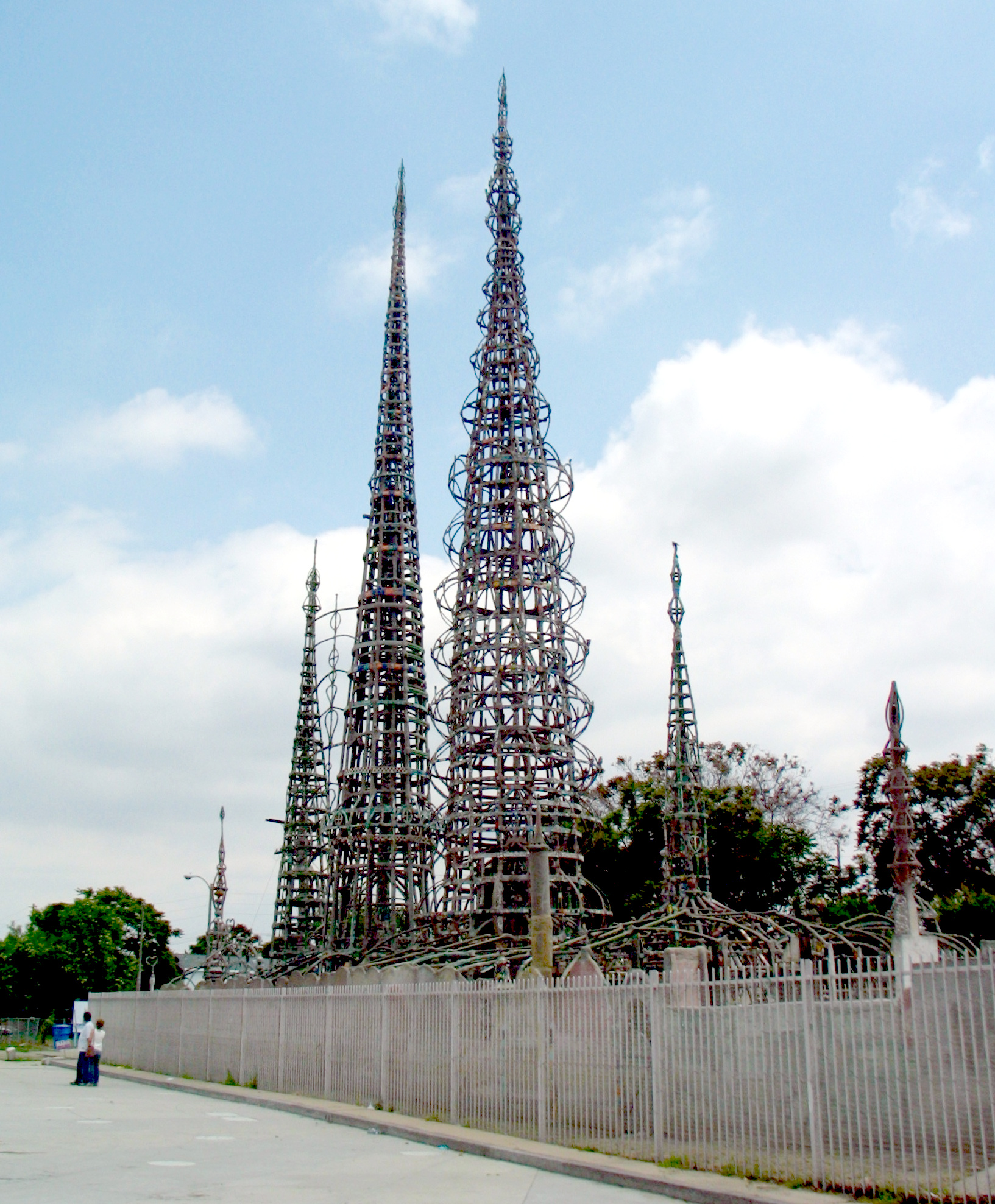
The Watts Towers, Towers of Simon Rodia, or Nuestro Pueblo ("our town" in Spanish) are a collection of 17 interconnected sculptural towers, architectural structures, and individual sculptural features and mosaics within the site of the artist's original residential property in Watts, Los Angeles, California, United States. The entire site of towers, structures, sculptures, pavement, and walls were designed and built solely by Sabato ("Simon" or "Sam") Rodia (1879 or 1886 to 1965), an Italian immigrant construction worker and tile mason, over a period of 33 years from 1921 to 1954. The tallest of the towers is 99.5 feet (30.3 m). The work is an example of outsider art (or Art Brut) and Italian-American naïve art.
The Watts Towers were designated a National Historic Landmark and a California Historical Landmark in 1990. They are also a Los Angeles Historic-Cultural Monument, and one of nine folk art sites listed in the National Register of Historic Places in Los Angeles. The Watts Towers of Simon Rodia State Historic Park encompasses the Watts Towers site.
Sabato ("Simon" or "Sam") Rodia (12 February, 1878 – July 17, 1965) was born and raised in Serino, Italy. In 1895, aged seventeen, he emigrated to the United States with his brother. Rodia lived in Pennsylvania until his brother died in a mining incident. He then moved to Seattle, Washington, where he married Lucia Ucci in 1902. They soon moved to Oakland, where Rodia's three children were born. Following his divorce around 1909, he moved to Long Beach and worked in construction and other odd jobs before finally settling in Watts in 1920. Among the projects he is known, or claimed, to have worked on are the UC Berkeley campus, the Eastern Star Home and the Bullocks Wilshire building. Rodia began constructing the Watts Towers in 1921.
There has been some question as to what Rodia was called during his lifetime; some sources have cited that his birth name was "Sabatino" and it is disputed as to whether he was called "Simon" during his lifetime. It is widely known and accepted that he was referred to as "Sam" by close friends. He appears as Samuel Rodia (and still living in Oakland) in the 1910 U.S. Census, but by the time of the 1920 U.S. Census, he had already become Sam Rodia. His surname has also been misspelled as "Rodella" or "Rodilla".
The sculptures' armatures are constructed from steel rebar and Rodia's own concoction of a type of concrete, wrapped with wire mesh. The main supports are embedded with pieces of porcelain, tile, and glass. They are decorated with found objects, including bottles, ceramic tiles, seashells, figurines, mirrors, and other items. Rodia called the Towers "Nuestro Pueblo" ("our town" in Spanish). He built them with no special equipment or predetermined design, working alone with hand tools. Neighborhood children brought pieces of broken pottery to Rodia, and he also used damaged pieces from Malibu Potteries and CALCO (California Clay Products Company). Green glass includes recognizable soft drink bottles from the 1930s through the 1950s, some still bearing the former logos of 7 Up, Squirt, Bubble Up, and Canada Dry; blue glass appears to be from milk of magnesia bottles. Their structural design and placement near the builder's home are strongly reminiscent of the gigli ("lilies") towers which feature in an annual festival to St. Paulinus in Nola, Italy, with which he was probably familiar.
Rodia bent much of the Towers' framework from scrap rebar, using nearby railroad tracks as a makeshift vise. Other items came from alongside the Pacific Electric Railway right-of-way between Watts and Wilmington. Rodia often walked the right-of-way all the way to Wilmington in search of material, a distance of nearly 20 miles (32 km).
In the summer of 1954, Rodia suffered a mild stroke. Shortly after the stroke, he fell off a tower from a low height. In 1955, Rodia gave his property to a neighbor and left, reportedly tired of battling with the City of Los Angeles for permits, and because he understood the possible consequences of his aging and being alone. He also mentioned that the towers were frequently vandalized by neighbors. He moved to Martinez, California, to be with his sister. He remained there for the next eleven years until his death in 1965.
Rodia's bungalow inside the enclosure burned down as a result of an accident on the Fourth of July 1956, and the City of Los Angeles condemned the structure and ordered it all to be destroyed. Actor Nicholas King and film editor William Cartwright visited the site in 1959, and purchased the property from Rodia's neighbor for $2,000 in order to preserve it. The city's decision to pursue expediting the demolition was still in force. The towers had already become famous and there was opposition from around the world. King, Cartwright, architects, artists, enthusiasts, academics, and community activists formed the Committee for Simon Rodia's Towers in Watts. The committee negotiated with the city to allow for an engineering test to establish the safety of the structures and avoid their demolition.
Hub AI
Watts Towers AI simulator
(@Watts Towers_simulator)
Watts Towers
The Watts Towers, Towers of Simon Rodia, or Nuestro Pueblo ("our town" in Spanish) are a collection of 17 interconnected sculptural towers, architectural structures, and individual sculptural features and mosaics within the site of the artist's original residential property in Watts, Los Angeles, California, United States. The entire site of towers, structures, sculptures, pavement, and walls were designed and built solely by Sabato ("Simon" or "Sam") Rodia (1879 or 1886 to 1965), an Italian immigrant construction worker and tile mason, over a period of 33 years from 1921 to 1954. The tallest of the towers is 99.5 feet (30.3 m). The work is an example of outsider art (or Art Brut) and Italian-American naïve art.
The Watts Towers were designated a National Historic Landmark and a California Historical Landmark in 1990. They are also a Los Angeles Historic-Cultural Monument, and one of nine folk art sites listed in the National Register of Historic Places in Los Angeles. The Watts Towers of Simon Rodia State Historic Park encompasses the Watts Towers site.
Sabato ("Simon" or "Sam") Rodia (12 February, 1878 – July 17, 1965) was born and raised in Serino, Italy. In 1895, aged seventeen, he emigrated to the United States with his brother. Rodia lived in Pennsylvania until his brother died in a mining incident. He then moved to Seattle, Washington, where he married Lucia Ucci in 1902. They soon moved to Oakland, where Rodia's three children were born. Following his divorce around 1909, he moved to Long Beach and worked in construction and other odd jobs before finally settling in Watts in 1920. Among the projects he is known, or claimed, to have worked on are the UC Berkeley campus, the Eastern Star Home and the Bullocks Wilshire building. Rodia began constructing the Watts Towers in 1921.
There has been some question as to what Rodia was called during his lifetime; some sources have cited that his birth name was "Sabatino" and it is disputed as to whether he was called "Simon" during his lifetime. It is widely known and accepted that he was referred to as "Sam" by close friends. He appears as Samuel Rodia (and still living in Oakland) in the 1910 U.S. Census, but by the time of the 1920 U.S. Census, he had already become Sam Rodia. His surname has also been misspelled as "Rodella" or "Rodilla".
The sculptures' armatures are constructed from steel rebar and Rodia's own concoction of a type of concrete, wrapped with wire mesh. The main supports are embedded with pieces of porcelain, tile, and glass. They are decorated with found objects, including bottles, ceramic tiles, seashells, figurines, mirrors, and other items. Rodia called the Towers "Nuestro Pueblo" ("our town" in Spanish). He built them with no special equipment or predetermined design, working alone with hand tools. Neighborhood children brought pieces of broken pottery to Rodia, and he also used damaged pieces from Malibu Potteries and CALCO (California Clay Products Company). Green glass includes recognizable soft drink bottles from the 1930s through the 1950s, some still bearing the former logos of 7 Up, Squirt, Bubble Up, and Canada Dry; blue glass appears to be from milk of magnesia bottles. Their structural design and placement near the builder's home are strongly reminiscent of the gigli ("lilies") towers which feature in an annual festival to St. Paulinus in Nola, Italy, with which he was probably familiar.
Rodia bent much of the Towers' framework from scrap rebar, using nearby railroad tracks as a makeshift vise. Other items came from alongside the Pacific Electric Railway right-of-way between Watts and Wilmington. Rodia often walked the right-of-way all the way to Wilmington in search of material, a distance of nearly 20 miles (32 km).
In the summer of 1954, Rodia suffered a mild stroke. Shortly after the stroke, he fell off a tower from a low height. In 1955, Rodia gave his property to a neighbor and left, reportedly tired of battling with the City of Los Angeles for permits, and because he understood the possible consequences of his aging and being alone. He also mentioned that the towers were frequently vandalized by neighbors. He moved to Martinez, California, to be with his sister. He remained there for the next eleven years until his death in 1965.
Rodia's bungalow inside the enclosure burned down as a result of an accident on the Fourth of July 1956, and the City of Los Angeles condemned the structure and ordered it all to be destroyed. Actor Nicholas King and film editor William Cartwright visited the site in 1959, and purchased the property from Rodia's neighbor for $2,000 in order to preserve it. The city's decision to pursue expediting the demolition was still in force. The towers had already become famous and there was opposition from around the world. King, Cartwright, architects, artists, enthusiasts, academics, and community activists formed the Committee for Simon Rodia's Towers in Watts. The committee negotiated with the city to allow for an engineering test to establish the safety of the structures and avoid their demolition.
Recent media