
Recent from talks
Wave shoaling
Knowledge base stats:
Talk channels stats:
Members stats:
Wave shoaling
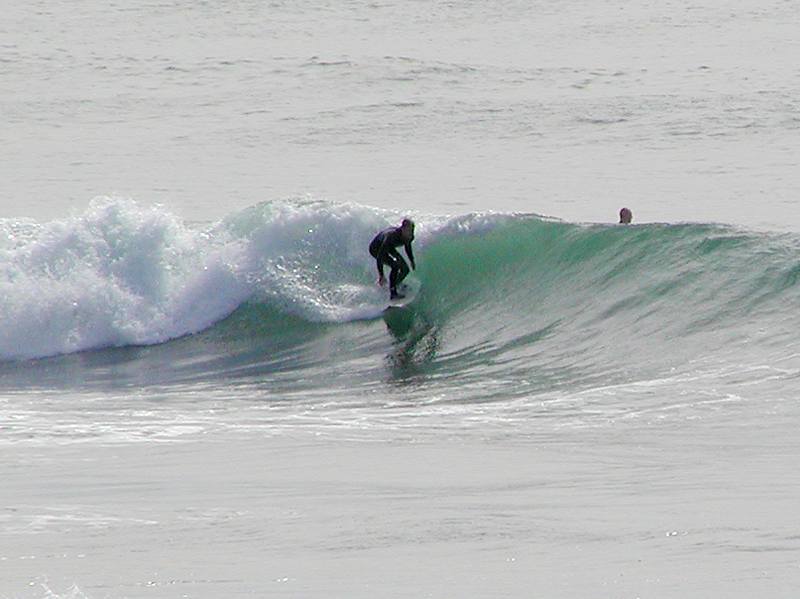
In fluid dynamics, wave shoaling is the effect by which surface waves, entering shallower water, increase in wave height. It is caused by the fact that the group velocity, which is also the wave-energy transport velocity, decreases with water depth. Under stationary conditions, a decrease in transport speed must be compensated by an increase in energy density in order to maintain a constant energy flux. Shoaling waves will also exhibit a reduction in wavelength while the frequency remains constant.
In other words, as the waves approach the shore and the water gets shallower, the waves get taller, slow down, and get closer together.
Particularly in a waterbody shallow enough for its surface to be affected by its bottom and where depth contours parallel the shore, a wave packet that does dissipate its energy by breaking will rise in height as it enters yet shallower water. This is plainly evident for tsunamis as they wax in height when approaching a coastline, often with devastating results.
Waves nearing the coast experience changes in wave height through different effects. Some of the important wave processes are refraction, diffraction, reflection, wave breaking, wave–current interaction, friction, wave growth due to the wind, and wave shoaling. In the absence of the other effects, wave shoaling is the change of wave height that occurs solely by changes in mean water depth – without alterations in wave propagation direction or energy dissipation. Pure wave shoaling occurs for long-crested waves propagating perpendicular to the parallel depth contour lines of a mildly sloping sea-bed. Then the wave height at a certain location can be expressed as:

with the shoaling coefficient and the wave height in deep water. The shoaling coefficient depends on the local water depth and the wave frequency (or equivalently on and the wave period ). Deep water means that the waves are (hardly) affected by the sea bed, which occurs when the depth is larger than about half the deep-water wavelength



For non-breaking waves, the energy flux associated with the wave motion, which is the product of the wave energy density with the group velocity, between two wave rays is a conserved quantity (i.e. a constant when following the energy of a wave packet from one location to another). Under stationary conditions the total energy transport must be constant along the wave ray – as first shown by William Burnside in 1915. For waves affected by refraction and shoaling (i.e. within the geometric optics approximation), the rate of change of the wave energy transport is:
where is the co-ordinate along the wave ray and is the energy flux per unit crest length. A decrease in group speed and distance between the wave rays must be compensated by an increase in energy density . This can be formulated as a shoaling coefficient relative to the wave height in deep water.


For shallow water, when the wavelength is much larger than the water depth – in case of a constant ray distance (i.e. perpendicular wave incidence on a coast with parallel depth contours) – wave shoaling satisfies Green's law:
Hub AI
Wave shoaling AI simulator
(@Wave shoaling_simulator)
Wave shoaling
In fluid dynamics, wave shoaling is the effect by which surface waves, entering shallower water, increase in wave height. It is caused by the fact that the group velocity, which is also the wave-energy transport velocity, decreases with water depth. Under stationary conditions, a decrease in transport speed must be compensated by an increase in energy density in order to maintain a constant energy flux. Shoaling waves will also exhibit a reduction in wavelength while the frequency remains constant.
In other words, as the waves approach the shore and the water gets shallower, the waves get taller, slow down, and get closer together.
Particularly in a waterbody shallow enough for its surface to be affected by its bottom and where depth contours parallel the shore, a wave packet that does dissipate its energy by breaking will rise in height as it enters yet shallower water. This is plainly evident for tsunamis as they wax in height when approaching a coastline, often with devastating results.
Waves nearing the coast experience changes in wave height through different effects. Some of the important wave processes are refraction, diffraction, reflection, wave breaking, wave–current interaction, friction, wave growth due to the wind, and wave shoaling. In the absence of the other effects, wave shoaling is the change of wave height that occurs solely by changes in mean water depth – without alterations in wave propagation direction or energy dissipation. Pure wave shoaling occurs for long-crested waves propagating perpendicular to the parallel depth contour lines of a mildly sloping sea-bed. Then the wave height at a certain location can be expressed as:
with the shoaling coefficient and the wave height in deep water. The shoaling coefficient depends on the local water depth and the wave frequency (or equivalently on and the wave period ). Deep water means that the waves are (hardly) affected by the sea bed, which occurs when the depth is larger than about half the deep-water wavelength
For non-breaking waves, the energy flux associated with the wave motion, which is the product of the wave energy density with the group velocity, between two wave rays is a conserved quantity (i.e. a constant when following the energy of a wave packet from one location to another). Under stationary conditions the total energy transport must be constant along the wave ray – as first shown by William Burnside in 1915. For waves affected by refraction and shoaling (i.e. within the geometric optics approximation), the rate of change of the wave energy transport is:
where is the co-ordinate along the wave ray and is the energy flux per unit crest length. A decrease in group speed and distance between the wave rays must be compensated by an increase in energy density . This can be formulated as a shoaling coefficient relative to the wave height in deep water.
For shallow water, when the wavelength is much larger than the water depth – in case of a constant ray distance (i.e. perpendicular wave incidence on a coast with parallel depth contours) – wave shoaling satisfies Green's law:
Recent media