Hubbry Logo
search
logo
2308931

Waveplate

logo
Community Hub0 Subscribers
Read side by side
from Wikipedia
  Electric field parallel to optic axis
  Electric field perpendicular to axis
  The combined field
Linearly polarized light entering a half-wave plate can be resolved into two waves, parallel and perpendicular to the optic axis of the waveplate. In the plate, the parallel wave propagates slightly slower than the perpendicular one. At the far side of the plate, the parallel wave is exactly half of a wavelength delayed relative to the perpendicular wave, and the resulting combination is a mirror-image of the entry polarization state (relative to the optic axis).

A waveplate or retarder is an optical device that alters the polarization state of a light wave travelling through it. Two common types of waveplates are the half-wave plate, which rotates the polarization direction of linearly polarized light, and the quarter-wave plate, which converts between different elliptical polarizations (such as the special case of converting from linearly polarized light to circularly polarized light and vice versa.)[1]

Waveplates are constructed out of a birefringent material (such as quartz or mica, or even plastic), for which the index of refraction is different for light that is linearly polarized along one or the other of two certain perpendicular crystal axes. The behavior of a waveplate (that is, whether it is a half-wave plate, a quarter-wave plate, etc.) depends on the thickness of the crystal, the wavelength of light, and the variation of the index of refraction. By appropriate choice of the relationship between these parameters, it is possible to introduce a controlled phase shift between the two polarization components of a light wave, thereby altering its polarization.[1] With an engineered combination of two birefringent materials, an achromatic waveplate[2] can be manufactured such that the spectral response of its phase retardance can be nearly flat.

A common use of waveplates—particularly the sensitive-tint (full-wave) and quarter-wave plates—is in optical mineralogy. Addition of plates between the polarizers of a petrographic microscope makes the optical identification of minerals in thin sections of rocks easier,[3] in particular by allowing deduction of the shape and orientation of the optical indicatrices within the visible crystal sections. This alignment can allow discrimination between minerals which otherwise appear very similar in plane polarized and cross polarized light.

Principles of operation

[edit]
A wave in a uniaxial crystal will separate in two components, one parallel and one perpendicular to the optic axis, that will accumulate phase at different rates. This can be used to manipulate the polarization state of the wave.
A waveplate mounted in a rotary mount

A waveplate works by shifting the phase between two perpendicular polarization components of the light wave. A typical waveplate is simply a birefringent crystal with a carefully chosen orientation and thickness. The crystal is cut into a plate, with the orientation of the cut chosen so that the optic axis of the crystal is parallel to the surfaces of the plate. This results in two axes in the plane of the cut: the ordinary axis, with index of refraction no, and the extraordinary axis, with index of refraction ne. The ordinary axis is perpendicular to the optic axis. The extraordinary axis is parallel to the optic axis. For a light wave normally incident upon the plate, the polarization component along the ordinary axis travels through the crystal with a speed vo = c/no, while the polarization component along the extraordinary axis travels with a speed ve = c/ne. This leads to a phase difference between the two components as they exit the crystal. When ne < no, as in calcite, the extraordinary axis is called the fast axis and the ordinary axis is called the slow axis. For ne > no the situation is reversed.

Depending on the thickness of the crystal, light with polarization components along both axes will emerge in a different polarization state. The waveplate is characterized by the amount of relative phase, Γ, that it imparts on the two components, which is related to the birefringence Δn and the thickness L of the crystal by the formula
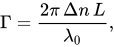
where λ0 is the vacuum wavelength of the light.

Waveplates in general, as well as polarizers, can be described using the Jones matrix formalism, which uses a vector to represent the polarization state of light and a matrix to represent the linear transformation of a waveplate or polarizer.

Although the birefringence Δn may vary slightly due to dispersion, this is negligible compared to the variation in phase difference according to the wavelength of the light due to the fixed path difference (λ0 in the denominator in the above equation). Waveplates are thus manufactured to work for a particular range of wavelengths. The phase variation can be minimized by stacking two waveplates that differ by a tiny amount in thickness back-to-back, with the slow axis of one along the fast axis of the other. With this configuration, the relative phase imparted can be, for the case of a quarter-wave plate, one-fourth a wavelength rather than three-fourths or one-fourth plus an integer. This is called a zero-order waveplate.

For a single waveplate changing the wavelength of the light introduces a linear error in the phase. Tilt of the waveplate enters via a factor of 1/cos θ (where θ is the angle of tilt) into the path length and thus only quadratically into the phase. For the extraordinary polarization the tilt also changes the refractive index to the ordinary via a factor of cos θ, so combined with the path length, the phase shift for the extraordinary light due to tilt is zero.

A polarization-independent phase shift of zero order needs a plate with thickness of one wavelength. For calcite the refractive index changes in the first decimal place, so that a true zero order plate is ten times as thick as one wavelength. For quartz and magnesium fluoride the refractive index changes in the second decimal place and true zero order plates are common for wavelengths above 1 μm.

Plate types

[edit]

Half-wave plate

[edit]
A wave passing through a half-wave plate

For a half-wave plate, the relationship between L, Δn, and λ0 is chosen so that the phase shift between polarization components is Γ = π. Now suppose a linearly polarized wave with polarization vector is incident on the crystal. Let θ denote the angle between and , where is the vector along the waveplate's fast axis. Let z denote the propagation axis of the wave. The electric field of the incident wave is where lies along the waveplate's slow axis. The effect of the half-wave plate is to introduce a phase shift term eiΓ = eiπ = −1 between the f and s components of the wave, so that upon exiting the crystal the wave is now given by If denotes the polarization vector of the wave exiting the waveplate, then this expression shows that the angle between and is −θ. Evidently, the effect of the half-wave plate is to mirror the wave's polarization vector through the plane formed by the vectors and . For linearly polarized light, this is equivalent to saying that the effect of the half-wave plate is to rotate the polarization vector through an angle 2θ; however, for elliptically polarized light the half-wave plate also has the effect of inverting the light's handedness.[1]

Quarter-wave plate

[edit]
Two waves differing by a quarter-phase shift for one axis
Creating circular polarization using a quarter-wave plate and a polarizing filter

For a quarter-wave plate, the relationship between L, Δn, and λ0 is chosen so that the phase shift between polarization components is Γ = π/2. Now suppose a linearly polarized wave is incident on the crystal. This wave can be written as

where the f and s axes are the quarter-wave plate's fast and slow axes, respectively, the wave propagates along the z axis, and Ef and Es are real. The effect of the quarter-wave plate is to introduce a phase shift term eiΓ =eiπ/2 = i between the f and s components of the wave, so that upon exiting the crystal the wave is now given by

The wave is now elliptically polarized.

If the axis of polarization of the incident wave is chosen so that it makes a 45° with the fast and slow axes of the waveplate, then Ef = Es ≡ E, and the resulting wave upon exiting the waveplate is

and the wave is circularly polarized.

If the axis of polarization of the incident wave is chosen so that it makes a 0° with the fast or slow axes of the waveplate, then the polarization will not change, so remains linear. If the angle is in between 0° and 45° the resulting wave has an elliptical polarization.

A circulating polarization can be visualized as the sum of two linear polarizations with a phase difference of 90°. The output depends on the polarization of the input. Suppose polarization axes x and y parallel with the slow and fast axis of the waveplate:

Composition of two linearly polarized waves, phase shifted by π/2

The polarization of the incoming photon (or beam) can be resolved as two polarizations on the x and y axis. If the input polarization is parallel to the fast or slow axis, then there is no polarization of the other axis, so the output polarization is the same as the input (only the phase more or less delayed). If the input polarization is 45° to the fast and slow axis, the polarization on those axes are equal. But the phase of the output of the slow axis will be delayed 90° with the output of the fast axis. If not the amplitude but both sine values are displayed, then x and y combined will describe a circle. With other angles than 0° or 45° the values in fast and slow axis will differ and their resultant output will describe an ellipse.

Full-wave, or sensitive-tint plate

[edit]

A full-wave plate introduces a phase difference of exactly one wavelength between the two polarization directions, for one wavelength of light. In optical mineralogy, it is common to use a full-wave plate designed for green light (a wavelength near 540 nm). Linearly polarized white light which passes through the plate becomes elliptically polarized, except for that green light wavelength, which will remain linear. If a linear polarizer oriented perpendicular to the original polarization is added, this green wavelength is fully extinguished but elements of the other colors remain. This means that under these conditions the plate will appear an intense shade of red-violet, sometimes known as "sensitive tint".[4] This gives rise to this plate's alternative names, the sensitive-tint plate or (less commonly) red-tint plate. These plates are widely used in mineralogy to aid in identification of minerals in thin sections of rocks.[3]

Multiple-order vs. zero-order waveplates

[edit]

A multiple-order waveplate is made from a single birefringent crystal that produces an integer multiple of the rated retardance (for example, a multiple-order half-wave plate may have an absolute retardance of 37λ/2). By contrast, a zero-order waveplate produces exactly the specified retardance. This can be accomplished by combining two multiple-order wave plates such that the difference in their retardances yields the net (true) retardance of the waveplate. Zero-order waveplates are less sensitive to temperature and wavelength shifts, but are more expensive than multiple-order ones.[5]

Stacking a series of different-order waveplates with polarization filters between them yields a Lyot filter. Either the filters can be rotated, or the waveplates can be replaced with liquid crystal layers, to obtain a widely tunable pass band in optical transmission spectrum.

Use in mineralogy and optical petrology

[edit]
Thin crystalline film of caesium chloride photographed using a petrographic microscope.

The sensitive-tint (full-wave) and quarter-wave plates are widely used in the field of optical mineralogy. Addition of plates between the polarizers of a petrographic microscope makes easier the optical identification of minerals in thin sections of rocks,[3] in particular by allowing deduction of the shape and orientation of the optical indicatrices within the visible crystal sections.

In practical terms, the plate is inserted between the perpendicular polarizers at an angle of 45 degrees. This allows two different procedures to be carried out to investigate the mineral under the crosshairs of the microscope. Firstly, in ordinary cross polarized light, the plate can be used to distinguish the orientation of the optical indicatrix relative to crystal elongation – that is, whether the mineral is "length slow" or "length fast" – based on whether the visible interference colors increase or decrease by one order when the plate is added. Secondly, a slightly more complex procedure allows for a tint plate to be used in conjunction with interference figure techniques to allow measurement of the optic angle of the mineral. The optic angle (often notated as "2V") can both be diagnostic of mineral type, as well as in some cases revealing information about the variation of chemical composition within a single mineral type.

See also

[edit]

References

[edit]
[edit]
Revisions and contributorsEdit on WikipediaRead on Wikipedia
from Grokipedia
A waveplate, also known as a retarder, is an optical device constructed from birefringent material that transmits light while modifying its polarization state by introducing a controlled phase shift between two orthogonal polarization components, without attenuating, deviating, or displacing the beam.[1] This phase shift arises from the material's birefringence, where the refractive indices differ for light polarized along the fast and slow axes, causing one component to propagate slower than the other.[2] The magnitude of the retardance is determined by the material thickness dd, the birefringence Δn=neno\Delta n = n_e - n_o (difference between extraordinary and ordinary refractive indices), and the wavelength λ\lambda, according to the formula δ=2πdΔnλ\delta = \frac{2\pi d \Delta n}{\lambda}.[2] Waveplates are categorized primarily by the phase shift they introduce, with the most common types being the quarter-wave plate (λ/4\lambda/4), which imparts a 90° retardance, and the half-wave plate (λ/2\lambda/2), which provides a 180° retardance.[1] A quarter-wave plate, for instance, converts linearly polarized light into circularly polarized light when the incident polarization is at 45° to the optic axis, as it equalizes the amplitudes of the orthogonal components while shifting their phase by a quarter wavelength.[3] In contrast, a half-wave plate rotates the plane of linear polarization by twice the angle between the incident polarization and the fast axis, enabling precise control over polarization orientation.[1] Other variants include zero-order, multi-order, achromatic, and superachromatic waveplates, designed to minimize wavelength dependence and extend operational bandwidths across UV, visible, or IR spectra.[2] These devices are typically fabricated from materials exhibiting uniaxial birefringence, such as crystal quartz, magnesium fluoride (MgF₂), sapphire, or liquid crystal polymers, with quartz being particularly favored for its low absorption and high damage threshold in precision applications.[1][2] Waveplates find essential use in polarization-sensitive systems, including optical isolators (combining with polarizers to block back-reflections), circular dichroism spectroscopy, laser beam control, and quantum optics experiments where maintaining specific polarization states is critical.[1] Their chromatic nature—where retardance varies with wavelength—necessitates careful selection for broadband or monochromatic sources to ensure performance.[2]

Fundamentals

Polarized Light and Birefringence

Polarized light refers to electromagnetic waves in which the oscillations of the electric field vector are confined to a specific plane or pattern perpendicular to the direction of propagation. Linear polarization occurs when the electric field vibrates along a single axis, such as horizontal or vertical relative to the propagation direction.[4] Circular polarization arises when two orthogonal linear components of equal amplitude are combined with a 90-degree phase difference, causing the electric field to rotate in a circle as the wave advances, either clockwise (right-handed) or counterclockwise (left-handed).[5] Elliptical polarization is a more general state where the orthogonal components have unequal amplitudes or the phase difference is not exactly 90 degrees, resulting in an elliptical trace of the electric field vector.[6] In contrast, unpolarized light consists of electromagnetic waves with electric field vectors oscillating randomly in all planes perpendicular to the propagation direction, lacking a preferred orientation. Natural sources such as sunlight, incandescent lamps, and candle flames emit unpolarized light because the vibrating charges responsible for emission move in random directions.[7] Polarized light can emerge from unpolarized sources through processes like reflection off non-metallic surfaces (e.g., water or glass) or scattering in the atmosphere, where specific orientations are selectively enhanced.[8] Birefringence, also known as double refraction, is the optical phenomenon observed in anisotropic materials where a single incident light ray splits into two refracted rays of different velocities and polarization directions upon entering the material. These materials exhibit direction-dependent refractive indices due to their non-cubic crystal structures, which cause the speed of light to vary based on the ray's polarization relative to the crystal's optic axis.[9] The two resulting rays are the ordinary ray, which follows Snell's law as in isotropic media and is polarized perpendicular to the plane containing the optic axis and the propagation direction, and the extraordinary ray, which deviates from Snell's law and experiences a different refractive index, polarized in the orthogonal direction. This splitting arises because the material's molecular arrangement imposes different impedances on light waves polarized along different axes.[10] The Jones calculus provides a mathematical framework for representing and manipulating polarization states using two-dimensional complex vectors, assuming fully polarized monochromatic light. In this notation, the polarization state is described by a Jones vector E=(ExEy)\mathbf{E} = \begin{pmatrix} E_x \\ E_y \end{pmatrix}, where ExE_x and EyE_y are the complex amplitudes of the electric field components along the x and y axes, respectively, with the phase information encoded in their arguments.[11] For example, horizontal linear polarization is (10)\begin{pmatrix} 1 \\ 0 \end{pmatrix}, vertical is (01)\begin{pmatrix} 0 \\ 1 \end{pmatrix}, right-circular is 12(1i)\frac{1}{\sqrt{2}} \begin{pmatrix} 1 \\ -i \end{pmatrix}, and left-circular is 12(1i)\frac{1}{\sqrt{2}} \begin{pmatrix} 1 \\ i \end{pmatrix}.[12] Optical elements like polarizers or retarders are modeled as 2x2 complex matrices that transform the input Jones vector to the output state.[13] The phenomenon of birefringence was first observed and documented in 1669 by Danish scientist Erasmus Bartholinus, who noticed double refraction when viewing objects through transparent crystals of calcite (Iceland spar), leading to displaced images that hinted at underlying polarization effects.[14] This discovery laid foundational groundwork for later understandings of light's transverse wave nature and polarization.[15]

Principle of Operation

A waveplate functions by introducing a controlled phase difference, known as retardation, between the orthogonal polarization components of an incident light wave, thereby modifying the overall polarization state. This effect stems from the birefringence of the material, where light polarized parallel to the fast axis propagates with a lower refractive index nfn_f and higher speed, while light polarized parallel to the slow axis experiences a higher refractive index nsn_s and lower speed. The fast and slow axes are mutually orthogonal principal directions of the waveplate, determined by the crystal orientation, and they split the input polarization into two independent components that travel through the device without mixing.[16] The phase retardation δ\delta is derived from the difference in optical path lengths for these components. The phase accumulated by a wave traveling distance dd (the thickness of the waveplate) in a medium of refractive index nn is ϕ=2πλnd\phi = \frac{2\pi}{\lambda} n d, where λ\lambda is the vacuum wavelength of the light. Thus, the retardation is the difference δ=ϕsϕf=2πλ(nsnf)d\delta = \phi_s - \phi_f = \frac{2\pi}{\lambda} (n_s - n_f) d. This relative phase shift alters the timing between the fast and slow components, enabling precise control over polarization without absorption.[16]/12%3A_Polarization/12.03%3A_Wave_Plates_and_Polarizers) In the Jones calculus, a linear retarder (waveplate) with its fast axis aligned to the reference x-direction is represented by the matrix
(eiδ/200eiδ/2), \begin{pmatrix} e^{i \delta / 2} & 0 \\ 0 & e^{-i \delta / 2} \end{pmatrix},
which advances the phase of the fast-axis component by δ/2\delta/2 and retards the slow-axis component by δ/2\delta/2, resulting in a net relative retardation of δ\delta. The common phase factor eiδ/2e^{i \delta / 2} can be factored out, as it does not influence the polarization state. For a waveplate oriented at an arbitrary angle, the matrix is rotated accordingly using the rotation matrix.[17][18]
When linearly polarized light enters the waveplate at an angle θ\theta to the fast axis, its electric field decomposes into components Ef=E0cosθE_f = E_0 \cos \theta along the fast axis and Es=E0sinθE_s = E_0 \sin \theta along the slow axis. Upon transmission, these acquire phases eiδ/2e^{i \delta / 2} and eiδ/2e^{-i \delta / 2}, respectively, yielding an output field that traces an elliptical polarization path, with the major and minor axes determined by θ\theta and δ\delta. The eccentricity and orientation of the ellipse vary continuously with these parameters, except for special cases like θ=0\theta = 0^\circ or 9090^\circ (output remains linear) or δ=0\delta = 0 (no change).[1]/12%3A_Polarization/12.03%3A_Wave_Plates_and_Polarizers) For circularly polarized input, the waveplate can either preserve the handedness or convert it to the opposite circular polarization, depending on the alignment of the input with respect to the axes and the value of δ\delta. Linear input generally converts to elliptical, while the reverse—elliptical to linear or other states—can also occur, making waveplates versatile for polarization manipulation in optical systems.[1][16]

Types of Waveplates

Half-Wave Plate

A half-wave plate is a birefringent optical device that introduces a relative phase retardation of π radians (or odd multiples thereof) between the ordinary and extraordinary wavefronts of polarized light passing through it.[19] This retardation corresponds to a half-wavelength path difference at the design wavelength, achieved by selecting the thickness of the birefringent material such that the optical path difference satisfies δ = (2m + 1)π, where m is an integer representing the order of the plate.[20] In the Jones calculus formalism, the effect of a half-wave plate with its fast axis oriented at an angle θ to the reference axis can be described by the matrix
(cos(2θ)sin(2θ)sin(2θ)cos(2θ)), \begin{pmatrix} \cos(2\theta) & \sin(2\theta) \\ \sin(2\theta) & -\cos(2\theta) \end{pmatrix},
which acts on the incident Jones vector to transform the polarization state.[21] For incident linearly polarized light with its plane of polarization at an angle θ to the fast axis of the plate, the output remains linearly polarized but rotated to an angle of -θ relative to the fast axis, resulting in an overall rotation of the polarization plane by 2θ.[22] This transformation preserves the linear nature of the polarization without introducing circular components, making the half-wave plate a key tool for polarization rotation in optical systems.[19] Half-wave plates find applications in scenarios requiring precise control of linear polarization orientation, such as in laser systems for adjustable beam splitters or in polarimetry setups for modulating polarization states.[23] A notable example is their use in isolating circular polarization components from an input that includes linear polarization; by mounting a half-wave plate ahead of a quarter-wave plate and rotating it continuously, the linear component can be depolarized through averaging, while the circular component remains unaffected and can be selectively analyzed.[24] The performance of a half-wave plate is wavelength-sensitive due to the dispersion of the birefringence in the material, which causes the actual phase retardation to deviate from the ideal π radians at wavelengths away from the design value.[25] For instance, a plate designed for visible light may exhibit reduced rotation efficiency in the near-infrared, necessitating achromatic designs or careful wavelength selection for broadband applications.[23]

Quarter-Wave Plate

A quarter-wave plate is a type of waveplate that introduces a relative phase retardation of π/2\pi/2 radians (90 degrees), or odd multiples thereof, between the two orthogonal polarization components propagating along its fast and slow axes in a birefringent material.[3] This retardation arises from the difference in refractive indices experienced by the ordinary and extraordinary rays, with the plate's thickness precisely engineered to achieve this quarter-wavelength shift at the design wavelength.[1] When linearly polarized light enters at an angle of 45 degrees to the fast axis, the quarter-wave plate transforms it into circularly polarized light, where the two components are equal in amplitude but quadrature in phase.[17] The output handedness—left-circular (LCP) or right-circular (RCP)—depends on the input polarization orientation relative to the axes and the propagation direction. For instance, with the fast axis horizontal and light incident from the left, a linear input at +45 degrees to the fast axis produces RCP, where the electric field vector rotates clockwise when looking towards the source; conversely, a -45-degree input yields LCP with counterclockwise rotation.[1] This selective conversion enables the plate to distinguish or generate specific circular polarization states, with the fast and slow axes defined by the material's birefringence. The Jones matrix representation for a quarter-wave plate, assuming the fast axis aligned with the x-direction, is given by
(eiπ/400eiπ/4), \begin{pmatrix} e^{i \pi / 4} & 0 \\ 0 & e^{-i \pi / 4} \end{pmatrix},
which applies the π/2\pi/2 phase shift differentially to the horizontal and vertical components./04:_Polarization/4.03:_Creating_and_Manipulating_Polarisation_States) Quarter-wave plates play a crucial role in generating and analyzing circularly polarized light in optical systems, such as in ellipsometry, laser applications, and polarization-sensitive spectroscopy.[26] However, material dispersion causes the retardation to vary with wavelength, limiting broadband performance unless compensated, as the phase shift deviates from π/2\pi/2 outside the design band.[26] A representative application involves pairing a quarter-wave plate with a linear polarizer oriented at 45 degrees to the plate's fast axis, forming a circular polarizer that produces circularly polarized output; this configuration is employed in anti-reflection schemes for displays, where it absorbs reflected light to minimize glare in OLED panels.[27]

Full-Wave Plate

A full-wave plate, also known as a sensitive-tint plate or first-order red plate, is a birefringent optical device designed to introduce a phase retardation of exactly 2π radians—or one full wavelength—between the ordinary and extraordinary rays at a design wavelength, typically 540–560 nm in the green portion of the visible spectrum. This retardation is achieved through a precisely controlled thickness of the birefringent material, such as gypsum, mica, or quartz, cut parallel to the optic axis. The device minimally alters the polarization state of monochromatic light at the design wavelength when the input is linearly polarized, effectively behaving as if no retarder is present under crossed polarizers.[28][29][30] In white light illumination, the full-wave plate exhibits a distinctive magenta interference color, referred to as the sensitive tint, due to material dispersion that causes varying phase shifts across wavelengths; green light is extinguished, while red and blue components pass more readily. This tint serves as a baseline for interference color analysis in polarized light microscopy. The plate's high sensitivity to small deviations from the exact 2π retardation makes it particularly valuable for detecting subtle birefringence effects.[28][29] The primary application of the full-wave plate lies in visualizing strain birefringence, especially in petrographic and materials analysis. Inserted at 45 degrees to the polarizer in a polarized light microscope, it shifts the observed retardation scale by one full order, causing isotropic or low-birefringence regions to appear magenta; small additional retardations ε (where total δ ≈ 2π + ε) then produce vivid color shifts from this baseline, enabling the detection of strain patterns with resolutions down to approximately 2 nm. This technique is widely used for examining weakly birefringent specimens, such as biological tissues, crystals, and stressed materials, to determine the sign (positive or negative) and magnitude of birefringence.[28][30] Historically, the sensitive-tint plate traces its origins to the gypsum waveplate developed by Jean-Baptiste Biot in 1813, which was integrated into early polarizing microscopes during the 19th century to advance petrographic studies of mineral thin sections. Pioneers like Henry Clifton Sorby further popularized its use in the 1850s for detailed optical mineralogy, establishing it as a standard accessory for interference color interpretation via tools like Michel-Lévy charts.[30] Despite its utility, the full-wave plate has notable limitations, including high sensitivity to thickness variations during fabrication or use, which can introduce unintended retardation errors. It is also prone to shifts from temperature fluctuations, as the birefringence of materials like gypsum changes with thermal expansion, potentially altering the sensitive tint and reducing accuracy in uncontrolled environments. Additionally, it is less effective for specimens with high inherent retardations, where color overlaps may obscure details.[1][28][31]

Design Considerations

Multiple-Order vs. Zero-Order Waveplates

Waveplates are classified based on their order, defined as $ m = \frac{\delta}{2\pi} $, where $ \delta $ is the phase retardation introduced between the ordinary and extraordinary rays.[26] Zero-order waveplates achieve the desired retardation with $ m < 1 $ (i.e., the phase retardation $ \delta < 2\pi $), typically constructed as ultra-thin single plates or compound assemblies of multiple thin plates cemented or air-spaced together.[1] In contrast, multiple-order waveplates use thicker single plates where $ m > 1 $, resulting in a total retardation that includes the desired phase shift plus integer multiples of $ 2\pi $.[2] The structural differences lead to distinct performance characteristics. Zero-order waveplates offer broadband operation across a substantial wavelength range, low sensitivity to wavelength variations, reduced temperature dependence, and compact size due to their thin profile (often a few microns for true zero-order designs).[26] However, they are more expensive to fabricate and handle because of the precision required for thin or compound constructions, and some materials may introduce higher absorption losses.[1] Multiple-order waveplates, being thicker (e.g., 0.5 mm or more), are lower in cost and easier to manufacture and integrate mechanically, but they exhibit narrowband performance, high sensitivity to wavelength changes (known as the $ \Delta \lambda $ effect, where small shifts alter the effective retardation), and greater vulnerability to temperature fluctuations that affect birefringence.[2][32] For multiple-order waveplates, the effective retardation is given by $ \delta_{\text{eff}} = \delta - 2\pi m $, where the total $ \delta $ includes excess full-wave shifts; this results in stepping behavior at wavelengths where $ m $ changes discretely, causing abrupt jumps in $ \delta_{\text{eff}} $ and limiting operational bandwidth to a few nanometers.[26] Zero-order designs avoid such stepping by lacking excess orders, ensuring smoother retardation across broader spectra.[1] In practice, zero-order waveplates are preferred in laser systems, such as tunable or diode lasers, for their stability against wavelength and temperature drifts.[16] Multiple-order waveplates find use in basic polarimeters and monochromatic laboratory setups where cost and simplicity outweigh bandwidth needs.[1]

Achromatic and Variable Waveplates

Achromatic waveplates are designed to provide a constant phase retardation over a broad wavelength range by compensating for the dispersion inherent in single-material birefringents. These devices typically employ compound structures combining multiple birefringent materials with opposing dispersion characteristics, such as quartz and mica, where the thicknesses are precisely chosen to maintain an effective phase difference δ nearly independent of wavelength. For instance, a quartz-mica achromatic quarter-wave plate achieves stable λ/4 retardation across the visible spectrum, with typical bandwidths spanning 400-700 nm.[33][34] An alternative to birefringent compound designs is the Fresnel rhomb, a non-birefringent achromatic retarder that utilizes total internal reflection (TIR) within a glass prism to introduce a phase shift. In this configuration, light undergoes two TIR events at a specific angle (typically around 54°), each producing a 45° relative phase difference between the p- and s-polarizations, resulting in a total π/2 shift for quarter-wave operation. Since the phase shift from TIR is largely wavelength-independent, Fresnel rhombs offer broadband performance without material dispersion issues, making them suitable for high-power applications where crystalline waveplates might suffer damage.[1][35] Variable waveplates enable dynamic control of the phase retardation δ, often through electro-optic or liquid crystal mechanisms. Liquid crystal variable retarders (LCVRs) use nematic liquid crystals sandwiched between electrodes, where an applied voltage reorients the molecules to tune the effective birefringence and thus δ, typically over a range from 0 to 2π at a given wavelength. Electro-optic tunable retarders, based on the Pockels effect in crystals like KD*P, achieve similar tunability by inducing birefringence proportional to the electric field strength, allowing rapid switching for applications requiring adjustable polarization. These devices offer tuning ranges up to λ (corresponding to 2π phase) with response times on the order of milliseconds for LCVRs and microseconds for Pockels cells. Mechanical variable retarders, such as Babinet-Soleil compensators, consist of a fixed birefringent plate and two opposing wedges (typically quartz), where relative translation adjusts the effective thickness and thus the retardation from zero to several wavelengths, offering wavelength-independent tuning suitable for spectroscopy and polarimetry.[36][37][38] Post-2000 advancements have introduced polymer-based achromatic waveplates, leveraging liquid crystal polymers (LCPs) laminated between glass substrates to create compact, zero-order devices with enhanced angular acceptance and reduced sensitivity to wavelength variations compared to traditional quartz-MgF₂ pairs. These polymer designs provide stable retardation over broad bands, such as 450-650 nm for quarter-wave operation, and are valued for their low cost and durability in integrated optics. Additionally, metamaterial approaches have emerged for infrared applications, combining nanostructured silicon gratings with liquid crystals to realize tunable achromatic waveplates in the short-wave IR (e.g., 1.5-2 μm), offering sub-wavelength thickness and polarization control beyond conventional limits.[39][40][41]

Fabrication and Materials

Birefringent Materials

Birefringent materials are essential for waveplates, as they exhibit a difference in refractive index (Δn) for light polarized along orthogonal axes, enabling controlled phase retardation. Common crystalline materials include quartz, mica, calcite, sapphire, and magnesium fluoride (MgF₂), each selected for specific optical and physical properties.[1] Crystalline quartz, a positive uniaxial crystal, offers a moderate birefringence of Δn ≈ 0.009 and a broad transparency range from 0.2 μm to 3.5 μm, along with excellent chemical, mechanical, and thermal stability, making it suitable for high-precision waveplates in visible and near-infrared applications. Mica, particularly muscovite, provides a higher birefringence of Δn ≈ 0.036, with good transparency from ~0.2 μm to 8 μm for thin sheets and mechanical flexibility due to its layered structure, though it requires careful cleaving to achieve thin, uniform plates. Calcite exhibits exceptionally high birefringence (Δn ≈ 0.172), ideal for strong retardation effects, but its perfect rhombohedral cleavage limits its use to applications where structural integrity is not compromised, and it operates from ~0.2 μm to 2.5 μm with moderate thermal stability. Sapphire, a negative uniaxial crystal, has a birefringence of Δn ≈ 0.008 but excels in ultraviolet applications (down to 0.15 μm) due to its high hardness, chemical inertness, and thermal durability up to 2000°C, though it requires precise polishing for low-order waveplates. Magnesium fluoride (MgF₂), a positive uniaxial crystal, has Δn ≈ 0.009 and transmits from 0.12 μm to 7.5 μm, valued for its low refractive index and use in UV waveplates.[42] Key properties influencing material choice include the magnitude of birefringence (Δn), which determines the required thickness for a given phase shift; the transparency spectral range, spanning UV to IR; thermal stability to minimize retardation changes with temperature; and mechanical durability for handling and longevity. For instance, quartz and sapphire demonstrate low thermal expansion coefficients (around 10^{-6}/K), ensuring stable performance in varying environments, while mica's lower hardness (Mohs 2–2.5) contrasts with sapphire's exceptional durability (Mohs 9). Synthetic alternatives expand options for cost-effective or tunable devices. Polymer films, such as stretched polycarbonate, provide low-cost birefringence (Δn ≈ 0.001–0.01, wavelength-dependent) with transparency from UV to near-IR and good mechanical flexibility, though they exhibit higher sensitivity to temperature and humidity compared to crystals. Liquid crystal materials, like nematic phases, offer voltage-tunable birefringence (Δn up to 0.2) across visible to IR ranges, enabling dynamic waveplates, but they require encapsulation to prevent degradation and have limited thermal stability above 100°C. Selection criteria for birefringent materials prioritize the operational wavelength range (e.g., UV for sapphire and MgF₂, IR for quartz), the desired retardation order (higher Δn allows thinner plates for zero-order designs), and environmental resistance, such as avoiding hygroscopic salts like potassium dihydrogen phosphate that absorb moisture and alter performance. Materials must also balance dispersion effects, where Δn varies with wavelength, to maintain achromaticity, and exhibit low absorption to preserve light intensity. Recent advancements since the 2010s have introduced nanostructured metamaterials, which engineer custom Δn through subwavelength patterning rather than inherent crystal properties, enabling compact terahertz waveplates with broadband operation (e.g., 0.5–2 THz) and polarization control beyond natural limits of crystalline materials.

Manufacturing Techniques

Waveplates are typically manufactured from birefringent crystals such as quartz or sapphire, beginning with controlled crystal growth to ensure optical quality. For quartz, the hydrothermal growth method is widely used, involving the dissolution of silica in an alkaline aqueous solution under high pressure and temperature (around 300–400°C) within an autoclave, followed by slow crystallization onto seed plates to produce large, low-defect boules suitable for slicing into waveplate blanks.[43][44] Sapphire crystals, valued for their high thermal and mechanical stability, are commonly grown using the Czochralski process, where a seed crystal is dipped into molten alumina (Al₂O₃) at approximately 2050°C and slowly pulled upward while rotating to form a cylindrical boule with uniform birefringence properties.[45][46] Following growth, fabrication involves precise mechanical processing to achieve the required retardation. Boules are sliced perpendicular or at specific angles to the optic axis using diamond saws to minimize stress-induced birefringence, ensuring the fast and slow axes align correctly for polarization control.[16] The slices are then lapped and polished to a thickness that yields the desired phase retardation, such as λ/4 for quarter-wave plates, with tolerances often better than λ/200 to maintain uniformity across the aperture; surface flatness is polished to λ/10 or better to reduce wavefront distortion.[47] Anti-reflection coatings, typically multilayer dielectric stacks, are applied via evaporation or sputtering to minimize losses at the design wavelength, enhancing transmission efficiency to over 99%.[1] Zero-order waveplates, which provide broadband performance and low sensitivity to temperature, are assembled from two or more multiple-order plates of the same material but with slightly different thicknesses and opposite relative retardation (e.g., one left-handed and one right-handed quartz). In cemented assemblies, the plates are bonded with optical epoxy for mechanical stability and compactness, though this can introduce minor absorption; air-spaced designs use spacers to separate the plates, reducing dispersion effects and allowing easier alignment but increasing vulnerability to misalignment.[1][48] This configuration effectively cancels higher-order retardations, yielding a thin equivalent zero-order plate with retardation equal to the difference between components.[26] Quality control ensures retardation uniformity and axis precision through optical metrology. Interferometry, often using a Fizeau or Twyman-Green setup, measures phase retardation across the plate to verify uniformity within ±λ/500, detecting defects like wedge or strain.[49] Polarimetry techniques, such as rotating-waveplate polarimeters, assess fast/slow axis orientation and optical rotation with accuracies better than 0.1°, confirming alignment to the specified tolerance.[50] Recent advancements enable patterned and custom waveplates beyond traditional slicing. Photolithography fabricates sub-wavelength gratings in birefringent films, creating spatially varying retardation for beam shaping or vortex generation, with resolutions down to 100 nm using UV exposure and etching.[51] Post-2015 developments in 3D printing utilize stereolithography or two-photon polymerization of birefringent polymers like liquid crystals to produce complex, freeform waveplates with integrated features, achieving retardations up to λ/2 over THz frequencies while allowing rapid prototyping.[52] These methods leverage the form birefringence from anisotropic microstructures, with refractive index differences (Δn) around 0.1–0.2 depending on the polymer alignment.[53]

Applications

In Mineralogy and Petrology

In petrographic microscopes, full-wave plates are employed for strain analysis in rock thin sections by enhancing the visibility of low-order interference colors, allowing geologists to quantify deformation through retardation measurements. Quarter-wave plates, inserted between the sample and analyzer, facilitate conoscopic observations by resolving isogyres in interference figures, aiding the identification of mineral optic axes and symmetry. These accessories are positioned at 45 degrees to the polarizer to maximize contrast in birefringent minerals.[28][54] The sensitive-tint method utilizes a full-wave plate to detect small birefringences in rocks, where the addition of the plate's retardation shifts the interference tint from neutral gray (near 0 order) through a full cycle (2π phase difference), producing characteristic purple or blue hues that indicate minute strain or orientation differences in minerals like quartz or feldspar. This technique is particularly valuable for analyzing weakly birefringent phases in metamorphic or sedimentary rocks. Birefringence in minerals arises from their anisotropic crystal structures, which split light into ordinary and extraordinary rays with differing velocities.[29][55] Polarized light microscopy was pioneered in petrology by Henry Clifton Sorby in the 1850s through thin-section studies, establishing the use of birefringence for mineral identification and rock fabric analysis. Waveplate accessories, such as gypsum plates, became standard in the late 19th century for quantitative optical work.[56][55] Despite their utility, traditional waveplate applications in mineralogy require manual alignment of plates and samples, which can introduce errors in quantitative retardation assessments, a limitation increasingly addressed by digital polarimeters and automated imaging systems developed in the 2020s for thin-section analysis. These modern tools use software-corrected polarization states to minimize operator dependency.[57][58]

In Optics and Photonics

In laser systems, half-wave plates and quarter-wave plates are essential for controlling the polarization state to achieve mode locking and suppress unwanted modes, particularly in fiber lasers where nonlinear polarization rotation is employed.[59] These devices enable precise polarization isolation, preventing back-reflections and maintaining stable operation in high-power ytterbium-doped fiber lasers by adjusting the state of polarization with minimal insertion loss.[60] For instance, in femtosecond fiber lasers, a half-wave plate facilitates fine polarization tuning to optimize pulse generation and beam quality.[60] Waveplates play a critical role in display technologies by compensating for birefringence in liquid crystal displays (LCDs), thereby widening viewing angles and reducing light leakage in off-axis directions.[61] In twisted nematic LCDs, birefringent films acting as waveplates align the polarization to minimize contrast degradation, achieving viewing angles up to 80 degrees with improved color uniformity.[62] Since the early 2000s, similar compensation techniques have been adapted for organic light-emitting diode (OLED) displays, where quarter-wave plates combined with linear polarizers suppress internal reflections and enhance contrast ratios across broadband visible spectra.[63] In optical communications, achromatic waveplates are integrated into polarization-division multiplexing (PDM) systems for telecommunication fibers to maintain polarization orthogonality over extended bandwidths, enabling higher data rates without signal crosstalk.[64] These devices compensate for polarization mode dispersion in single-mode fibers, supporting terabit-per-second transmission by preserving the distinct polarization states of multiplexed channels across the C-band (1530–1565 nm).[65] Zero-order waveplates are widely used in quantum optics for precise control of photon polarization in entanglement experiments, where they introduce minimal phase retardation to generate Bell states with high fidelity.[66] In setups involving spontaneous parametric down-conversion, these plates rotate polarization to create polarization-entangled photon pairs, achieving visibilities exceeding 99% in interference measurements essential for quantum key distribution and teleportation protocols.[67] Their low temperature sensitivity ensures stable entanglement over long integration times in fiber-coupled quantum networks.[68] Emerging applications leverage metasurface-based waveplates for dynamic beam steering in augmented reality (AR) and virtual reality (VR) systems, offering compact, integrated solutions for holographic displays post-2020.[69] These nanostructured metasurfaces enable polarization-dependent phase gradients, achieving steering angles up to 30 degrees with diffraction efficiencies over 80% in the visible range, surpassing traditional liquid crystal approaches in speed and form factor.[70] In integrated photonics, dielectric metasurface waveplates facilitate on-chip polarization manipulation for silicon photonic circuits, supporting scalable quantum and classical interconnects with sub-wavelength footprints.[71]

References

User Avatar
No comments yet.
