



Community hub
Recent from talks
Contribute something
Nothing was collected or created yet.
Weber modular function
View on WikipediaIn mathematics, the Weber modular functions are a family of three functions f, f1, and f2,[note 1] studied by Heinrich Martin Weber.
Definition
[edit]Let where τ is an element of the upper half-plane. Then the Weber functions are

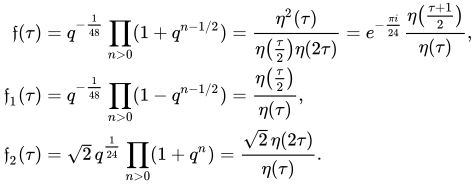
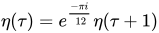
These are also the definitions in Duke's paper "Continued Fractions and Modular Functions".[note 2] The function is the Dedekind eta function and should be interpreted as . The descriptions as quotients immediately imply



The transformation τ → –1/τ fixes f and exchanges f1 and f2. So the 3-dimensional complex vector space with basis f, f1 and f2 is acted on by the group SL2(Z).
Alternative infinite product
[edit]Alternatively, let be the nome,

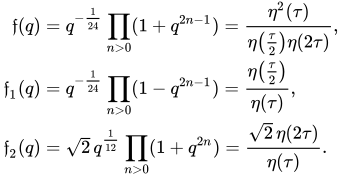
The form of the infinite product has slightly changed. But since the eta quotients remain the same, then as long as the second uses the nome . The utility of the second form is to show connections and consistent notation with the Ramanujan G- and g-functions and the Jacobi theta functions, both of which conventionally uses the nome.

Relation to the Ramanujan G and g functions
[edit]Still employing the nome , define the Ramanujan G- and g-functions as
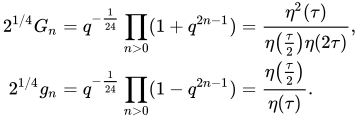
The eta quotients make their connection to the first two Weber functions immediately apparent. In the nome, assume Then,

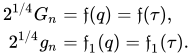
Ramanujan found many relations between and which implies similar relations between and . For example, his identity,



leads to
![{\displaystyle {\big [}{\mathfrak {f}}^{8}(q)-{\mathfrak {f}}_{1}^{8}(q){\big ]}{\big [}{\mathfrak {f}}(q)\,{\mathfrak {f}}_{1}(q){\big ]}^{8}={\big [}{\sqrt {2}}{\big ]}^{8}.}](https://wikimedia.org/api/rest_v1/media/math/render/svg/949929d60616d5cb072e9a35d655a324ec5272db)
For many values of n, Ramanujan also tabulated for odd n, and for even n. This automatically gives many explicit evaluations of and . For example, using , which are some of the square-free discriminants with class number 2,

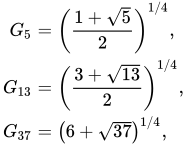
and one can easily get from these, as well as the more complicated examples found in Ramanujan's Notebooks.
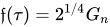
Relation to Jacobi theta functions
[edit]The argument of the classical Jacobi theta functions is traditionally the nome

![{\displaystyle {\begin{aligned}\vartheta _{10}(0;\tau )&=\theta _{2}(q)=\sum _{n=-\infty }^{\infty }q^{(n+1/2)^{2}}={\frac {2\eta ^{2}(2\tau )}{\eta (\tau )}},\\[2pt]\vartheta _{00}(0;\tau )&=\theta _{3}(q)=\sum _{n=-\infty }^{\infty }q^{n^{2}}\;=\;{\frac {\eta ^{5}(\tau )}{\eta ^{2}\left({\frac {\tau }{2}}\right)\eta ^{2}(2\tau )}}={\frac {\eta ^{2}\left({\frac {\tau +1}{2}}\right)}{\eta (\tau +1)}},\\[3pt]\vartheta _{01}(0;\tau )&=\theta _{4}(q)=\sum _{n=-\infty }^{\infty }(-1)^{n}q^{n^{2}}={\frac {\eta ^{2}\left({\frac {\tau }{2}}\right)}{\eta (\tau )}}.\end{aligned}}}](https://wikimedia.org/api/rest_v1/media/math/render/svg/c3e300f5c009f2bbbcf635af0396ddf692c7fbd0)
Dividing them by , and also noting that , then they are just squares of the Weber functions

![{\displaystyle {\begin{aligned}{\frac {\theta _{2}(q)}{\eta (\tau )}}&={\mathfrak {f}}_{2}(q)^{2},\\[4pt]{\frac {\theta _{4}(q)}{\eta (\tau )}}&={\mathfrak {f}}_{1}(q)^{2},\\[4pt]{\frac {\theta _{3}(q)}{\eta (\tau )}}&={\mathfrak {f}}(q)^{2},\end{aligned}}}](https://wikimedia.org/api/rest_v1/media/math/render/svg/0588ab25f6f0d2459d9cc4a905c44c9571b91dd2)
with even-subscript theta functions purposely listed first. Using the well-known Jacobi identity with even subscripts on the LHS,

therefore,

Relation to j-function
[edit]The three roots of the cubic equation
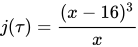
where j(τ) is the j-function are given by . Also, since,

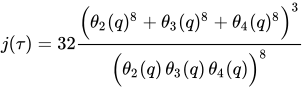
and using the definitions of the Weber functions in terms of the Jacobi theta functions, plus the fact that , then


since and have the same formulas in terms of the Dedekind eta function .
See also
[edit]References
[edit]- Duke, William (2005), Continued Fractions and Modular Functions (PDF), Bull. Amer. Math. Soc. 42
- Weber, Heinrich Martin (1981) [1898], Lehrbuch der Algebra (in German), vol. 3 (3rd ed.), New York: AMS Chelsea Publishing, ISBN 978-0-8218-2971-4
- Yui, Noriko; Zagier, Don (1997), "On the singular values of Weber modular functions", Mathematics of Computation, 66 (220): 1645–1662, doi:10.1090/S0025-5718-97-00854-5, MR 1415803
Notes
[edit]- ^ f, f1 and f2 are not modular functions (per the Wikipedia definition), but every modular function is a rational function in f, f1 and f2. Some authors use a non-equivalent definition of "modular functions".
- ^ https://www.math.ucla.edu/~wdduke/preprints/bams4.pdf Continued Fractions and Modular Functions, W. Duke, pp 22-23