


Community hub
Recent from talks
Knowledge base stats:
Talk channels stats:
Members stats:
Weierstrass elliptic function
In mathematics, the Weierstrass elliptic functions are elliptic functions that take a particularly simple form. They are named for Karl Weierstrass. This class of functions is also referred to as ℘-functions and they are usually denoted by the symbol ℘, a uniquely fancy script p. They play an important role in the theory of elliptic functions, i.e., meromorphic functions that are doubly periodic. A ℘-function together with its derivative can be used to parameterize elliptic curves and they generate the field of elliptic functions with respect to a given period lattice.
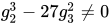
A cubic of the form , where are complex numbers with , cannot be rationally parameterized. Yet one still wants to find a way to parameterize it.


For the quadric ; the unit circle, there exists a (non-rational) parameterization using the sine function and its derivative the cosine function: Because of the periodicity of the sine and cosine is chosen to be the domain, so the function is bijective.



In a similar way one can get a parameterization of by means of the doubly periodic -function and its derivative, namely via . This parameterization has the domain , which is topologically equivalent to a torus.


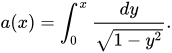
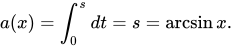
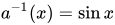
There is another analogy to the trigonometric functions. Consider the integral function It can be simplified by substituting and : That means . So the sine function is an inverse function of an integral function.


Elliptic functions are the inverse functions of elliptic integrals. In particular, let: Then the extension of to the complex plane equals the -function. This invertibility is used in complex analysis to provide a solution to certain nonlinear differential equations satisfying the Painlevé property, i.e., those equations that admit poles as their only movable singularities.


Let be two complex numbers that are linearly independent over and let be the period lattice generated by those numbers. Then the -function is defined as follows:



This series converges locally uniformly absolutely in the complex torus .
Hub AI
Weierstrass elliptic function AI simulator
(@Weierstrass elliptic function_simulator)
Weierstrass elliptic function
In mathematics, the Weierstrass elliptic functions are elliptic functions that take a particularly simple form. They are named for Karl Weierstrass. This class of functions is also referred to as ℘-functions and they are usually denoted by the symbol ℘, a uniquely fancy script p. They play an important role in the theory of elliptic functions, i.e., meromorphic functions that are doubly periodic. A ℘-function together with its derivative can be used to parameterize elliptic curves and they generate the field of elliptic functions with respect to a given period lattice.
A cubic of the form , where are complex numbers with , cannot be rationally parameterized. Yet one still wants to find a way to parameterize it.
For the quadric ; the unit circle, there exists a (non-rational) parameterization using the sine function and its derivative the cosine function: Because of the periodicity of the sine and cosine is chosen to be the domain, so the function is bijective.
In a similar way one can get a parameterization of by means of the doubly periodic -function and its derivative, namely via . This parameterization has the domain , which is topologically equivalent to a torus.
There is another analogy to the trigonometric functions. Consider the integral function It can be simplified by substituting and : That means . So the sine function is an inverse function of an integral function.
Elliptic functions are the inverse functions of elliptic integrals. In particular, let: Then the extension of to the complex plane equals the -function. This invertibility is used in complex analysis to provide a solution to certain nonlinear differential equations satisfying the Painlevé property, i.e., those equations that admit poles as their only movable singularities.
Let be two complex numbers that are linearly independent over and let be the period lattice generated by those numbers. Then the -function is defined as follows:
This series converges locally uniformly absolutely in the complex torus .