



Community hub
Western Interconnection
View on Wikipedia

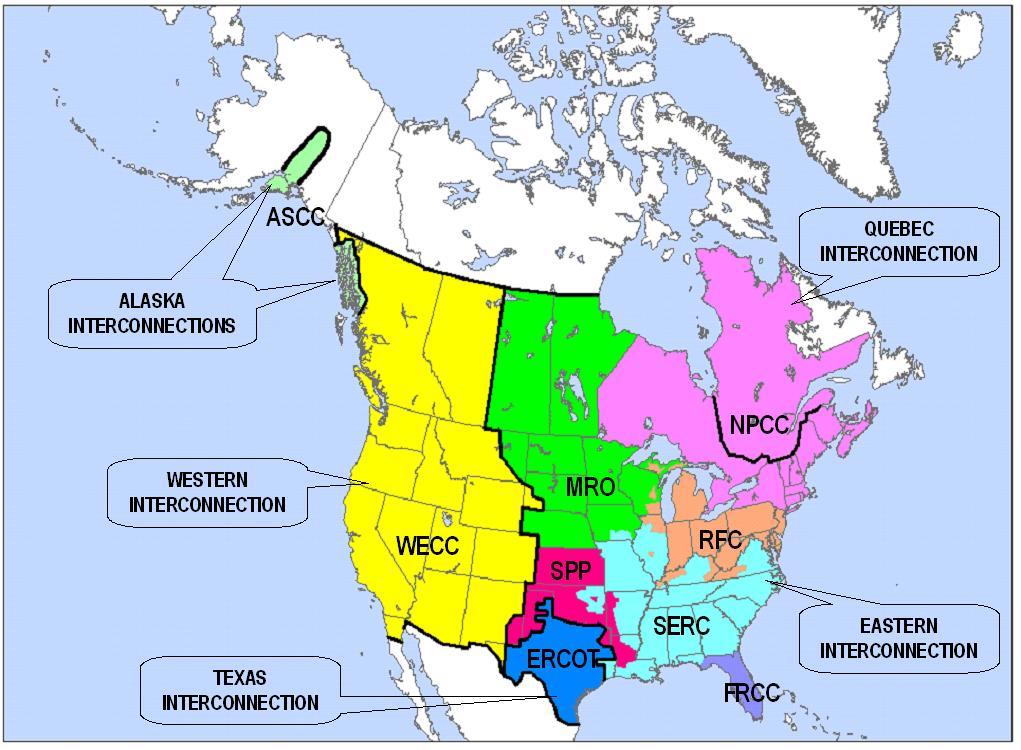
The Western Interconnection is a wide area synchronous grid and one of the two major alternating current (AC) power grids in the North American power transmission grid. The other major wide area synchronous grid is the Eastern Interconnection. The minor interconnections are the Québec Interconnection, the Texas Interconnection, and the Alaska Interconnections.
All of the electric utilities in the Western Interconnection are electrically tied together during normal system conditions and operate at a synchronized frequency of 60 Hz. The Western Interconnection stretches from Western Canada south to Baja California in Mexico, reaching eastward over the Rockies to the Great Plains.
Interconnections can be tied to each other via high-voltage direct current power transmission lines (DC ties) such as the north-south Pacific DC Intertie, or with variable-frequency transformers (VFTs), which permit a controlled flow of energy while also functionally isolating the independent AC frequencies of each side. There are six DC ties to the Eastern Interconnection in the US and one in Canada,[1] and there are proposals to add four additional ties.[2] It is not tied to the Alaska Interconnection.
Consumption
[edit]In 2015, WECC had an energy consumption of 883 TWh, roughly equally distributed between industrial, commercial and residential consumption. There was a summer peak demand of 150,700 MW and a winter peak demand (2014–15) of 126,200 MW.[3]
Production
[edit]The region had a nameplate capacity of 265 GW in 2015, 276 GW in 2019, and 286 GW in 2021.[4] Together, wind, solar, and hydro resources account for 47% of installed capacity. Installed coal capacity was 24 GW, compared to roughly 34 GW of wind and 28 GW of solar. While the resource mix is changing, with wind and solar eclipsing coal in installed capacity, in 2021 coal still generated slightly more power than wind and solar combined, down from twice as much in 2017.[3][4]
See also
[edit]References
[edit]- ^ "Transmission". Archived from the original on 2014-12-24. Retrieved 2014-03-14.
- ^ Visualizing The U.S. Electric Grid
- ^ a b 2016 State of the Interconnection page 10-14 + 18-23. WECC, 2016. Archive
- ^ a b "State of the Interconnection 2023" (PDF). wecc.org. March 24, 2023. Archived (PDF) from the original on May 23, 2023. Retrieved May 26, 2023.
Further reading
[edit]Western Interconnection
View on GrokipediaOverview and Scope
Definition and Boundaries
The Western Interconnection is one of North America's two major synchronous alternating current (AC) power grids, alongside the Eastern Interconnection, and operates as a vast, interconnected electrical system where all components maintain synchronization at a nominal frequency of 60 Hz, forming a single "electrical island" isolated from other grids by limited asynchronous ties.[1] This synchronization ensures that generators, transmission lines, and loads across the region function in unison, allowing for coordinated power flow and reliability under normal conditions.[1] The grid's design as a synchronous network distinguishes it from asynchronous connections, such as high-voltage direct current (HVDC) lines that link it sparingly to adjacent systems, preventing widespread frequency disturbances from propagating.[9] Geographically, the Western Interconnection spans approximately 1.8 million square miles, extending from the Rocky Mountains westward to the Pacific Ocean and from the provinces of western Canada southward to Baja California in Mexico.[14] This expansive footprint encompasses diverse terrains, including deserts, mountains, and coastal areas, and covers portions of two Canadian provinces—Alberta and British Columbia—as well as the northern part of Baja California, Mexico.[15] In the United States, it primarily serves 11 states: Arizona, California, Colorado, Idaho, Montana, Nevada, New Mexico, Oregon, Utah, Washington, and Wyoming, delivering electricity to over 80 million people through an integrated network of generation and transmission infrastructure.[16] Unlike the Eastern Interconnection, which covers the eastern two-thirds of the contiguous United States and parts of Canada, or the Texas Interconnection (ERCOT), a standalone synchronous grid serving most of Texas, the Western Interconnection remains electrically isolated as a distinct asynchronous entity, with power exchanges between these systems limited to specific interties to maintain operational independence and stability.[17] This separation underscores the Western Interconnection's unique role in managing regional reliability, overseen by the Western Electricity Coordinating Council (WECC) as the designated entity under North American Electric Reliability Corporation (NERC) standards.[18]Significance to North America
The Western Interconnection plays a pivotal role in supporting the economic vitality of western North America by delivering reliable electricity to a diverse array of industries across its vast footprint. It powers the technology sector in California, where data centers and semiconductor manufacturing drive innovation and employment; facilitates mining operations in the Rocky Mountains, essential for extracting critical minerals like copper and uranium; and sustains agriculture in the Southwest, including irrigation-dependent farming in Arizona and irrigation systems in California's Central Valley. These contributions enhance regional gross domestic product, with studies estimating that improved grid coordination could yield billions in annual economic benefits through reduced energy costs and increased efficiency. Reliability within the Western Interconnection is crucial for averting disruptions that could ripple through cross-border trade and affect daily life for approximately 80 million residents in the U.S., Canada, and parts of Mexico. The grid manages highly variable electricity loads stemming from diverse climates, ranging from arid deserts in the Southwest to snowy peaks in the Rockies and coastal influences in the Pacific Northwest, thereby minimizing blackout risks that might otherwise halt commerce and essential services. Interconnected operations help maintain stability, ensuring continuous power for transportation, healthcare, and manufacturing sectors that underpin North American economic interdependence.[16][19] The interconnection facilitates seamless power sharing during periods of shortage, exemplified by hydroelectric exports from British Columbia, Canada, via BC Hydro to the U.S. Northwest, which can then be transmitted southward to meet peak demands in the Southwest. This cross-border exchange, supported by multiple transmission interties, bolsters energy security and affordability by balancing seasonal surpluses and deficits across the region. In comparison to other North American grids, the Western Interconnection spans a larger geographical area—about 1.8 million square miles—than the ERCOT grid in Texas (268,000 square miles) but serves a smaller population than the Eastern Interconnection (approximately 240 million), presenting unique challenges such as transmitting power over extended distances through rugged terrain and public lands.[20][21][16]Historical Development
Early Formation and Evolution
The origins of the Western Interconnection trace back to the 1920s and 1930s, when early hydroelectric projects in the western United States began linking local power systems through nascent transmission networks. During this period, the construction of major federal dams, such as Hoover Dam completed in 1936 on the Colorado River, enabled initial power exports over long distances, including a 266-mile transmission line to Los Angeles that marked one of the first large-scale interconnections in the region.[22] Precursors to the Bonneville Power Administration (BPA), established by the Bonneville Project Act of 1937, facilitated the integration of Bonneville Dam's output starting in 1938, with short initial lines connecting the dam to nearby load centers in Oregon and Washington.[22] These developments were driven by the need for flood control, irrigation, and electrification in arid western states, laying the groundwork for broader utility ties without centralized oversight.[23] Post-World War II expansion accelerated the interconnection's growth, particularly through federal hydroelectric investments that tied utilities across multiple states. The completion of Grand Coulee Dam in 1941 on the Columbia River provided substantial capacity, which the BPA integrated via the "Master Grid" transmission system initiated in 1938 and largely completed by 1945, encompassing 2,736 miles of lines and 55 substations at voltages up to 230 kV.[24] This network connected Bonneville and Grand Coulee Dams to regional utilities, including the formation of the Northwest Power Pool in 1942, which linked BPA with 10 public and private entities in the Pacific Northwest for coordinated power sharing.[25] By the late 1940s, these ties extended northward, with a 230-kV line to Canadian utilities at Blaine, Washington, in 1947, fostering a more cohesive system amid postwar industrial demands.[24] In the 1960s and 1970s, the evolving network prompted the creation of formal coordination mechanisms to address increasing interdependencies, culminating in the formation of the Western Systems Coordinating Council (WSCC) in 1967 by 40 interconnected power systems.[18] The WSCC aimed to enhance reliability through planning and operational coordination, particularly as growing transmission ties strained isolated utility operations during the 1973 oil crisis, which heightened concerns over energy security and supply disruptions.[18] This era saw the introduction of higher-voltage lines, such as 500-kV facilities like the Big Eddy-Keeler line in 1964, further binding the region.[24] The Western Interconnection's development remained largely organic, propelled by individual utility requirements for reliable supply rather than top-down federal planning, resulting in a sprawling network by the late 20th century that spanned from Canada to Mexico.[24] Expansions, such as the Pacific Northwest-Pacific Southwest Intertie completed in 1970, indirectly incorporated distant resources like Hoover Dam into the broader system, emphasizing practical responses to load growth and resource distribution.[26] This decentralized approach allowed for adaptive growth, with BPA's network alone reaching over 12,000 circuit miles by 1974 through incremental additions of steel-tower and wood-pole lines.[24]Key Milestones and Regulatory Changes
The 2000-2001 California energy crisis marked a critical turning point for the Western Interconnection, characterized by widespread blackouts, soaring wholesale electricity prices that reached over $1,000 per megawatt-hour in some instances, and severe financial strain on utilities due to market manipulations and structural flaws in California's deregulated market design.[27] This event, exacerbated by drought-induced supply shortages and Enron's gaming strategies, exposed vulnerabilities in regional coordination and transmission planning across the interconnection, prompting federal intervention to stabilize markets and prevent cascading failures.[28] In response, the Federal Energy Regulatory Commission (FERC) accelerated the implementation of Order No. 2000, issued in December 1999, which mandated the formation of Regional Transmission Organizations (RTOs) to enhance interregional planning, mitigate congestion, and improve overall reliability in areas like the Western Interconnection. Following the crisis and amid heightened scrutiny from the Enron scandal, which revealed systemic risks in energy trading and reliability oversight, the Western Systems Coordinating Council (WSCC) transitioned to the Western Electricity Coordinating Council (WECC) in April 2002 through a merger with the Western Regional Transmission Association and the Southwest Regional Transmission Association.[18] This restructuring expanded WECC's scope to include transmission planning and market interface functions while aligning it more closely with the North American Electric Reliability Corporation (NERC), establishing WECC as the designated Regional Entity for enforcing reliability standards in the Western Interconnection by 2007.[29] Between 2011 and 2018, WECC implemented key NERC reliability standards to bolster grid stability, including PRC-024-1, approved by FERC in 2014 and effective in 2016, which required generating resources to maintain frequency and voltage protection settings to prevent involuntary losses during disturbances. Subsequent revisions, such as PRC-024-2 in 2015, further refined ride-through requirements for generators to support system recovery.[30] The period also saw increased emphasis on wildfire mitigation following the devastating 2018 California wildfires, including the Camp Fire, which destroyed transmission infrastructure and caused widespread outages, leading WECC to initiate assessments and develop strategies for protecting the bulk electric system from fire-induced reliability threats.[31] In the 2020s, the U.S. Department of Energy's National Transmission Planning Study (NTP Study), released in October 2024, has driven interconnection-wide transmission planning efforts to meet decarbonization objectives, including a 90% reduction in power-sector CO2 emissions by 2035 relative to 2005 levels.[32] The study's Western Interconnection Baseline analysis demonstrates that targeted transmission expansions, combined with high renewable penetration, could achieve a 73% emissions reduction by 2030 while lowering generation costs by 32%, underscoring the need for coordinated regional upgrades to integrate clean energy and enhance resilience.[33]Geographical Coverage
Regions and Jurisdictions Served
The Western Interconnection serves all or portions of 14 U.S. states, spanning from the Pacific Coast to the Rocky Mountains and encompassing key sub-regions that reflect diverse geographic, climatic, and energy characteristics. The Southwest sub-region includes Arizona, New Mexico, and southern Nevada, where arid conditions and solar potential shape local grid dynamics.[33] The Pacific Northwest covers Washington, Oregon, Idaho, and the western portion of Montana, benefiting from abundant hydropower resources in river basins.[34] California operates as a distinct major region, given its vast population, isolated grid segments, and emphasis on renewable integration.[18] The Rockies sub-region comprises Colorado, Utah, and Wyoming, featuring high-elevation terrain and growing wind energy development.[33] Portions of additional states, such as western Texas, Nebraska, and South Dakota, also fall within the interconnection's footprint, though their involvement is more limited.[18] In Canada, the interconnection includes the provinces of Alberta and British Columbia, which contribute significantly through their generation portfolios—hydro accounts for approximately 97% of British Columbia's electricity generation and about 3% in Alberta—facilitating exports southward to meet U.S. demand, particularly during peak periods.[35][36][18] The southern extension reaches the northern portion of Baja California in Mexico, interconnected primarily via high-voltage transmission lines linking San Diego, California, to Tijuana and Mexicali, enabling bidirectional power flows to support regional reliability and renewable exchanges.[1] Cross-border power flows within the Western Interconnection are governed by international treaties, such as the U.S.-Canada Electric Reliability Council framework and bilateral agreements with Mexico's Comisión Federal de Electricidad, promoting coordinated operations and economic dispatch across jurisdictions while ensuring grid stability. These dynamics support integrated energy markets, with notable hydro exports from Canada and emerging renewable ties to Mexico.Major Balancing Authorities
The Western Interconnection encompasses approximately 38 balancing authorities responsible for maintaining real-time balance between electricity supply and demand across their respective areas, ensuring grid reliability through coordinated operations.[37] These entities monitor generation, manage reserves, and facilitate power exchanges to respond to fluctuations, operating under Western Electricity Coordinating Council (WECC) regional reliability standards that promote seamless interconnection-wide coordination.[38] WECC oversees these authorities to enforce compliance with protocols for frequency control and contingency planning. The California Independent System Operator (CAISO) serves as the largest balancing authority in the Western Interconnection, managing about 35% of the region's electric load.[37] It oversees a peak load of approximately 46,000 MW within California, integrating high levels of renewable energy such as solar and wind, which can constitute over 50% of supply during certain periods.[39] CAISO's operations focus on maintaining grid stability amid variable renewable output through advanced forecasting and resource dispatch.[40] The Bonneville Power Administration (BPA) operates a key balancing authority in the Pacific Northwest, primarily leveraging federal hydroelectric resources to serve loads across Washington, Oregon, Idaho, and Montana.[41] It balances a regional peak load of around 30,000 MW, with hydroelectric generation providing the majority of its capacity, enabling flexible response to seasonal water availability and demand variations.[42] BPA coordinates with neighboring utilities to optimize hydro-dominated supply for the area's industrial and residential needs.[43] Other significant balancing authorities include the Western Area Power Administration (WAPA), which manages operations in the Rockies and Southwest regions spanning multiple states such as Colorado, Arizona, and New Mexico.[44] WAPA operates four control centers to balance federal hydropower and transmission across its territories, supporting loads in arid and mountainous areas with a focus on cost-based delivery to utilities.[45] In Canada, the Alberta Electric System Operator (AESO) functions as a balancing authority for Alberta, handling a winter peak load of about 12,750 MW while interconnecting with the U.S. portion via AC ties.[46] Smaller entities, such as NV Energy in Nevada, manage localized loads around 8,000 MW, contributing to broader exchanges through WECC protocols.[47]Technical Specifications
Frequency Synchronization and Response
The Western Interconnection operates as a synchronous alternating current (AC) power grid, where all generators, transmission lines, and loads are interconnected and must maintain a precisely synchronized frequency of 60 Hz to ensure stable power exchange and prevent system-wide disruptions such as blackouts.[48] This synchronization is achieved through the inherent coupling of synchronous generators, which rotate at speeds tied to the grid frequency, allowing real-time balancing of generation and demand across the vast region from Western Canada to Baja California.[49] Deviations from 60 Hz signal an imbalance, prompting automatic adjustments to restore equilibrium and avoid cascading failures. To maintain this stability, the Western Interconnection adheres to the Frequency Response Obligation (FRO) established under NERC Reliability Standard BAL-003-2, which requires the system to arrest frequency declines following major disturbances by increasing generation output.[50] For the 2025 operating year, the Interconnection Frequency Response Obligation (IFRO) is set at -1,041.80 MW per 0.1 Hz deviation, meaning the collective response from resources must provide at least this amount of upward power adjustment for every 0.1 Hz drop below 60 Hz.[51] This obligation is met primarily through rapid governor responses from conventional synchronous resources, such as hydroelectric and natural gas plants, which automatically increase output within seconds of detecting frequency changes.[52] The FRO is allocated proportionally among balancing authorities based on their share of the interconnection's peak demand, ensuring coordinated reliability.[51] Frequency control and monitoring in the Western Interconnection are governed by NERC Standard BAL-001-2, which mandates balancing authorities to maintain interconnection frequency within predefined limits through real-time area control error (ACE) management and performance metrics like Control Performance Standard 1 (CPS1). This standard requires CPS1 to average at least 100% annually, verifying that frequency deviations are minimized over time. As a protective measure, under-frequency load shedding (UFLS) is implemented if frequency falls below 59.5 Hz, automatically disconnecting blocks of load to prevent further decline and potential blackout, in line with WECC's off-nominal frequency plan.[53] The increasing penetration of inverter-based resources (IBRs), such as solar photovoltaic and wind generation, poses challenges to frequency response in the Western Interconnection, as these resources lack the inherent rotational inertia and governor mechanisms of traditional synchronous generators, leading to faster frequency swings and reduced natural damping. IBRs provide limited primary frequency response without modifications, exacerbating risks during low-inertia conditions when renewables dominate the generation mix. To address this, synthetic inertia technologies are being adopted, enabling IBRs to emulate inertial response through fast frequency regulation via power electronics, injecting or absorbing power rapidly to mimic the stabilizing effects of conventional plants.[52] NERC Standard PRC-029-1, effective August 28, 2025, requires IBRs connected to the bulk electric system to provide specified frequency and voltage ride-through capabilities to mitigate these risks. WECC and NERC guidelines emphasize grid-forming capabilities and fast frequency response in IBR interconnections to enhance overall system resilience.Voltage Levels and Transmission Standards
The Western Interconnection utilizes a hierarchical voltage system to enable efficient bulk power transfer, sub-transmission, and local distribution across its expansive footprint. High-voltage alternating current (AC) transmission lines, typically operating at 230 kV, 345 kV, and 500 kV, form the backbone for long-distance conveyance of electricity from generation sources to load centers, reducing resistive losses in conductors over distances that can span thousands of miles.[54] Sub-transmission lines, rated between 69 kV and 161 kV, serve as an intermediary layer, linking high-voltage transmission networks to distribution substations while supporting regional power flows and redundancy.[54] Distribution systems further step down voltages to primary levels of 12 kV to 35 kV for delivery to urban and rural feeders, with final transformers reducing this to 120/240 V single-phase or 208/480 V three-phase for end-user consumption in residential, commercial, and industrial settings.[55][56] To maintain stability during faults and disturbances, the interconnection follows North American Electric Reliability Corporation (NERC) Standard PRC-024-4, effective August 28, 2025, which mandates specific voltage ride-through capabilities for synchronous generators, Type 1 and Type 2 wind resources, and synchronous condensers connected to the bulk electric system. This standard requires generating units to remain in operation through defined voltage dips and swells—such as 0.0 to 0.88 per unit for up to 10 cycles—without tripping, thereby preventing cascading outages; the Western Electricity Coordinating Council (WECC) oversees compliance and enforcement of this standard regionally.[38][57] The scale of this infrastructure underscores its design for reliability over vast terrains, encompassing approximately 158,000 miles of transmission lines in total, of which federal operators like the Western Area Power Administration manage over 17,000 circuit-miles optimized for minimal losses through high-conductivity materials and strategic routing.[58][3]| Voltage Category | Typical Levels (kV) | Primary Function |
|---|---|---|
| High-Voltage Transmission | 230, 345, 500 | Long-distance bulk power transfer |
| Sub-Transmission | 69–161 | Regional connectivity to distribution |
| Primary Distribution | 12–35 | Local delivery to end-users |
| Utilization (Consumer) | 0.12/0.24 | Household and commercial loads |
Electricity Generation
Primary Energy Sources
The primary energy sources in the Western Interconnection reflect a diverse mix dominated by natural gas and hydroelectric power, with growing contributions from renewables and a declining role for coal. In 2023, natural gas accounted for approximately 38% of net electricity generation, serving as the largest source due to its flexibility and prevalence in combined-cycle and peaker plants, particularly in California and the Southwest, where it supports peak demand and renewable variability.[59] Hydroelectric power contributed about 16% of generation, primarily from large-scale federal projects in the Pacific Northwest, including the Columbia River system with a federal capacity of 10,479 MW managed by entities like the Bonneville Power Administration.[59] Renewable sources have expanded significantly, comprising around 26% of the 2023 generation mix. Wind power provided 14-15%, concentrated in the Rocky Mountains and Pacific Northwest regions, where onshore facilities leverage consistent wind resources for baseload and intermediate supply. Solar generation reached about 10%, driven by utility-scale photovoltaic and concentrating solar projects in the Southwest deserts of Arizona, Nevada, and California, with rapid growth reflecting favorable solar irradiance and policy incentives. Geothermal energy, unique to California due to its tectonic activity and the Geysers field, supplied roughly 1% but offers reliable baseload output from enhanced geothermal systems.[59] Other sources include coal at under 10% (9% in 2023), which has been declining amid retirements and shifts to cleaner alternatives, particularly in the Mountain West states like Wyoming and Montana. Nuclear power contributes about 2%, led by the Palo Verde Generating Station in Arizona with a capacity of approximately 4,000 MW, providing steady baseload from its three pressurized water reactors. Oil-based generation remains minimal, typically under 1%, used only for emergency or remote applications.[59][60]| Energy Source | Approximate Share of 2023 Net Generation (%) | Key Regions/Notes |
|---|---|---|
| Natural Gas | 38 | Flexible peakers in CA/SW |
| Hydroelectric | 16 | Federal PNW projects |
| Wind | 14-15 | Rockies/PNW |
| Solar | 10 | SW deserts |
| Coal | 9 | Declining in Mountain West |
| Nuclear | 2 | Palo Verde (AZ) |
| Geothermal | 1 | CA-specific |
| Other (incl. oil) | <1 | Minimal/emergency use |