Recent from talks
Nothing was collected or created yet.
Energy storage
View on Wikipedia

| Part of a series on |
| Power engineering |
|---|
| Electric power conversion |
| Electric power infrastructure |
| Electric power systems components |
| Part of a series on |
| Sustainable energy |
|---|
Energy storage is the capture of energy produced at one time for use at a later time[1] to reduce imbalances between energy demand and energy production. A device that stores energy is generally called an accumulator or battery. Energy comes in multiple forms including radiation, chemical, gravitational potential, electrical potential, electricity, elevated temperature, latent heat and kinetic. Energy storage involves converting energy from forms that are difficult to store to more conveniently or economically storable forms.
Some technologies provide short-term energy storage, while others can endure for much longer. Bulk energy storage is currently dominated by hydroelectric dams, both conventional as well as pumped. Grid energy storage is a collection of methods used for energy storage on a large scale within an electrical power grid.
Common examples of energy storage are the rechargeable battery, which stores chemical energy readily convertible to electricity to operate a mobile phone; the hydroelectric dam, which stores energy in a reservoir as gravitational potential energy; and ice storage tanks, which store ice frozen by cheaper energy at night to meet peak daytime demand for cooling. Fossil fuels such as coal and gasoline store ancient energy derived from sunlight by organisms that later died, became buried and over time were then converted into these fuels. Food (which is made by the same process as fossil fuels) is a form of energy stored in chemical form.
History
[edit]In the 20th century grid, electrical power was largely generated by burning fossil fuel. When less power was required, less fuel was burned.[2] Hydropower, a mechanical energy storage method, is the most widely adopted mechanical energy storage, and has been in use for centuries. Large hydropower dams have been energy storage sites for more than one hundred years.[3] Concerns with air pollution, energy imports, and global warming have spawned the growth of renewable energy such as solar and wind power.[2] Wind power is uncontrolled and may be generating at a time when no additional power is needed. Solar power varies with cloud cover and at best is only available during daylight hours, while demand often peaks after sunset (see duck curve). Interest in storing power from these intermittent sources grows as the renewable energy industry begins to generate a larger fraction of overall energy consumption.[4] In 2023 BloombergNEF forecast total energy storage deployments to grow at a compound annual growth rate of 27 percent through 2030.[5]
Off grid electrical use was a niche market in the 20th century, but in the 21st century, it has expanded. Portable devices are in use all over the world. Solar panels are now common in the rural settings worldwide. Access to electricity is now a question of economics and financial viability, and not solely on technical aspects. Electric vehicles are gradually replacing combustion-engine vehicles. However, powering long-distance transportation without burning fuel remains in development.
Methods
[edit]
Outline
[edit]The following list includes a variety of types of energy storage:
- Fossil fuel storage
- Mechanical
- Spring
- Compressed-air energy storage (CAES)
- Fireless locomotive
- Flywheel energy storage
- Solid mass gravitational
- Hydraulic accumulator
- Pumped-storage hydroelectricity (a.k.a. pumped hydroelectric storage, PHS, or pumped storage hydropower, PSH)
- Thermal expansion
- Electrical, electromagnetic
- Capacitor
- Supercapacitor
- Superconducting magnetic energy storage (SMES, also superconducting storage coil)
- Biological
- Electrochemical (battery energy storage system, BESS)
- Thermal
- Chemical
Mechanical
[edit]
Energy can be stored in water pumped to a higher elevation using pumped storage methods or by moving solid matter to higher locations (gravity batteries). Other commercial mechanical methods include compressing air and flywheels that convert electric energy into internal energy or kinetic energy and then back again when electrical demand peaks.
Hydroelectricity
[edit]Hydroelectric dams with reservoirs can be operated to provide electricity at times of peak demand. Water is stored in the reservoir during periods of low demand and released when demand is high. The net effect is similar to pumped storage, but without the pumping loss.
While a hydroelectric dam does not directly store energy from other generating units, it behaves equivalently by lowering output in periods of excess electricity from other sources. In this mode, dams are one of the most efficient forms of energy storage, because only the timing of its generation changes. Hydroelectric turbines have a start-up time on the order of a few minutes.[6]
Pumped hydro
[edit]
Worldwide, pumped-storage hydroelectricity (PSH) is the largest-capacity form of active grid energy storage available, and, as of March 2012, the Electric Power Research Institute (EPRI) reports that PSH accounts for more than 99% of bulk storage capacity worldwide, representing around 127,000 MW.[7] PSH energy efficiency varies in practice between 70% and 80%,[7][8][9][10] with claims of up to 87%.[11]
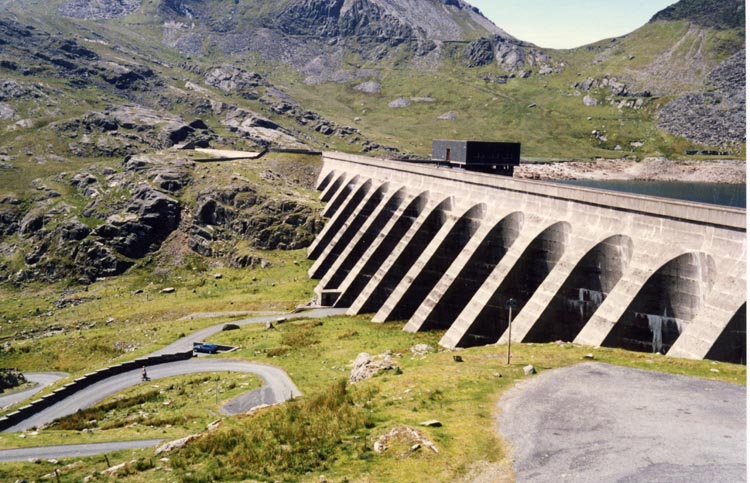
At times of low electrical demand, excess generation capacity is used to pump water from a lower source into a higher reservoir. When demand grows, water is released back into a lower reservoir (or waterway or body of water) through a turbine, generating electricity. Reversible turbine-generator assemblies act as both a pump and turbine (usually a Francis turbine design). Nearly all facilities use the height difference between two water bodies. Pure pumped-storage plants shift the water between reservoirs, while the "pump-back" approach is a combination of pumped storage and conventional hydroelectric plants that use natural stream-flow.
Compressed air
[edit]
Compressed-air energy storage (CAES) uses surplus energy to compress air for subsequent electricity generation.[12] Small-scale systems have long been used in such applications as propulsion of mine locomotives. The compressed air is stored in an underground reservoir, such as a salt dome.
Compressed-air energy storage (CAES) plants can bridge the gap between production volatility and load. CAES storage addresses the energy needs of consumers by effectively providing readily available energy to meet demand. Renewable energy sources like wind and solar energy vary. So at times when they provide little power, they need to be supplemented with other forms of energy to meet energy demand. Compressed-air energy storage plants can take in the surplus energy output of renewable energy sources during times of energy over-production. This stored energy can be used at a later time when demand for electricity increases or energy resource availability decreases.[13]
Compression of air creates heat; the air is warmer after compression. Expansion requires heat. If no extra heat is added, the air will be much colder after expansion. If the heat generated during compression can be stored and used during expansion, efficiency improves considerably.[14] A CAES system can deal with the heat in three ways. Air storage can be adiabatic, diabatic, or isothermal. Another approach uses compressed air to power vehicles.[15][16]
Flywheel
[edit]

Flywheel energy storage (FES) works by accelerating a rotor (a flywheel) to a very high speed, holding energy as rotational energy. When energy is added the rotational speed of the flywheel increases, and when energy is extracted, the speed declines, due to conservation of energy.
Most FES systems use electricity to accelerate and decelerate the flywheel, but devices that directly use mechanical energy are under consideration.[17]
FES systems have rotors made of high strength carbon-fiber composites, suspended by magnetic bearings and spinning at speeds from 20,000 to over 50,000 revolutions per minute (rpm) in a vacuum enclosure.[18] Such flywheels can reach maximum speed ("charge") in a matter of minutes. The flywheel system is connected to a combination electric motor/generator.
FES systems have relatively long lifetimes (lasting decades with little or no maintenance;[18] full-cycle lifetimes quoted for flywheels range from in excess of 105, up to 107, cycles of use),[19] high specific energy (100–130 W·h/kg, or 360–500 kJ/kg)[19][20] and power density.
Solid mass gravitational
[edit]Changing the altitude of solid masses can store or release energy via an elevating system driven by an electric motor/generator. Studies suggest energy can begin to be released with as little as 1 second warning, making the method a useful supplemental feed into an electricity grid to balance load surges.[21]
Efficiencies can be as high as 85% recovery of stored energy.[22]
This can be achieved by siting the masses inside old vertical mine shafts or in specially constructed towers where the heavy weights are winched up to store energy and allowed a controlled descent to release it. At 2020 a prototype vertical store is being built in Edinburgh, Scotland[23]
Potential energy storage or gravity energy storage was under active development in 2013 in association with the California Independent System Operator.[24][25][26] It examined the movement of earth-filled hopper rail cars driven by electric locomotives from lower to higher elevations.[27]
Other proposed methods include:-
- using rails,[27][28] cranes,[22] or elevators[29] to move weights up and down;
- using high-altitude solar-powered balloon platforms supporting winches to raise and lower solid masses slung underneath them,[30]
- using winches supported by an ocean barge to take advantage of a 4 km (13,000 ft) elevation difference between the sea surface and the seabed,[31]

Thermal
[edit]Thermal energy storage (TES) is the temporary storage or removal of heat.
Sensible heat thermal
[edit]Sensible heat storage take advantage of sensible heat in a material to store energy.[32]
Seasonal thermal energy storage (STES) allows heat or cold to be used months after it was collected from waste energy or natural sources. The material can be stored in contained aquifers, clusters of boreholes in geological substrates such as sand or crystalline bedrock, in lined pits filled with gravel and water, or water-filled mines.[33] Seasonal thermal energy storage (STES) projects often have paybacks in four to six years.[34] An example is Drake Landing Solar Community in Canada, for which 97% of the year-round heat is provided by solar-thermal collectors on garage roofs, enabled by a borehole thermal energy store (BTES).[35][36][37] In Braedstrup, Denmark, the community's solar district heating system also uses STES, at a temperature of 65 °C (149 °F). A heat pump, which runs only while surplus wind power is available. It is used to raise the temperature to 80 °C (176 °F) for distribution. When wind energy is not available, a gas-fired boiler is used. Twenty percent of Braedstrup's heat is solar.[38]
Latent heat thermal (LHTES)
[edit]Latent heat thermal energy storage systems work by transferring heat to or from a material to change its phase. A phase-change is the melting, solidifying, vaporizing or liquifying. Such a material is called a phase change material (PCM). Materials used in LHTESs often have a high latent heat so that at their specific temperature, the phase change absorbs a large amount of energy, much more than sensible heat.[39]
A steam accumulator is a type of LHTES where the phase change is between liquid and gas and uses the latent heat of vaporization of water. Ice storage air conditioning systems use off-peak electricity to store cold by freezing water into ice. The stored cold in ice releases during melting process and can be used for cooling at peak hours.
Cryogenic thermal energy storage
[edit]Air can be liquefied by cooling using electricity and stored as a cryogen with existing technologies. The liquid air can then be expanded through a turbine and the energy recovered as electricity. The system was demonstrated at a pilot plant in the UK in 2012.[40] In 2019, Highview announced plans to build a 50 MW in the North of England and northern Vermont, with the proposed facility able to store five to eight hours of energy, for a 250–400 MWh storage capacity.[41]
Carnot battery
[edit]Electrical energy can be stored thermally by resistive heating or heat pumps, and the stored heat can be converted back to electricity via Rankine cycle or Brayton cycle.[42] This technology has been studied to retrofit coal-fired power plants into fossil-fuel free generation systems.[43] Coal-fired boilers are replaced by high-temperature heat storage charged by excess electricity from renewable energy sources. In 2020, German Aerospace Center started to construct the world's first large-scale Carnot battery system, which has 1,000 MWh storage capacity.[44]
Electrochemical
[edit]Rechargeable battery
[edit]
A rechargeable battery comprises one or more electrochemical cells. It is known as a 'secondary cell' because its electrochemical reactions are electrically reversible. Rechargeable batteries come in many shapes and sizes, ranging from button cells to megawatt grid systems.
Rechargeable batteries have lower total cost of use and environmental impact than non-rechargeable (disposable) batteries. Some rechargeable battery types are available in the same form factors as disposables. Rechargeable batteries have higher initial cost but can be recharged very cheaply and used many times.
Common rechargeable battery chemistries include:
- Lead–acid battery: Lead acid batteries hold the largest market share of electric storage products. A single cell produces about 2V when charged. In the charged state the metallic lead negative electrode and the lead sulfate positive electrode are immersed in a dilute sulfuric acid (H2SO4) electrolyte. In the discharge process electrons are pushed out of the cell as lead sulfate is formed at the negative electrode while the electrolyte is reduced to water.
- Lead–acid battery technology has been developed extensively. Upkeep requires minimal labor and its cost is low. The battery's available energy capacity is subject to a quick discharge resulting in a low life span and low energy density.[47]
- Nickel–cadmium battery (NiCd): Uses nickel oxide hydroxide and metallic cadmium as electrodes. Cadmium is a toxic element, and was banned for most uses by the European Union in 2004. Nickel–cadmium batteries have been almost completely replaced by nickel–metal hydride (NiMH) batteries.
- Nickel–metal hydride battery (NiMH): First commercial types were available in 1989.[48] These are now a common consumer and industrial type. The battery has a hydrogen-absorbing alloy for the negative electrode instead of cadmium.
- Lithium-ion battery: The choice in many consumer electronics and have one of the best energy-to-mass ratios and a very slow self-discharge when not in use.
- Lithium-ion polymer battery: These batteries are light in weight and can be made in any shape desired.
- Aluminium-sulfur battery with rock salt crystals as electrolyte: aluminium and sulfur are Earth-abundant materials and are much cheaper than traditional Lithium.[49]
Flow battery
[edit]A flow battery works by passing a solution over a membrane where ions are exchanged to charge or discharge the cell. Cell voltage is chemically determined by the Nernst equation and ranges, in practical applications, from 1.0 V to 2.2 V. Storage capacity depends on the volume of solution. A flow battery is technically akin both to a fuel cell and an electrochemical accumulator cell. Commercial applications are for long half-cycle storage such as backup grid power.
Supercapacitor
[edit]
Supercapacitors, also called electric double-layer capacitors (EDLC) or ultracapacitors, are a family of electrochemical capacitors[50] that do not have conventional solid dielectrics. Capacitance is determined by two storage principles, double-layer capacitance and pseudocapacitance.[51][52]
Supercapacitors bridge the gap between conventional capacitors and rechargeable batteries. They store the most energy per unit volume or mass (energy density) among capacitors. They support up to 10,000 farads/1.2 Volt,[53] up to 10,000 times that of electrolytic capacitors, but deliver or accept less than half as much power per unit time (power density).[50]
While supercapacitors have specific energy and energy densities that are approximately 10% of batteries, their power density is generally 10 to 100 times greater. This results in much shorter charge/discharge cycles. Also, they tolerate many more charge-discharge cycles than batteries.
Supercapacitors have many applications, including:
- Low supply current for memory backup in static random-access memory (SRAM)
- Power for cars, buses, trains, cranes and elevators, including energy recovery from braking, short-term energy storage and burst-mode power delivery
Chemical
[edit]Power-to-gas
[edit]
Power-to-gas is the conversion of electricity to a gaseous fuel such as hydrogen or methane. The three commercial methods use electricity to reduce water into hydrogen and oxygen by means of electrolysis.
In the first method, hydrogen is injected into the natural gas grid or is used for transportation. The second method is to combine the hydrogen with carbon dioxide to produce methane using a methanation reaction such as the Sabatier reaction, or biological methanation, resulting in an extra energy conversion loss of 8%. The methane may then be fed into the natural gas grid. The third method uses the output gas of a wood gas generator or a biogas plant, after the biogas upgrader is mixed with the hydrogen from the electrolyzer, to upgrade the quality of the biogas.
Hydrogen
[edit]The element hydrogen can be a form of stored energy. Hydrogen can produce electricity via a hydrogen fuel cell.
At penetrations below 20% of the grid demand, renewables do not severely change the economics; but beyond about 20% of the total demand,[54] external storage becomes important. If these sources are used to make ionic hydrogen, they can be freely expanded. A 5-year community-based pilot program using wind turbines and hydrogen generators began in 2007 in the remote community of Ramea, Newfoundland and Labrador.[55] A similar project began in 2004 on Utsira, a small Norwegian island.
Energy losses involved in the hydrogen storage cycle come from the electrolysis of water, liquification or compression of the hydrogen and conversion to electricity.[56]
Hydrogen can also be produced from aluminum and water by stripping aluminum's naturally occurring aluminum oxide barrier and introducing it to water. This method is beneficial because recycled aluminum cans can be used to generate hydrogen; however, systems to harness this option have not been commercially developed and are much more complex than electrolysis systems.[57] Common methods to strip the oxide layer include caustic catalysts such as sodium hydroxide and alloys with gallium, mercury and other metals.[58]
Underground hydrogen storage is the practice of hydrogen storage in caverns, salt domes and depleted oil and gas fields.[59][60] Large quantities of gaseous hydrogen have been stored in caverns by Imperial Chemical Industries for many years without any difficulties.[61] The European Hyunder project indicated in 2013 that storage of wind and solar energy using underground hydrogen would require 85 caverns.[62]
Powerpaste is a magnesium and hydrogen -based fluid gel that releases hydrogen when reacting with water. It was invented, patented and is being developed by the Fraunhofer Institute for Manufacturing Technology and Advanced Materials (IFAM) of the Fraunhofer-Gesellschaft. Powerpaste is made by combining magnesium powder with hydrogen to form magnesium hydride in a process conducted at 350 °C and five to six times atmospheric pressure. An ester and a metal salt are then added to make the finished product. Fraunhofer states that they are building a production plant slated to start production in 2021, which will produce 4 tons of Powerpaste annually.[63] Fraunhofer has patented their invention in the United States and EU.[64] Fraunhofer claims that Powerpaste is able to store hydrogen energy at 10 times the energy density of a lithium battery of a similar dimension and is safe and convenient for automotive situations.[63]
Methane
[edit]Methane is the simplest hydrocarbon with the molecular formula CH4. Methane is more easily stored and transported than hydrogen. Storage and combustion infrastructure (pipelines, gasometers, power plants) are mature.
Synthetic natural gas (syngas or SNG) can be created in a multi-step process, starting with hydrogen and oxygen. Hydrogen is then reacted with carbon dioxide in a Sabatier process, producing methane and water. Methane can be stored and later used to produce electricity. The resulting water is recycled, reducing the need for water. In the electrolysis stage, oxygen is stored for methane combustion in a pure oxygen environment at an adjacent power plant, eliminating nitrogen oxides.
Methane combustion produces carbon dioxide (CO2) and water. The carbon dioxide can be recycled to boost the Sabatier process and water can be recycled for further electrolysis. Methane production, storage and combustion recycles the reaction products.
The CO2 has economic value as a component of an energy storage vector, not a cost as in carbon capture and storage.
Power-to-liquid
[edit]Power-to-liquid is similar to power to gas except that the hydrogen is converted into liquids such as methanol or ammonia. These are easier to handle than gases, and require fewer safety precautions than hydrogen. They can be used for transportation, including aircraft, but also for industrial purposes or in the power sector.[65]
Biofuels
[edit]Various biofuels such as biodiesel, vegetable oil, alcohol fuels, or biomass can replace fossil fuels. Various chemical processes can convert the carbon and hydrogen in coal, natural gas, plant and animal biomass and organic wastes into short hydrocarbons suitable as replacements for existing hydrocarbon fuels. Examples are Fischer–Tropsch diesel, methanol, dimethyl ether and syngas. This diesel source was used extensively in World War II in Germany, which faced limited access to crude oil supplies. South Africa produces most of the country's diesel from coal for similar reasons.[66] A long term oil price above US$35/bbl may make such large scale synthetic liquid fuels economical.
Power-to-Solid
[edit]Similar to power-to-liquid and power-to-gas concepts, energy may be stored in solid materials, for example in metals[67][68] such as Iron, Aluminium and non-metallic materials such as Sulfur.[69] Energy in the form of electricity or solar heat is stored chemically and can be released on-demand. Historically, solid energy carriers have been long used in Fireworks and Rockets.
Aluminum
[edit]Aluminum has been proposed as an energy store by a number of researchers. Its electrochemical equivalent (8.04 Ah/cm3) is nearly four times greater than that of lithium (2.06 Ah/cm3).[70] Energy can be extracted from aluminum by reacting it with water to generate hydrogen.[71] However, it must first be stripped of its natural oxide layer, a process which requires pulverization,[72] chemical reactions with caustic substances, or alloys.[58] The byproduct of the reaction to create hydrogen is aluminum oxide, which can be recycled into aluminum with the Hall–Héroult process, making the reaction theoretically renewable.[58] If the Hall-Héroult Process is run using solar or wind power, aluminum could be used to store the energy produced at higher efficiency than direct solar electrolysis.[73]
Boron, silicon, and zinc
[edit]Boron,[74] silicon,[75] and zinc[76] have been proposed as energy storage solutions.
Other chemical
[edit]The organic compound norbornadiene converts to quadricyclane upon exposure to light, storing solar energy as the energy of chemical bonds. A working system has been developed in Sweden as a molecular solar thermal system.[77]
Electrical methods
[edit]Capacitor
[edit]
A capacitor (originally known as a 'condenser') is a passive two-terminal electrical component used to store energy electrostatically. Practical capacitors vary widely, but all contain at least two electrical conductors (plates) separated by a dielectric (i.e., insulator). A capacitor can store electric energy when disconnected from its charging circuit, so it can be used like a temporary battery, or like other types of rechargeable energy storage system.[78] Capacitors are commonly used in electronic devices to maintain power supply while batteries change. (This prevents loss of information in volatile memory.) Conventional capacitors provide less than 360 joules per kilogram, while a conventional alkaline battery has a density of 590 kJ/kg.
Capacitors store energy in an electrostatic field between their plates. Given a potential difference across the conductors (e.g., when a capacitor is attached across a battery), an electric field develops across the dielectric, causing positive charge (+Q) to collect on one plate and negative charge (-Q) to collect on the other plate. If a battery is attached to a capacitor for a sufficient amount of time, no current can flow through the capacitor. However, if an accelerating or alternating voltage is applied across the leads of the capacitor, a displacement current can flow. Besides capacitor plates, charge can also be stored in a dielectric layer.[79]
Capacitance is greater given a narrower separation between conductors and when the conductors have a larger surface area. In practice, the dielectric between the plates emits a small amount of leakage current and has an electric field strength limit, known as the breakdown voltage. However, the effect of recovery of a dielectric after a high-voltage breakdown holds promise for a new generation of self-healing capacitors.[80][81] The conductors and leads introduce undesired inductance and resistance.
Research is assessing the quantum effects of nanoscale capacitors[82] for digital quantum batteries.[83][84]
Superconducting magnetics
[edit]Superconducting magnetic energy storage (SMES) systems store energy in a magnetic field created by the flow of direct current in a superconducting coil that has been cooled to a temperature below its superconducting critical temperature. A typical SMES system includes a superconducting coil, power conditioning system and refrigerator. Once the superconducting coil is charged, the current does not decay and the magnetic energy can be stored indefinitely.[85]
The stored energy can be released to the network by discharging the coil. The associated inverter/rectifier accounts for about 2–3% energy loss in each direction. SMES loses the least amount of electricity in the energy storage process compared to other methods of storing energy. SMES systems offer round-trip efficiency greater than 95%.[86]
Due to the energy requirements of refrigeration and the cost of superconducting wire, SMES is used for short duration storage such as improving power quality. It also has applications in grid balancing.[85]
Applications
[edit]Mills
[edit]The classic application before the Industrial Revolution was the control of waterways to drive water mills for processing grain or powering machinery. Complex systems of reservoirs and dams were constructed to store and release water (and the potential energy it contained) when required.[87]
Homes
[edit]Home energy storage is expected to become increasingly common given the growing importance of distributed generation of renewable energies (especially photovoltaics) and the important share of energy consumption in buildings.[88] To exceed a self-sufficiency of 40% in a household equipped with photovoltaics, energy storage is needed.[88] Multiple manufacturers produce rechargeable battery systems for storing energy, generally to hold surplus energy from home solar or wind generation. Today, for home energy storage, Li-ion batteries are preferable to lead-acid ones given their similar cost but much better performance.[89]
Tesla Motors produces two models of the Tesla Powerwall. One is a 10 kWh weekly cycle version for backup applications and the other is a 7 kWh version for daily cycle applications.[90] In 2016, a limited version of the Tesla Powerpack 2 cost $398(US)/kWh to store electricity worth 12.5 cents/kWh (US average grid price) making a positive return on investment doubtful unless electricity prices are higher than 30 cents/kWh.[91]
RoseWater Energy produces two models of the "Energy & Storage System", the HUB 120[92] and SB20.[93] Both versions provide 28.8 kWh of output, enabling it to run larger houses or light commercial premises, and protecting custom installations. The system provides five key elements into one system, including providing a clean 60 Hz Sine wave, zero transfer time, industrial-grade surge protection, renewable energy grid sell-back (optional), and battery backup.[94][95]
Enphase Energy announced an integrated system that allows home users to store, monitor and manage electricity. The system stores 1.2 kWh of energy and 275W/500W power output.[96]
Storing wind or solar energy using thermal energy storage though less flexible, is considerably cheaper than batteries. A simple 52-gallon electric water heater can store roughly 12 kWh of energy for supplementing hot water or space heating.[97]
For purely financial purposes in areas where net metering is available, home generated electricity may be sold to the grid through a grid-tie inverter without the use of batteries for storage.
Grid electricity and power stations
[edit]Renewable energy
[edit]

The largest source and the greatest store of renewable energy is provided by hydroelectric dams. A large reservoir behind a dam can store enough water to average the annual flow of a river between dry and wet seasons, and a very large reservoir can store enough water to average the flow of a river between dry and wet years. While a hydroelectric dam does not directly store energy from intermittent sources, it does balance the grid by lowering its output and retaining its water when power is generated by solar or wind. If wind or solar generation exceeds the region's hydroelectric capacity, then some additional source of energy is needed.
Many renewable energy sources (notably solar and wind) produce variable power.[102] Storage systems can level out the imbalances between supply and demand that this causes. Electricity must be used as it is generated or converted immediately into storable forms.[103]
The main method of electrical grid storage is pumped-storage hydroelectricity. Areas of the world such as Norway, Wales, Japan and the US have used elevated geographic features for reservoirs, using electrically powered pumps to fill them. When needed, the water passes through generators and converts the gravitational potential of the falling water into electricity.[102] Pumped storage in Norway, which gets almost all its electricity from hydro, has currently a capacity of 1.4 GW but since the total installed capacity is nearly 32 GW and 75% of that is regulable, it can be expanded significantly.[104]
Some forms of storage that produce electricity include pumped-storage hydroelectric dams, rechargeable batteries, thermal storage including molten salts which can efficiently store and release very large quantities of heat energy,[105] and compressed air energy storage, flywheels, cryogenic systems and superconducting magnetic coils.
Surplus power can also be converted into methane (Sabatier process) with stockage in the natural gas network.[106][107]
In 2011, the Bonneville Power Administration in the northwestern United States created an experimental program to absorb excess wind and hydro power generated at night or during stormy periods that are accompanied by high winds. Under central control, home appliances absorb surplus energy by heating ceramic bricks in special space heaters to hundreds of degrees and by boosting the temperature of modified hot water heater tanks. After charging, the appliances provide home heating and hot water as needed. The experimental system was created as a result of a severe 2010 storm that overproduced renewable energy to the extent that all conventional power sources were shut down, or in the case of a nuclear power plant, reduced to its lowest possible operating level, leaving a large area running almost completely on renewable energy.[108][109]
Another advanced method used at the former Solar Two project in the United States and the Solar Tres Power Tower in Spain uses molten salt to store thermal energy captured from the sun and then convert it and dispatch it as electrical power. The system pumps molten salt through a tower or other special conduits to be heated by the sun. Insulated tanks store the solution. Electricity is produced by turning water to steam that is fed to turbines.
Since the early 21st century batteries have been applied to utility scale load-leveling and frequency regulation capabilities.[102]
In vehicle-to-grid storage, electric vehicles that are plugged into the energy grid can deliver stored electrical energy from their batteries into the grid when needed.
Air conditioning
[edit]Thermal energy storage (TES) can be used for air conditioning.[110] It is most widely used for cooling single large buildings and/or groups of smaller buildings. Commercial air conditioning systems are the biggest contributors to peak electrical loads. In 2009, thermal storage was used in over 3,300 buildings in over 35 countries. It works by chilling material at night and using the chilled material for cooling during the hotter daytime periods.[105]
The most popular technique is ice storage, which requires less space than water and is cheaper than fuel cells or flywheels. In this application, a standard chiller runs at night to produce an ice pile. Water circulates through the pile during the day to chill water that would normally be the chiller's daytime output.
A partial storage system minimizes capital investment by running the chillers nearly 24 hours a day. At night, they produce ice for storage and during the day they chill water. Water circulating through the melting ice augments the production of chilled water. Such a system makes ice for 16 to 18 hours a day and melts ice for six hours a day. Capital expenditures are reduced because the chillers can be just 40% – 50% of the size needed for a conventional, no-storage design. Storage sufficient to store half a day's available heat is usually adequate.
A full storage system shuts off the chillers during peak load hours. Capital costs are higher, as such a system requires larger chillers and a larger ice storage system.
This ice is produced when electrical utility rates are lower.[111] Off-peak cooling systems can lower energy costs. The U.S. Green Building Council has developed the Leadership in Energy and Environmental Design (LEED) program to encourage the design of reduced-environmental impact buildings. Off-peak cooling may help toward LEED Certification.[112]
Thermal storage for heating is less common than for cooling. An example of thermal storage is storing solar heat to be used for heating at night.
Latent heat can also be stored in technical phase change materials (PCMs). These can be encapsulated in wall and ceiling panels, to moderate room temperatures.
Transport
[edit]Liquid hydrocarbon fuels are the most commonly used forms of energy storage for use in transportation, followed by a growing use of Battery Electric Vehicles and Hybrid Electric Vehicles. Other energy carriers such as hydrogen can be used to avoid producing greenhouse gases.
Public transport systems like trams and trolleybuses require electricity, but due to their variability in movement, a steady supply of electricity via renewable energy is challenging. Photovoltaic systems installed on the roofs of buildings can be used to power public transportation systems during periods in which there is increased demand for electricity and access to other forms of energy are not readily available.[113] Upcoming transitions in the transportation system also include e.g. ferries and airplanes, where electric power supply is investigated as an interesting alternative.[114]
Electronics
[edit]Capacitors are widely used in electronic circuits for blocking direct current while allowing alternating current to pass. In analog filter networks, they smooth the output of power supplies. In resonant circuits they tune radios to particular frequencies. In electric power transmission systems they stabilize voltage and power flow.[115]
Use cases
[edit]The United States Department of Energy International Energy Storage Database (IESDB), is a free-access database of energy storage projects and policies funded by the United States Department of Energy Office of Electricity and Sandia National Labs.[116]
Capacity
[edit]Storage capacity is the amount of energy extracted from an energy storage device or system; usually measured in joules or kilowatt-hours and their multiples, it may be given in number of hours of electricity production at power plant nameplate capacity; when storage is of primary type (i.e., thermal or pumped-water), output is sourced only with the power plant embedded storage system.[117][118]
Economics
[edit]The economics of energy storage strictly depends on the reserve service requested, and several uncertainty factors affect the profitability of energy storage. Therefore, not every storage method is technically and economically suitable for the storage of several MWh, and the optimal size of the energy storage is market and location dependent.[119]
Moreover, ESS are affected by several risks, e.g.:[120]
- Techno-economic risks, which are related to the specific technology;
- Market risks, which are the factors that affect the electricity supply system;
- Regulation and policy risks.
Therefore, traditional techniques based on deterministic Discounted Cash Flow (DCF) for the investment appraisal are not fully adequate to evaluate these risks and uncertainties and the investor's flexibility to deal with them. Hence, the literature recommends to assess the value of risks and uncertainties through the Real Option Analysis (ROA), which is a valuable method in uncertain contexts.[120]
The economic valuation of large-scale applications (including pumped hydro storage and compressed air) considers benefits including: curtailment avoidance, grid congestion avoidance, price arbitrage and carbon-free energy delivery.[105][121][122] In one technical assessment by the Carnegie Mellon Electricity Industry Centre, economic goals could be met using batteries if their capital cost was $30 to $50 per kilowatt-hour.[105]
A metric of energy efficiency of storage is energy storage on energy invested (ESOI), which is the amount of energy that can be stored by a technology, divided by the amount of energy required to build that technology. The higher the ESOI, the better the storage technology is energetically. For lithium-ion batteries this is around 10, and for lead acid batteries it is about 2. Other forms of storage such as pumped hydroelectric storage generally have higher ESOI, such as 210.[123]
Pumped-storage hydroelectricity is by far the largest storage technology used globally.[124] However, the usage of conventional pumped-hydro storage is limited because it requires terrain with elevation differences and also has a very high land use for relatively small power.[125] In locations without suitable natural geography, underground pumped-hydro storage could also be used.[126] High costs and limited life still make batteries a "weak substitute" for dispatchable power sources, and are unable to cover for variable renewable power gaps lasting for days, weeks or months. In grid models with high VRE share, the excessive cost of storage tends to dominate the costs of the whole grid — for example, in California alone 80% share of VRE would require 9.6 TWh of storage but 100% would require 36.3 TWh. As of 2018 the state only had 150 GWh of storage, primarily in pumped storage and a small fraction in batteries. According to another study, supplying 80% of US demand from VRE would require a smart grid covering the whole country or battery storage capable to supply the whole system for 12 hours, both at cost estimated at $2.5 trillion.[127][128] Similarly, several studies have found that relying only on VRE and energy storage would cost about 30–50% more than a comparable system that combines VRE with nuclear plants or plants with carbon capture and storage instead of energy storage.[129][130]
Research
[edit]Germany
[edit]In 2013, the German government allocated €200M (approximately US$270M) for research, and another €50M to subsidize battery storage in residential rooftop solar panels, according to a representative of the German Energy Storage Association.[131]
Siemens AG commissioned a production-research plant to open in 2015 at the Zentrum für Sonnenenergie und Wasserstoff (ZSW, the German Center for Solar Energy and Hydrogen Research in the State of Baden-Württemberg), a university/industry collaboration in Stuttgart, Ulm and Widderstall, staffed by approximately 350 scientists, researchers, engineers, and technicians. The plant develops new near-production manufacturing materials and processes (NPMM&P) using a computerized Supervisory Control and Data Acquisition (SCADA) system. It aims to enable the expansion of rechargeable battery production with increased quality and lower cost.[132][133]
From 2023 onwards, a new project by the German Research Foundation focuses on molecular photoswitches to store solar thermal energy. The spokesperson of these so-called molecular solar thermal (MOST) systems is Prof. Dr. Hermann A. Wegner.[134]
United States
[edit]In 2014, research and test centers opened to evaluate energy storage technologies. Among them was the Advanced Systems Test Laboratory at the University of Wisconsin at Madison in Wisconsin State, which partnered with battery manufacturer Johnson Controls.[135] The laboratory was created as part of the university's newly opened Wisconsin Energy Institute. Their goals include the evaluation of state-of-the-art and next generation electric vehicle batteries, including their use as grid supplements.[135]
The State of New York unveiled its New York Battery and Energy Storage Technology (NY-BEST) Test and Commercialization Center at Eastman Business Park in Rochester, New York, at a cost of $23 million for its almost 1,700 m2 laboratory. The center includes the Center for Future Energy Systems, a collaboration between Cornell University of Ithaca, New York and the Rensselaer Polytechnic Institute in Troy, New York. NY-BEST tests, validates and independently certifies diverse forms of energy storage intended for commercial use.[136]
On September 27, 2017, Senators Al Franken of Minnesota and Martin Heinrich of New Mexico introduced Advancing Grid Storage Act (AGSA), which would devote more than $1 billion in research, technical assistance and grants to encourage energy storage in the United States.[137]
In grid models with high VRE share, the excessive cost of storage tends to dominate the costs of the whole grid – for example, in California alone 80% share of VRE would require 9.6 TWh of storage but 100% would require 36.3 TWh. According to another study, supplying 80% of US demand from VRE would require a smart grid covering the whole country or battery storage capable to supply the whole system for 12 hours, both at cost estimated at $2.5 trillion.[127][128]
United Kingdom
[edit]In the United Kingdom, some 14 industry and government agencies allied with seven British universities in May 2014 to create the SUPERGEN Energy Storage Hub in order to assist in the coordination of energy storage technology research and development.[138][139]
See also
[edit]References
[edit]- ^ Clarke, Energy. "Energy Storage". Clarke Energy. Archived from the original on July 28, 2020. Retrieved June 5, 2020.
- ^ a b Liasi, Sahand Ghaseminejad; Bathaee, Seyed Mohammad Taghi (July 30, 2019). "Optimizing microgrid using demand response and electric vehicles connection to microgrid". 2017 Smart Grid Conference (SGC). pp. 1–7. doi:10.1109/SGC.2017.8308873. ISBN 978-1-5386-4279-5. S2CID 3817521.
- ^ Hittinger, Eric; Ciez, Rebecca E. (October 17, 2020). "Modeling Costs and Benefits of Energy Storage Systems". Annual Review of Environment and Resources. 45 (1): 445–469. doi:10.1146/annurev-environ-012320-082101. ISSN 1543-5938.
- ^ Bailera, Manuel; Lisbona, Pilar; Romeo, Luis M.; Espatolero, Sergio (March 1, 2017). "Power to Gas projects review: Lab, pilot and demo plants for storing renewable energy and CO2". Renewable and Sustainable Energy Reviews. 69: 292–312. doi:10.1016/j.rser.2016.11.130. ISSN 1364-0321. Archived from the original on March 10, 2020.
- ^ "BloombergNEF". Energy Storage News. October 18, 2023.
- ^ Huggins, Robert A (September 1, 2010). Energy Storage. Springer. p. 60. ISBN 978-1-4419-1023-3.
- ^ a b "Energy storage – Packing some power". The Economist. March 3, 2011. Archived from the original on March 6, 2020. Retrieved March 11, 2012.
- ^ Jacob, Thierry.Pumped storage in Switzerland – an outlook beyond 2000 Archived July 7, 2011, at the Wayback Machine Stucky. Accessed: February 13, 2012.
- ^ Levine, Jonah G. Pumped Hydroelectric Energy Storage and Spatial Diversity of Wind Resources as Methods of Improving Utilization of Renewable Energy Sources Archived August 1, 2014, at the Wayback Machine page 6, University of Colorado, December 2007. Accessed: February 12, 2012.
- ^ Yang, Chi-Jen. Pumped Hydroelectric Storage Archived September 5, 2012, at the Wayback Machine Duke University. Accessed: February 12, 2012.
- ^ Energy Storage Archived April 7, 2014, at the Wayback Machine Hawaiian Electric Company. Accessed: February 13, 2012.
- ^ Wald, Matthew L. (July 27, 2010). "Wind Drives Growing Use of Batteries". The New York Times. ISSN 0362-4331. Retrieved April 24, 2025.
- ^ Keles, Dogan; Hartel, Rupert; Möst, Dominik; Fichtner, Wolf (Spring 2012). "Compressed-air energy storage power plant investments under uncertain electricity prices: an evaluation of compressed-air energy storage plants in liberalized energy markets". The Journal of Energy Markets. 5 (1): 54. doi:10.21314/JEM.2012.070. ProQuest 1037988494.
- ^ Gies, Erica. Global Clean Energy: A Storage Solution Is in the Air Archived May 8, 2019, at the Wayback Machine, International Herald Tribune online website, October 1, 2012, and in print on October 2, 2012, in The International Herald Tribune. Retrieved from NYTimes.com website, March 19, 2013.
- ^ Diem, William. Experimental car is powered by air: French developer works on making it practical for real-world driving, Auto.com, March 18, 2004. Retrieved from Archive.org on March 19, 2013.
- ^ Slashdot: Car Powered by Compressed Air Archived July 28, 2020, at the Wayback Machine, Freep.com website, 2004.03.18
- ^ "Wayback Machine" (PDF). www.xtrac.com. Archived from the original (PDF) on March 11, 2012. Retrieved April 24, 2025.
- ^ a b Castelvecchi, Davide (May 19, 2007). "Spinning into control: High-tech reincarnations of an ancient way of storing energy". Science News. 171 (20): 312–313. doi:10.1002/scin.2007.5591712010. Archived from the original on June 6, 2014. Retrieved May 8, 2014.
- ^ a b "Storage Technology Report, ST6 Flywheel" (PDF). Archived from the original (PDF) on January 14, 2013. Retrieved May 8, 2014.
- ^ "Next-gen of Flywheel Energy Storage". Product Design & Development. Archived from the original on July 10, 2010. Retrieved May 21, 2009.
- ^ Fraser, Douglas (October 22, 2019). "Edinburgh company generates electricity from gravity". BBC News. Archived from the original on July 28, 2020. Retrieved January 14, 2020.
- ^ a b Akshat Rathi (August 18, 2018). "Stacking concrete blocks is a surprisingly efficient way to store energy". Quartz. Archived from the original on December 3, 2020. Retrieved August 20, 2018.
- ^ Gourley, Perry (August 31, 2020). "Edinburgh firm behind incredible gravity energy storage project hails milestone". The Scotsman. Archived from the original on September 2, 2020. Retrieved September 1, 2020.
- ^ Packing Some Power: Energy Technology: Better ways of storing energy are needed if electricity systems are to become cleaner and more efficient , The Economist, March 3, 2012
- ^ Downing, Louise. Ski Lifts Help Open $25 Billion Market for Storing Power Archived September 17, 2016, at the Wayback Machine, Bloomberg News online, September 6, 2012
- ^ Kernan, Aedan. Storing Energy on Rail Tracks Archived April 12, 2014, at the Wayback Machine, Leonardo-Energy.org website, October 30, 2013
- ^ a b Massey, Nathanael and ClimateWire. Energy Storage Hits the Rails Out West: In California and Nevada, projects store electricity in the form of heavy rail cars pulled up a hill Archived April 30, 2014, at the Wayback Machine, ScientificAmerican.com website, March 25, 2014. Retrieved March 28, 2014.
- ^ David Z. Morris (May 22, 2016). "Energy-Storing Train Gets Nevada Approval". Fortune. Archived from the original on August 20, 2018. Retrieved August 20, 2018.
- ^ "Lift Energy Storage System: Turning skyscrapers into gravity batteries". New Atlas. May 31, 2022. Retrieved May 31, 2022.
- ^ "StratoSolar gravity energy storage". Archived from the original on August 20, 2018. Retrieved August 20, 2018.
- ^ Choi, Annette (May 24, 2017). "Simple Physics Solutions to Storing Renewable Energy". NOVA. PBS. Archived from the original on August 29, 2019. Retrieved August 29, 2019.
- ^ Layered Materials for Energy Storage and Conversion, Editors: Dongsheng Geng, Yuan Cheng, Gang Zhang, Royal Society of Chemistry, Cambridge 2019,
- ^ "Evidence Gathering: Thermal Energy Storage (TES) Technologies" (PDF). Department for Business, Energy & Industrial Strategy. Archived (PDF) from the original on October 31, 2020. Retrieved October 24, 2020.
- ^ Hellström, G. (May 19, 2008), Large-Scale Applications of Ground-Source Heat Pumps in Sweden, IEA Heat Pump Annex 29 Workshop, Zurich.
- ^ Wong, B. (2013). Integrating solar & heat pumps. Archived June 10, 2016, at the Wayback Machine.
- ^ Wong, B. (2011). Drake Landing Solar Community. Archived March 4, 2016, at the Wayback Machine
- ^ Canadian Solar Community Sets New World Record for Energy Efficiency and Innovation Archived April 30, 2013, at the Wayback Machine, Natural Resources Canada, October 5, 2012.
- ^ Solar District Heating (SDH). 2012. Braedstrup Solar Park in Denmark Is Now a Reality! Archived January 26, 2013, at the Wayback Machine Newsletter. October 25, 2012. SDH is a European Union-wide program.
- ^ Sekhara Reddy, M.C.; T., R.L.; K., D.R; Ramaiah, P.V (2015). "Enhancement of thermal energy storage system using sensible heat and latent heat storage materials". I-Manager's Journal on Mechanical Engineering. 5: 36. ProQuest 1718068707.
- ^ "Electricity Storage" (PDF). Institute of Mechanical Engineers. May 2012. Archived (PDF) from the original on January 10, 2020. Retrieved October 31, 2020.
- ^ Danigelis, Alyssa (December 19, 2019). "First Long-Duration Liquid Air Energy Storage System Planned for the US". Environment+Energy Leader. Archived from the original on November 4, 2020. Retrieved December 20, 2019.
- ^ Dumont, Olivier; Frate, Guido Francesco; Pillai, Aditya; Lecompte, Steven; De paepe, Michel; Lemort, Vincent (2020). "Carnot battery technology: A state-of-the-art review". Journal of Energy Storage. 32 101756. Bibcode:2020JEnSt..3201756D. doi:10.1016/j.est.2020.101756. hdl:2268/251473. ISSN 2352-152X. S2CID 225019981.
- ^ Susan Kraemer (April 16, 2019). "Make Carnot Batteries with Molten Salt Thermal Energy Storage in ex-Coal Plants". SolarPACES. Archived from the original on October 30, 2020. Retrieved October 31, 2020.
- ^ "World's first Carnot battery stores electricity in heat". German Energy Solutions Initiative. September 20, 2020. Archived from the original on October 23, 2020. Retrieved October 29, 2020.
- ^ "Microsoft datacenter batteries to support growth of renewables on the power grid". Source. Retrieved April 24, 2025.
- ^ "What is an Uninterruptible Power Supply - Definition from TechTarget.com". Search Data Center. Retrieved April 24, 2025.
- ^ Yao, L.; Yang, B.; Cui, H.; Zhuang, J.; Ye, J.; Xue, J. (2016). "Challenges and progresses of energy storage technology and its application in power systems". Journal of Modern Power Systems and Clean Energy. 4 (4): 520–521. doi:10.1007/s40565-016-0248-x.
- ^ Aifantis, Katerina E.; Hackney, Stephen A.; Kumar, R. Vasant (March 30, 2010). High Energy Density Lithium Batteries: Materials, Engineering, Applications. John Wiley & Sons. ISBN 978-3-527-63002-8.
- ^ David L. Chandler (August 24, 2022). "A new concept for low-cost batteries".
- ^ a b B. E. Conway (1999). Electrochemical Supercapacitors: Scientific Fundamentals and Technological Applications. Berlin: Springer. ISBN 978-0-306-45736-4. Retrieved May 2, 2013.
- ^ Marin S. Halper, James C. Ellenbogen (March 2006). Supercapacitors: A Brief Overview (PDF) (Technical report). MITRE Nanosystems Group. Archived from the original (PDF) on February 1, 2014. Retrieved January 20, 2014.
- ^ Frackowiak, Elzbieta; Béguin, François (2001). "Carbon materials for the electrochemical storage of energy in Capacitors". Carbon. 39 (6): 937–950. Bibcode:2001Carbo..39..937F. doi:10.1016/S0008-6223(00)00183-4.
- ^ "Capacitor cells – ELTON". Elton-cap.com. Archived from the original on June 23, 2013. Retrieved May 29, 2013.
- ^ Zerrahn, Alexander; Schill, Wolf-Peter; Kemfert, Claudia (2018). "On the economics of electrical storage for variable renewable energy sources". European Economic Review. 108: 259–279. arXiv:1802.07885. doi:10.1016/j.euroecorev.2018.07.004. ISSN 0014-2921. S2CID 3484041.
- ^ Oprisan, Morel. Introduction of Hydrogen Technologies to Ramea Island Archived July 30, 2016, at the Wayback Machine, CANMET Technology Innovation Centre, Natural Resources Canada, April 2007.
- ^ Zyga, Lisa (December 11, 2006). "Why A Hydrogen Economy Doesn't Make Sense". Physorg.com web site. Physorg.com. pp. 15–44. Archived from the original on April 1, 2012. Retrieved November 17, 2007.
- ^ "Safe, efficient way to produce hydrogen from aluminum particles and water for in-flight aircraft energy". Archived from the original on July 9, 2018. Retrieved July 9, 2018.
- ^ a b c "New process generates hydrogen from aluminum alloy to run engines, fuel cells". Archived from the original on December 13, 2020. Retrieved July 9, 2018.
- ^ Eberle, Ulrich and Rittmar von Helmolt. "Sustainable transportation based on electric vehicle concepts: a brief overview" Archived October 21, 2013, at the Wayback Machine. Energy & Environmental Science, Royal Society of Chemistry, May 14, 2010, accessed August 2, 2011.
- ^ "Benchmarking of selected storage options" (PDF).[permanent dead link]
- ^ "HyWeb – The LBST Information Portal on Hydrogen and Fuel Cells". hyweb.de. Archived from the original on January 2, 2004. Retrieved September 28, 2008.
- ^ "Storing renewable energy: Is hydrogen a viable solution?" (PDF).[permanent dead link]
- ^ a b "Hydrogen-powered drives for e-scooters" (Press release). Fraunhofer Society. February 1, 2021. Archived from the original on February 3, 2021. Retrieved February 22, 2021.
- ^ Röntzsch, Lars; Vogt, Marcus (February 2019). White paper – PowerPaste for off-grid power supply (Technical report). Fraunhofer Society. Archived from the original on February 7, 2021. Retrieved February 22, 2021.
- ^ Varone, Alberto; Ferrari, Michele (2015). "Power to liquid and power to gas: An option for the German Energiewende". Renewable and Sustainable Energy Reviews. 45: 207–218. Bibcode:2015RSERv..45..207V. doi:10.1016/j.rser.2015.01.049.[permanent dead link]
- ^ Clean Alternative Fuels: Fischer-Tropsch Archived July 10, 2007, at the Wayback Machine, Transportation and Air Quality, Transportation and Regional Programs Division, United States Environmental Protection Agency, March 2002.
- ^ Bergthorson, J. M.; Goroshin, S.; Soo, M. J.; Julien, P.; Palecka, J.; Frost, D. L.; Jarvis, D. J. (December 15, 2015). "Direct combustion of recyclable metal fuels for zero-carbon heat and power". Applied Energy. 160: 368–382. doi:10.1016/j.apenergy.2015.09.037. ISSN 0306-2619.
- ^ Bergthorson, Jeffrey M. (September 1, 2018). "Recyclable metal fuels for clean and compact zero-carbon power". Progress in Energy and Combustion Science. 68: 169–196. doi:10.1016/j.pecs.2018.05.001. ISSN 0360-1285.
- ^ Zhang, Feichi; Heidarifatasmi, Hosein; Harth, Stefan; Zirwes, Thorsten; Wang, Robert; Fedoryk, Michal; Sebbar, Nadia; Habisreuther, Peter; Trimis, Dimosthenis; Bockhorn, Henning (November 1, 2020). "Numerical evaluation of a novel double-concentric swirl burner for sulfur combustion". Renewable and Sustainable Energy Reviews. 133 110257. doi:10.1016/j.rser.2020.110257. ISSN 1364-0321.
- ^ "Overview of Lithium-Ion Batteries" (PDF). Panasonic. Archived (PDF) from the original on September 21, 2018. Retrieved July 9, 2018.
- ^ White Paper: A Novel Method For Grid Energy Storage Using Aluminum Fuel Archived May 31, 2013, at the Wayback Machine, Alchemy Research, April 2012.
- ^ "Army discovery may offer new energy source". United States Army. Archived from the original on July 9, 2018. Retrieved July 9, 2018.
- ^ "Current Efficiency, Specific Energy Consumption, Net Carbon Consumption – The Aluminum Smelting Process". aluminum-production.com. Archived from the original on July 9, 2018. Retrieved July 9, 2018.
- ^ Cowan, Graham R.L. Boron: A Better Energy Carrier than Hydrogen? Archived July 5, 2007, at the Wayback Machine, June 12, 2007
- ^ Auner, Norbert. Silicon as an intermediary between renewable energy and hydrogen Archived July 29, 2013, at the Wayback Machine, Frankfurt, Germany: Institute of Inorganic Chemistry, Johann Wolfgang Goethe University Frankfurt, Leibniz-Informationszentrum Wirtschaft, May 5, 2004, No. 11.
- ^ Engineer-Poet. Ergosphere Blog, Zinc: Miracle metal? Archived August 14, 2007, at the Wayback Machine, June 29, 2005.
- ^ "Liquid storage of solar energy: More effective than ever before". sciencedaily.com. Archived from the original on March 20, 2017. Retrieved March 21, 2017.
- ^ Miller, Charles. Illustrated Guide to the National Electrical Code Archived August 19, 2020, at the Wayback Machine, p. 445 (Cengage Learning 2011).
- ^ Bezryadin, A.; et., al. (2017). "Large energy storage efficiency of the dielectric layer of graphene nanocapacitors". Nanotechnology. 28 (49): 495401. arXiv:2011.11867. Bibcode:2017Nanot..28W5401B. doi:10.1088/1361-6528/aa935c. PMID 29027908. S2CID 44693636.
- ^ Belkin, Andrey; et., al. (2017). "Recovery of Alumina Nanocapacitors after High Voltage Breakdown". Sci. Rep. 7 (1): 932. Bibcode:2017NatSR...7..932B. doi:10.1038/s41598-017-01007-9. PMC 5430567. PMID 28428625.
- ^ Chen, Y.; et., al. (2012). "Study on self-healing and lifetime characteristics of metallized-film capacitor under high electric field". IEEE Transactions on Plasma Science. 40 (8): 2014–2019. Bibcode:2012ITPS...40.2014C. doi:10.1109/TPS.2012.2200699. S2CID 8722419.
- ^ Hubler, A.; Osuagwu, O. (2010). "Digital quantum batteries: Energy and information storage in nanovacuum tube arrays". Complexity. 15 (5): 48–55. doi:10.1002/cplx.20306.
- ^ Talbot, David (December 21, 2009). "A Quantum Leap in Battery Design". Technology Review. Massachusetts Institute of Technology. Retrieved June 9, 2011.
- ^ Hubler, Alfred W. (January–February 2009). "Digital Batteries". Complexity. 14 (3): 7–8. Bibcode:2009Cmplx..14c...7H. doi:10.1002/cplx.20275.
- ^ a b Hassenzahl, W.V., "Applied Superconductivity: Superconductivity, An Enabling Technology For 21st Century Power Systems?", IEEE Transactions on Magnetics, pp. 1447–1453, Vol. 11, Iss. 1, March 2001.
- ^ Cheung K.Y.C; Cheung S.T.H.; Navin De Silvia; Juvonen; Singh; Woo J.J. Large-Scale Energy Storage Systems, Imperial College London: ISE2, 2002/2003.
- ^ Encyclopedia of technology and applied sciences. Vol. 10. New York: Marshall Cavendish. 2000. p. 1401. ISBN 0-7614-7126-X. Retrieved December 31, 2020.
Simple waterwheels were used in the Balkans of Europe in 100 B.C.E for powering flour mills. Elaborate Irrigation systems had been built in Egypt and Mesopotamia a thousand years before that, and it is very likely that these systems contained simple waterwheels. Waterwheels powered by a stream running underneath were common in the Roman Empire during the third and fourth centuries C.E. After the fall of the Western Roman Empire, water technology advanced further in the Middle East than in Europe, but waterwheels were commonly used to harness water as a source of power in Europe during the Middle Ages. The Doomsday Book of 1086 C.E. lists 5624 water powered mills in the southern half of England. The designs of more efficient waterwheels were brought back to Europe from the Middle East by the Crusaders and were used for grinding grain and for powering furnace bellows.
- ^ a b Guilherme de Oliveira e Silva; Patrick Hendrick (September 15, 2016). "Lead-acid batteries coupled with photovoltaics for increased electricity self-sufficiency in households". Applied Energy. 178: 856–867. Bibcode:2016ApEn..178..856D. doi:10.1016/j.apenergy.2016.06.003.
- ^ de Oliveira e Silva, Guilherme; Hendrick, Patrick (June 1, 2017). "Photovoltaic self-sufficiency of Belgian households using lithium-ion batteries, and its impact on the grid". Applied Energy. 195: 786–799. Bibcode:2017ApEn..195..786D. doi:10.1016/j.apenergy.2017.03.112.
- ^ Debord, Matthew (May 1, 2015). "Elon Musk's big announcement: it's called 'Tesla Energy'". Business Insider. Archived from the original on May 5, 2015. Retrieved June 11, 2015.
- ^ Lambert, Fred (May 15, 2017). "Tesla slashes price of the Powerpack system by another 10% with new generation". Electrek. Archived from the original on November 14, 2016. Retrieved November 14, 2016.
- ^ "RoseWater Energy Group to Debut HUB 120 at CEDIA 2017". August 29, 2017. Archived from the original on June 5, 2019. Retrieved June 5, 2019.
- ^ "Rosewater Energy – Products". Archived from the original on June 5, 2019. Retrieved June 5, 2019.
- ^ "RoseWater Energy: The Cleanest, Greenest $60K Power Supply Ever". Commercial Integrator. October 19, 2015. Archived from the original on June 5, 2019. Retrieved June 5, 2019.
- ^ "How RoseWater's Giant Home Battery is Different from Tesla's". CEPRO. October 19, 2015. Archived from the original on July 12, 2021. Retrieved July 12, 2021.
- ^ Delacey, Lynda (October 29, 2015). "Enphase plug-and-play solar energy storage system to begin pilot program". gizmag.com. Archived from the original on December 22, 2015. Retrieved December 20, 2015.
- ^ "Your Water Heater Can Become A High-Power Home Battery". popsci.com. April 7, 2016. Archived from the original on May 5, 2017. Retrieved May 16, 2017.
- ^ Wright, matthew; Hearps, Patrick; et al. Australian Sustainable Energy: Zero Carbon Australia Stationary Energy Plan Archived November 24, 2015, at the Wayback Machine, Energy Research Institute, University of Melbourne, October 2010, p. 33. Retrieved from BeyondZeroEmissions.org website.
- ^ Innovation in Concentrating Thermal Solar Power (CSP) Archived September 24, 2015, at the Wayback Machine, RenewableEnergyFocus.com website.
- ^ Ray Stern. "Solana: 10 Facts You Didn't Know About the Concentrated Solar Power Plant Near Gila Bend". Phoenix New Times. Archived from the original on October 11, 2013. Retrieved December 6, 2015.
- ^ Edwin Cartlidge (November 18, 2011). "Saving for a rainy day". Science. 334 (6058): 922–924. Bibcode:2011Sci...334..922C. doi:10.1126/science.334.6058.922. PMID 22096185.
- ^ a b c Wald, Matthew, L. Wind Drives Growing Use of Batteries Archived December 5, 2019, at the Wayback Machine, The New York Times, July 28, 2010, p. B1.
- ^ Erik Ingebretsen; Tor Haakon Glimsdal Johansen (July 16, 2013). "The Potential of Pumped Hydro Storage in Norway (abstract)" (PDF). Archived from the original (PDF) on February 28, 2014. Retrieved February 16, 2014.
{{cite journal}}: Cite journal requires|journal=(help) - ^ "Norway statistics – International Hydropower Association" Archived September 14, 2018, at the Wayback Machine. Retrieved on September 13, 2018.
- ^ a b c d Wald, Matthew L. Ice or Molten Salt, Not Batteries, to Store Energy Archived November 12, 2020, at the Wayback Machine, The New York Times website, April 21, 2014, and in print on April 22, 2014, p. F7 of the New York edition. Retrieved May 29, 2014.
- ^ Schmid, Jürgen. Renewable Energies and Energy Efficiency: Bioenergy and renewable power methane in integrated 100% renewable energy system Archived December 2, 2011, at the Wayback Machine (thesis), Universität Kassel/Kassel University Press, September 23, 2009.
- ^ "Association négaWatt – Scénario négaWatt 2011". Archived from the original on January 5, 2012. Retrieved October 19, 2011.
- ^ Wald, Matthew L. Taming Unruly Wind Power Archived December 2, 2012, at the Wayback Machine, The New York Times, November 4, 2011, and in print on November 5, 2011, p. B1 of the New York edition.
- ^ Wald, Matthew, L. Sudden Surplus Calls for Quick Thinking Archived June 6, 2014, at the Wayback Machine, The New York Times online website, July 7, 2010.
- ^ Thermal Energy Storage Myths Archived March 26, 2010, at the Wayback Machine, Calmac.com website.
- ^ Fire and Ice based storage Archived August 25, 2009, at the Wayback Machine, DistributedEnergy.com website, April 2009.
- ^ Air-Conditioning, Heating and Refrigeration Institute, Fundamentals of HVAC/R, Page 1263
- ^ Bartłomiejczyk, Mikołaj (2018). "Potential Application of Solar Energy Systems for Electrified Urban Transportation Systems". Energies. 11 (4): 1. doi:10.3390/en11040954.
- ^ Brelje, Benjamin J.; Martins, Joaquim R.R.A. (January 2019). "Electric, hybrid, and turboelectric fixed-wing aircraft: A review of concepts, models, and design approaches". Progress in Aerospace Sciences. 104: 1–19. Bibcode:2019PrAeS.104....1B. doi:10.1016/j.paerosci.2018.06.004.
- ^ Bird, John (2010). Electrical and Electronic Principles and Technology. Routledge. pp. 63–76. ISBN 978-0-08-089056-2. Retrieved March 17, 2013.
- ^ DOE Global Energy Storage Database Archived November 13, 2013, at the Wayback Machine, United States Department of Energy, Office of Electricity and Sandia National Labs.
- ^ Herrman, Ulf; Nava, Paul (February 13, 2016). "Thermal Storage Concept for a 50 MW Trough Power Plant in Spain" (PDF). nrel.gov. NREL. Archived from the original (PDF) on April 2, 2016. Retrieved February 13, 2017.
- ^ Doetsch, Christian (November 6, 2014). "Electric Storage Devices – "Definition" of Storage Capacity, Power, Efficiency" (PDF). iea-eces.org. Archived from the original (PDF) on February 13, 2017. Retrieved February 13, 2017.
- ^ Locatelli, Giorgio; Palerma, Emanuele; Mancini, Mauro (April 1, 2015). "Assessing the economics of large Energy Storage Plants with an optimisation methodology". Energy. 83: 15–28. Bibcode:2015Ene....83...15L. doi:10.1016/j.energy.2015.01.050. hdl:11311/965814.
- ^ a b Locatelli, Giorgio; Invernizzi, Diletta Colette; Mancini, Mauro (June 1, 2016). "Investment and risk appraisal in energy storage systems: A real options approach" (PDF). Energy. 104: 114–131. Bibcode:2016Ene...104..114L. doi:10.1016/j.energy.2016.03.098. S2CID 62779581. Archived (PDF) from the original on July 19, 2018. Retrieved July 5, 2019.
- ^ Loisel, Rodica; Mercier, Arnaud; Gatzen, Christoph; Elms, Nick; Petric, Hrvoje (2010). "Valuation framework for large scale electricity storage in a case with wind curtailment". Energy Policy. 38 (11): 7323–7337. Bibcode:2010EnPol..38.7323L. doi:10.1016/j.enpol.2010.08.007.
- ^ Wald, Matthew. Green Blog: The Convoluted Economics of Storing Energy Archived April 2, 2013, at the Wayback Machine, The New York Times, January 3, 2012.
- ^ "Stanford scientists calculate the carbon footprint of grid-scale battery technologies". Stanford University. March 5, 2013. Archived from the original on December 2, 2015. Retrieved November 13, 2015.
- ^ Perishable. "Global Energy Storage Database | Energy Storage Systems". Archived from the original on July 9, 2021. Retrieved July 9, 2021.
- ^ "Hydropower Special Market Report – Analysis". IEA. June 30, 2021. Archived from the original on July 9, 2021. Retrieved July 9, 2021.
- ^ Vilanova, Mateus Ricardo Nogueira; Flores, Alessandro Thiessen; Balestieri, José Antônio Perrella (July 18, 2020). "Pumped hydro storage plants: a review". Journal of the Brazilian Society of Mechanical Sciences and Engineering. 42 (8): 415. doi:10.1007/s40430-020-02505-0. ISSN 1806-3691. S2CID 225550878.
- ^ a b "The $2.5 trillion reason we can't rely on batteries to clean up the grid". MIT Technology Review. Archived from the original on August 24, 2021. Retrieved July 9, 2021.
- ^ a b "Relying on renewables alone significantly inflates the cost of overhauling energy". MIT Technology Review. Archived from the original on August 13, 2021. Retrieved July 9, 2021.
- ^ Zappa, William; Junginger, Martin; van den Broek, Machteld (January 2019). "Is a 100% renewable European power system feasible by 2050?". Applied Energy. 233–234: 1027–1050. Bibcode:2019ApEn..233.1027Z. doi:10.1016/j.apenergy.2018.08.109. S2CID 116855350.
- ^ Baird, Zachariah Steven; Neshumayev, Dmitri; Järvik, Oliver; Powell, Kody M. (December 30, 2021). "Comparison of the most likely low-emission electricity production systems in Estonia". PLOS ONE. 16 (12) e0261780. Bibcode:2021PLoSO..1661780B. doi:10.1371/journal.pone.0261780. ISSN 1932-6203. PMC 8717974. PMID 34968401.
- ^ Galbraith, Kate. Filling the Gaps in the Flow of Renewable Energy Archived April 10, 2017, at the Wayback Machine, The New York Times, October 22, 2013.
- ^ Aschenbrenner, Norbert. Test Plant For Automated Battery Production Archived May 8, 2014, at the Wayback Machine, Physics.org website, May 6, 2014. Retrieved May 8, 2014.
- ^ Produktionsforschung | Prozessentwicklung und Produktionstechnik für große Lithium-Ionen-Zellen Archived May 12, 2014, at the Wayback Machine, Zentrum für Sonnenenergie- und Wasserstoff-Forschung Baden-Württemberg website, 2011. (in German)
- ^ "FOR5499: Molecular Solar Energy Management – Chemistry of MOST Systems". GEPRIS. Retrieved November 26, 2024.[permanent dead link]
- ^ a b Content, Thomas. Johnson Controls, UW Open Energy Storage Systems Test Lab In Madison Archived May 8, 2014, at the Wayback Machine, Milwaukee, Wisconsin: Milwaukee Journal Sentinel, May 5, 2014.
- ^ Loudon, Bennett J. NY-BEST Opens $23M Energy Storage Center Archived July 28, 2020, at the Wayback Machine, Rochester, New York: Democrat and Chronicle, April 30, 2014.
- ^ "Senators want more than $1 billion to promote energy storage answers". pv magazine USA. Archived from the original on September 28, 2017. Retrieved September 28, 2017.
- ^ SUPERGEN hub to set the direction of the UK's energy storage Archived May 9, 2014, at the Wayback Machine, HVNPlus.co.uk website, May 6, 2014. Retrieved May 8, 2014.
- ^ New SUPERGEN Hub to set UK's energy storage course Archived May 8, 2014, at the Wayback Machine, ECNMag.com website, May 2, 2014.
Further reading
[edit]Journals and papers
- Chen, Haisheng; Thang Ngoc Cong; Wei Yang; Chunqing Tan; Yongliang Li; Yulong Ding. Progress in electrical energy storage system: A critical review, Progress in Natural Science, accepted July 2, 2008, published in Vol. 19, 2009, pp. 291–312, doi: 10.1016/j.pnsc.2008.07.014. Sourced from the National Natural Science Foundation of China and the Chinese Academy of Sciences. Published by Elsevier and Science in China Press. Synopsis: a review of electrical energy storage technologies for stationary applications. Retrieved from ac.els-cdn.com on May 13, 2014. (PDF)
- Corum, Lyn. The New Core Technology: Energy storage is part of the smart grid evolution, The Journal of Energy Efficiency and Reliability, December 31, 2009. Discusses: Anaheim Public Utilities Department, lithium ion energy storage, iCel Systems, Beacon Power, Electric Power Research Institute (EPRI), ICEL, Self Generation Incentive Program, ICE Energy, vanadium redox flow, lithium Ion, regenerative fuel cell, ZBB, VRB, lead acid, CAES, and Thermal Energy Storage. (PDF)
- de Oliveira e Silva, G.; Hendrick, P. (2016). "Lead-acid batteries coupled with photovoltaics for increased electricity self-sufficiency in households". Applied Energy. 178: 856–867. Bibcode:2016ApEn..178..856D. doi:10.1016/j.apenergy.2016.06.003.
- Sahoo, Subrat; Timmann, Pascal (2023). "Energy Storage Technologies for Modern Power Systems: A Detailed Analysis of Functionalities, Potentials, and Impacts" (PDF). IEEE Access. 11: 49689–49729. Bibcode:2023IEEEA..1149689S. doi:10.1109/ACCESS.2023.3274504. ISSN 2169-3536. Retrieved December 14, 2024.
- Whittingham, M. Stanley. History, Evolution, and Future Status of Energy Storage, Proceedings of the IEEE, manuscript accepted February 20, 2012, date of publication April 16, 2012; date of current version May 10, 2012, published in Proceedings of the IEEE, Vol. 100, May 13, 2012, 0018–9219, pp. 1518–1534, doi: 10.1109/JPROC.2012.219017. Retrieved from ieeexplore.ieee.org May 13, 2014. Synopsis: A discussion of the important aspects of energy storage including emerging battery technologies and the importance of storage systems in key application areas, including electronic devices, transportation, and the utility grid. (PDF)
Books
- GA Mansoori, N Enayati, LB Agyarko (2016), Energy: Sources, Utilization, Legislation, Sustainability, Illinois as Model State, World Sci. Pub. Co., ISBN 978-981-4704-00-7
- Díaz-González, Franscisco (2016). Energy storage in power systems. United Kingdom: John Wiley & Sons. ISBN 978-1-118-97132-1.
External links
[edit]- U.S. Dept of Energy – Energy Storage Systems Government research center on energy storage technology.
- U.S. Dept of Energy – International Energy Storage Database Archived November 13, 2013, at the Wayback Machine The DOE International Energy Storage Database provides free, up-to-date information on grid-connected energy storage projects and relevant state and federal policies.
- IEEE Special Issue on Massive Energy Storage Archived March 27, 2017, at the Wayback Machine
- IEA-ECES – International Energy Agency – Energy Conservation through Energy Conservation programme.
- Energy Information Administration Glossary
- Energy Storage Project Regeneration.
Energy storage
View on GrokipediaHistory
Early Developments in Mechanical and Thermal Storage
The earliest forms of mechanical energy storage involved flywheels, with heavy rotating discs used in ancient potter's wheels to sustain momentum and store kinetic energy from manual input.[12] These devices, dating back to antiquity, provided rudimentary smoothing of intermittent human power, a principle later scaled during the Industrial Revolution where flywheels in steam engines stored excess kinetic energy to deliver consistent rotational output despite piston irregularities.[13] Flywheels operated on the physical principle of converting variable torque into steady motion via inertia, with energy density limited by material strength and rotational speed.[14] Pumped hydroelectric storage, another foundational mechanical method, relied on gravitational potential energy by elevating water during surplus periods for later release through turbines. The first operational pumped-storage facility was constructed in 1909 near Schaffhausen, Switzerland, employing reversible pump-turbines to shift water between reservoirs based on demand.[15] This system demonstrated scalability for grid applications, though early implementations were constrained by topography and hydraulic efficiency losses from pumping. In the United States, the Rocky River facility in Connecticut, completed in 1929 with a capacity of 30 MW, became the inaugural example, pumping water from the Housatonic River to an upper reservoir during off-peak hours.[16] Compressed air storage emerged in the 19th century for industrial uses, such as powering mining drills and locomotives by compressing air into reservoirs during high-supply periods for later expansion through engines.[17] These systems exploited the compressibility of gases under Boyle's law, storing energy at pressures up to several atmospheres, though thermodynamic losses from heat dissipation reduced round-trip efficiency to below 50% without recuperation.[18] Thermal energy storage predates mechanical innovations, with ancient societies heating stones in fires and insulating them in pits or containers to retain sensible heat for post-combustion uses like cooking or space heating.[19] In Persia around 400 BCE, yakhchals—evaporative cooling towers up to 18 meters tall—produced and stored ice in subterranean chambers via nighttime water freezing and thick insulation, enabling year-round cold storage in arid regions through latent heat management.[19] Greeks and Romans similarly harvested mountain snow for urban cooling, transporting and insulating it seasonally, an early exploitation of phase-change storage for refrigeration. By the early 19th century, insulated ice boxes preserved harvested ice for household cooling, bridging ancient techniques to industrialized thermal management.Electrochemical and Electrical Innovations (19th-20th Century)
In 1859, French physicist Gaston Planté invented the lead-acid battery, the first practical rechargeable electrochemical storage device, consisting of lead electrodes separated by rubber and immersed in dilute sulfuric acid electrolyte, which formed lead dioxide on the positive plate during charging.[20] This innovation enabled storage capacities of around 100 watt-hours per kilogram initially, though with limitations like acid corrosion and gassing, and found early use in telegraph stations and electric lighting systems.[20] In 1866, French engineer Georges Leclanché patented the carbon-zinc wet cell, employing a zinc anode, manganese dioxide cathode, and ammonium chloride electrolyte in a porous pot, yielding about 1.5 volts and serving as the precursor to dry cells for portable electrochemical storage, despite being primarily non-rechargeable due to zinc dendrite formation.[21] This design improved on earlier primary cells by reducing electrolyte spillage and powered early electrical devices like doorbells and railway signals, with energy densities around 50-100 watt-hours per kilogram.[21] The late 19th and early 20th centuries brought alkaline rechargeable batteries. In 1899, Swedish engineer Waldemar Jungner developed the nickel-cadmium (NiCd) battery, using nickel oxide hydroxide cathode, cadmium anode, and potassium hydroxide electrolyte, achieving rechargeability over hundreds of cycles and energy densities up to 50 watt-hours per kilogram, though cadmium toxicity later prompted restrictions.[22] Concurrently, Thomas Edison patented the nickel-iron (NiFe) battery in 1901 after a decade of refinement, featuring iron anode, nickel oxide cathode, and potassium hydroxide electrolyte, prized for its 20-50 year lifespan and tolerance to overcharge and deep discharge, albeit with lower energy density (20-50 watt-hours per kilogram) and hydrogen gassing issues.[23] These batteries supported nascent electric vehicles and industrial backups, with Edison's version powering early EVs like the 1910 Baker Electric.[23] Electrical innovations centered on capacitors, evolving from 18th-century Leyden jars into compact devices for transient storage. Throughout the 19th century, paper-and-foil capacitors with paraffin or oil impregnation emerged for telegraphy, storing energies in the joule range at voltages up to 500 volts, enabling pulse discharge but limited by low capacitance (microfarads) and dielectric breakdown.[24] In 1896, Charles Pollak invented the aluminum electrolytic capacitor, exploiting anodic oxide formation on etched aluminum foil in borax electrolyte for capacitances up to 100 microfarads at 10-20 volts, facilitating higher energy storage (millijoules) in early radio and power electronics, though polarity sensitivity and electrolyte evaporation constrained reliability until 20th-century refinements. These devices complemented batteries by providing rapid, high-power bursts unsuited to electrochemical kinetics.Post-2000 Expansion Driven by Renewables and Policy
The expansion of energy storage technologies after 2000 was primarily propelled by the accelerating deployment of intermittent renewable sources such as solar photovoltaic (PV) and wind power, which grew from comprising 0.2% of global electricity generation in 2000 to 13.4% by 2023. This surge exposed the challenges of supply variability, necessitating storage to balance grid demand, prevent curtailment, and maintain reliability, as renewables' output fluctuates with weather and time of day.[25] Policies mandating higher renewable penetration amplified these dynamics, creating economic incentives for storage integration to firm intermittent generation. Government policies played a pivotal role in this expansion. In the United States, state-level Renewable Portfolio Standards (RPS), adopted widely post-2000, required utilities to source a growing percentage of electricity from renewables—reaching targets like 20-50% in many states by the 2010s—which indirectly boosted storage demand to manage integration costs and grid stability.[26] By 2025, 17 U.S. states had enacted specific energy storage policies, including procurement targets and regulatory reforms to facilitate deployment.[27] Internationally, European Union directives and global commitments, such as the push to triple renewable capacity by 2030, further underscored storage's role in enabling higher renewable shares while addressing intermittency.[28] These measures, often backed by subsidies and tax credits, shifted investment toward storage as a complement to subsidized renewables, though critics note that such policies can overlook full system costs including backup needs.[29] Electrochemical storage, dominated by lithium-ion batteries, experienced the most dramatic growth, with global grid-scale capacity expanding from near-zero in the early 2000s to over 100 GW by the mid-2020s, driven by renewables' scale-up.[30] Costs for lithium-ion packs plummeted from approximately $1,400 per kilowatt-hour in 2010 to $115 per kilowatt-hour in 2024, enabling economic viability for utility-scale applications and accelerating deployment in renewable-heavy regions.[31] This decline, attributed largely to research and development investments and manufacturing scale rather than just material prices, allowed batteries to capture over 90% of new storage additions by the 2020s.[32] Pumped hydro, while still comprising the majority of total capacity, saw modest additions of about 2 GW in the decade to 2019, underscoring batteries' role in addressing short-duration variability from renewables.[33] By 2025, this policy-renewables nexus had positioned energy storage as essential for transitioning to higher renewable penetration, with projections from the International Energy Agency indicating a need for 1,500 GW globally by 2030 under net-zero pathways to accommodate expanded solar and wind capacity.[30] However, realization depends on continued cost reductions and grid adaptations, as intermittency imposes thermodynamic and scalability limits on storage alone without overbuild or hybrid systems.[34]Recent Milestones (2010s-2025)
Lithium-ion battery pack prices declined from $1,400 per kWh in 2010 to less than $140 per kWh in 2023, facilitating the commercialization of grid-scale energy storage systems through economies of scale in production and advancements in cell chemistry.[30] This cost trajectory, representing over 90% reduction over the decade, shifted batteries from niche applications to viable alternatives for peaking power and renewable integration.[35] In the United States, utility-scale battery capacity grew from 47 MW in 2010 to 17.4 GW by 2023, with installations accelerating post-2015 due to falling costs and policy incentives like California's 2010 storage mandate targeting 1.3 GW by 2020.[36] Key early deployments in the 2010s included the AES Alamitos Battery Energy Storage System in California, a 19.5 MW lithium-ion facility operational by 2017 that demonstrated rapid response for grid stability, influencing subsequent projects.[37] The Hornsdale Power Reserve in South Australia, commissioned in 2017 with 150 MW/193.5 MWh capacity using Tesla lithium-ion batteries, achieved global firsts in frequency control ancillary services, reducing dispatch costs by A$40 million in its initial year and deferring $116 million in network upgrades.[38] By the late 2010s, hybrid systems combining batteries with renewables emerged, such as the 2019 Stafford Hill Solar + Storage project in Vermont, integrating 5 MWh batteries with 3.6 MW solar to enhance dispatchability.[38] The 2020s marked explosive growth, with global battery storage deployments more than doubling year-on-year in 2023 to set records, driven by renewable expansion and grid modernization needs.[30] Utility-scale projects scaled dramatically; Moss Landing Energy Storage Facility in California reached 400 MW/1,600 MWh in Phase 1 by 2021, expanding toward 3 GW/12 GWh total capacity by mid-decade, becoming one of the world's largest to support California's duck curve management.[38] Other milestones included the 2021 Rongke Power vanadium flow battery in China (100 MW/400 MWh), advancing longer-duration alternatives to lithium-ion with over 13,000 cycles demonstrated, and the 2022 Crimson Storage in California (350 MW/1,400 MWh), providing flexible capacity amid rising demand.[39] By 2024-2025, U.S. additions exceeded 10 GW annually, with Texas leading via market-driven interconnections adding over 10 GW since 2020, exemplified by the Callisto I Energy Center (223 MW/200 MWh) commissioned in 2024.[40][41] Innovations in hybrid peaker replacements, like low-emission gas-battery systems, and emerging long-duration technologies such as iron-air batteries entering pilots underscored diversification beyond lithium-ion dominance.[2] Global capacity projections for 2025 anticipated surpassing 30 GW in the U.S. alone, reflecting matured supply chains and software for optimized dispatch.[42]Fundamental Principles
Definitions, Metrics, and First-Principles Considerations
Energy storage refers to technologies and systems that capture energy from sources such as electricity generation and convert it into forms like chemical potential, gravitational potential, kinetic energy, or thermal energy for release at a later time to balance supply and demand mismatches.[43] These systems are essential for integrating variable renewable sources, where production peaks do not align with consumption, enabling dispatchable power from inherently intermittent inputs.[44] Performance is quantified through metrics that capture capacity, usability, durability, and economics. Energy capacity measures the total storable energy, typically in kilowatt-hours (kWh), determining duration of discharge at rated power.[45] Power rating, in kilowatts (kW), indicates the maximum rate of energy delivery or absorption, influencing response to grid fluctuations.[45] Round-trip efficiency, the ratio of retrievable energy to input energy (often 70-95% for lithium-ion batteries), accounts for conversion losses across charge-discharge cycles.[46] Energy density (watt-hours per kilogram or liter) and power density (watts per kilogram or liter) assess compactness, with batteries achieving 100-250 Wh/kg gravimetrically versus pumped hydro's lower effective densities due to infrastructure scale.[47] Cycle life tracks full charge-discharge repetitions before capacity falls to 80% of nominal (e.g., 3,000-5,000 for lithium iron phosphate batteries), while depth of discharge specifies safe utilization fraction to prolong lifespan.[48] Economic viability uses levelized cost of storage ($/MWh), incorporating capital, operational, and lifetime energy throughput.[48] From physical fundamentals, storage processes entail reversible transformations between energy carriers, bounded by conservation laws and thermodynamic irreversibilities. The first law ensures no net energy creation, but the second law imposes entropy generation, manifesting as unavoidable heat dissipation from friction, resistance, or reaction kinetics, capping round-trip efficiencies below 100%—for example, even ideal isothermal electrochemical storage incurs overpotential losses from electrode kinetics and mass transport.[49] Practical densities are further constrained by material properties: chemical storage limited by atomic bonding energies and diffusion rates, mechanical by structural strength against fatigue, and thermal by heat capacity and conduction without phase-change losses.[50] These principles dictate that scaling favors low-loss, high-reversibility mechanisms but penalizes high-entropy pathways, explaining why electrochemical systems outperform thermal for short-duration applications despite comparable theoretical capacities.[51]Efficiency, Losses, and Thermodynamic Constraints
Round-trip efficiency (RTE) measures the performance of energy storage systems as the ratio of usable energy output during discharge to the energy input required for charging, expressed as a percentage, and typically ranges from 40% to 90% depending on the technology and operating conditions.[52] [53] This metric captures the cumulative impact of inefficiencies across the full cycle, including conversion steps where electrical or mechanical energy is transformed into storable forms such as potential, kinetic, chemical, or thermal energy, and then reversed. Practical RTE values reflect real-world degradation from non-ideal components, with lithium-ion batteries achieving approximately 82-86% in utility-scale applications as of 2021, while pumped hydroelectric storage hovers around 80%.[54] [53] Losses in energy storage arise from multiple physical mechanisms, broadly categorized as conversion losses during charge-discharge cycles, parasitic losses from auxiliary systems like pumps or fans, and standby losses during idle periods. Conversion losses stem from resistive heating (I²R losses) in electrical conductors, frictional dissipation in mechanical systems, and overvoltage penalties in electrochemical reactions, where activation, concentration, and ohmic effects reduce the effective voltage below theoretical reversibility.[55] Parasitic losses, such as those from circulation pumps in thermal storage or inverter inefficiencies, can consume 5-10% of input energy, while standby mechanisms like self-discharge in batteries (e.g., 1-3% per month for lithium-ion) or evaporation in hydro reservoirs compound over time.[55] These losses are quantified through standardized testing protocols, such as those from the U.S. Department of Energy, which emphasize AC-AC efficiency for grid-tied systems to include power electronics impacts.[56] Thermodynamic constraints impose fundamental limits on RTE via the second law, which prohibits perpetual motion machines of the second kind and requires entropy generation in all real processes, ensuring no storage system achieves 100% efficiency. Irreversibilities, including finite heat transfer rates and non-quasistatic operations, generate dissipative heat that cannot be fully recovered, with exergy destruction— the loss of available work—often exceeding 20-50% even in optimized designs.[55] For thermal-based storage, the Carnot theorem caps efficiency at 1 - (T_low / T_high), where temperatures are in Kelvin, limiting systems like molten salt storage to below 60% when coupled to Rankine cycles due to low-grade heat rejection.[57] Electrochemical systems face similar bounds from Nernstian potentials and kinetic barriers, while mechanical storage contends with viscous drag and material hysteresis; overall, exergy RTE provides a more rigorous metric than energy RTE, highlighting quality degradation where high-entropy heat supplants high-quality work.[55] [58] Advances in materials and cycle optimization can approach these limits but cannot transcend them, as confirmed by analyses of diverse storage modalities.[57]Scalability, Duration, and Dispatchability Factors
Scalability in energy storage refers to the feasibility of expanding system capacity and power output, influenced by modular design, material availability, and site constraints. Electrochemical batteries, such as lithium-ion systems, exhibit high scalability through modular assembly, allowing gigawatt-hour deployments by aggregating cells, though limited by global supply chains for critical minerals like lithium and cobalt.[59] In contrast, pumped hydro storage (PHS) faces geographical limitations requiring suitable elevation differences and water reservoirs, restricting new installations to specific terrains and incurring high upfront capital costs exceeding $1,000 per kW.[60] Compressed air energy storage (CAES) similarly depends on underground formations like salt caverns, constraining scalability to regions with favorable geology.[61] Duration categorizes storage by discharge time: short-duration (seconds to 2 hours) for power applications like frequency regulation, exemplified by supercapacitors and flywheels; medium-duration (2-10 hours) for daily peaking via batteries; and long-duration (beyond 10 hours to seasonal) for extended renewables integration, including PHS and emerging flow batteries or hydrogen systems.[62] Lithium-ion batteries typically provide 2-4 hours at full power before capacity diminishes, with costs rising for longer durations due to added materials—NREL projections indicate 10-hour systems at higher capital expenditures than 4-hour counterparts.[63] Long-duration options like PHS achieve up to 80% round-trip efficiency over days but scale poorly due to environmental and permitting hurdles.[64] Dispatchability measures the ability to inject or absorb power on demand, with storage technologies generally offering rapid response compared to non-dispatchable renewables. Batteries dispatch in milliseconds with ramp rates near instantaneous, enabling ancillary services, while PHS ramps in minutes but provides sustained output reliably.[65] CAES offers dispatchable power up to 100 MW per unit but with slower startup times of 10-15 minutes.[66] These factors interplay causally: short-duration systems prioritize dispatch speed over energy density, limiting scalability for bulk storage, whereas long-duration methods enhance grid resilience but face thermodynamic losses from extended holding, such as self-discharge in batteries exceeding 1-2% per month.[67] Empirical data from U.S. deployments show batteries dominating short-to-medium dispatchable applications, comprising over 90% of new utility-scale additions by 2023, driven by their flexibility despite duration constraints.[68]Storage Methods
Mechanical Storage Systems
Mechanical energy storage systems store electrical energy by converting it into potential or kinetic energy, which is later reconverted to electricity as needed. These systems include pumped hydroelectric storage, compressed air energy storage, flywheel systems, and emerging gravity-based methods. They are particularly suited for grid-scale applications due to their ability to provide long-duration storage and high power output, though many require specific geographical or geological conditions. Globally, mechanical storage constitutes the majority of utility-scale energy storage capacity, with efficiencies typically ranging from 70% to 85%.[69] Pumped hydroelectric storage (PHS) operates by pumping water to an elevated reservoir during periods of excess electricity generation and releasing it through turbines to generate power during demand peaks. It accounts for approximately 96% of utility-scale energy storage in the United States and over 90% worldwide. As of 2023, global PHS capacity stood at 179 gigawatts (GW), with an addition of 8.4 GW of pumped storage capacity in 2024, bringing the total to around 187 GW. Round-trip efficiencies for PHS systems range from 70% to 80%, influenced by factors such as elevation difference, turbine design, and pumping losses. Major installations include the Bath County Pumped Storage Station in Virginia, USA, with 3 GW capacity, and the Fengning Pumped Storage Power Station in China, the world's largest at 3.6 GW operational since 2021. Despite high upfront capital costs and environmental impacts from reservoir construction, PHS offers lifespans exceeding 50 years and minimal degradation over time.[70][71][72] Compressed air energy storage (CAES) compresses air using surplus electricity and stores it in underground caverns or salt domes, later expanding the air through turbines to produce power. Operational CAES plants are limited, with the 290 MW Huntorf facility in Germany (commissioned 1978) and the 110 MW McIntosh plant in Alabama, USA (1991), representing the primary examples. Traditional diabatic CAES systems achieve round-trip efficiencies of 60-65%, as heat from compression is dissipated and requires natural gas combustion for reheating during expansion. Advanced adiabatic CAES variants, which store heat separately, target efficiencies above 70%, though commercial deployment remains nascent as of 2025. CAES provides multi-hour discharge capabilities but depends on suitable geological formations, limiting scalability compared to PHS.[73][74] Flywheel energy storage systems (FESS) store kinetic energy in a rotating mass, typically a high-strength carbon fiber or steel rotor suspended in a vacuum to minimize friction losses. Modern FESS units achieve round-trip efficiencies of 90-99%, with discharge times on the order of seconds to minutes, making them ideal for high-power, short-duration applications like frequency regulation and uninterruptible power supplies. Capacities are generally small, ranging from kilowatts to a few megawatts per unit; for instance, systems from Vycon claim up to 99.6% efficiency without mechanical bearing maintenance. Deployments include grid stabilization in renewable-heavy networks and transportation, such as kinetic energy recovery in vehicles. Limitations include high material costs and energy density constraints, restricting FESS to niche roles rather than bulk storage.[75][76] Gravity energy storage systems leverage potential energy by raising and lowering heavy masses, such as concrete blocks or water columns, using cranes, winches, or rail systems. Emerging variants include crane-based systems like those developed by Energy Vault, which stack modular blocks, and shaft-based or inclined plane designs. Theoretical round-trip efficiencies reach 85-90% in optimized configurations, with pilots demonstrating 70-75% in practice. As of 2025, these remain in demonstration phases, with no large-scale commercial deployments; for example, Gravitricity's underground mine shaft prototypes target multi-hour storage. Advantages include material recyclability and siting flexibility away from water bodies, but challenges involve mechanical wear and slower response times compared to flywheels. Gravity methods represent a promising alternative to PHS for regions lacking suitable topography.[77][78]Thermal Energy Storage Systems
Thermal energy storage (TES) systems capture excess thermal energy generated during periods of high production or low demand for release when needed, facilitating the integration of intermittent renewables like concentrated solar power (CSP) into thermal networks or electricity generation via heat engines. These systems operate on principles of heat retention in materials, with performance governed by insulation quality, material properties, and thermodynamic losses such as conduction and convection. TES is distinct from electrical storage by directly handling heat rather than converting to electricity, avoiding associated conversion inefficiencies but requiring compatible downstream uses like steam turbines or district heating. Global TES deployment, primarily in CSP and heating sectors, reached market values of approximately USD 2.43 billion in 2024, with projections for growth driven by renewable mandates, though installed thermal capacity remains smaller than electrochemical alternatives due to niche applications.[79][80] Sensible heat storage, the most mature TES type, relies on temperature changes in solid or fluid media without phase transitions, storing energy as , where is mass, specific heat capacity, and temperature swing. Water tanks, common for low-temperature district heating (up to 90–120°C), offer energy densities of 30–100 kWh/m³ for practical ΔT ranges, with efficiencies above 90% in insulated systems but requiring large volumes. High-temperature variants use molten salts, such as binary nitrate mixtures (e.g., 60% NaNO₃–40% KNO₃), stable up to 565°C, in two-tank configurations—cold at 290°C and hot at 565°C—for CSP plants, achieving volumetric densities of 50–100 kWh/m³ and round-trip efficiencies of 96–99% through minimal stratification and parasitic pumping losses. Packed-bed systems with rocks or ceramic pebbles, fluidized by air, enable single-tank thermocline operation, reducing costs by 30% over two-tank designs while maintaining 90–95% efficiency, as demonstrated in pilot-scale tests with airflow cycles.[81][82][83] Latent heat storage employs phase-change materials (PCMs) that absorb or release energy during solid-liquid or solid-solid transitions at constant temperature, yielding 5–10 times higher energy density than sensible methods (100–300 kWh/m³). Organic PCMs like paraffins (melting at 40–70°C) suit building thermal management, while inorganic salt hydrates (e.g., Na₂SO₄·10H₂O at 32°C) or eutectics target HVAC and industrial cooling, though challenges include supercooling, phase segregation, and corrosion necessitating encapsulation. Efficiencies reach 75–90%, limited by incomplete phase transitions and container interactions, with applications in CSP hybridization or chilled water storage for peak shaving. Commercial examples include ice-based systems for cooling, storing up to 300 kWh/m³ latent heat at 0°C, integrated in over 1,000 U.S. facilities by the 1990s for demand response.[84][85][86] Thermochemical storage involves reversible endothermic/exothermic reactions, such as hydration-dehydration of salts (e.g., MgCl₂ or SrBr₂), offering theoretical densities exceeding 1,000 kWh/m³ and near-100% efficiency over long durations due to low self-discharge at ambient conditions. However, practical systems face low reaction rates, material degradation, and high costs, with technology readiness levels below 5; lab prototypes achieve 70–85% round-trip efficiency but require vacuum or sorbent enhancements for viability. Applications target seasonal storage for solar heating, where sensible or latent alternatives falter due to losses over months.[81][87][88] Prominent deployments include Spain's Andasol CSP plants (operational since 2011), each with 50 MW capacity and 7.5-hour molten salt storage (approximately 1.1 GWh thermal per plant across three units), enabling nighttime generation. In contrast, the U.S. Crescent Dunes project (110 MW, 10-hour storage) demonstrated molten salt feasibility but suffered salt freeze-ups and leaks post-2015 commissioning, resulting in bankruptcy by 2020 and underscoring risks from impurities and thermal fatigue. TES excels in cost-effectiveness for long-duration (>4 hours) heat dispatch, with levelized costs of 20–50 USD/MWh thermal in CSP versus 100+ USD/MWh for batteries on equivalent electrical basis, though scalability is constrained by site-specific thermal loads.[89][90][80]Electrochemical Storage Systems
Electrochemical storage systems convert electrical energy into chemical potential energy via reversible redox reactions within cells comprising an anode, cathode, and electrolyte, enabling charge and discharge cycles.[91] These systems decouple power output from energy capacity in some designs, offering scalability for applications from portable devices to grid stabilization, though they face constraints from material degradation, thermal runaway risks in certain chemistries, and reliance on finite resources like lithium and vanadium. Round-trip efficiencies typically range from 70% to 95%, influenced by overpotentials, internal resistances, and side reactions, with thermodynamic limits imposing inherent losses due to entropy changes in the reactions.[92] Lead-acid batteries, the most mature electrochemical technology dating to 1859, remain prevalent for short-duration backup power in uninterruptible power supplies and telecommunications due to their low upfront cost of approximately $150-250 per kWh and established recycling infrastructure, achieving 75-85% round-trip efficiency and 200-500 deep-discharge cycles before capacity fades to 80%. However, their low gravimetric energy density of 30-50 Wh/kg and volumetric density limit grid-scale viability, as sulfation and grid corrosion accelerate degradation under frequent cycling, rendering them suboptimal for high-renewable-penetration scenarios requiring prolonged dispatchability.[93] Lithium-ion batteries dominate modern electrochemical storage, particularly for 1-4 hour grid applications, with 2025 utility-scale system costs projected at $140-200 per kWh for 4-hour duration packs, driven by economies of scale in production.[63] They offer high energy densities of 150-250 Wh/kg, round-trip efficiencies of 85-95%, and cycle lives exceeding 3,000 at 80% depth of discharge, facilitating rapid response times under 100 milliseconds for frequency regulation.[3] Limitations include calendar aging from solid electrolyte interphase growth, safety concerns from flammable organic electrolytes leading to thermal runaway incidents, and supply vulnerabilities from concentrated mining in geopolitically sensitive regions for lithium, cobalt, and nickel.[94] Redox flow batteries, exemplified by all-vanadium systems, separate power (stack size) and energy (electrolyte volume) components, enabling independent scaling for long-duration storage up to 10+ hours with round-trip efficiencies of 75-85% and cycle lives over 10,000 without significant capacity fade.[95] Advantages include inherent safety from aqueous, non-flammable electrolytes and tolerance for deep discharges, positioning them for grid firming in renewable-heavy networks, though vanadium's high cost ($20-30/kg) and low energy density (20-40 Wh/kg) constrain deployment to pilot scales as of 2025, with ongoing research targeting organic or iron-based alternatives to reduce expenses.[96] Emerging variants like sodium-ion batteries promise lower costs via abundant materials but lag in energy density at 100-150 Wh/kg and require advancements in cathode stability for commercial traction.[97]Chemical Storage Systems
Chemical storage systems store energy by converting electricity into chemical fuels through processes such as electrolysis or methanation, which can later be reconverted to electricity via combustion, fuel cells, or turbines. These systems differ from electrochemical batteries by involving discrete chemical reactions that produce storable molecules like hydrogen or ammonia, enabling long-duration or seasonal storage without self-discharge.[98] The primary appeal lies in their scalability for grid applications, where excess renewable generation is transformed into fuels compatible with existing infrastructure, though round-trip efficiencies typically range from 20% to 50% due to thermodynamic losses in electrolysis (70-80% efficient) and reconversion (40-60% in fuel cells).[99][100] Hydrogen serves as the most developed chemical storage medium, produced via water electrolysis using surplus electricity to yield H₂, which is then compressed (up to 700 bar) or liquefied for storage. Reconversion occurs through proton-exchange membrane fuel cells, achieving electrical efficiencies of 50-60%, but overall power-to-power cycles yield 30-40% efficiency when accounting for compression and purification losses.[101] Pilot projects, such as power-to-gas facilities in Europe, demonstrate integration with natural gas grids by blending hydrogen or synthesizing methane (CH₄) via the Sabatier reaction (CO₂ + 4H₂ → CH₄ + 2H₂O), extending storage duration to months with minimal degradation.[102] Challenges include hydrogen's low volumetric density (requiring large volumes or high pressures) and embrittlement risks to materials, limiting current deployments to demonstration scales like the 6 MW facility in Germany operational since 2015.[103] Ammonia (NH₃) emerges as a hydrogen carrier for chemical storage, synthesized via the Haber-Bosch process using green hydrogen and nitrogen, offering higher volumetric energy density (about 3-4 times that of compressed H₂) and easier liquefaction at -33°C or moderate pressures.[104] Round-trip efficiencies for ammonia-based systems range from 23-42%, influenced by electrolysis voltage and downstream power generation via turbines or fuel cells, with advantages in transport and storage over pure hydrogen due to established chemical industry infrastructure.[105] Economic analyses indicate viability for seasonal grid balancing, as ammonia incurs lower separation energy for feedstocks compared to carbon-based fuels, though NOx emissions from combustion necessitate advanced catalysts.[106] Deployments remain nascent, with green ammonia pilots targeting energy storage alongside fertilizer production, projecting costs below $500/MWh by 2030 under scaled renewable inputs.[107] Other synthetic fuels, such as methanol (CH₃OH) or Fischer-Tropsch liquids, extend chemical storage by reacting captured CO₂ with hydrogen, mimicking fossil fuels for compatibility with vehicles and turbines. These power-to-liquid pathways achieve similar low efficiencies (around 30-40%) but enable carbon-neutral cycles if CO₂ is sourced from direct air capture.[91] Despite potential for terawatt-hour scale storage, adoption lags due to high capital costs ($1,000-2,000/kW for electrolyzers as of 2023) and energy penalties from CO₂ handling, positioning chemical systems as complementary to shorter-duration alternatives rather than primary grid stabilizers in the near term.[108]Electrical Storage Systems
Electrical storage systems encompass technologies that store energy directly in electric or magnetic fields, distinct from electrochemical or mechanical methods, enabling rapid discharge for applications requiring high power density such as power quality stabilization and short-term grid support.[109] These systems include conventional capacitors, supercapacitors (also known as ultracapacitors), and superconducting magnetic energy storage (SMES), each characterized by near-instantaneous response times on the order of milliseconds but limited by relatively low energy densities compared to batteries. Their efficiency often exceeds 95%, with minimal losses due to non-resistive storage mechanisms, though scalability for long-duration storage remains constrained by material limits and costs.[110] Conventional capacitors store energy electrostatically via the formula , where is capacitance and is voltage, achieving high power densities up to kilowatts per kilogram but energy densities typically below 0.1 Wh/kg, rendering them unsuitable for bulk energy storage.[111] They exhibit efficiencies approaching 100% and cycle lives exceeding millions, operating reliably across wide temperature ranges without degradation, though their low capacity limits use to pulse power applications like voltage regulation in electronics or pulsed lasers.[110] In grid contexts, capacitors support ancillary services such as frequency response but contribute negligibly to overall capacity due to rapid self-discharge and volume requirements for meaningful storage.[112] Supercapacitors bridge capacitors and batteries by storing charge at the electrode-electrolyte interface through electric double-layer capacitance or pseudocapacitive reactions, yielding energy densities of 5-20 Wh/kg and power densities over 10 kW/kg, with charge-discharge times under seconds.[113] Advantages include cycle lives up to 1 million, operational temperatures from -40°C to 65°C, and minimal maintenance, making them ideal for hybridizing with batteries in regenerative braking for electric vehicles or stabilizing renewable intermittency in microgrids.[114] Disadvantages encompass higher self-discharge rates (up to 40% per day) and costs around $10,000-20,000 per kWh, restricting deployment to short-duration needs like peak shaving rather than overnight storage.[115] Commercial examples include Skeleton Technologies' systems integrated in wind farms for inertia support, demonstrating response times below 1 ms.[116] SMES systems store energy in the magnetic field of a superconducting coil, governed by (where is inductance and is current), with efficiencies over 95% and discharge rates enabling full power output in microseconds, supported by cryogenic cooling to maintain zero-resistance superconductivity.[117] High-temperature superconductors using liquid nitrogen (77 K) have reduced costs since the 1990s, but energy densities remain low at 0.5-5 Wh/kg, and systems require vacuum enclosures and power electronics, limiting scalability.[118] Deployments include pilot units for power quality in utilities, such as a 1 MW/0.5 s system in Japan for fault ride-through and a distributed array in the U.S. for transmission stability, though high capital costs ($10,000+ per kW) confine use to niche high-value applications like military pulse power or grid frequency control. Overall, electrical storage excels in dispatchability for sub-second to minute timescales but lags in cost-effectiveness for grid-scale duration beyond seconds.[119]Applications
Energy storage applications are broadly categorized into grid-scale systems for utilities, which encompass batteries and pumped hydro among other technologies; residential and commercial storage for homes and businesses; transportation and industrial uses; and emerging alternative technologies such as flow batteries and gravity storage.[120][121]Grid-Scale Electricity Storage
Grid-scale electricity storage encompasses utility-owned or independent systems with capacities typically exceeding 10 megawatts (MW) that capture electrical energy during periods of surplus generation and dispatch it to the grid during high demand, thereby mitigating supply-demand imbalances and supporting grid stability. These systems address the intermittency of renewable sources like solar and wind by storing excess output for later use, while also delivering ancillary services such as frequency regulation, voltage control, and black-start capabilities to restore power after outages. Pumped hydroelectric storage dominates current deployments, representing over 94% of global installed energy storage capacity with approximately 160 gigawatts (GW) operational as of 2020, though battery systems have accelerated growth due to their modularity and rapid response times.[122][2][123] A primary application is energy arbitrage, where storage charges from low-cost or curtailed renewable generation—often at night or during windy periods—and discharges during peak evening hours when electricity prices spike, reducing reliance on expensive fossil fuel peaker plants. In California, for instance, battery storage provided over 5 GW of capacity by late 2024, contributing to peak shaving and avoiding blackouts during heatwaves by shifting solar energy from midday surpluses. Frequency regulation represents another critical use, with batteries responding in milliseconds to grid fluctuations, outperforming traditional generators in precision and earning revenue through markets like those operated by the California Independent System Operator (CAISO). Globally, the International Energy Agency projects a 35-fold increase in grid-scale battery capacity by mid-century under net-zero pathways to firm intermittent renewables and cut curtailment losses.[2][124][125] Renewable integration benefits from storage's ability to smooth output variability; for example, co-located batteries with solar farms store daytime overgeneration for evening dispatch, enabling higher renewable penetration without excessive grid upgrades. Pairing renewables with energy storage enables reliable supply to meet rising electricity demand driven by data centers, artificial intelligence infrastructure, electrification, and industrial needs, with demand forecasted to grow significantly; for instance, the International Energy Agency projects data centre electricity consumption to grow by around 15% annually from 2024 to 2030, while the U.S. Department of Energy estimates U.S. data center load growth to double or triple by 2028.[126][127] In the United States, utility-scale battery additions reached 12.3 GW in 2024 alone, facilitating transmission deferral by injecting power locally rather than building new lines, which can cost billions and take years to permit. Pumped hydro excels in long-duration applications, providing multi-hour discharge to balance seasonal hydro variability or extended wind lulls, as seen in China's recent facilities that pair with solar deserts to stabilize regional grids. However, batteries typically offer 2-10 hours of storage, limiting their role in multi-day events without hybrid configurations.[128][129][59] Challenges include high capital costs, ranging from $200 to $600 per kilowatt-hour for batteries, alongside round-trip efficiencies of 70-90% that incur thermodynamic losses during charge-discharge cycles. Site constraints hinder pumped hydro expansion, requiring suitable topography and water resources, while lithium-ion batteries face risks of thermal runaway fires and recycling complexities, though advancements in flow batteries aim to extend durations beyond 10 hours for greater dispatchability. Despite these, economic viability has improved with battery costs falling over 80% since 2010, driven by scale and policy incentives, positioning storage as a cornerstone for resilient grids amid rising electrification demands.[130][131][120]Transportation and Mobility
Energy storage systems are essential for electrifying transportation, enabling vehicles to store electrical energy from the grid or regenerative braking for propulsion, thereby reducing reliance on fossil fuels.[132] In electric vehicles (EVs), lithium-ion batteries dominate as the primary storage technology, providing high energy density suitable for passenger cars and light-duty applications.[133] Global EV battery demand reached approximately 1 TWh in 2024 and is projected to exceed 3 TWh by 2030 under stated policies scenarios, driven by increasing EV adoption.[134] These batteries typically retain at least 70% of initial capacity after extensive use, with many lasting over 200,000 miles or 20 years in real-world conditions, though degradation accelerates under high temperatures or frequent fast charging.[133][135] EVs achieve propulsion efficiency of 87-91% from battery energy, far surpassing internal combustion engines at 16-25%, due to direct electric drive and minimal mechanical losses.[136] Regenerative braking systems recapture kinetic energy during deceleration, storing it back in batteries or supplementary devices, improving overall efficiency by 10-30% in urban driving cycles.[137] For high-power demands like rapid acceleration, supercapacitors complement batteries by enabling fast charge-discharge cycles with minimal degradation, often integrated in hybrid setups for regenerative braking.[138] Flywheel energy storage systems (FESS) offer mechanical alternatives for kinetic energy recovery, particularly in hybrid vehicles, where spinning rotors store energy with efficiencies up to 90% for short bursts, though limited by gyroscopic effects and safety concerns in consumer applications.[139][140] Such systems have been prototyped in racing and buses, recovering braking energy mechanically to avoid battery stress.[141] Hydrogen fuel cells provide an alternative chemical storage pathway, converting stored hydrogen and oxygen into electricity via electrochemical reaction, suitable for heavy-duty trucks and buses requiring longer ranges without frequent recharging.[142] Fuel cell systems offer higher gravimetric energy density than batteries—enabling lighter packs for equivalent range—but suffer from lower overall efficiency (around 50-60% well-to-tank) due to hydrogen production and compression losses, making them less viable for passenger EVs where batteries excel in round-trip efficiency.[143][144] Hydrogen vehicles achieve refueling in minutes versus hours for battery charging, but infrastructure limitations and higher costs currently restrict deployment to niche fleets.[144] Challenges in transportation energy storage include balancing energy density, power density, cycle life, and safety; batteries risk thermal runaway under abuse, while flywheels pose containment risks from rotor failure.[145] Ongoing research focuses on solid-state batteries for higher densities and next-generation chemistries to extend range beyond 500 km per charge, alongside hybrid integrations for optimized performance across vehicle types.[145][146]Residential, Commercial, and Portable Uses
In residential applications, lithium-ion battery systems dominate, typically integrated with rooftop solar photovoltaic panels to store surplus daytime generation for evening consumption, reducing reliance on grid electricity during peak pricing periods or outages. The Tesla Powerwall, for instance, offers 13.5 kWh of usable capacity per unit with a continuous power output of 5 kW, enabling whole-home backup for essentials like lighting, appliances, and HVAC systems during blackouts lasting hours to days.[147] Global adoption reflects growing market penetration, with the residential energy storage system market valued at USD 1.231 billion in 2024 and forecasted to expand at a compound annual growth rate (CAGR) of 18.6% to USD 5.715 billion by 2033, driven primarily by falling battery prices and policy incentives in regions like California and Australia.[148] In the United States, residential installations reached approximately 100,000 systems cumulatively by mid-2024, concentrated in solar-rich states where net metering policies enhance economic viability through self-consumption and time-of-use arbitrage.[149] Nonetheless, upfront costs remain a barrier, with a typical 10-15 kWh system installation exceeding USD 10,000 after incentives, while cycle life degradation—often 20-30% capacity loss after 10 years—necessitates accurate modeling of return on investment, which varies by local electricity rates and rarely exceeds 5-7% annually without subsidies.[149][150] Commercial uses leverage larger-scale battery installations for demand response, peak shaving to mitigate high utility charges, and backup power for facilities like retail outlets, offices, and data centers, where downtime costs can exceed thousands per hour. Lithium-ion systems sized 50-500 kWh provide frequency regulation services to grid operators and enable microgrid operation during disruptions, as seen in deployments supporting EV charging hubs or commercial solar arrays.[151] The commercial segment contributes to the broader battery energy storage system market, valued at USD 10.026 billion globally in 2024 with projections to USD 74.879 billion by 2033 at a CAGR of around 25%, though commercial shares remain smaller than utility-scale due to site-specific economics.[152] Reliability challenges include thermal management to prevent runaway events in dense installations and integration complexities with existing building management systems, potentially increasing operational costs by 10-15% if not optimized.[153] Portable energy storage encompasses compact lithium-ion or lithium iron phosphate devices, ranging from power banks (under 1 kWh) for charging smartphones and laptops to modular stations (2-5 kWh) for camping, emergency backup, or remote worksites, offering discharge times of hours via AC/DC outlets. These systems support off-grid applications like powering tools or medical devices during outages, with safety features like built-in inverters and overcharge protection.[154] The portable energy storage market was valued at USD 3.5 billion in 2023, growing at a CAGR of 23.8% through 2032, fueled by demand in disaster-prone areas and recreational uses, though limitations in energy density—typically 150-250 Wh/kg—constrain runtime for high-draw loads compared to stationary counterparts.[155] Durability issues, such as reduced performance in extreme temperatures, underscore the need for robust casing and battery management systems to maintain efficiency over 500-1,000 cycles.[150]Industrial and Process Applications
Industrial energy storage systems address the high, often variable demands of manufacturing and processing operations by enabling load management, power reliability, and cost optimization through arbitrage between off-peak and peak pricing periods. Battery-based systems, particularly lithium-ion, dominate due to their scalability and rapid discharge capabilities, allowing facilities to store surplus energy from on-site renewables or grid purchases during low-cost hours and deploy it for energy-intensive tasks such as electric arc furnaces in steel production or electrolysis in aluminum smelting.[156][157] These applications reduce exposure to volatile electricity prices, with industrial users reporting potential savings of 10-30% on energy bills via peak shaving, where storage offsets demand charges that can constitute up to 50% of commercial-industrial electricity costs in some regions.[158][159] In chemical and petrochemical processes, electrochemical and thermal storage integrate to buffer intermittent heat or power needs, such as in steam generation or reactor operations, where excess thermal energy from exothermic reactions is captured in molten salts or phase-change materials for reuse, minimizing fuel consumption and emissions. Compressed air energy storage (CAES) variants serve niche roles in industries requiring pneumatic power, storing compressed air to drive turbines or tools during surges, as demonstrated in pilot systems for mining and cement production that achieve round-trip efficiencies of 50-70%.[160][91] Flywheel systems provide ultrashort-term, high-power support for uninterruptible applications like semiconductor fabrication, delivering megawatts in seconds to prevent process disruptions from voltage sags, with deployments in data-heavy industrial cleanrooms showing response times under 10 milliseconds.[161] Oil and gas upstream facilities employ battery energy storage for hybrid power optimization, combining diesel generators with BESS to reduce runtime on fossil fuels by 20-40% during low-load periods, as seen in onshore receiving facilities where storage enables seamless renewable integration and black-start capabilities.[162] Microgrid configurations with storage enhance resilience in remote industrial sites, such as mining operations, by islanding from the grid during outages and prioritizing critical loads like conveyor systems or ventilation, with case studies from 2023-2024 indicating uptime improvements of over 99% in harsh environments.[163][164] These deployments underscore storage's role in causal energy matching—aligning supply temporally with process demands—though efficacy depends on site-specific factors like duty cycles and grid tariffs, with empirical data from NREL analyses confirming that mismatched applications yield suboptimal returns.[91]Global Capacity and Deployment
Current Installed Capacity and Growth Rates
As of the end of 2024, global installed energy storage capacity, measured primarily in power terms (gigawatts, GW), remains dominated by pumped storage hydropower (PSH), which accounts for the vast majority of operational capacity at approximately 179 GW.[165] PSH's share exceeds 90% of total utility-scale storage when excluding emerging technologies, reflecting its long-standing role as the most mature and scalable form of grid storage, though new installations have been modest, adding only a few GW annually in recent years due to high upfront capital requirements and geographic constraints.[122] Electrochemical storage, particularly lithium-ion batteries, has seen explosive growth, with cumulative capacity reaching about 155 GW by the end of 2024 following 69 GW of additions that year, nearly doubling from 86 GW at the end of 2023.[166] Excluding PSH, battery storage now constitutes the bulk of non-hydro capacity, driven by declining costs and integration with variable renewables like solar and wind. Other forms, such as compressed air, flywheels, and thermal storage, remain negligible globally, with less than 5 GW combined installed power capacity.[8] Annual additions excluding PSH are projected to hit a record 92 GW (247 GWh energy capacity) in 2025, representing a 23% increase over 2024 levels, with a compound annual growth rate (CAGR) of approximately 15% anticipated through 2035 amid maturing supply chains and policy support in key markets.[167][168] Battery growth rates have moderated from triple-digit year-over-year expansions pre-2023 but continue outpacing PSH, where projected CAGR hovers around 9% through 2033, limited by fewer viable sites and longer development timelines.[169] This divergence underscores batteries' role in enabling short-duration flexibility for renewables, while PSH provides longer-duration storage essential for baseload balancing.[2]| Storage Type | Approximate Cumulative Capacity (End 2024, GW power) | 2024 Additions (GW) | Projected 2025 Additions (GW, excl. PSH for batteries) |
|---|---|---|---|
| Pumped Hydro | 179 | ~2-3 | ~3-4 |
| Batteries (Li-ion dominant) | 155 | 69 | 92 |
| Other | <5 | <1 | <2 |
Regional Variations and Leading Markets
China dominates global energy storage deployment, accounting for approximately two-thirds of installed battery storage capacity as of 2025, driven by its control over battery manufacturing supply chains and aggressive policies integrating storage with solar and wind expansion.[170] In 2024, China added over 100 GWh of capacity, contributing more than half of worldwide battery energy storage system (BESS) installations in the first nine months of 2025 alone, with projections for continued leadership through 2035 amid state subsidies and grid-scale mandates.[171][8] The United States ranks second, with deployments accelerating due to federal incentives under the Inflation Reduction Act and rising demand for grid reliability in regions with high renewable penetration, such as California and Texas.[172] U.S. additions reached 3.8 GW in the third quarter of 2024, part of a broader trend projecting it as one of the two largest markets alongside China through 2035, though policy uncertainties like tariffs could temper 2025 growth to 23% globally.[8][173] Europe exhibits varied adoption, with Germany and the United Kingdom leading continental efforts through auctions and targets for energy security following the 2022 Russia-Ukraine conflict, but overall lagging behind Asia and North America due to higher costs and regulatory fragmentation.[174] The region, alongside the Americas and China, comprised over 90% of 2024's 175.4 GWh global additions, yet faces slower scaling compared to the U.S. in per-capita terms.[175] Australia emerges as a notable outlier in Oceania, with rapid BESS growth supporting its variable wind and solar resources, ranking among the top 20 globally by planned capacity as of 2025.[170] Other emerging markets, including South Korea and India, show potential but remain constrained by infrastructure and financing gaps.[176]| Region/Country | Share of Global BESS Capacity (2025 est.) | Key Drivers |
|---|---|---|
| China | ~66% | Manufacturing dominance, policy mandates[170] |
| United States | ~10-15% | Incentives, grid needs[8] |
| Europe (aggregate) | ~10% | Energy security policies[175] |
| Australia | ~2-3% | Renewables integration[176] |
Economics
Cost Components and Historical Trends
The capital costs (CAPEX) of battery energy storage systems (BESS) primarily consist of battery modules, which account for 64-69% of total expenditures, balance-of-system components such as inverters, thermal management, and enclosures (around 20-25%), power conversion systems (10-15%), and engineering, procurement, and construction (EPC) overheads including site preparation and installation (5-10%).[178][63] Operating expenses (OPEX) are lower, typically 1-2% of CAPEX annually, encompassing maintenance, monitoring, insurance, and eventual battery replacement due to degradation, with charging costs dependent on electricity prices.[63] For pumped hydro storage, CAPEX is dominated by civil engineering works like reservoirs and tunnels (50-70% of costs), turbines, and generators, often totaling $1,000-2,000 per kW of installed capacity, while OPEX remains minimal at under 1% annually due to mechanical durability and minimal degradation.[179] These breakdowns reflect site-specific factors, such as geography for hydro and scale for batteries, with battery costs more sensitive to commodity prices for lithium, nickel, and cobalt. Historical trends show lithium-ion battery pack prices declining sharply from approximately $1,400 per kWh in 2010 to $115 per kWh in 2024, driven by manufacturing scale-up, supply chain efficiencies, and technological refinements like higher energy density cells, though full system costs for grid-scale BESS remain higher at $200-400 per kWh due to added BOS and integration. In 2025, global average turnkey BESS system CAPEX reached $117/kWh, significantly lower in China at ~$73/kWh with tenders as low as $63/kWh, compared to ~$177/kWh in Europe, though some European projects sourcing Chinese equipment achieved ~$120/kWh all-in, as seen in Italy.[30][31][180][181] This 90%+ reduction aligns with learning curves from increased production volumes, particularly in electric vehicles spilling over to stationary storage, but recent volatility from raw material shortages has slowed declines, with 2024 marking the largest drop since 2017 at 20%. Projections indicate further 10-20% cost reductions for 2026 in Europe and the US.[31] NREL indicate utility-scale 4-hour BESS costs could fall to $147-339 per kWh by 2035, contingent on continued innovation and without accounting for potential supply constraints.[63] In contrast, pumped hydro costs have remained relatively stable over decades, with historical CAPEX around $1,500-2,500 per kW since the 1970s, limited by geographical constraints and long permitting timelines rather than technological learning, though recent projects show marginal efficiencies from larger-scale designs exceeding 2,000 MW capacity.[182] Other technologies like compressed air energy storage exhibit similar stagnation, with costs hovering at $1,000-1,500 per kW without the rapid deflation seen in batteries. These divergent trends underscore batteries' responsiveness to market forces versus the capital-intensive, site-bound nature of mechanical storage, influencing deployment economics amid variable renewable integration.[63][182]| Year | Lithium-Ion Pack Cost ($/kWh) | Key Driver |
|---|---|---|
| 2010 | ~1,400 | Early commercialization stage[30] |
| 2012 | ~800 | Initial scale-up in production[183] |
| 2023 | ~144 | Supply chain stabilization post-shortages[31] |
| 2024 | 115 | Oversupply and tech efficiencies[31] |
Levelized Cost of Storage and Economic Viability
The levelized cost of storage (LCOS) measures the per-unit cost of electricity discharged from an energy storage system over its lifetime, accounting for capital expenditures, operations and maintenance, charging costs, round-trip efficiency losses, and degradation.[184] It is derived by dividing the net present value of total lifetime costs by the cumulative energy output, typically expressed in dollars per megawatt-hour ($/MWh).[185] Unlike levelized cost of energy (LCOE) for generation, LCOS incorporates the cost of input energy and discharge inefficiencies, making it sensitive to electricity price arbitrage opportunities and system utilization rates.[186] Data on total cost of ownership (TCO) remains scarce. For lithium-ion batteries, unsubsidized LCOS in utility-scale applications (e.g., 4-hour duration) ranged from $132 to $250/MWh in 2025 analyses, reflecting declines driven by falling battery pack prices and manufacturing scale, with some reports indicating ~$65/MWh in markets outside China and the US.[187][181] These reductions, approximately 24% for transmission-linked systems since prior reports, have offset cost increases from 2021-2024 supply chain disruptions.[188] Pumped hydroelectric storage exhibits lower LCOS, often $80-150/MWh unsubsidized, due to longer lifespans (40-60 years) and minimal degradation, though capital-intensive upfront and geographically constrained.[184] Compressed air energy storage (CAES) and flow batteries show higher ranges, $150-300/MWh, limited by efficiency (50-70%) and emerging scale.[185]| Technology | Unsubsidized LCOS Range ($/MWh, 2025) | Key Assumptions |
|---|---|---|
| Lithium-ion (4-hour) | 132-250 | 15-20 year life, 85-90% efficiency, utility-scale |
| Pumped Hydro | 80-150 | 50-year life, site-specific, low O&M |
| Flow Batteries | 200-350 | Longer duration, lower energy density |
