Hubbry Logo
Whipple shieldWhipple shieldMain
Open search
Whipple shield
Community hub
Whipple shield
logo
8 pages, 0 posts
0 subscribers
Be the first to start a discussion here.
Whipple shield
Whipple shield
from Wikipedia
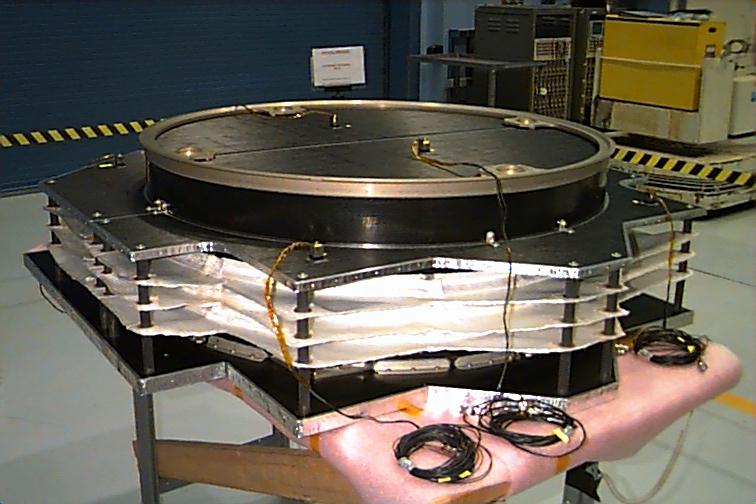
Whipple shield used on NASA's Stardust probe

The Whipple shield or Whipple bumper is a type of spaced armor shielding, invented by Fred Whipple,[1] designed to protect crewed and uncrewed spacecraft from hypervelocitycollisions with micrometeoroids and orbital debris. Relative velocities of objects in earth orbit can range as high as 18 kilometers per second (11.2 miles per second), meaning even very small objects can damage spacecraft. According to NASA, the Whipple shield is designed to withstand collisions with debris up to 1 cm.[2]

Shield Design

[edit]

In contrast to monolithic shielding of early spacecraft, Whipple shields consist of a relatively thin outer bumper spaced some distance from the main spacecraft wall. The bumper is not expected to stop the incoming particle or even remove much of its energy, but to break up and disperse it, dividing the original particle energy among many fragments that fan out between bumper and wall. The original particle energy is spread more thinly over a larger wall area, which is more likely to withstand it. Although a Whipple shield lowers total spacecraft mass compared to a solid shield (always desirable in spaceflight), the extra enclosed volume may require a larger payload fairing.

There are several variations on the simple Whipple shield. Multi-shock shields,[3][4] like the one used on the Stardust spacecraft, use multiple bumpers spaced apart to increase the shield's ability to protect the spacecraft. Whipple shields that have a filling between the rigid layers of the shield are called stuffed Whipple shields.[5][6] The filling in these shields is usually a high-strength material like Kevlar or Nextel aluminium oxide fiber.[7] The type of shield, the material, thickness and distance between layers are varied to produce a shield with minimal mass that will also minimize the probability of penetration. There are over 100 shield configurations on the International Space Station alone,[8] with important and high-risk areas having better shielding.

See also

[edit]

References

[edit]
[edit]
Revisions and contributorsEdit on WikipediaRead on Wikipedia
from Grokipedia
A Whipple shield is a lightweight, multi-layer spaced armor system designed to protect and space habitats from impacts by micrometeoroids and orbital (MMOD), by fragmenting incoming particles into a dispersed cloud of lower-energy that can be more easily stopped by an inner rear wall. Invented in 1946 by American astronomer Fred Whipple, who proposed it as a "meteor bumper" to safeguard early concepts from small particle collisions, the design revolutionized space protection by offering superior performance over solid monolithic shielding while minimizing added mass and volume. The basic configuration consists of a thin outer bumper—typically made of aluminum or composite materials—spaced a critical distance from the 's primary structure, where the bumper vaporizes or shatters the impactor upon collision at speeds up to 14 km/s, diluting its destructive potential across a wider area. Over decades, the Whipple shield has evolved into variants such as stuffed Whipple shields, which incorporate intermediate layers of materials like or to further attenuate debris, enhancing protection for crewed missions. It was first implemented in the on satellites and has since become a cornerstone of MMOD defense, prominently featured on the (ISS), where hundreds of tailored shields—varying in thickness and configuration by exposure risk—safeguard pressurized modules against particles up to several millimeters in diameter. NASA's Impact Technology (HVIT) facility continues to refine these designs through extensive testing, including over 400 annual hypervelocity experiments, to validate ballistic limit equations that predict shield performance under diverse impact conditions. Beyond the ISS, Whipple shields have protected missions like NASA's Stardust sample-return probe and remain integral to modern spacecraft, including those for lunar and deep-space exploration, demonstrating their enduring effectiveness in mitigating the pervasive threat of .

History

Invention

In the aftermath of , as advancements in rocketry fueled early aspirations for , astronomers and engineers grew increasingly concerned about the vulnerability of to impacts, which could puncture pressurized hulls at hypervelocities exceeding 10 km/s. These natural particles, remnants of comets and asteroids, posed a significant to the structural integrity of future satellites and crewed vehicles in the emerging . In 1946, American astronomer Fred L. Whipple proposed a innovative lightweight shielding solution, termed the "meteor bumper," to mitigate these threats as a more mass-efficient alternative to traditional solid armor plating. Detailed in his foundational paper "Meteorites and Space Travel," published in The Astronomical Journal, the design consisted of thin spaced plates positioned ahead of a spacecraft's pressure hull. Whipple's concept aimed to protect early orbital platforms by disrupting incoming micrometeoroids before they could cause catastrophic damage. The theoretical foundation of the meteor bumper relied on the dynamics of impacts, where the thin outer bumper plate would vaporize and fragment the upon collision, creating an expanding debris cloud that disperses across a wider area. This fragmentation process, rather than allowing intact penetration, reduced the localized on the rear wall, thereby enhancing overall while keeping the shield's minimal for launch constraints. Whipple's into these impact phenomena marked a pivotal shift toward layered, sacrificial shielding in .

Development and Variants

Following the initial invention in 1947, refinements to the Whipple shield emerged during the to address hypervelocity impacts from micrometeoroids and orbital debris. In the , adopted the design for Apollo-era missions, using equations like the 1969 Cour-Palais model to size structural walls on the Command Module and , enabling extrapolation of ground test data to orbital conditions. By the mid-1980s, developed stuffed Whipple shields as a derivative, inserting lightweight fillers such as or ceramic fabric between the bumper and rear wall to enhance debris cloud dispersion and improve protection against impacts up to several millimeters in diameter. These configurations provided 50% to 300% better performance than equivalent-weight double-aluminum bumpers by interrupting and fragmenting debris more effectively. In the , multi-shock shields advanced the concept further with multiple thin bumpers spaced to subject projectiles to repeated shocks, promoting melting and vaporization for higher-velocity threats exceeding 9 km/s. This variant, featuring aligned layers like ceramic cloth, was implemented on the Stardust mission launched in 1999 to withstand encounter impacts. Key innovations included US Patent 5,067,388 (1991) by Crews and Cour-Palais, which optimized multi-layer setups for particle shielding, and US Patent 5,610,363 (1997) by Crews et al., enhancing stuffed variants with intermediate barriers for superior debris mitigation. As of 2025, recent advancements integrate advanced composites into Whipple shields for deep-space missions, yielding lighter, thinner designs that dissipate more efficiently while reducing secondary . For instance, Atomic-6's Space Armor tiles employ composite materials to outperform traditional shields against hypersonic , offering easier installation and up to 65% energy dissipation rates in coated configurations.

Design and Mechanism

Basic Components

A standard Whipple shield is composed of three primary physical elements: a thin outer bumper, an intervening void , and a rear wall that typically forms part of the spacecraft's structural hull. The outer bumper serves as the initial barrier and is usually constructed from aluminum alloys, such as 6061-T6, with thicknesses ranging from 1 to 2.6 mm to balance weight and effectiveness against anticipated threats. The void , or standoff , separates the bumper from the rear wall and typically spans 5 to 30 cm, optimized to permit expansion of impact-generated debris while preventing contact with the rear wall. The rear wall, often made from stronger aluminum alloys like 2219-T87, provides the final protective layer and integrates with the spacecraft's or hull, with thicknesses commonly between 3.2 and 6.4 mm. In advanced configurations known as stuffed Whipple shields, the void space incorporates lightweight materials such as fabric for tensile strength or ceramic fiber (composed of aluminum oxide) to enhance debris fragmentation and absorption. Component dimensions and materials vary according to mission profiles; for instance, shields for low-Earth orbit operations may employ thinner bumpers and shorter standoffs to address higher debris flux from smaller particles, while interplanetary missions often require thicker layers and greater spacing to counter larger meteoroids.

Operating Principle

The Whipple shield operates in the impact regime, typically involving speeds of 3 to 18 km/s, where incoming projectiles such as micrometeoroids or orbital vaporize upon contact with the outer bumper due to extreme shock pressures exceeding material strengths. At these velocities, both the projectile and bumper materials exhibit fluid-like hydrodynamic behavior, allowing the shield to leverage principles of shock physics rather than relying on structural rigidity. The core mechanism begins with the thin outer bumper, which shatters the incoming particle into a cloud comprising fragments, molten droplets, and vaporized material from both the and the bumper itself. This initial impact generates intense shock waves that fragment the threat, initiating the formation of the expanding cloud. The deliberate spacing between the bumper and the rear wall then permits the cloud to spread laterally as it propagates, causing the particles to diverge and lose coherent before reaching the inner structure. This expansion dilutes the localized pressure and velocity of the , transforming a concentrated strike into a distributed, lower-intensity loading on the rear wall. Energy dissipation occurs primarily through the conversion of the projectile's into , shock heating, and material vaporization during fragmentation, which spreads the impact effects over a much larger area than a solid shield would allow. Unlike monolithic barriers that absorb energy through deformation and potential perforation, the Whipple shield's spaced architecture exploits the of impacts to prevent deep penetration by ensuring the rear wall experiences a broader, less damaging impulse. This design fundamentally relies on the hydrodynamic response of materials under extreme conditions to enhance protection efficiency.

Applications

Spacecraft Protection

Whipple shields serve as a primary defense mechanism against micrometeoroids and orbital debris (MMOD) for satellites, deep-space probes, and crewed habitats in orbit, functioning by vaporizing or fragmenting incoming projectiles upon impact with a thin outer bumper to disperse the resulting debris cloud over a larger rear-wall area, thereby minimizing penetration risk. This design, originally conceived in the , enables lightweight protection compared to solid armor, allowing to withstand impacts from particles up to approximately 1 cm in diameter at speeds around 10 km/s. On the (ISS), launched starting with the Zarya module in 1998, more than 100 distinct Whipple shield configurations have been implemented across modules including Zarya, Unity (Node 1), and subsequent additions like the U.S. Laboratory and Node 2, often using stuffed variants with ceramic fabric and layers to enhance performance against the low-Earth orbit debris environment. These shields cover critical pressurized volumes and external hardware, with over 500 defined regions in the ISS geometry model tailored to directional flux variations. A notable application occurred on NASA's Stardust mission (1999–2006), where a multi-shock Whipple shield protected the during its encounter with Comet Wild 2 in , consisting of a front composite bumper panel, three spaced layers of ceramic cloth for repeated shock disruption, and a rear composite wall to capture dispersed fragments while also safeguarding against interstellar dust impacts at velocities up to 6.1 km/s. This configuration not only enabled safe sample collection from the comet but also demonstrated the shield's dual role in active scientific operations and passive protection in interplanetary space. Integrating Whipple shields into presents challenges such as existing hulls—often through augmentation layers on modules like the ISS Service Module—and balancing added mass against capacity, as shield weight escalates exponentially with required protection levels while standoff distances (typically 10–12 cm) must accommodate structural constraints. For instance, stuffed Whipple variants can reduce mass by up to 50% compared to basic designs but require precise scaling of materials like aluminum bumpers and fabric interlayers for robotic probes, as seen in adaptations for fuel tanks where 3–15 kg additions achieve compliance with MMOD risk thresholds. As of 2025, Whipple-derived shielding continues in modern programs, including NASA's Artemis initiative for lunar habitats and Orion spacecraft MMOD protection, where advanced multi-wall concepts mitigate debris risks in cis-lunar space, and commercial low-Earth orbit constellations, which incorporate shielding to address heightened collision probabilities from dense satellite populations.

Other Uses

The principles underlying the Whipple shield, particularly its spaced-layer design for fragmenting high-velocity projectiles, have been adapted in terrestrial high-speed projectile testing facilities to evaluate armor performance. Scaled Whipple shield configurations are employed to simulate hypervelocity impacts, providing insights into material behavior under extreme conditions for armor development. In experimental fields, Whipple shields are subjected to hypervelocity railgun tests to assess their effectiveness against micrometeorite-like fragments. Railguns accelerate small solid projectiles to speeds exceeding 3 km/s, replicating the fragmentation and energy dissipation processes of the shield's operating principle. Such testing has validated shield performance in controlled environments, contributing to advancements in protective materials. Stuffed Whipple shield variants, incorporating intermediate layers for enhanced protection, have been explored for radiation shielding in off-Earth structures, drawing on the core fragmentation mechanism to mitigate secondary fragments from impacts. This adaptation extends the shield's utility beyond pure threats to combined environmental hazards.

Performance and Testing

Effectiveness

Whipple shields provide effective protection against micrometeoroids and orbital particles up to approximately 1 cm in diameter at hypervelocities typical of , such as 7 km/s, with design capabilities addressing the broader threat range of 3 to 18 km/s according to standards. Their performance is evaluated through hypervelocity impact simulations using two-stage light-gas guns at facilities like NASA's , which accelerate projectiles to speeds up to 11 km/s while measuring key metrics such as dimensions, cloud expansion, and rear wall penetration depth. In tests, Whipple shields demonstrate 2 to 5 times greater than equivalent aluminum shields of comparable protective capability, meaning they achieve similar ballistic limits at a fraction of the weight. For instance, stuffed Whipple variants incorporating materials like and between bumpers can reduce rear wall damage by up to 90% compared to conventional designs in controlled hypervelocity experiments. Real-world validation on the confirms this effectiveness, with no known critical penetration failures of Whipple or stuffed Whipple shields reported despite thousands of tracked and orbital encounters over more than two decades of operation as of 2025.

Limitations

The spaced architecture of Whipple shields necessitates a significant standoff distance between the bumper and rear wall, typically 15 to 30 times the expected projectile diameter, which expands the overall volume of the protected and complicates integration within payload fairings during launch. This volumetric penalty can limit design flexibility for compact satellites or modules, as increasing the standoff from baseline values like 11.4 cm to 15.2 cm may add several centimeters to the diameter, potentially requiring larger launch vehicles and escalating costs. Although Whipple shields offer mass advantages over monolithic alternatives, their multilayered construction—including bumpers, rear walls, and support structures—can contribute substantially to the spacecraft's structural , often accounting for around 10% of the total vehicle in debris-prone missions such as those on the . The support framework alone may comprise up to 8% of the shield's in multi-stage configurations, and adjustments like thickening the rear wall by a few millimeters can result in a 15-16% increase per component, trading gains against higher launch expenses estimated at $1,500 to $3,000 per kilogram as of 2025. Whipple shields exhibit critical vulnerability gaps against larger orbital exceeding 1 cm in , where the bumper fails to adequately fragment the , leading to potential catastrophic penetration of the rear wall. They are also ineffective at low velocities below 3 km/s, as impacts in this ballistic deformation regime do not trigger the desired shattering and dispersion, allowing the intact or minimally fragmented to or perforate the structure more readily than at hypervelocities of 3-7 km/s. In orbital environments, maintaining Whipple shields poses substantial challenges, as the spaced voids between layers are difficult to inspect without invasive procedures like spacewalks, which carry risks and require specialized tools for on-orbit assessments. Partial impacts on the bumper can generate secondary clouds within the standoff region, potentially causing internal damage to adjacent systems or even contributing to further orbital proliferation if fragments escape the . As of 2025, the escalating density of orbital —driven by mega-constellations such as and OneWeb, with over 1.2 million objects larger than 1 cm now populating low-Earth orbit—intensifies challenges for Whipple shield efficacy, as heightened collision probabilities in congested altitude bands like 550 km demand more robust protection against diverse debris profiles. This has spurred the need for hybrid designs integrating Whipple elements with like cores or stuffed intermediates to address the limitations of traditional spaced armor in high-traffic regimes.

References

Add your contribution
Related Hubs
User Avatar
No comments yet.