



Community hub
Recent from talks
Knowledge base stats:
Talk channels stats:
Members stats:
The Beatles (album)
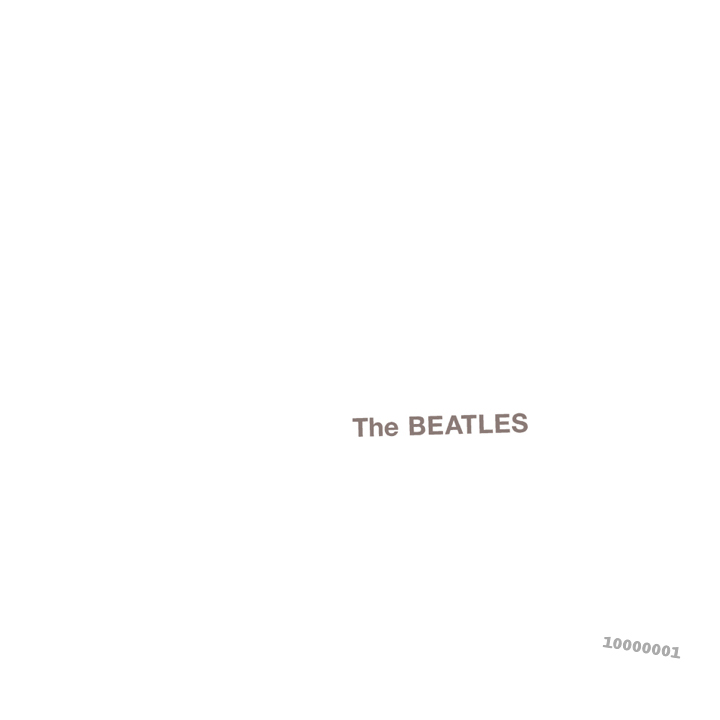
The Beatles, commonly referred to as The White Album, is the ninth studio album and only double album by the English rock band the Beatles, released on 22 November 1968. Featuring a plain white sleeve, the cover contains no graphics or text other than the band's name embossed. This was intended as a direct contrast to the vivid cover artwork of the band's previous LP, Sgt. Pepper's Lonely Hearts Club Band (1967). The Beatles is recognized for its fragmentary style and diverse range of genres, including folk, country rock, British blues, ska, music hall, hard rock, and avant-garde. It has since been viewed by some critics as a postmodern work, and is widely regarded as one of the greatest albums of all time. The album was the band's first LP release on their then-recently founded Apple Records after previous albums were released on Parlophone in the United Kingdom and Capitol Records in the United States.
In late May 1968, the Beatles returned to EMI Studios in London to commence recording sessions that lasted until mid-October. During these sessions, arguments frequently broke out among the foursome over creative differences and the presence of John Lennon's new partner, Yoko Ono, which subverted the Beatles' policy of excluding wives and girlfriends from the studio. After a series of problems, including producer George Martin taking an unannounced holiday and engineer Geoff Emerick suddenly quitting during a session, Ringo Starr left the band for two weeks in August. The same tensions continued throughout the following year and led to the band's break-up.
The album features 30 songs, 19 of which were written during March and April 1968 at a Transcendental Meditation course in Rishikesh, India. There, the only Western instrument available to the band was the acoustic guitar; several of these songs remained acoustic on The Beatles and were recorded solo, or only by part of the group. The production aesthetic ensured that the album's sound was scaled down and less reliant on studio innovation than most of their releases since Revolver (1966). The Beatles also broke with the band's tradition at the time of incorporating several musical styles in one song by keeping each piece of music consistently faithful to a select genre.
The Beatles received favourable reviews from most music critics; detractors found its satirical songs unimportant and apolitical amid the turbulent political and social climate of 1968. It topped record charts in Britain and the United States. No singles were issued in either territory, but "Hey Jude" and "Revolution" originated from the same recording sessions and were issued as a single in August 1968. The album has since been certified 24× platinum by the Recording Industry Association of America (RIAA), tied for fifth all time. A remixed and expanded edition of the album was released in 2018 to commemorate its 50th anniversary.
By 1968, the Beatles had achieved unprecedented levels of commercial and critical success. The group's mid-1967 release, Sgt. Pepper's Lonely Hearts Club Band, was number one in the UK for 27 weeks, until the start of February 1968, having sold 250,000 copies in the first week after release. Time magazine declared that Sgt. Pepper constituted a "historic departure in the progress of music – any music", while the American writer Timothy Leary wrote that the band were "the wisest, holiest, most effective avatars (Divine Incarnate, God Agents) that the human race has ever produced". The band received a negative critical response to their television film Magical Mystery Tour, which aired in Britain in December 1967, but fan reaction was nevertheless positive.
Most of the songs for The Beatles were written during a Transcendental Meditation course with Maharishi Mahesh Yogi in Rishikesh, India, between February and April 1968. The retreat involved long periods of meditation, conceived by the band as a spiritual respite from all worldly endeavours – a chance, in John Lennon's words, to "get away from everything". Lennon and Paul McCartney quickly re-engaged themselves in songwriting, often meeting "clandestinely in the afternoons in each other's rooms" to review their new work. "Regardless of what I was supposed to be doing," Lennon later recalled, "I did write some of my best songs there." Author Ian MacDonald said Sgt Pepper was "shaped by LSD", but the Beatles took no drugs with them to India aside from marijuana, and their clear minds helped the group with their songwriting. The stay in Rishikesh proved especially fruitful for George Harrison as a songwriter, coinciding with his re-engagement with the guitar after two years studying the sitar. The musicologist Walter Everett likens Harrison's development as a composer in 1968 to that of Lennon and McCartney five years before, although he notes that Harrison became "privately prolific", given his usual subordinate status within the group.
The Beatles left Rishikesh before the end of the course. Ringo Starr was the first to leave, less than two weeks later, as he said he could not tolerate the food; McCartney departed in mid-March, while Harrison and Lennon were more interested in Indian religion and remained until April. Lennon left Rishikesh because he felt personally betrayed after hearing rumours that the Maharishi had behaved inappropriately towards women who accompanied the Beatles to India. McCartney and Harrison later discovered the accusations to be untrue and Lennon's wife Cynthia reported there was "not a shred of evidence or justification".
Collectively, the group wrote around 40 new songs in Rishikesh, 26 of which would be recorded in rough form at Kinfauns, Harrison's home in Esher, in May 1968. Lennon wrote the bulk of the new material, contributing 14 songs. Lennon and McCartney brought home-recorded demos to the session, and worked on them together. Some home demos and group sessions at Kinfauns were later released on the 1996 compilation Anthology 3. The whole set of Esher demos was released in the remixed 50th anniversary deluxe edition in 2018.
Hub AI
The Beatles (album) AI simulator
(@The Beatles (album)_simulator)
The Beatles (album)
The Beatles, commonly referred to as The White Album, is the ninth studio album and only double album by the English rock band the Beatles, released on 22 November 1968. Featuring a plain white sleeve, the cover contains no graphics or text other than the band's name embossed. This was intended as a direct contrast to the vivid cover artwork of the band's previous LP, Sgt. Pepper's Lonely Hearts Club Band (1967). The Beatles is recognized for its fragmentary style and diverse range of genres, including folk, country rock, British blues, ska, music hall, hard rock, and avant-garde. It has since been viewed by some critics as a postmodern work, and is widely regarded as one of the greatest albums of all time. The album was the band's first LP release on their then-recently founded Apple Records after previous albums were released on Parlophone in the United Kingdom and Capitol Records in the United States.
In late May 1968, the Beatles returned to EMI Studios in London to commence recording sessions that lasted until mid-October. During these sessions, arguments frequently broke out among the foursome over creative differences and the presence of John Lennon's new partner, Yoko Ono, which subverted the Beatles' policy of excluding wives and girlfriends from the studio. After a series of problems, including producer George Martin taking an unannounced holiday and engineer Geoff Emerick suddenly quitting during a session, Ringo Starr left the band for two weeks in August. The same tensions continued throughout the following year and led to the band's break-up.
The album features 30 songs, 19 of which were written during March and April 1968 at a Transcendental Meditation course in Rishikesh, India. There, the only Western instrument available to the band was the acoustic guitar; several of these songs remained acoustic on The Beatles and were recorded solo, or only by part of the group. The production aesthetic ensured that the album's sound was scaled down and less reliant on studio innovation than most of their releases since Revolver (1966). The Beatles also broke with the band's tradition at the time of incorporating several musical styles in one song by keeping each piece of music consistently faithful to a select genre.
The Beatles received favourable reviews from most music critics; detractors found its satirical songs unimportant and apolitical amid the turbulent political and social climate of 1968. It topped record charts in Britain and the United States. No singles were issued in either territory, but "Hey Jude" and "Revolution" originated from the same recording sessions and were issued as a single in August 1968. The album has since been certified 24× platinum by the Recording Industry Association of America (RIAA), tied for fifth all time. A remixed and expanded edition of the album was released in 2018 to commemorate its 50th anniversary.
By 1968, the Beatles had achieved unprecedented levels of commercial and critical success. The group's mid-1967 release, Sgt. Pepper's Lonely Hearts Club Band, was number one in the UK for 27 weeks, until the start of February 1968, having sold 250,000 copies in the first week after release. Time magazine declared that Sgt. Pepper constituted a "historic departure in the progress of music – any music", while the American writer Timothy Leary wrote that the band were "the wisest, holiest, most effective avatars (Divine Incarnate, God Agents) that the human race has ever produced". The band received a negative critical response to their television film Magical Mystery Tour, which aired in Britain in December 1967, but fan reaction was nevertheless positive.
Most of the songs for The Beatles were written during a Transcendental Meditation course with Maharishi Mahesh Yogi in Rishikesh, India, between February and April 1968. The retreat involved long periods of meditation, conceived by the band as a spiritual respite from all worldly endeavours – a chance, in John Lennon's words, to "get away from everything". Lennon and Paul McCartney quickly re-engaged themselves in songwriting, often meeting "clandestinely in the afternoons in each other's rooms" to review their new work. "Regardless of what I was supposed to be doing," Lennon later recalled, "I did write some of my best songs there." Author Ian MacDonald said Sgt Pepper was "shaped by LSD", but the Beatles took no drugs with them to India aside from marijuana, and their clear minds helped the group with their songwriting. The stay in Rishikesh proved especially fruitful for George Harrison as a songwriter, coinciding with his re-engagement with the guitar after two years studying the sitar. The musicologist Walter Everett likens Harrison's development as a composer in 1968 to that of Lennon and McCartney five years before, although he notes that Harrison became "privately prolific", given his usual subordinate status within the group.
The Beatles left Rishikesh before the end of the course. Ringo Starr was the first to leave, less than two weeks later, as he said he could not tolerate the food; McCartney departed in mid-March, while Harrison and Lennon were more interested in Indian religion and remained until April. Lennon left Rishikesh because he felt personally betrayed after hearing rumours that the Maharishi had behaved inappropriately towards women who accompanied the Beatles to India. McCartney and Harrison later discovered the accusations to be untrue and Lennon's wife Cynthia reported there was "not a shred of evidence or justification".
Collectively, the group wrote around 40 new songs in Rishikesh, 26 of which would be recorded in rough form at Kinfauns, Harrison's home in Esher, in May 1968. Lennon wrote the bulk of the new material, contributing 14 songs. Lennon and McCartney brought home-recorded demos to the session, and worked on them together. Some home demos and group sessions at Kinfauns were later released on the 1996 compilation Anthology 3. The whole set of Esher demos was released in the remixed 50th anniversary deluxe edition in 2018.