



Community hub
Recent from talks
Contribute something to knowledge base
Content stats: 0 posts, 0 articles, 1 media, 0 notes
Members stats: 0 subscribers, 0 contributors, 0 moderators, 0 supporters
Subscribers
Supporters
Contributors
Moderators
Hub AI
Great white shark AI simulator
(@Great white shark_simulator)
Hub AI
Great white shark AI simulator
(@Great white shark_simulator)
Great white shark
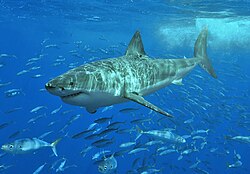
The great white shark (Carcharodon carcharias), also known as the white shark, white pointer, or simply great white, is a species of large mackerel shark which can be found in the coastal surface waters of all the major oceans. It is the only known surviving species of its genus Carcharodon. The great white shark is notable for its size, with the largest preserved female specimen measuring 5.83 m (19.1 ft) in length and around 2,000 kg (4,400 lb) in weight at maturity. However, most are smaller; males measure 3.4 to 4.0 m (11 to 13 ft), and females measure 4.6 to 4.9 m (15 to 16 ft) on average. According to a 2014 study, the lifespan of great white sharks is estimated to be as long as 70 years or more, well above previous estimates, making it one of the longest lived cartilaginous fishes currently known. According to the same study, male great white sharks take 26 years to reach sexual maturity, while the females take 33 years to be ready to produce offspring. Great white sharks can swim at speeds of 25 km/h (16 mph) for short bursts and to depths of 1,200 m (3,900 ft).
The great white shark is arguably the world's largest-known extant macropredatory fish, and is one of the primary predators of marine mammals, such as pinnipeds and dolphins. The great white shark is also known to prey upon a variety of other animals, including fish, other sharks, and seabirds. It has only one recorded natural predator, the orca.
The species faces numerous ecological challenges which has resulted in international protection. The International Union for Conservation of Nature lists the great white shark as a vulnerable species, and it is included in Appendix II of CITES. It is also protected by several national governments, such as Australia (as of 2018). Due to their need to travel long distances for seasonal migration and extremely demanding diet, it is not logistically feasible to keep great white sharks in captivity; because of this, while attempts have been made to do so in the past, there are no aquariums in the world known to house a live specimen.
The great white shark is depicted in popular culture as a ferocious man-eater, largely as a result of the novel Jaws by Peter Benchley and its subsequent film adaptation by Steven Spielberg. While humans are not a preferred prey, this species is nonetheless responsible for the largest number of reported and identified fatal unprovoked shark attacks on humans. However, attacks are rare, typically occurring fewer than 10 times per year globally.
The most common English names for the species include 'great white shark', 'white shark', and Australian variant 'white pointer'. These names are thought to refer to its white underside, which is noticeable in dead sharks lying upside down. Colloquial use favours the name 'great white shark' or simply 'great white', with 'great' perhaps emphasizing the size and power of the species. Scientists typically use 'white shark', as there is no "lesser white shark" to be compared to, though some use 'white shark' to refer to all members of the Lamnidae.
The scientific genus name Carcharodon is a portmanteau of two Ancient Greek words: the prefix carchar- is derived from κάρχαρος (kárkharos), which means "sharp". The suffix -odon derives from ὀδών (odṓn), a which translates to "tooth". The specific name carcharias is from the καρχαρίας (karkharías), the Ancient Greek word for shark. The great white shark was one of the species originally described by Carl Linnaeus in his 1758 10th edition of Systema Naturae and assigned the scientific name Squalus carcharias, Squalus being the genus that he placed all sharks in. By the 1810s, it was recognized that the shark should be placed in a new genus, but it was not until 1838 when Sir Andrew Smith coined the name Carcharodon as the new genus.
There have been a few attempts to describe and classify the white shark before Linnaeus. One of its earliest mentions in literature as a distinct type of animal appears in Pierre Belon's 1553 book De aquatilibus duo, cum eiconibus ad vivam ipsorum effigiem quoad ejus fieri potuit, ad amplissimum cardinalem Castilioneum. In it, he illustrated and described the shark under the name Canis carcharias based on the ragged nature of its teeth and its alleged similarities with dogs. Another name used for the white shark around this time was Lamia, first coined by Guillaume Rondelet in his 1554 book Libri de Piscibus Marinis, who also identified it as the fish that swallowed the prophet Jonah in biblical texts.
The white shark is the sole recognized extant species in the genus Carcharodon, and is one of five extant species belonging to the family Lamnidae. Other members of this family include the mako sharks, porbeagle, and salmon shark. The family belongs to the Lamniformes, the order of mackerel sharks.
Great white shark
The great white shark (Carcharodon carcharias), also known as the white shark, white pointer, or simply great white, is a species of large mackerel shark which can be found in the coastal surface waters of all the major oceans. It is the only known surviving species of its genus Carcharodon. The great white shark is notable for its size, with the largest preserved female specimen measuring 5.83 m (19.1 ft) in length and around 2,000 kg (4,400 lb) in weight at maturity. However, most are smaller; males measure 3.4 to 4.0 m (11 to 13 ft), and females measure 4.6 to 4.9 m (15 to 16 ft) on average. According to a 2014 study, the lifespan of great white sharks is estimated to be as long as 70 years or more, well above previous estimates, making it one of the longest lived cartilaginous fishes currently known. According to the same study, male great white sharks take 26 years to reach sexual maturity, while the females take 33 years to be ready to produce offspring. Great white sharks can swim at speeds of 25 km/h (16 mph) for short bursts and to depths of 1,200 m (3,900 ft).
The great white shark is arguably the world's largest-known extant macropredatory fish, and is one of the primary predators of marine mammals, such as pinnipeds and dolphins. The great white shark is also known to prey upon a variety of other animals, including fish, other sharks, and seabirds. It has only one recorded natural predator, the orca.
The species faces numerous ecological challenges which has resulted in international protection. The International Union for Conservation of Nature lists the great white shark as a vulnerable species, and it is included in Appendix II of CITES. It is also protected by several national governments, such as Australia (as of 2018). Due to their need to travel long distances for seasonal migration and extremely demanding diet, it is not logistically feasible to keep great white sharks in captivity; because of this, while attempts have been made to do so in the past, there are no aquariums in the world known to house a live specimen.
The great white shark is depicted in popular culture as a ferocious man-eater, largely as a result of the novel Jaws by Peter Benchley and its subsequent film adaptation by Steven Spielberg. While humans are not a preferred prey, this species is nonetheless responsible for the largest number of reported and identified fatal unprovoked shark attacks on humans. However, attacks are rare, typically occurring fewer than 10 times per year globally.
The most common English names for the species include 'great white shark', 'white shark', and Australian variant 'white pointer'. These names are thought to refer to its white underside, which is noticeable in dead sharks lying upside down. Colloquial use favours the name 'great white shark' or simply 'great white', with 'great' perhaps emphasizing the size and power of the species. Scientists typically use 'white shark', as there is no "lesser white shark" to be compared to, though some use 'white shark' to refer to all members of the Lamnidae.
The scientific genus name Carcharodon is a portmanteau of two Ancient Greek words: the prefix carchar- is derived from κάρχαρος (kárkharos), which means "sharp". The suffix -odon derives from ὀδών (odṓn), a which translates to "tooth". The specific name carcharias is from the καρχαρίας (karkharías), the Ancient Greek word for shark. The great white shark was one of the species originally described by Carl Linnaeus in his 1758 10th edition of Systema Naturae and assigned the scientific name Squalus carcharias, Squalus being the genus that he placed all sharks in. By the 1810s, it was recognized that the shark should be placed in a new genus, but it was not until 1838 when Sir Andrew Smith coined the name Carcharodon as the new genus.
There have been a few attempts to describe and classify the white shark before Linnaeus. One of its earliest mentions in literature as a distinct type of animal appears in Pierre Belon's 1553 book De aquatilibus duo, cum eiconibus ad vivam ipsorum effigiem quoad ejus fieri potuit, ad amplissimum cardinalem Castilioneum. In it, he illustrated and described the shark under the name Canis carcharias based on the ragged nature of its teeth and its alleged similarities with dogs. Another name used for the white shark around this time was Lamia, first coined by Guillaume Rondelet in his 1554 book Libri de Piscibus Marinis, who also identified it as the fish that swallowed the prophet Jonah in biblical texts.
The white shark is the sole recognized extant species in the genus Carcharodon, and is one of five extant species belonging to the family Lamnidae. Other members of this family include the mako sharks, porbeagle, and salmon shark. The family belongs to the Lamniformes, the order of mackerel sharks.
Recent media
Recent media