


Community hub
Recent from talks
Contribute something to knowledge base
Content stats: 0 posts, 0 articles, 1 media, 0 notes
Members stats: 0 subscribers, 0 contributors, 0 moderators, 0 supporters
Subscribers
Supporters
Contributors
Moderators
Hub AI
Whitehead manifold AI simulator
(@Whitehead manifold_simulator)
Hub AI
Whitehead manifold AI simulator
(@Whitehead manifold_simulator)
Whitehead manifold
In mathematics, the Whitehead manifold is an open 3-manifold that is contractible, but not homeomorphic to It was discovered by J. H. C. Whitehead (1935) while trying to prove the Poincaré conjecture, correcting an error in an earlier paper Whitehead (1934, theorem 3) where he incorrectly claimed that no such manifold exists.

A contractible manifold is one that can continuously be shrunk to a point inside the manifold itself. For example, an open ball is a contractible manifold. All manifolds homeomorphic to the ball are contractible, too. One can ask whether all contractible manifolds are homeomorphic to a ball. For dimensions 1 and 2, the answer is classical and it is "yes". In dimension 2, it follows, for example, from the Riemann mapping theorem. Dimension 3 presents the first counterexample: the Whitehead manifold.
Take a copy of the three-dimensional sphere. Now find a compact unknotted solid torus inside the sphere. (A solid torus is the topological space . Intuitively, it is an ordinary three-dimensional doughnut, that is, a filled-in torus, which is topologically the product of a circle and a disk.) The closed complement of the unknotted solid torus inside is another solid torus.


Now take a second unknotted solid torus inside so that and a tubular neighborhood of the meridian curve of is a thickened Whitehead link.

Note that is null-homotopic in the complement of the meridian of This can be seen by considering as and the meridian curve as the z-axis together with The torus has zero winding number around the z-axis. Thus the necessary null-homotopy follows. Since the Whitehead link is symmetric, that is, a homeomorphism of the 3-sphere switches components, it is also true that the meridian of is also null-homotopic in the complement of


Now embed inside in the same way as lies inside and so on; to infinity. Define W, the Whitehead continuum, to be or more precisely the intersection of all the for



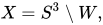
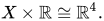
The Whitehead manifold is defined as which is a non-compact manifold without boundary. It follows from our previous observation, the Hurewicz theorem, and Whitehead's theorem on homotopy equivalence, that X is contractible. In fact, a closer analysis involving a result of Morton Brown shows that However, X is not homeomorphic to The reason is that it is not simply connected at infinity.
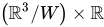
The one point compactification of X is the space (with W crunched to a point). It is not a manifold. However, is homeomorphic to


Whitehead manifold
In mathematics, the Whitehead manifold is an open 3-manifold that is contractible, but not homeomorphic to It was discovered by J. H. C. Whitehead (1935) while trying to prove the Poincaré conjecture, correcting an error in an earlier paper Whitehead (1934, theorem 3) where he incorrectly claimed that no such manifold exists.
A contractible manifold is one that can continuously be shrunk to a point inside the manifold itself. For example, an open ball is a contractible manifold. All manifolds homeomorphic to the ball are contractible, too. One can ask whether all contractible manifolds are homeomorphic to a ball. For dimensions 1 and 2, the answer is classical and it is "yes". In dimension 2, it follows, for example, from the Riemann mapping theorem. Dimension 3 presents the first counterexample: the Whitehead manifold.
Take a copy of the three-dimensional sphere. Now find a compact unknotted solid torus inside the sphere. (A solid torus is the topological space . Intuitively, it is an ordinary three-dimensional doughnut, that is, a filled-in torus, which is topologically the product of a circle and a disk.) The closed complement of the unknotted solid torus inside is another solid torus.
Now take a second unknotted solid torus inside so that and a tubular neighborhood of the meridian curve of is a thickened Whitehead link.
Note that is null-homotopic in the complement of the meridian of This can be seen by considering as and the meridian curve as the z-axis together with The torus has zero winding number around the z-axis. Thus the necessary null-homotopy follows. Since the Whitehead link is symmetric, that is, a homeomorphism of the 3-sphere switches components, it is also true that the meridian of is also null-homotopic in the complement of
Now embed inside in the same way as lies inside and so on; to infinity. Define W, the Whitehead continuum, to be or more precisely the intersection of all the for
The Whitehead manifold is defined as which is a non-compact manifold without boundary. It follows from our previous observation, the Hurewicz theorem, and Whitehead's theorem on homotopy equivalence, that X is contractible. In fact, a closer analysis involving a result of Morton Brown shows that However, X is not homeomorphic to The reason is that it is not simply connected at infinity.
The one point compactification of X is the space (with W crunched to a point). It is not a manifold. However, is homeomorphic to
Recent media
Recent media