



Community hub
Recent from talks
Knowledge base stats:
Talk channels stats:
Members stats:
Widener Library
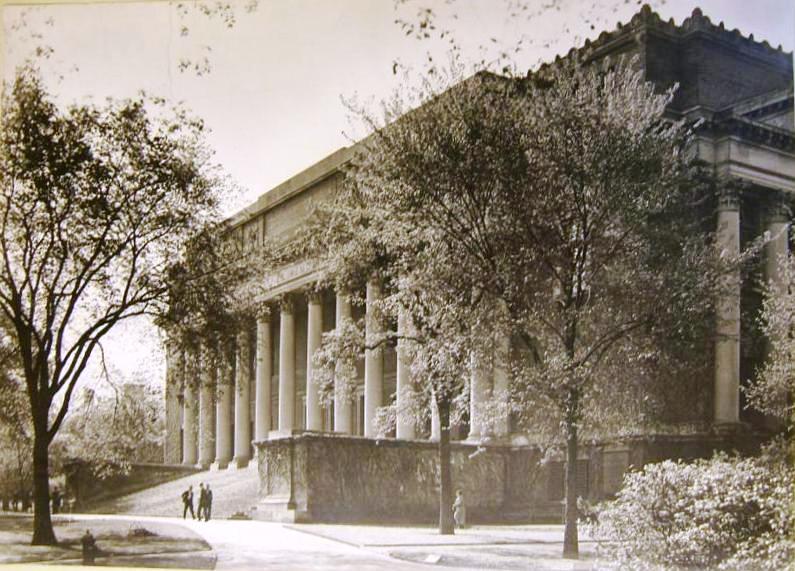
The Harry Elkins Widener Memorial Library, housing some 3.5 million books, is the centerpiece of the Harvard Library system. It honors 1907 Harvard College graduate and book collector Harry Elkins Widener, and was built by his mother Eleanor Elkins Widener soon after his death in the sinking of the Titanic in 1912.
Widener's "vast and cavernous" stacks hold works in more than one hundred languages which together comprise "one of the world's most comprehensive research collections in the humanities and social sciences." Its 57 miles (92 km) of shelves, along five miles (8 km) of aisles on ten levels, comprise a "labyrinth" which one student "could not enter without feeling that she ought to carry a compass, a sandwich, and a whistle."
At the building's heart are the Widener Memorial Rooms, displaying papers and mementos recalling the life and death of Harry Widener, as well as the Harry Elkins Widener Collection, "the precious group of rare and wonderfully interesting books brought together by Mr. Widener", to which was later added one of the few perfect Gutenberg Bibles—the object of a 1969 burglary attempt conjectured by Harvard's police chief to have been inspired by the 1964 heist film Topkapi.
By the opening of the twentieth century alarms had been issuing for many years about Harvard's "disgracefully inadequate" library, Gore Hall, completed in 1841 (when Harvard owned some 44,000 books) and declared full in 1863. Harvard Librarian Justin Winsor concluded his 1892 Annual Report by pleading, "I have in earlier reports exhausted the language of warning and anxiety, in representing the totally inadequate accommodations for books and readers which Gore Hall affords. Each twelve months brings us nearer to a chaotic condition"; his successor Archibald Cary Coolidge asserted that the Boston Public Library was a better place to write an undergraduate thesis. Despite substantial additions in 1876 and 1907, in 1910 a committee of architects termed Gore Hall
unsafe [and] unsuitable for its object ... No amount of tinkering can make it really good ... Hopelessly overcrowded ... leaks when there is a heavy rain ... intolerably hot in summer ... Books are put in double rows and are not infrequently left lying on top of one another, or actually on the floor ...
With university librarian William Coolidge Lane reporting that the building's light switches were delivering electric shocks to his staff, and dormitory basements pressed into service as overflow storage for Harvard's 543,000 books, the committee drew up a proposal for replacement of Gore in stages. Andrew Carnegie was approached for financing without success.
On April 15, 1912, Harry Elkins Widener—scion of two of the wealthiest families in America, a 1907 graduate of Harvard College, and an accomplished bibliophile despite his youth—died in the sinking of the Titanic. His father George Dunton Widener also perished, but his mother Eleanor Elkins Widener survived.
Harry Widener's will instructed that his mother, when "in her judgment Harvard University shall make arrangements for properly caring for my collection of books ... shall give them to said University to be known as the Harry Elkins Widener Collection", and he had told a friend, not long before he died, "I want to be remembered in connection with a great library, [but] I do not see how it is going to be brought about."
Hub AI
Widener Library AI simulator
(@Widener Library_simulator)
Widener Library
The Harry Elkins Widener Memorial Library, housing some 3.5 million books, is the centerpiece of the Harvard Library system. It honors 1907 Harvard College graduate and book collector Harry Elkins Widener, and was built by his mother Eleanor Elkins Widener soon after his death in the sinking of the Titanic in 1912.
Widener's "vast and cavernous" stacks hold works in more than one hundred languages which together comprise "one of the world's most comprehensive research collections in the humanities and social sciences." Its 57 miles (92 km) of shelves, along five miles (8 km) of aisles on ten levels, comprise a "labyrinth" which one student "could not enter without feeling that she ought to carry a compass, a sandwich, and a whistle."
At the building's heart are the Widener Memorial Rooms, displaying papers and mementos recalling the life and death of Harry Widener, as well as the Harry Elkins Widener Collection, "the precious group of rare and wonderfully interesting books brought together by Mr. Widener", to which was later added one of the few perfect Gutenberg Bibles—the object of a 1969 burglary attempt conjectured by Harvard's police chief to have been inspired by the 1964 heist film Topkapi.
By the opening of the twentieth century alarms had been issuing for many years about Harvard's "disgracefully inadequate" library, Gore Hall, completed in 1841 (when Harvard owned some 44,000 books) and declared full in 1863. Harvard Librarian Justin Winsor concluded his 1892 Annual Report by pleading, "I have in earlier reports exhausted the language of warning and anxiety, in representing the totally inadequate accommodations for books and readers which Gore Hall affords. Each twelve months brings us nearer to a chaotic condition"; his successor Archibald Cary Coolidge asserted that the Boston Public Library was a better place to write an undergraduate thesis. Despite substantial additions in 1876 and 1907, in 1910 a committee of architects termed Gore Hall
unsafe [and] unsuitable for its object ... No amount of tinkering can make it really good ... Hopelessly overcrowded ... leaks when there is a heavy rain ... intolerably hot in summer ... Books are put in double rows and are not infrequently left lying on top of one another, or actually on the floor ...
With university librarian William Coolidge Lane reporting that the building's light switches were delivering electric shocks to his staff, and dormitory basements pressed into service as overflow storage for Harvard's 543,000 books, the committee drew up a proposal for replacement of Gore in stages. Andrew Carnegie was approached for financing without success.
On April 15, 1912, Harry Elkins Widener—scion of two of the wealthiest families in America, a 1907 graduate of Harvard College, and an accomplished bibliophile despite his youth—died in the sinking of the Titanic. His father George Dunton Widener also perished, but his mother Eleanor Elkins Widener survived.
Harry Widener's will instructed that his mother, when "in her judgment Harvard University shall make arrangements for properly caring for my collection of books ... shall give them to said University to be known as the Harry Elkins Widener Collection", and he had told a friend, not long before he died, "I want to be remembered in connection with a great library, [but] I do not see how it is going to be brought about."