Hubbry Logo
Book collectingBook collectingMain
Open search
Book collecting
Community hub
Book collecting
logo
8 pages, 0 posts
0 subscribers
Be the first to start a discussion here.
Book collecting
Book collecting
from Wikipedia
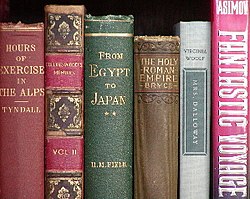
Some inexpensive collectible books: these are, left to right, by Tyndall, Collingwood, H. M. Field, Bryce, Woolf, and Asimov.

Book collecting is the collecting of books, including seeking, locating, acquiring, organizing, cataloging, displaying, storing, and maintaining whatever books are of interest to a given collector. The love of books is bibliophilia, and someone who loves to read, admire, and a person who collects books is often called a bibliophile.

Book prices generally depend on the demand for a given edition which is based on factors such as the number of copies available, the book's condition, and if they were signed by the author (and/or editor or illustrator, if applicable) or by a famous previous owner.[1] For example, a first edition And to Think That I Saw It on Mulberry Street can reach the price of $12,000 in the best condition.

History

[edit]

In the ancient world, papyri and scrolls (the precursors of the book in codex form) were collected by both institutions and private individuals. In surviving accounts there are references to bibliophile book collectors in that era. Xenophon wrote disparagingly of a man who tried to collect more books than his friends.[2] Seneca the Younger was skeptical of those who collect books they do not read,[2] asking: "What is the use of possessing numberless books and libraries, whose titles their owner can hardly read through in a lifetime?"[3] Book collectors in western antiquity prized accurate transcription and high-quality materials.[2]

In 1344 the English bishop Richard de Bury wrote The Philobiblon, in which he praised the love and appreciation of books.[4] Philip the Good brought together a collection of "about six hundred manuscripts in his possession at the height of his reign",[5] which was the largest private collection of his day.

With the advent of the printing press invented by Johannes Gutenberg in the 15th century, which resulted in cheaper and more abundant books, and with the contemporaneous economic, social and political changes of the Renaissance, book collecting received a great impetus. Jean Grolier, the Treasurer-General of France, was an important bibliophile and book collector of this period.[6]

With the advent of the Romantic era in the 18th century and its focus on the past, book collectors began to show an interest in old books, antiquarian editions and manuscripts. This new emphasis was nourished by the flood of old books onto the market following the dissolution of monastic and aristocratic libraries during the French Revolution and the Napoleonic Wars.[7]

The British Whig politician George John, 2nd Earl Spencer (1758-1834) collected tens of thousands of volumes. Strengths of his collection included first editions of the classics; works produced by important early presses, and notably an almost complete collection of Aldine editions; and many Bibles.[8]

Sir Thomas Phillipps (1792-1872) collected 40,000 printed books and 60,000 manuscripts.[9] He was "the greatest collector of manuscript material the world has ever known".[10]

The increasingly wealthy United States during the 19th century saw the appearance of "titan" book collectors such as the railroad magnate Henry Huntington and the financier and banker J. Pierpont Morgan.[11]

Prices

[edit]

The Rothschild Prayerbook sold for $13.6 million while the St Cuthbert Gospel sold for $14.7 million. Both of these religious texts were sold in 2012. The Northumberland Bestiary sold for $20 million in 2007. The New Book of Tang sold for $17.1 million in 2018. William Shakespeare’s First Folio, printed in 1623, sold for $9.978 million in 2020. An Action Comics #1 issue sold for a record $3.2 million in 2014 with a cover price of 10 cents.[12]

Condition

[edit]

Despite appearing in many films and other popular culture, wearing cotton gloves while handling old or rare books does not protect the book, and can increase the risk of inadvertent damage.[13] However, the theatrical effect of showing a rare book being handled with gloved hands may increase its selling price.[13]

Antiquarian book collecting

[edit]

Antiquarian book collecting may be roughly defined as an interest in books printed prior to 1900 and can encompass interest in 19th, 18th, 17th, 16th, and 15th-century books. Antiquarian book collectors are not exclusively interested in first editions and first printings, although they can be. European books created before 1455 are all hand-written and are therefore one-of-a-kind historical artifacts in which the idea of "edition" and "printing" is irrelevant. Any book printed up to the year 1501 is known as an incunable or incunabulum. Such books command a premium and are particularly sought after by collectors interested in the history of printing.[14]

The beginning of Paradise Lost from a 1720 illustrated edition. Not a first edition but desirable among antiquarians.

The first English movable-type printer was Caxton in the late 15th century. Editions of his books from the 15th century are very rare. Occasionally, 16th-century editions similar to Caxton's books appear among antiquarian book dealers and auctions, often fetching very high prices. The last Shakespeare First Folio of 1623 (first edition of the collected works of William Shakespeare) garnered a record-breaking $9,978,000 at Christie's in October 2020.[15]

Books owned by well-known individuals that also have a connection with the author (often as a gift from the author with a written dedication to the recipient) are known as association copies.[16]

The American School Library is an example of a very rare multi-volume boxed set with works by many popular or famous authors. Apparently the only extant full set is owned by the Smithsonian Institution's National Museum of American History.[17][18]

Prominent book collectors

[edit]

In China

[edit]

The history of book collecting in China dates back over two millennia. An important effort to collect books in China was made during the early Han dynasty by the government, as many important books were burned during the Qin dynasty.[25] From then on, book collecting began to flourish in China, particularly after the invention of block printing during the early Tang dynasty, with both imperial and private collections blooming throughout the country. However, the systematic study of book collecting began only during the Qing dynasty.[26]

Terminology

[edit]
  • Cangshulou (Chinese: 藏書樓 "book collecting tower"): library, such as the private Tianyi Chamber (天一閣), the oldest existing library in China, or the imperial Wenyuan Chamber (文淵閣), where the works collected in the Complete Library of the Four Treasuries were reposited
  • Jinxiangben (巾箱本 "headscarf box edition"): ancient pocket edition
  • Jiupingzhuang (舊平裝 "old paperback") or Jiushu (舊書 "old books"): old books published after 1911, when the Qing dynasty was overthrown
  • Maobianben (毛邊本 "hairy-side edition"): uncut editions
  • Songben (宋本 "Song edition") or Songban (宋版 "Song edition"): block printed books published during the Song dynasty, highly valued by collectors
  • Xianzhuangshu (線裝書 "thread-bound book"): thread-bound books, usually referred to those published before 1911

Virtual book collecting

[edit]

Virtual book collecting can be described as collecting books in a digital format (virtually) on a computer or other electronic device. A bibliophile may acquire ebooks by downloading them or copying from borrowed media, such as CDs and DVDs. However, this may violate copyright law, depending on the license under which the ebook was released. Ebooks acquired from Project Gutenberg and many similar free collections cause no violation as they have gone out of copyright, have been released under a Creative Commons license, or else are in the public domain.

See also

[edit]

References

[edit]

Works cited

[edit]

Further reading

[edit]
[edit]
Revisions and contributorsEdit on WikipediaRead on Wikipedia
from Grokipedia
Book collecting, also known as bibliophily, is the pursuit of acquiring and preserving books valued not only for their content but also for their physical form, rarity, condition, , or historical significance, often beginning when readers develop an appreciation for books as tangible objects to own and admire. This hobby encompasses a wide range of motivations, including the thrill of the hunt for specific editions, the aesthetic and intellectual pleasure derived from handling fine volumes, and the potential for long-term financial appreciation, with values sometimes appreciating over 5 to 20 years. Collectors typically focus on authors, subjects, or genres of personal interest, such as first editions of literary classics or specialized works in fields like or , and may spend anywhere from $100 to $100,000 annually depending on the scope of their passion. The practice has ancient roots, tracing back to the collection of scrolls and papyri by institutions and individuals in the classical world, but it gained widespread prominence after the invention of the in the , which increased the production and availability of books. By the , book collecting evolved into a cultural phenomenon, particularly among British and American gentlemen, marked by ""—an intense, sometimes compulsive drive to amass libraries, fueled by auctions and the dispersal of aristocratic collections following events like the . In America, the late 19th and early 20th centuries represented a "golden age" of , driven by a sense of moral duty to preserve national heritage amid rapid industrialization, with notable figures like Henry Huntington and J. Pierpont Morgan building vast libraries of Americana and European literature through dealers and auctions. This era emphasized "choice and select" acquisitions over sheer quantity, often prioritizing uncut pages, unique bindings, and to enhance a book's intellectual and market value. Key practices in book collecting include meticulous attention to a book's edition status—favoring first printings for their authenticity—and its physical condition, such as original bindings, completeness, and absence of defects like or . , or the documented ownership history, adds significant value, as seen in collections tracing back to famous owners, while like receipts or inscriptions provide contextual insights. Modern collectors benefit from professional associations like the Antiquarian Booksellers' Association of America (ABAA) and the International League of Antiquarian Booksellers (ILAB), which uphold ethical standards, offer authentication, and facilitate access to global markets through fairs, catalogs, and online platforms. Ultimately, book collecting serves as both a personal endeavor and a contribution to cultural preservation, ensuring that rare volumes endure for future generations.

Fundamentals

Definition and Scope

Book collecting is the pursuit of acquiring, preserving, and studying physical books as tangible artifacts, often motivated by personal appreciation, scholarly interest, or potential financial value, distinct from mere reading for content consumption. This practice emphasizes the book's material qualities, such as its edition, binding, provenance, and condition, transforming it from a utilitarian object into a collectible item worthy of ownership and admiration. The scope of book collecting encompasses a wide array of physical formats, including printed books, manuscripts, and such as pamphlets, broadsides, and letters, which document historical, cultural, or literary significance. It excludes digital formats like e-books, which lack the physicality central to the , as well as general reading assembled for casual use rather than curation. Collectors may focus on specific authors, genres, eras, or themes, with the field's breadth allowing for personalized boundaries limited primarily by individual imagination and resources. While related to bibliophilia—the broad love of books that includes reading and admiration—book collecting specifically involves deliberate gathering and preservation, whereas represents an obsessive extreme where acquisition overrides practical or rational limits, potentially harming social or financial well-being. Historically, book collecting evolved from an elite activity among and scholars in antiquity and the to a more accessible in the , enabled by mass printing, auctions, and online platforms that allow participants of modest means to engage. The global rare book market, a key indicator of this activity, is valued at approximately US$2 billion as of 2025, projected to reach US$2.8 billion by 2033 at a CAGR of approximately 4.3%, driven by online sales and collector interest.

Motivations and Types

Book collecting is motivated by diverse personal, intellectual, and practical interests. Aesthetic appreciation draws many to the tactile and visual qualities of books, such as fine bindings, illustrations, and typography, treating them as artistic objects rather than mere vessels for text. Intellectual pursuit motivates others to amass works that deepen engagement with literature, philosophy, or history, fostering ongoing study and reflection. Investment potential appeals to those viewing rare books as assets that may appreciate over time, with examples like early editions of J.D. Salinger's The Catcher in the Rye rising from an original price of $3 to thousands of dollars in the modern market. Preservation of cultural heritage drives collectors to safeguard items of historical significance, while social status has historically and continues to motivate displays of erudition through impressive libraries. Sentimental value often emerges in inscribed copies, evoking personal connections, and the rarity-driven thrill of acquisition provides excitement akin to a competitive pursuit. Common types of book collections reflect these motivations and vary by purpose and scope. Personal libraries prioritize utility, gathering books for regular reading and reference to build a functional, enjoyable resource tailored to everyday interests. Investment portfolios emphasize high-value items, such as first editions or prints, selected for their potential economic return rather than frequent use. Scholarly sets focus on comprehensive groupings, like complete runs of an author's works or curated thematic compilations, supporting in-depth and academic . Decorative collections highlight visual appeal, centering on exquisitely bound volumes or illustrated editions intended for display in homes or institutions. Within these, sub-types include signed books, authenticated with an author's for added , and association copies, which bear connections to notable figures, enhancing their historical and emotional resonance. Psychologically, book collecting functions as a form of curation that extends , allowing individuals to express values, aspirations, and expertise through material possessions. It provides a sense of control and accomplishment, particularly in organizing and displaying items to narrate one's intellectual journey or cultural affiliations. Collector profiles span amateurs, who engage as hobbyists driven by passion and discovery, to professional dealers, who approach it with commercial acumen and deeper market knowledge; scholars often blend the two, starting with content-focused acquisitions before prioritizing rarity and condition. A frequent pitfall among collectors is overemphasizing quantity over quality, leading to expansive but unfocused accumulations that strain storage resources and compromise long-term preservation. Without selective criteria, such collections risk overcrowding shelves, which can cause physical damage from leaning or improper support, exacerbating issues like exposure or pest infestation in inadequate spaces. Prioritizing condition and helps mitigate these challenges, ensuring .

Historical Development

Origins in Antiquity and Middle Ages

The practice of book collecting originated in ancient civilizations, where written works on durable materials served as repositories of knowledge, ritual, and administration. In ancient Egypt, scribes began collecting and copying texts on papyrus scrolls around 2500 BCE, with evidence of organized storage in wooden boxes and libraries attached to temples and palaces. These collections, often comprising administrative records, religious hymns, and medical treatises, were curated by professional scribes to preserve cultural and practical wisdom. In the Hellenistic world, the Library of Alexandria, established in the early 3rd century BCE under Ptolemaic rule, exemplified elite collecting on a grand scale, amassing between 400,000 and 700,000 papyrus scrolls through systematic acquisition from across the Mediterranean. This institution, funded by royal patronage, prioritized Greek literature, philosophy, and scientific works, functioning as a center for scholarly research and textual criticism. Parallel developments occurred in Asia, where early collecting emphasized imperial and scholarly preservation. During the Han Dynasty in (circa 2nd century BCE), imperial libraries gathered texts on bamboo slips, including classics like the Confucian and historical annals, with collections exceeding thousands of slips housed in palace archives. These efforts, directed by the emperor and court scholars, aimed to standardize and protect foundational texts amid political consolidation. In ancient , scholars compiled and collected palm-leaf manuscripts from around the 5th century BCE onward, inscribing religious, philosophical, and astronomical works such as the and Ayurvedic treatises, often stored in temple libraries or monastic repositories. These manuscripts, bound with cords and protected in wooden covers, were actively copied and exchanged among scholars to maintain oral and written traditions. In the medieval period, book collecting evolved within religious and intellectual frameworks in and the Islamic world. European monastic scriptoria, active from the 6th to 12th centuries, became hubs for producing and collecting illuminated manuscripts, where monks laboriously copied biblical texts, patristic writings, and liturgical books on in dedicated workshops. These collections, enriched with and illustrations, preserved classical knowledge through the lens of . Concurrently, during the , the in (established in the 9th century under Caliph ) served as a major translation and collection center, assembling Arabic versions of Greek philosophical and scientific texts from and , alongside Persian and Indian works. This institution's library facilitated scholarly debate and knowledge synthesis, drawing scholars from diverse regions. Throughout these eras, book collecting was intrinsically linked to , , and displays of power, with libraries often patronized by rulers or religious to legitimize and foster intellectual prestige. Such efforts were vulnerable to destruction, as seen in the 48 BCE fire at , where Julius Caesar's forces inadvertently burned part of the collection during a naval conflict, resulting in the loss of tens of thousands of scrolls.

Renaissance to Industrial Era

The invention of Johannes Gutenberg's movable-type printing press in the 1450s marked a pivotal shift in book production, allowing for the mass replication of texts and dramatically increasing their availability beyond the confines of handwritten manuscripts. This innovation spurred the creation of incunabula—books printed in Europe before 1501—which quickly became prized possessions among Renaissance humanists eager to revive classical knowledge. Humanists such as Francesco Petrarca (Petrarch), active in the 14th century as a precursor to the full Renaissance, had already demonstrated intense interest in recovering ancient texts through manuscript hunting, but the press transformed this pursuit into a burgeoning market for early printed editions. By the 17th and 18th centuries, book collecting had evolved into a marker of intellectual and social prestige, particularly among British aristocrats who assembled vast libraries of folios and rare volumes. Notable examples include the Harleian Library, meticulously built by Robert Harley (1661–1724), 1st Earl of Oxford, and his son Edward Harley (1689–1741), 2nd Earl of Oxford, which encompassed over 50,000 printed books and 7,600 manuscripts acquired through targeted purchases of entire collections. The emergence of dedicated auction houses further professionalized the trade; , founded in 1744 by London bookseller , began as a venue for selling rare books and manuscripts, hosting its inaugural auction of scholarly volumes that year. The Industrial Era of the 19th century saw the consolidation of book collecting into a structured marketplace, driven by the rise of specialized antiquarian dealers who catered to an expanding class of affluent collectors. Firms like Maggs Bros., established in London in 1853, exemplified this development by focusing on rare and early printed books, sourcing items from estates and European markets to supply discerning buyers. In America, industrialists entered the fray, with Henry Clay Folger, a Standard Oil executive, initiating his renowned collection of Shakespeare folios shortly after his 1885 marriage, methodically acquiring pieces through dealers and auctions over the subsequent decades to build what would become the world's largest holding of 82 first folios. This era was punctuated by the "" phenomenon in early 19th-century Britain, a fervor among the upper classes that led to extravagant, often irrational purchases of books valued more for rarity and ostentation than utility, as satirized in contemporary accounts of auctions where collectors vied for incunabula and fine bindings. The trend toward institutionalization emerged late in the century with the founding of the Bibliographical Society in 1892, which aimed to foster scholarly research into the history, production, and description of books, thereby elevating collecting from personal indulgence to academic pursuit.

20th Century and Global Expansion

The early marked a significant shift in book collecting toward greater accessibility through public auctions, which democratized participation beyond elite private sales. Notable examples include the dispersal of prominent collections like that of Charles William Dyson Perrins, whose illuminated manuscripts and early printed books were auctioned at in starting in December 1947, attracting international bidders and setting records for medieval works. This period saw the rise of specialized auction houses that facilitated the global trade in rare books, transforming collecting from a niche aristocratic pursuit into a more structured market. Post-World War II, American auction houses asserted dominance, with Parke-Bernet Galleries in New York emerging as a leading venue for high-profile sales of Americana and European rarities, handling collections that reflected the influx of an materials displaced by the war. By the 1950s and 1960s, Parke-Bernet's auctions, such as the landmark Thomas W. Streeter Americana sale from 1966 to 1969, underscored U.S. leadership in the field, drawing collectors from and beyond. World War II profoundly disrupted book collecting through widespread confiscations and looting, particularly by Nazi authorities targeting Jewish libraries and cultural institutions across . From to the 1940s, the Nazis seized millions of volumes, including entire private and communal Jewish libraries, as part of systematic cultural plunder coordinated by figures like Alfred Rosenberg's Einsatzstab Reichsleiter Rosenberg. These efforts resulted in the dispersal of priceless Judaica and Hebrew texts to German institutions or private hands, with estimates suggesting over 2 million books looted from Jewish owners alone. Post-war restitution initiatives, led by Allied forces and organizations like the Monuments, Arts, and Archives program, sought to recover and return these materials, though many items remain unidentified in libraries worldwide; for instance, ongoing discoveries in U.S. and academic collections highlight the enduring challenge of provenance research. These events not only decimated collections but also spurred international agreements on protection, influencing global collecting ethics into the late . The global expansion of book collecting in the 20th century extended beyond and , shaped by ideological conflicts and . In the , state-controlled libraries amassed vast official collections under centralized institutions like the Lenin State Library (now ), promoting socialist literature while suppressing dissent; however, underground networks emerged as a clandestine form of , where individuals hand-copied and circulated banned works, including and dissident writings, from the 1950s onward to evade . fostered a parallel collecting culture among intellectuals, with texts reproduced on typewriters or X-ray film, representing resistance and preserving forbidden knowledge amid state monopolies on publishing. This duality—official grandeur versus subversive personal hoarding—highlighted collecting's role in ideological battles. Institutional growth in the late further propelled the democratization of book collecting, particularly through national libraries and subscription models. The 's consolidation in 1973, enacted via the British Library Act 1972, unified disparate collections including the British Museum Library into a single national institution, enhancing public access to over 150 million items and symbolizing post-war cultural rebuilding. Concurrently, the growth of hobbyist collecting was boosted by initiatives like the Book-of-the-Month Club, founded in 1926 by Harry Scherman, which by the mid-20th century had millions of subscribers receiving curated new releases at affordable prices, thereby introducing amateur collectors to contemporary literature and expanding the market beyond rarities. This model influenced global reading habits, with similar clubs emerging in and elsewhere, making book ownership a widespread activity rather than an elite endeavor.

Core Practices

Acquisition Methods

Book collectors acquire volumes through a variety of traditional channels that emphasize personal interaction and expertise. Independent bookshops specializing in and rare books serve as primary sources, where collectors can browse shelves and consult knowledgeable staff for items matching their interests. Estate sales, often arising from the dispersal of private libraries after an owner's death, provide opportunities to purchase lots of books at negotiated prices, sometimes uncovering hidden gems from personal collections. Auctions, such as those conducted by , offer competitive bidding for high-value items; the process involves pre-sale viewings, catalog reviews, and either in-person, telephone, or online participation, with specialists providing valuations to guide collectors. Networking at book fairs organized by associations like the Antiquarian Booksellers' Association (ABA), founded in , fosters connections among collectors and dealers, allowing direct access to rare stock and insider knowledge on upcoming opportunities. Private sales form another cornerstone of acquisition, relying on established relationships between collectors and dealers. Collectors often maintain "want lists" with trusted booksellers, who notify them of matching items from private inventories or incoming stock, enabling discreet purchases without public exposure. Bulk acquisitions occur when libraries deaccession duplicates or out-of-scope materials to manage space and costs; dealers or collectors purchase these lots wholesale, refining them for resale or integration into personal libraries, with librarians typically consulting market experts to ensure fair handling. These methods prioritize and , allowing collectors to secure thematic sets or rarities not available through open markets. The rise of online platforms has democratized access to books worldwide since the 1990s. , launched in 1995, quickly became a venue for rare book trading, enabling collectors to bid on or buy fixed-price listings from individual sellers and dealers, expanding the market beyond local boundaries. , established in 1996, specializes in rare and collectible volumes, connecting users to a of booksellers through searchable catalogs and secure transactions. For contemporary releases, subscription services like deliver curated new fiction selections monthly, allowing collectors to build modern holdings systematically with options to select or skip titles. Ethical considerations underpin all acquisition methods, particularly regarding to prevent involvement with stolen goods. Collectors must verify an item's ownership history through , unique identifiers like stamps or wear patterns, and databases such as the Stolen Book Database, avoiding suspicious sellers or overly discounted offers. Building networks via clubs like the , founded in 1884, promotes ethical practices through shared resources, lectures, and member expertise, ensuring acquisitions support legitimate trade and cultural preservation.

Condition Assessment

Condition assessment is a critical process in book collecting, involving the systematic evaluation of a book's physical attributes to determine its collectibility and preservation needs. Collectors and dealers rely on standardized grading systems to communicate the state of a book objectively. The most widely adopted scale originates from the 1949 guidelines published in AB Bookman's Weekly, a seminal periodical in the antiquarian trade, which defines conditions from "As New" (a pristine, unread copy indistinguishable from when issued) to "Poor" (heavily worn with significant defects, suitable only as a reading copy). Intermediate grades include "Fine" (nearly perfect with only minor flaws), "Very Good" (showing moderate wear but intact), "Good" (average used condition with notable defects), and "Fair" (worn but complete). Descriptors such as "ex-library" flag books with institutional markings like stamps or labels, which typically diminish desirability due to alterations from prior use. Key factors in assessing condition encompass the book's structural and aesthetic elements. Binding integrity is paramount, evaluated by checking for tight hinges, absence of cracks in the spine, and secure attachment of covers to the text block. Page quality is scrutinized for issues like —brown spotting caused by chemical reactions in the paper, often seen in 19th-century volumes—and , which are handwritten annotations in the margins that may indicate ownership history but can detract from pristine appeal if extensive. The presence and state of a , if original, significantly influence grading, as even minor tears or fading can lower the overall assessment. Tools such as (UV) lights aid in detecting invisible repairs, as modern adhesives or infill materials often fluoresce differently from aged paper, revealing alterations not visible under normal light. Common condition issues arise from handling, age, and environment. Wear from use includes bumped corners, where edges are dented from impacts, and general rubbing on covers or spines. Environmental damage, particularly from high , can cause pages to warp (cockling), promote mold growth, or exacerbate by accelerating degradation. These factors underscore the need for stable storage conditions, ideally at 40-50% relative to prevent such deterioration. Restoration raises ethical considerations in condition assessment, with principles emphasizing minimal intervention to preserve authenticity. Repairs should prioritize reversibility, allowing future conservators to undo treatments without further damage to the original materials, such as using acid-free adhesives that can be solubilized. The of Antiquarian Booksellers (ILAB), founded in , mandates full disclosure of any restorations in descriptions to maintain transparency in the trade. Proper documentation ensures accurate condition records for collections. Cataloging involves detailed notes on defects, accompanied by high-resolution photographs of key areas like bindings and title pages, alongside provenance details tracing ownership history. ILAB standards require such comprehensive descriptions to facilitate informed collecting and sales.

Valuation and Pricing

Valuation in book collecting hinges on several interconnected factors that determine a book's monetary worth, with rarity serving as a foundational element often tied to limited print runs or unique survival rates. For instance, books with small initial printings, such as first editions of seminal works, command higher values due to their in the market. Demand further amplifies this rarity, particularly for first editions of bestselling or culturally significant titles, where collector interest drives prices upward based on the author's enduring fame and the edition's historical importance. , or the documented ownership history—especially associations with notable authors, celebrities, or institutions—can significantly elevate a book's value by adding layers of historical and cultural context. Condition remains a baseline multiplier, as previously assessed, but its impact is quantified here through these economic lenses. Pricing mechanisms in the rare book market primarily operate through auctions and dealer sales, where transparency and establish benchmark values. Auction houses like and provide public records that serve as key indicators; a prominent example is the 1994 sale of Leonardo da Vinci's for $30.8 million, which set a record for the most expensive at the time and highlighted the premium on exceptional and rarity. Dealers typically apply markups ranging from 50% to 100% on acquisition costs to cover expertise, overhead, and profit, with the exact varying by item rarity and market conditions. These markups reflect the specialized of the , where sellers often acquire stock through estate sales, consignments, or private networks before reselling to collectors. Market trends in rare book valuation show resilience amid economic fluctuations, with notable recovery patterns following downturns. After the , the sector rebounded as investors sought tangible assets, demonstrating the market's relative insulation from broader recessions compared to other . Investment returns for rare books vary by category; for instance, rare titles yielded an average annual real return of 2.8% over 45 years, underscoring that financial gains are often modest and supplemented by non-pecuniary benefits like cultural appreciation. Inflation adjustments are crucial for long-term holdings, as nominal prices for blue-chip items have generally outpaced general , though recessions can temporarily suppress demand for high-end collectibles by curbing among affluent buyers. Tools and resources facilitate accurate pricing by aggregating data from auctions, dealer listings, and historical sales. Platforms like ViaLibri function as global search engines for rare books, enabling comparisons across thousands of dealer inventories to gauge current market pricing. Similarly, the Rare Book Hub compiles auction records and transaction histories, allowing collectors to track trends and verify values through comprehensive databases. These indices, including specialized price guides, help mitigate subjectivity in valuation by providing empirical benchmarks influenced by ongoing economic factors.

Specializations

Antiquarian and Rare Books

Antiquarian books are generally defined as printed works from before 1800, prized for their historical craftsmanship, materials, and cultural context, often encompassing incunabula—books produced before 1501 using early printing techniques. Rare books, by contrast, emphasize scarcity and uniqueness, frequently arising from limited editions with print runs under 500 copies, exceptional , or survival in fine condition despite age. A quintessential example is the of 1455, the first major European book printed with movable metal type, of which approximately 49 copies remain extant worldwide, about 21 of which are complete, making it a cornerstone of printing history. Collectors of antiquarian and rare books prioritize strategies centered on completeness and comprehensiveness, such as assembling full sets of multi-volume works like 18th-century encyclopedias, which provide cohesive historical records and amplify scholarly utility over individual volumes. These pursuits demand meticulous , as forgeries represent a persistent challenge; notable 19th-century scandals, including those orchestrated by bibliographer Thomas J. Wise—who fabricated spurious early editions of works by authors like —exposed vulnerabilities in verification and eroded trust in the trade. The market for and rare books operates at a premium level, with high-end transactions routinely surpassing $1 million at international fairs such as Firsts: London's Rare Book Fair, where aggregate sales have exceeded £7 million in a single edition, reflecting demand from institutions and private buyers. Preservation is paramount for these fragile artifacts, necessitating storage in controlled environments—away from direct , extreme , and fluctuations in —to mitigate degradation of , bindings, and inks, often employing custom archival enclosures like clamshell boxes. Beyond commerce, and rare books hold profound cultural value in advancing , particularly through of textual in early editions, which reveal authorial revisions, printing errors, and evolving interpretations essential for reconstructing literary and historical .

Thematic and Genre Collecting

Thematic and genre collecting in book collecting emphasizes personal passion for specific subjects, literary forms, or creative outputs, often prioritizing completeness, , and cultural resonance over age or scarcity alone. Collectors in this area build libraries that reflect intellectual or emotional interests, such as exploring societal themes through or documenting human experiences via . This approach fosters deep engagement, with enthusiasts seeking editions that enhance or historical context, like illustrated or regional adaptations. Science fiction collecting frequently centers on award-winning works, with many enthusiasts pursuing complete sets of Hugo Award novels, established since 1953 as the premier accolade in the genre voted by fans at World Science Fiction Conventions. For instance, Robert A. Heinlein's Stranger in a Strange Land (1961), the first Hugo winner to top bestseller lists, exemplifies the appeal of titles that blend speculative ideas with cultural impact, often collected in first editions from publishers like Putnam. Thematic subsets include dystopian narratives or space opera runs, where collectors value signed copies or anthology inclusions from series like Isaac Asimov's The Hugo Winners. Travelogue collecting highlights 19th-century accounts of exploration, capturing imperial-era voyages and cultural encounters through firsthand narratives, with collectors favoring illustrated editions that serve as visual records of lost worlds. Notable examples include Bayard Taylor's Views A-Foot (1846), an early American guide blending personal adventure with practical advice drawn from Karl Baedeker's handbooks, and Mark Twain's The Innocents Abroad (1869), a satirical take on European tours that remains a cornerstone for its wit and period detail. These books appeal for their role as "time machines," offering insights into extinct travel routes and societal attitudes, often sought in original bindings with maps. Cookbook collecting by theme often targets regional variants, where differences in editions reflect local ingredients, customs, or historical adaptations, making them valuable for culinary historians. Collectors prioritize community-produced volumes, such as compilations from the early 20th century onward, which preserve folk recipes alongside social context, like Southern U.S. editions featuring dialect-specific instructions or wartime substitutions. Examples include state-specific reprints of Fannie Farmer's works, where variant covers or added chapters denote regional tweaks, building sets that trace evolving without focusing solely on rarity. In genre collecting, mystery enthusiasts commonly assemble first editions of and Marple series, valuing print variants that distinguish true firsts from later states, such as the 1926 The Murder of Roger Ackroyd with its unbroken "St Martin’s Lane" on the . These editions, often from Collins in the or Dodd, Mead in the , drive value through condition and , with presence multiplying prices by factors of 10 or more based on auction records. Children's literature collecting thrives on series like L. Frank Baum's Oz books (1900–1919), where enthusiasts catalog over 10 identification points per title, including illustration states and binding variants, to achieve completeness across the 14 core volumes. The first edition, with its rare pictorial , exemplifies this, as post-1935 reprints lack early color plates, prompting collectors to seek pre-1920 Reilly & Britnall issues for their fidelity to Baum's vision. Strategies in thematic collecting include building author runs, such as complete sets of Ernest Hemingway's novels in first editions, starting with scarce Paris imprints like (1923, 300 copies) and culminating in The Old Man and the Sea (1952, 50,000 copies). Collectors methodically acquire variants, like the signed limited (1929, 510 copies), to trace stylistic evolution, often consulting publisher colophons for authentication. Community aspects strengthen genre pursuits, as seen in the , founded in 1934 as the world's first society, which fosters collecting through scholarly publications like The Baker Street Journal and events dedicated to Arthur Conan Doyle's canon. Members exchange variant editions of the 60 Holmes stories, building themed libraries around editions with illustrations or early appearances. Value in this collecting derives from cultural icons, such as signed books related to , where first editions of biographies like Hunter Davies' (1968) inscribed by band members command premiums for their ties to pop history. Modern variants, including limited signed runs from publishers like Genesis Publications, enhance appeal by linking literary accounts to memorabilia. Contemporary extensions include graphic novels, where collectors target first printings of series like Alan Moore's (1986–1987), valuing variant covers and trade editions for their fusion of text and in exploring tropes. This niche emphasizes condition to preserve sequential artwork, with values rising for signed or annotated copies from imprints like DC Comics.

Regional Variations

In , book collecting traditions have historically prioritized incunabula—early printed books produced before 1501—for their typographic innovations and elaborate bindings, which often featured tooled and metal clasps reflecting craftsmanship. Major collections, such as the Chapin Library at , categorize incunabula alongside continental literature to underscore their role in preserving classical texts. French collectors in the 18th century further elevated the livre d'artiste, a format combining literary works with original artistic illustrations and bespoke bindings, as seen in François Boucher's personal of luxury editions that influenced the market for finely produced volumes. These practices emphasized aesthetic integration, where bindings served as artistic extensions of the content, distinguishing European collecting from mere accumulation. Across Asia, regional approaches to book collecting highlight ancient printing techniques and cultural reverence for texts as artifacts. In China, enthusiasts seek gu ben, or "ancient editions," particularly Song Dynasty (960–1279) woodblock-printed books, valued for their precise carving and paper quality that allowed mass production while maintaining elegance; the National Palace Museum preserves nearly 200 such volumes, representing regional publishing centers like those in Hangzhou. Japanese traditions include the historical practice of acquiring illustrated woodblock books (ehon) during the Edo period (1603–1868), where collectors prized complete sets for their ukiyo-e artistry, as evidenced by intact examples in the Pulverer Collection at the Smithsonian, which trace the evolution from manuscript to print culture. In India, the focus remains on Sanskrit manuscripts, hand-copied on palm leaves or paper with illuminations; institutions like the Bodleian Library hold over 8,700 such items, the largest collection outside South Asia, emphasizing preservation of Vedic and philosophical works through colonial-era acquisitions. In the , collecting practices reflect modern innovations and literary movements. American collectors uniquely emphasize dust jackets, introduced in the mid-19th century as disposable protectors but elevated to collectible status by the early for their bold graphic designs; the earliest printed jacket appeared in on an , with widespread U.S. adoption by the , as documented in publisher records from Appleton. Latin American traditions center on assembling sets of magic realism , such as first editions by , whose works blend folklore with narrative innovation; rare copies of (1967) command high value in specialist markets for their cultural impact on global . Other regions showcase transitions from oral to codex forms amid diverse influences. In East Africa, Swahili book collecting bridges oral traditions and print, with enthusiasts preserving riwaya—lyrical novels incorporating epic like the Liyongo cycle—collected in libraries such as the University of Pennsylvania's 1,100+ Swahili titles that document the shift from coastal manuscripts to modern editions. Middle Eastern practices prioritize Quranic codices, early bound manuscripts on or , sought for their calligraphic precision and variant readings; the University of Michigan's Islamic Manuscripts Collection includes numerous Quranic examples from the onward, highlighting their role in scholarly transmission. Globally, colonial exchanges shaped these variations through trade routes that disseminated European printing techniques to and while incorporating local materials, as explored in studies of 16th–18th-century artifact flows that enriched hybrid collections in ports like and Batavia.

Notable Figures and Collections

Prominent Collectors

Jean Grolier de Servières (1489–1565), a French bibliophile and Treasurer-General of , exemplified early collecting through his acquisition of Greek and Latin classics, often commissioning elaborate bindings adorned with gold tooling and his personal motto, "Io. Grolierii et amicorum" (of Jean Grolier and his friends). His method involved procuring multiple editions on fine paper with wide margins for annotation, reflecting a scholarly approach that prioritized aesthetic and intellectual enhancement over mere accumulation; he even gifted volumes to friends, fostering a communal aspect to his passion. Grolier's legacy endures in dispersed holdings at institutions like the , where his bindings continue to influence the valuation of 16th-century books. Sir Robert Bruce Cotton (1571–1631), an English and MP, built one of the earliest major private libraries of medieval manuscripts, beginning his collection at age 17 with items sourced from monastic dissolutions and European travels. His methodical approach included cataloging by historical busts (e.g., for Roman-era texts) and acquiring key documents like copies of the in 1629–1630, driven by a patriotic interest in British history. Cotton's quirks, such as appending "Bruceus" to his name to claim Scottish royal ties, underscored his personal stake in the materials; his library's political use by contemporaries highlighted its role beyond private study. The collection formed a cornerstone of the upon its 1700 bequest to the nation, preserving irreplaceable Anglo-Saxon and medieval artifacts. In the 20th century, Estelle Doheny (1875–1958), an American philanthropist and devout Catholic, amassed a renowned collection of religious texts, including illuminated manuscripts and early Bibles, with her holdings valued at over $34 million at auction in the 1980s. Advised by experts like Reverend William G. Ward, she focused on items of spiritual significance, such as a Gutenberg Bible she owned for decades, blending faith with rigorous acquisition through dealers and auctions. Doheny's legacy of philanthropy saw her donate the bulk to the Archdiocese of Los Angeles, establishing the Edward Laurence Doheny Memorial Library and funding charitable causes via her foundation. Henry Clay Folger (1857–1930), an American oil executive, pursued a singular obsession with Shakespearean folios, acquiring 82 copies of the 1623 over four decades, the largest such collection in the world, often at great personal cost—including nearly a year's salary for one volume. His method involved secretive bidding through agents to avoid price inflation, though his pursuit ultimately drove up market values for Shakespeareana, establishing folios as premier collectibles. Collaborating with his wife Emily, Folger's collection quirkily filled their New York home before relocation; their 1932 bequest founded the in , making it a global resource for Elizabethan studies. Women collectors like Mary Hyde (1912–2003), an American-British bibliophile, diversified the field through her focus on 18th-century literature, particularly and , amassing over 1,000 volumes including rare editions and manuscripts. Widowed young, she continued building the collection with her second husband, Donald Hyde, employing meticulous research and international sourcing to secure items like letters. Hyde's impact extended to scholarship, as her 2004 bequest to Harvard's Houghton Library shaped studies; her involvement in the further promoted women's roles in bibliophily. Such figures not only inflated prices for niche authors like but also advanced institutional access through generous donations.

Iconic Libraries and Archives

The in , exemplifies the transition of private collections to public institutions, established in 1919 by railroad magnate as a research and educational center open to scholars. Its vast holdings, exceeding 11 million items including rare books, manuscripts, and historical documents from the 11th to 21st centuries, underscore the scale of personal bibliophilic ambition transformed into communal resource. Similarly, the in originated as financier J.P. Morgan's private library in a 1906 building, becoming a public institution in 1924 under his son's direction, with a renowned focus on medieval and manuscripts that form the core of its 300,000+ printed volumes and thousands of illuminated works. National libraries serve as cornerstones of book collecting by amassing comprehensive records of cultural heritage. The traces its ancient roots to royal collections dating back to the , with formal foundation in 1461 under King Charles VII as the royal library, evolving into the modern institution responsible for since the 16th century and holding over 40 million items, including medieval manuscripts and early printed books. The , established in 1800 with an initial appropriation of $5,000 for books to support , has grown into the world's largest library, encompassing more than 170 million items with a strong emphasis on Americana through collections of historical newspapers, presidential papers, and early American imprints that document the nation's . Specialized institutional collections highlight targeted preservation of historical eras and themes. The , integrated into the since 1998, originated in the 1820s from King George III's personal assemblage of approximately 65,000 volumes spanning Enlightenment-era science, , and , donated to the in 1823 to enrich public scholarship on British intellectual traditions. The Vatican Apostolic Library, formally founded in 1475 by via the bull Ad decorem militantis ecclesiae, preserves one of the world's premier collections of incunabula—around 9,000 early printed books from the —alongside 180,000 manuscripts and 1.6 million printed works, safeguarding theological, classical, and humanistic texts central to Western scholarship. These iconic libraries face ongoing challenges in balancing preservation with accessibility. Digitization initiatives, such as partnerships with , have enabled institutions like the and to scan millions of volumes— for instance, the BnF's Gallica platform hosts over 10 million digitized items—reducing physical wear while expanding global reach. Access policies often restrict handling of rare materials to qualified researchers, with loans governed by strict protocols; for example, the requires nine months' advance notice for exhibition loans of up to 10 items, covering all transportation and costs to mitigate risks to fragile holdings. Such measures ensure the longevity of these collections for future generations of scholars.

Digital and Virtual Collecting

The advent of online marketplaces has transformed book collecting by enabling global access to rare and used volumes without physical travel. Platforms like , launched in 2003 as an evolution from its 2000 origins as a price comparison engine SearchBiblio.com, connect independent booksellers with collectors worldwide, emphasizing support for small businesses and offering over 100 million listings from thousands of independent booksellers. This expansion in the democratized acquisition, allowing collectors to compare prices and condition details across inventories. Similarly, virtual book fairs emerged prominently post-2020 due to restrictions, with the Antiquarian Booksellers' Association of America (ABAA) hosting its first online event from June 4-7, 2020, featuring real-time interactions with over 100 exhibitors and thousands of items for sale. These digital fairs persisted, providing year-round alternatives to traditional events and broadening participation for international collectors. Digital collecting extends beyond physical ownership to encompass e-books as modern collectibles, particularly through limited digital editions that mimic the scarcity of rare prints. For instance, (NFT)-linked texts allow authors to issue capped runs—such as editions limited to 500 copies—verifiable on for authenticity and resale value, enabling royalties on secondary markets while combating e-book . Complementing this, metadata archives like serve as vital resources for collectors, aggregating bibliographic details from libraries worldwide to track editions, provenance, and availability without acquiring physical copies. Launched by in 1971 but increasingly central to digital practices, WorldCat's database exceeds 500 million records, facilitating research into variants and historical contexts. Virtual communities foster collaboration among collectors through dedicated platforms and forums. , founded in 2005 by Tim Spalding, functions as a social cataloging tool where users build digital libraries, scan barcodes for entries, and connect with others sharing similar interests, drawing data from the and global libraries for accurate metadata. With a large user base, it supports tagging, reviews, and group discussions, turning personal collections into shareable networks. Online forums, including those on platforms like (e.g., r/bookcollecting), enable enthusiasts to exchange advice on acquisitions, valuations, and preservation, though they emphasize community guidelines to avoid commercial spam. While digital and virtual collecting offers unparalleled —allowing instant global searches, lower costs, and space-efficient storage—it sacrifices the tactile experience of physical , such as the texture of and of bindings, which studies link to better comprehension and retention. E-books and virtual tools reduce barriers for novice collectors but raise concerns over and lack of sensory engagement. Hybrid models address this by digitizing physical rarities through non-destructive scanning, creating high-resolution archives of fragile volumes for study while preserving originals; services employ overhead scanners to capture pages without spine stress, producing searchable PDFs or TIFF files enriched with metadata. This approach, increasingly used by institutions and private collectors, balances with the allure of tangible artifacts. In recent years as of 2025, social media platforms like and have drawn younger demographics into book collecting, promoting "shelfies" and thematic collections, while AI tools assist in valuation and , enhancing digital practices.

Preservation Challenges

Preservation challenges in book collecting encompass a range of environmental and human-induced threats that can compromise the integrity of physical collections, necessitating proactive conservation strategies to mitigate damage and ensure long-term accessibility. Environmental factors pose significant risks to books, primarily through fluctuations in humidity, exposure to light, and infestations by pests. High relative above 60% promotes mold growth and accelerates the degradation of and bindings, while low below 30% causes materials to become brittle and prone to cracking. and visible from natural or artificial sources fades inks, discolors , and weakens fibers over time, with even brief exposure compounding cumulative damage. Pests such as , which thrive in humid conditions, feed on starches in and adhesives in bindings, creating irregular holes and stains that irreparably alter texts and illustrations. Climate change exacerbates these threats by increasing the frequency and intensity of events, particularly floods that inundate archives and libraries with water, leading to widespread mold proliferation and structural failure in books. In the 2020s, events like the 2021 floods in damaged archives and libraries, highlighting how rising sea levels and heavier rainfall patterns heighten vulnerability for coastal and low-lying collections. Wildfires, intensified by , have also threatened repositories, as seen in the 2019-2020 Australian bushfires that endangered cultural holdings through and infiltration. Human factors further endanger collections through intentional and unintentional acts. Theft remains a persistent issue, with rare books targeted for their black-market value; organized theft rings have exploited weak in academic institutions, leading to significant losses. , including deliberate mutilation like page removal or ink defacement, often stems from ideological motives or , resulting in the loss of unique historical content. —the removal and sale of items deemed redundant—has sparked controversies in the and , as universities faced backlash for auctioning rare volumes to fund operations, raising ethical concerns over and donor intent. To counter these challenges, modern conservation techniques emphasize preventive measures tailored to material vulnerabilities. Acid-free storage enclosures, made from lignin-free with a above 7.0 and often buffered with , protect books from acidic off-gassing that causes embrittlement. Climate control systems maintain optimal conditions of 68°F ± 4°F (20°C ± 2°C) and 40-50% relative to slow chemical deterioration, with dataloggers monitoring fluctuations to prevent rapid changes that stress bindings. Professional restorers, guided by organizations like the Northeast Document Conservation Center (NEDCC), employ techniques such as surface , consolidation of flaking media, and rebinding with reversible adhesives to restore damaged items without altering their historical authenticity. Looking ahead, sustainability initiatives and legal frameworks offer pathways to resilient preservation. Eco-friendly practices, including the use of recycled, non-toxic bindings and adhesives derived from plant-based sources, reduce environmental impact while maintaining durability for rebindings. The , established in 1992, provides international recognition and funding support for safeguarding endangered documentary heritage, including rare books, by promoting best practices in and physical protection to counter global threats. These approaches underscore a shift toward integrated strategies that balance immediate conservation with long-term ecological and cultural stewardship. As of 2025, digital preservation networks are increasingly collaborating to ensure long-term access to and digitized materials.

References

Add your contribution
Related Hubs
User Avatar
No comments yet.