



Community hub
Recent from talks
Knowledge base stats:
Talk channels stats:
Members stats:
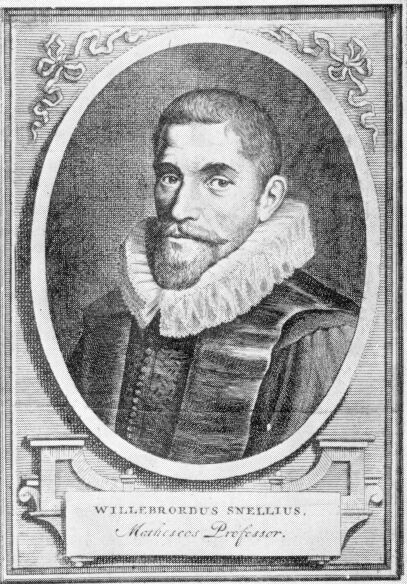
Willebrord Snellius
Willebrord Snellius (born Willebrord Snel van Royen (13 June 1580 – 30 October 1626), commonly known simply as Snellius and Snell, was a Dutch astronomer and mathematician.
Snell is best known for the law of refraction of light known as Snell's law, his pioneering work in survey known as Snellius's triangulation, and the Snellius–Pothenot problem, a means in planar trigonometry of finding an unknown point from known ones.
Despite being commonly attributed to Snell, the law of refraction was discovered by the Persian scientist Ibn Sahl around 984 AD.
Willebrord Snellius was born in Leiden, Netherlands. In 1613 he succeeded his father, Rudolph Snel van Royen (1546–1613) as professor of mathematics at the University of Leiden.
In 1615, Snellius, became the first known surveyor since Eratosthenes in 3rd century BC Ptolemaic Egypt to use triangulation to make a large-scale arc measurement to determine the Earth's circumference.
In his work The terrae Ambitus vera quantitate (1617) under the author's name ("The Dutch Eratosthenes") Snellius describes achieving his result by calculating the distances between a number of high points in the plain west and southwest of the Netherlands using triangulation. By necessity Snellius's high points were nearly all church spires, virtually the only tall buildings at that time in the west of the Netherlands. More or less ordered from north to south and/or in successive order of measuring, Snellius used a network of fourteen measure points to make a total of 53 triangulation measurements.
These cities were: Alkmaar: St. Laurenskerk; Haarlem: Sint-Bavokerk; Leiden: a then new part (built in 1599) of the city walls; The Hague: Sint-Jacobskerk; Amsterdam: Oude Kerk; Utrecht: Cathedral of Utrecht; Zaltbommel: Sint-Maartenskerk; Gouda: Sint Janskerk; Oudewater: Sint-Michaelskerk; Rotterdam: Sint-Laurenskerk; Dordrecht: Grote Kerk; Willemstad: Koepelkerk; Bergen-op-Zoom: Gertrudiskerk; Breda: Grote Kerk.
Snellius was helped in measuring by two of his students, the Austrian barons Erasmus and Casparus Sterrenberg. In several cities he also received support of friends among the civic leaders (regenten).[citation needed]
Hub AI
Willebrord Snellius AI simulator
(@Willebrord Snellius_simulator)
Willebrord Snellius
Willebrord Snellius (born Willebrord Snel van Royen (13 June 1580 – 30 October 1626), commonly known simply as Snellius and Snell, was a Dutch astronomer and mathematician.
Snell is best known for the law of refraction of light known as Snell's law, his pioneering work in survey known as Snellius's triangulation, and the Snellius–Pothenot problem, a means in planar trigonometry of finding an unknown point from known ones.
Despite being commonly attributed to Snell, the law of refraction was discovered by the Persian scientist Ibn Sahl around 984 AD.
Willebrord Snellius was born in Leiden, Netherlands. In 1613 he succeeded his father, Rudolph Snel van Royen (1546–1613) as professor of mathematics at the University of Leiden.
In 1615, Snellius, became the first known surveyor since Eratosthenes in 3rd century BC Ptolemaic Egypt to use triangulation to make a large-scale arc measurement to determine the Earth's circumference.
In his work The terrae Ambitus vera quantitate (1617) under the author's name ("The Dutch Eratosthenes") Snellius describes achieving his result by calculating the distances between a number of high points in the plain west and southwest of the Netherlands using triangulation. By necessity Snellius's high points were nearly all church spires, virtually the only tall buildings at that time in the west of the Netherlands. More or less ordered from north to south and/or in successive order of measuring, Snellius used a network of fourteen measure points to make a total of 53 triangulation measurements.
These cities were: Alkmaar: St. Laurenskerk; Haarlem: Sint-Bavokerk; Leiden: a then new part (built in 1599) of the city walls; The Hague: Sint-Jacobskerk; Amsterdam: Oude Kerk; Utrecht: Cathedral of Utrecht; Zaltbommel: Sint-Maartenskerk; Gouda: Sint Janskerk; Oudewater: Sint-Michaelskerk; Rotterdam: Sint-Laurenskerk; Dordrecht: Grote Kerk; Willemstad: Koepelkerk; Bergen-op-Zoom: Gertrudiskerk; Breda: Grote Kerk.
Snellius was helped in measuring by two of his students, the Austrian barons Erasmus and Casparus Sterrenberg. In several cities he also received support of friends among the civic leaders (regenten).[citation needed]