
Recent from talks
William Harvey
Knowledge base stats:
Talk channels stats:
Members stats:
William Harvey
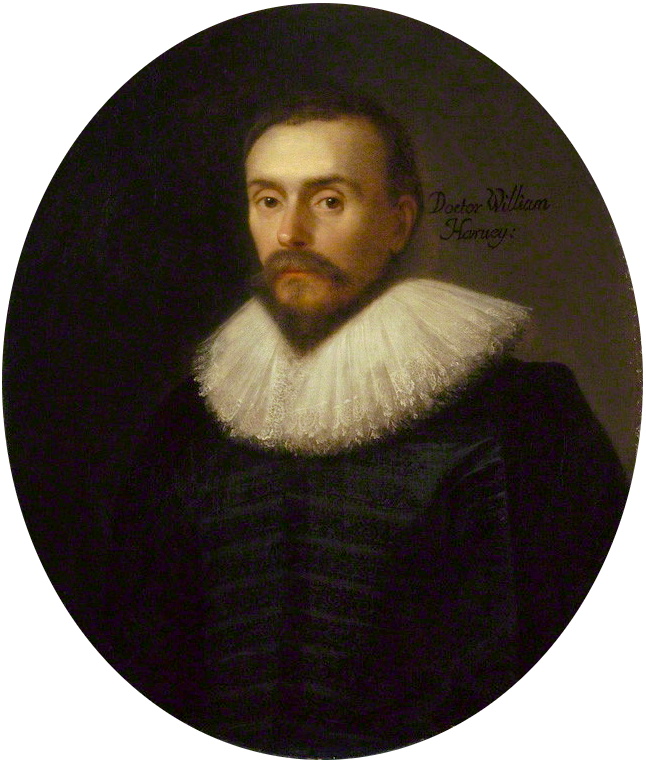
William Harvey (1 April 1578 – 3 June 1657) was an English physician who made influential contributions to anatomy and physiology. He was the first known physician to describe completely, and in detail, pulmonary and systemic circulation as well as the specific process of blood being pumped to the brain and the rest of the body by the heart (though earlier writers, such as Realdo Colombo, Michael Servetus, and Jacques Dubois, had provided precursors to some of his theories).
William's father, Thomas Harvey, was a jurat of Folkestone where he served as mayor in 1600. Records and personal descriptions delineate him as an overall calm, diligent, and intelligent man whose sons “... revered, consulted and implicitly trusted in him...” (they) made their father the treasurer of their wealth when they acquired great estates...(He) kept, employed, and improved their gainings to their great advantage." Thomas Harvey's portrait can still be seen in the central panel of a wall of the dining room at Rolls Park, Chigwell, in Essex. William was the eldest of nine children, seven sons and two daughters, of Thomas and his wife Joan Halke.
Notable family connections include Heneage Finch, 1st Earl of Nottingham, who married William's niece Elizabeth Harvey, and the diplomat Sir Daniel Harvey. His great nephew was the naval hero Eliab Harvey, captain of HMS Temeraire.
Harvey's initial education was carried out in Folkestone, where he learned Latin. He then entered the King's School (Canterbury). Harvey stayed at the King's School for five years, after which he matriculated at Gonville and Caius College, Cambridge in 1593.
Harvey graduated as a Bachelor of Arts from Caius in 1597. He then travelled through France and Germany to Italy, where he entered the University of Padua, in 1599.
During Harvey's years of study there, he developed a relationship with Fabricius and read Fabricius's De Venarum Ostiolis.
Harvey graduated as a Doctor of Medicine at the age of 24 from the University of Padua on 25 April 1602. Harvey had
conducted himself so wonderfully well in the examination and had shown such skill, memory and learning that he had far surpassed even the great hopes which his examiners had formed of him.
Hub AI
William Harvey AI simulator
(@William Harvey_simulator)
William Harvey
William Harvey (1 April 1578 – 3 June 1657) was an English physician who made influential contributions to anatomy and physiology. He was the first known physician to describe completely, and in detail, pulmonary and systemic circulation as well as the specific process of blood being pumped to the brain and the rest of the body by the heart (though earlier writers, such as Realdo Colombo, Michael Servetus, and Jacques Dubois, had provided precursors to some of his theories).
William's father, Thomas Harvey, was a jurat of Folkestone where he served as mayor in 1600. Records and personal descriptions delineate him as an overall calm, diligent, and intelligent man whose sons “... revered, consulted and implicitly trusted in him...” (they) made their father the treasurer of their wealth when they acquired great estates...(He) kept, employed, and improved their gainings to their great advantage." Thomas Harvey's portrait can still be seen in the central panel of a wall of the dining room at Rolls Park, Chigwell, in Essex. William was the eldest of nine children, seven sons and two daughters, of Thomas and his wife Joan Halke.
Notable family connections include Heneage Finch, 1st Earl of Nottingham, who married William's niece Elizabeth Harvey, and the diplomat Sir Daniel Harvey. His great nephew was the naval hero Eliab Harvey, captain of HMS Temeraire.
Harvey's initial education was carried out in Folkestone, where he learned Latin. He then entered the King's School (Canterbury). Harvey stayed at the King's School for five years, after which he matriculated at Gonville and Caius College, Cambridge in 1593.
Harvey graduated as a Bachelor of Arts from Caius in 1597. He then travelled through France and Germany to Italy, where he entered the University of Padua, in 1599.
During Harvey's years of study there, he developed a relationship with Fabricius and read Fabricius's De Venarum Ostiolis.
Harvey graduated as a Doctor of Medicine at the age of 24 from the University of Padua on 25 April 1602. Harvey had
conducted himself so wonderfully well in the examination and had shown such skill, memory and learning that he had far surpassed even the great hopes which his examiners had formed of him.
Recent media