Hubbry Logo
Pulmonary circulationPulmonary circulationMain
Open search
Pulmonary circulation
Community hub
Pulmonary circulation
logo
8 pages, 0 posts
0 subscribers
Be the first to start a discussion here.
Pulmonary circulation
from Wikipedia
Pulmonary circulation
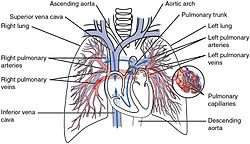
Pulmonary circulation in the heart
Details
SystemCirculatory system
Identifiers
MeSHD011652
TA24073
Anatomical terminology

The pulmonary circulation is a division of the circulatory system in all vertebrates. The circuit begins with deoxygenated blood returned from the body to the right atrium of the heart where it is pumped out from the right ventricle to the lungs. In the lungs the blood is oxygenated and returned to the left atrium to complete the circuit.[1]

The other division of the circulatory system is the systemic circulation that begins upon the oxygenated blood reaching the left atrium from the pulmonary circulation. From the atrium the oxygenated blood enters the left ventricle where it is pumped out to the rest of the body, then returning as deoxygenated blood back to the pulmonary circulation.

A separate circulatory circuit known as the bronchial circulation supplies oxygenated blood to the tissues of the lung that do not directly participate in gas exchange.

Anatomy

[edit]
3D rendering of a high resolution computed tomography of the thorax. The anterior thoracic wall, the airways and the pulmonary vessels anterior to the root of the lung have been digitally removed in order to visualize the different levels of the pulmonary circulation.
Image showing main pulmonary artery coursing ventrally to the aortic root and trachea. The right pulmonary artery passes dorsally to the ascending aorta, while the left pulmonary artery passes ventrally to the descending aorta.

The pulmonary arteries have both an internal and external elastic membrane, whereas pulmonary veins have a single (outer) elastic layer.[2]

Arteries

[edit]

From the right ventricle, blood is pumped through the semilunar pulmonary valve into the left and right main pulmonary artery (one for each lung), which branch into smaller pulmonary arteries that spread throughout the lungs.[3][4]

Veins

[edit]

Oxygenated blood leaves the lungs through pulmonary veins, which return it to the left part of the heart, completing the pulmonary cycle.[3][4]

Physiology

[edit]

Two pulmonary circulations

[edit]

The lung actually possesses a high-flow, low-pressure circulation which passes deoxygenated blood from the right heart through the capillaries surrounding the alveoli to be oxygenated, and a low-flow, high-pressure (just slightly lower than systemic arterial pressure) circulation which supplies oxygenated blood to other structures of the lung (airways, supporting tissues, and the vasa vasorum) via the bronchial arteries. This oxygenated blood supplied by the bronchial arteries amounts to 1-2% of left heart output, and is drained into the pulmonary venous system and returned to the left atrium.[5]

Pulmonary arterial pressure normally measures about 25 mmHg during systole, about 8 mmHg during diastole, for a mean arterial pressure of 15 mmHg.[5]

Capacity and compliance

[edit]

Compared to the systemic circulation, the pulmonary circulation has less than 1/8th the capacitance and contains ~1/10th the blood volume.[6] The pulmonary arteries and veins are short vessels. To accommodate the right ventricular stroke volume, the pulmonary arterial system has very high compliance; this is achieved by all pulmonary arteries possessing much larger diameters compared to systemic counterparts, as well as thin and distensible walls. Pulmonary blood flow is essentially equal to cardiac output. Pulmonary vessels typically function as distensible conduits that distend at higher intraluminal pressures and narrow with lower pressures.[5]

Blood flow, blood pressure and vascular resistance

[edit]

The (alveolar) pulmonary circulation operates as a very low pressure and resistance system. Indeed, blood pressure in the circulation is normally just sufficient to maintain blood flow in all parts of the lungs. Nevertheless, the pulmonary circulation can accommodate significantly increased flow during periods of increased demand. Abnormally high blood pressures in the pulmonary circulation (e.g. in left-sided heart failure) cause excess fluid to transude from the blood vessels into the alveoli and accumulate here, causing pulmonary edema and impairing gas exchange.[7] Pulmonary capillary pressure is estimated to normally stand at about 7mmHg (compared to about 17 mmHg in capillaries of the systemic circulation), though it has not been measured directly.[5]

During very heavy demand (e.g. during strenuous exercise), pulmonary blood flow may be increased to 4-fold to 7-fold of normal. The additional blood flow is accommodated by increasing the number of open capillaries (up to 3-fold greater), distending capillaries (up to 2-fold greater flow), and increasing pulmonary blood pressure; the former two mechanisms accommodate the additional blood flow by reducing vascular resistance and can normally accommodate all the additional required blood flow even at peak demand with little additional increase of pulmonary blood pressure.[5]

Blood normally passes through a pulmonary capillary in about 0.8 s, but the time spent traversing the capillaries is as little as 0.3 s during maximal blood flow.[5]

Autoregulation of alveolar blood flow

[edit]

Lung tissue is capable of reducing perfusion of poorly ventilated alveoli to redirect blood flow to better ventilated ones. Reduced O2 concentration in an alveolus causes adjacent blood vessels to constrict; vascular resistance may increase more than 5-fold with very low alveolar O2 levels. Hypoxic vasoconstriction of alveolar blood vessels is thought to be mediated by increased action of vasoconstrictors (e.g. endothelin, and reactive oxygen species), decreased release of vasodilators (e.g. nitric oxide), and closing of oxygen-sensitive K+ channels in vascular smooth muscle (directly causing depolarisation and consequent constriction of muscle).[5]

Hydrostatic effects and pulmonary blood flow

[edit]

The hydrostatic pressure of blood within blood vessels exhibits a gradient across the lung (as do blood vessels across any axis of the body). In an upright person, the lung normally measures 30 cm top-to-bottom for a hydrostatic pressure gradient of 23 mmHg, of which 15 mmHg is superior to the level of the heart. Consequently, in a standing person at rest, there is 5 times more blood flow at the bottom of the lung than at the top.[5]

The hydrostatic pressure gradient can lead to three different blood flow scenarios in different parts of the lung:[5]

  • Zone 1: upper-most zone where alveolar pressure always exceeds capillary blood pressure and no blood flow occurs.
  • Zone 2: intermediate zone where peak capillary blood pressure exceeds alveolar pressure during systole, but alveolar pressure always exceeds diastolic blood pressure, so that some blood flows through the capillaries but only during systole.
  • Zone 3: lower zone where capillary blood pressure during diastole exceeds alveolar pressure so that blood flow is continuous.

Normally, only zone 2 and zone 3 blood flow occurs in the lungs: as normal systolic pulmonary blood pressure is ~25 mmHg at heart level and the hydrostatic pressure of the blood is 15 mmHg at the top of the lung, capillary pressure at the top of the lung will amount to ~10 mmHg during systole, but because normal diastolic pulmonary blood pressure is only 8 mmHg, no blood flow will occur in parts of the lung where hydrostatic pressure of the blood exceeds 7 mmHg (this limit is situated about 10 cm about the level of the heart in vivo).[5]

Zone 1 blood flow occurs in the context of either abnormally low systolic pulmonary blood pressure, or abnormally high alveolar pressure. When alveolar pressure exceeds capillary blood pressure, capillaries collapse and blood flow ceases. Increased blood flow through the pulmonary circulation (e.g. during physical exertion) causes zone 2 parts of the lung to progressively transition to zone 3 patterns of blood flow.[5]

Pulmonary blood volume

[edit]

Pulmonary blood volume is normally about 450 mL (about 9% of total blood volume); about 70mL of this amount is contained within pulmonary capillaries, and the remainder is roughly equally distributed between the pulmonary arterial and venous systems.[5]

The pulmonary blood pool may range from half of the normal amount to twice the normal amount as result of various physiological or pathological conditions. Vigorous expiration that creates high pressures within the lungs can cause as much as 250 mL of blood to be ejected from the pulmonary circulation. The pulmonary blood pool can act as a blood reserve that can be mobilised into the systemic circulation (e.g. after blood loss). Dysfunction of the left heart can cause significant amounts of blood to dam up in the pulmonary circulation.[5]

Development

[edit]

The pulmonary circulation loop is virtually bypassed in fetal circulation.[8] The fetal lungs are collapsed, and blood passes from the right atrium directly into the left atrium through the foramen ovale (an open conduit between the paired atria) or through the ductus arteriosus (a shunt between the pulmonary artery and the aorta).[8]

When the lungs expand at birth, the pulmonary pressure drops and blood is drawn from the right atrium into the right ventricle and through the pulmonary circuit. Over the course of several months, the foramen ovale closes, leaving a shallow depression known as the fossa ovalis.[8][9]

Clinical significance

[edit]

A number of medical conditions may affect the pulmonary circulation:

History

[edit]
The opening page of one of Ibn al-Nafis's medical works

The pulmonary circulation is archaically known as the "lesser circulation" which is still used in non-English literature.[15][16]

The discovery of the pulmonary circulation has been attributed to many scientists with credit distributed in varying ratios by varying sources. In much of modern medical literature, the discovery is credited to English physician William Harvey (1578 – 1657 CE) based on the comprehensive completeness and correctness of his model, despite its relative recency.[17][18] Other sources credit one or more of Greek philosopher Hippocrates (460 – 370 BCE), Arab physician Ibn al-Nafis (1213 – 1288 CE), Syrian physician Qusta ibn Luqa or Spanish physician Michael Servetus (c. 1509 – 1553 CE).[19][20][21][22] Several figures such as Hippocrates and al-Nafis receive credit for accurately predicting or developing specific elements of the modern model of pulmonary circulation: Hippocrates[21] for being the first to describe pulmonary circulation as a discrete system separable from systemic circulation as a whole and al-Nafis[23] for making great strides over the understanding of those before him and towards a rigorous model. There is a great deal of subjectivity involved in deciding at which point a complex system is "discovered", as it is typically elucidated in piecemeal form so that the very first description, most complete or accurate description, and the most significant forward leaps in understanding are all considered acts of discovery of varying significance.[21]

Early descriptions of the cardiovascular system are found throughout several ancient cultures. The earliest known description of the role of air in circulation was produced in Egypt in 3500 BCE. At the time, the Egyptians believed that the heart was the origin of many channels that connected different parts of the body to each other and transported air – as well as urine, blood, and the soul – between them.[24] The Edwin Smith Papyrus (1700 BCE), named for American Egyptologist Edwin Smith (1822 – 1906 CE) who purchased the scroll in 1862, provided evidence that Egyptians believed that the heartbeat created a pulse that transported the above substances throughout the body.[25] A second scroll, the Ebers Papyrus (c. 1550 BCE), also emphasized the importance of the heart and its connection to vessels throughout the body and described methods to detect cardiac disease through pulse abnormalities. Although they had knowledge of the heartbeat, vessels, and pulse, the Egyptians attributed the movement of substances through the vessels to air that resided in these channels, rather than to the heart's exertion of pressure.[26]The Egyptians knew that air played an important role in circulation but did not yet have a conception of the role of the lungs.

The next addition to the historical understanding of pulmonary circulation arrived with the Ancient Greeks. Physician Alcmaeon (520 – 450 BCE) proposed that the brain, not the heart, was the connection point for all of the vessels in the body. He believed that the function of these vessels was to bring the "spirit" ("pneuma") and air to the brain.[24][27] Empedocles (492 – 432 BCE), a philosopher, proposed a series of pipes, impermeable to blood but continuous with blood vessels, that carried the pneuma throughout the body. He proposed that this spirit was internalized by pulmonary respiration.[24]

Hippocrates was the first to describe pulmonary circulation as a discrete system, separable from systemic circulation, in his Corpus Hippocraticum, which is often regarded as the foundational text of modern medicine.[21] Hippocrates developed the view that the liver and spleen produced blood, and that this traveled to the heart to be cooled by the lungs that surrounded it.[20] He described the heart as having two ventricles connected by an interventricular septum, and depicted the heart as the nexus point of all of the vessels of the body. He proposed that some vessels carried only blood and that others carried only air. He hypothesized that these air-carrying vessels were divisible into the pulmonary veins, which carried in air to the left ventricle, and the pulmonary artery, which carried in air to the right ventricle and blood to the lungs. He also proposed the existence of two atria of the heart functioning to capture air. He was one of the first to begin to accurately describe the anatomy of the heart and to describe the involvement of the lungs in circulation. His descriptions built substantially on previous and contemporaneous efforts but, by modern standards, his conceptions of pulmonary circulation and of the functions of the parts of the heart were still largely inaccurate.[24]

Greek philosopher and scientist Aristotle (384 – 322 BCE) followed Hippocrates and proposed that the heart had three ventricles, rather than two, that all connected to the lungs.[24] Greek physician Erasistratus (315 – 240 BCE) agreed with Hippocrates and Aristotle that the heart was the origin of all of the vessels in the body but proposed a system in which air was drawn into the lungs and traveled to the left ventricle via pulmonary veins. It was transformed there into the pneuma and distributed throughout the body by arteries, which contained only air.[25] In this system, veins distributed blood throughout the body, and thus blood did not circulate, but rather was consumed by the organs.[24]

The Greek physician Galen (129 – c. 210 CE) provided the next insights into pulmonary circulation. Though many of his theories, like those of his predecessors, were marginally or completely incorrect, his theory of pulmonary circulation dominated the medical community's understanding for hundreds of years after his death.[25] Galen contradicted Erasistratus before him by proposing that arteries carried both air and blood, rather than air alone (which was essentially correct, leaving aside that blood vessels carry constituents of air and not air itself).[20] He proposed that the liver was the originating point of all blood vessels. He also theorized that the heart was not a pumping muscle but rather an organ through which blood passed.[25] Galen's theory included a new description of pulmonary circulation: air was inhaled into the lungs where it became the pneuma. Pulmonary veins transmitted this pneuma to the left ventricle of the heart to cool the blood simultaneously arriving there. This mixture of pneuma, blood, and cooling produced the vital spirits that could then be transported throughout the body via arteries. Galen further proposed that the heat of the blood arriving in the heart produced noxious vapors that were expelled through the same pulmonary veins that first brought the pneuma.[28] He wrote that the right ventricle played a different role to the left: it transported blood to the lungs where the impurities were vented out so that clean blood could be distributed throughout the body. Though Galen's description of the anatomy of the heart was more complete than those of his predecessors, it included several mistakes. Most notably, Galen believed that blood flowed between the two ventricles of the heart through small, invisible pores in the interventricular septum.[24]

The next significant developments in the understanding of pulmonary circulation did not arrive until centuries later. Persian polymath Avicenna (c. 980 – 1037 CE) wrote a medical encyclopedia entitled The Canon of Medicine. In it, he translated and compiled contemporary medical knowledge and added some new information of his own.[23] However, Avicenna's description of pulmonary circulation reflected the incorrect views of Galen.[20]

The Arab physician, Ibn al-Nafis, wrote the Commentary on Anatomy in Avicenna's Canon in 1242 in which he provided possibly the first known description of the system that remains substantially congruent with modern understandings, in spite of its flaws. Ibn al-Nafis made two key improvements on Galen's ideas. First, he disproved the existence of the pores in the interventricular septum that Galen had believed allowed blood to flow between the left and right ventricles. Second, he surmised that the only way for blood to get from the right to the left ventricle in the absence of interventricular pores was a system like pulmonary circulation. He also described the anatomy of the lungs in clear and basically correct detail, which his predecessors had not.[23] However, like Aristotle and Galen, al-Nafis still believed in the quasi-mythical concept of vital spirit and that it was formed in the left ventricle from a mixture of blood and air. Despite the enormity of Ibn al-Nafis's improvements on the theories that preceded him, his commentary on The Canon was not widely known to Western scholars until the manuscript was discovered in Berlin, Germany, in 1924. As a result, the ongoing debate among Western scholars as to how credit for the discovery should be apportioned failed to include Ibn al-Nafis until, at earliest, the mid-20th century (shortly after which he came to enjoy a share of this credit).[20][23] In 2021, several researchers described a text predating the work of al-Nafis, fargh- beyn-roh va nafs, in which there is a comparable report on pulmonary circulation. The researchers argue that its author, Qusta ibn Luqa, is the best candidate for the discoverer of pulmonary circulation on a similar basis to arguments in favour of al-Nafis generally.[22]

It took centuries for other scientists and physicians to reach conclusions that were similar to and then more accurate than those of al-Nafis and ibn Luqa. This later progress, constituting the gap between medieval and modern understanding, occurred throughout Europe. Italian polymath Leonardo da Vinci (1452 – 1519 CE) was one of the first to propose that the heart was just a muscle, rather than a vessel of spirits and air, but he still subscribed to Galen's ideas of circulation and defended the existence of interventricular pores.[24] The Flemish physician Andreas Vesalius (1514 – 1564 CE) published corrections to Galen's view of circulatory anatomy, questioning the existence of interventricular pores, in his book De humani corporis fabrica libri septem in 1543.[28] Spanish Michael Servetus, after him, was the first European physician to accurately describe pulmonary circulation.[19] His assertions largely matched those of al-Nafis. In subsequent centuries, he has frequently been credited with the discovery, but some historians have propounded the idea that he potentially had access to Ibn al-Nafis's work while writing his own texts.[20] Servetus published his findings in Christianismi Restituto (1553): a theological work that was considered heretical by Catholics and Calvinists alike. As a result, both book and author were burned at the stake and only a few copies of his work survived.[20] Italian physician Realdo Colombo (c. 1515 – 1559 CE) published a book, De re anatomica libri XV, in 1559 that accurately described pulmonary circulation. It is still a matter of debate among historians as to whether Colombo reached his conclusions alone or based them to an unknown degree on the works of al-Nafis and Servetus.[20][24] Finally, in 1628, the influential British physician William Harvey (1578 – 1657 AD) provided at the time the most complete and accurate description of pulmonary circulation of any scholar worldwide in his treatise Exercitatio Anatomica de Motu Cordis et Sanguinis in Animalibus. At the macroscopic level, his model is still recognizable in and reconcilable with modern understandings of pulmonary circulation.[17]

References

[edit]
[edit]
Revisions and contributorsEdit on WikipediaRead on Wikipedia
from Grokipedia
Pulmonary circulation is the portion of the cardiovascular system that transports deoxygenated blood from the right ventricle of the heart to the lungs for gas exchange and returns oxygenated blood to the left atrium and ventricle. This low-pressure, high-flow circuit receives the entire cardiac output from the right heart and functions primarily to facilitate the oxygenation of blood and removal of carbon dioxide through diffusion in the pulmonary capillaries. Unlike the systemic circulation, which operates under higher pressure to supply oxygen and nutrients to body tissues, pulmonary circulation is characterized by thin-walled vessels and a parallel arrangement of capillaries that maximize surface area for efficient gas exchange. The anatomical structure of pulmonary circulation begins with the main pulmonary artery, which arises from the right ventricle and bifurcates into the right and left pulmonary arteries (the main trunk about 5 cm long), supplying the respective lungs. These arteries branch into smaller pulmonary arterioles and eventually form an extensive capillary network surrounding the alveoli, where gas exchange occurs. Oxygenated blood then collects in pulmonary venules, which converge into four pulmonary veins (two from each lung) that drain directly into the left atrium. The pulmonary arteries are thinner and more compliant than their systemic counterparts, with walls approximately one-third as thick, allowing them to accommodate the full cardiac output at low pressures (typically 25/8 mmHg in the pulmonary artery). Additionally, a separate bronchial circulation, derived from the systemic aorta, provides oxygenated blood to the lung parenchyma and airways, accounting for about 1% of cardiac output and draining partly into the pulmonary veins. Physiologically, pulmonary circulation operates as a low-resistance with high vascular compliance, enabling it to handle large volumes without significant elevation. flow distribution is influenced by gravity and zones: Zone 1 (alveolar exceeds arterial, minimal flow), Zone 2 (intermittent flow during ), and Zone 3 (continuous flow, predominant in dependent regions). The circuit's efficiency is maintained by lymphatic drainage, which removes excess fluid from the to keep alveoli dry, with lymphatics originating near terminal bronchioles and draining via bronchomediastinal trunks into the and right lymphatic duct. In the , pulmonary circulation is bypassed via shunts like the and foramen ovale, which close postnatally to establish the mature pathway. This ensures that deoxygenated from the body, entering the right atrium via the , is rapidly processed in the lungs before distribution to the systemic circulation.

Anatomy

Pulmonary Arteries

The pulmonary arteries originate from the right ventricle of the heart via the pulmonary trunk, a short vessel approximately 5 cm in length that arises at the base of the ventricle just distal to the pulmonary valve and ascends anteriorly before bifurcating into the left and right main pulmonary arteries at the level of the second costal cartilage. The pulmonary trunk has a diameter of about 2.5 to 3 cm in adults, facilitating the transport of deoxygenated blood to the lungs under low pressure. The main pulmonary arteries follow the branching pattern of the bronchial tree, dividing first into lobar arteries—typically two per lung (upper and lower for the right lung, and upper and lower for the left, with the left upper often including the lingula)—and then into segmental arteries that supply the bronchopulmonary segments. Each lung contains 8 to 10 bronchopulmonary segments, resulting in approximately 18 to 20 segments total across both lungs, with further subdivision into subsegmental arteries that penetrate the lung parenchyma. This hierarchical branching ensures even distribution of blood flow to match regional ventilation. The walls of the pulmonary arteries are thin and distensible, consisting of three layers (intima, media, and ) but with significantly less and elastic tissue compared to systemic arteries of similar size, which accommodates the low-pressure, high-compliance environment of the pulmonary circulation. This composition allows for easy distension during and minimal resistance to flow, with wall thickness typically less than 5% of the external diameter in muscular branches. Anatomical variations in the pulmonary arteries include asymmetry between the left and right main branches, where the right pulmonary artery is longer and courses horizontally beneath the , while the left is shorter and passes superior to the left main . Trifurcation of the pulmonary trunk, where it divides into three branches instead of two, occurs rarely and is often associated with other congenital anomalies. Within the lungs, variations such as absent or accessory lobar arteries (e.g., to the middle lobe) are noted in up to 20-30% of individuals, influencing surgical planning. The pulmonary arteries enter the lungs at the hilum, traveling alongside the bronchi within bronchovascular bundles that also include and lymphatics, ensuring coordinated delivery of to ventilated regions. This close anatomical relationship facilitates the matching of to ventilation throughout the pulmonary tree.

Pulmonary Capillaries

The pulmonary capillaries form a dense microvascular network surrounding the alveoli, creating a sheet-like that facilitates across an extensive surface area estimated at 70-80 in humans. This network comprises approximately 280 billion capillaries associated with around 300 million alveoli, enabling efficient of and between blood and air. The capillaries originate from the terminal branches of pulmonary arterioles, branching into interconnected segments embedded within the alveolar walls. Structurally, pulmonary capillaries feature thin endothelial walls, typically 0.2-0.5 μm thick, composed of flattened squamous endothelial cells that minimize the diffusion barrier. These capillaries lack fenestrations, relying instead on continuous non-fenestrated endothelium connected by tight junctions to maintain barrier integrity while allowing selective transcellular transport. The endothelial layer is supported by a thin basement membrane shared with adjacent alveolar epithelial cells, contributing to the overall blood-air barrier thickness of about 0.3-1 μm. In terms of distribution, the capillaries are primarily located within the alveolar septa, forming three morphological types: corner vessels at alveolar junctions, plate-like sheets spanning septal flats, and intricate networks in denser regions. This arrangement allows for dynamic adaptation, with capillary recruitment—opening of previously closed vessels—and distension—expansion of open vessels—occurring in response to increased pressure or inflation. At rest, the capillary bed holds about 70 mL of , which can increase to 200 mL during exercise through these mechanisms, enhancing capacity. Compared to systemic capillaries, pulmonary capillaries exhibit shorter path lengths, with individual segments averaging 8-10 μm, resulting in transit times of approximately 0.75 seconds at rest—shorter than the typical 1-2 seconds in systemic beds—to support rapid oxygenation without compromising efficiency. This anatomical design prioritizes a vast, low-resistance network optimized for the high-flow, low-pressure pulmonary circuit.

Pulmonary Veins

The pulmonary veins are the primary vessels responsible for draining oxygenated blood from the lungs to the left atrium of the heart. Typically, there are four main pulmonary veins: two from each lung, consisting of a superior and an inferior vein per lung. The right superior pulmonary vein drains the right upper and middle lobes, while the right inferior pulmonary vein drains the right lower lobe. On the left side, the superior pulmonary vein drains the upper lobe and lingula, and the inferior pulmonary vein drains the lower lobe. These veins converge at the left atrium, forming separate ostia in the majority of cases, and play a crucial role in completing the low-pressure pulmonary circuit by returning blood to the systemic circulation. The branching pattern of the pulmonary veins begins at the subsegmental level, where smaller venules collect from the pulmonary capillaries and coalesce into larger segmental veins. Unlike the pulmonary arteries and bronchi, which travel together in bronchovascular bundles, the pulmonary veins course independently, often running through the interlobular that separate the lobules. This arrangement allows the veins to drain from multiple segments without direct anatomical alignment to the airway or arterial structures, facilitating efficient collection across the parenchyma. The walls of the pulmonary veins are notably thin, even compared to those of the pulmonary arteries, featuring a minimal amount of elastic tissue and lacking valves, which distinguishes them from many systemic veins. This structure supports their function in a low-pressure environment, with the thin and sparse enabling distensibility while minimizing resistance to flow. Anatomical variations are common, including a shared common ostium for the two left pulmonary veins in approximately 20-30% of individuals, and accessory veins that drain specific regions such as the right middle lobe or left lingula, occurring in up to 26% of cases for the middle lobe variant. These variations can affect surgical planning but do not typically impair normal function. Pulmonary veins also maintain a close spatial relationship with the lung's , accompanying lymphatic vessels that drain from the alveolar regions through the interlobular and toward the hilum. This association aids in the coordinated clearance of interstitial fluid and immune cells alongside venous return, with lymphatics often positioned adjacent to venous segments in the framework.

Physiology

Dual Pulmonary and Bronchial Circulations

The lungs are supplied by two parallel vascular systems: the pulmonary circulation, which facilitates , and the , which provides nutritional support to the lung parenchyma and supporting structures. These dual circulations operate under distinct pressure gradients and flow rates, ensuring both oxygenation of systemic blood and maintenance of lung tissue viability. Although anatomically interconnected through anastomoses, their separation allows specialized functions without significant interference under normal conditions. The pulmonary circulation is a low-pressure that receives the entire from the right ventricle, approximately 5 L/min in adults at rest, directing deoxygenated blood through the pulmonary arteries to the alveolar capillaries for . Operating at mean pressures of about 15 mmHg (systolic ~25 mmHg, diastolic ~10 mmHg), this circuit minimizes the workload on the right ventricle while maximizing oxygen uptake and across a thin blood-gas barrier. Its high compliance and low resistance enable it to handle increased flow during exercise without substantial pressure rises. In contrast, the arises as a high-pressure systemic branch from the via the bronchial arteries, delivering oxygenated blood to nourish the tracheobronchial tree, visceral pleura, lymph nodes, and pulmonary vessel walls. This circuit accounts for only 1-2% of , equivalent to 50-150 mL/min, reflecting its role in metabolic support rather than bulk transport. Bronchial arteries typically originate as two left (from the descending ) and one right (from the first right intercostal or upper ), branching to follow the airways and extend to the lung periphery. Anatomically, the two systems remain largely separated, with bronchial arteries paralleling the bronchi and bronchioles to reach extrapulmonary and intrapulmonary tissues, while pulmonary arteries distribute to the gas-exchanging regions. Bronchial veins form a dual drainage pattern: superficial veins accompany the bronchi and empty into the azygos or hemiazygos system toward the , whereas deep bronchial veins anastomose extensively with pulmonary veins, directing up to 70-80% of bronchial flow into the left atrium and creating a small physiological . These anastomoses prevent isolated failure of either system but can lead to pathological shunting, such as desaturated blood mixing in or bronchial artery hypertrophy. Functionally, the pulmonary circulation optimizes ventilation-perfusion matching to support systemic oxygenation, with its regulating tone in response to local hypoxia. The , despite its modest volume, serves as the primary nutritional conduit, supplying over 90% of the oxygenated blood required for tissue metabolism, immune defense, and airway thermoregulation, as the pulmonary circuit's deoxygenated blood contributes minimally to parenchymal . In pathological states, such as or , inter-system shunts expand, allowing the to compensate by increasing flow up to several-fold, though this risks complications like .

Vascular Compliance and Capacity

The pulmonary vasculature exhibits high compliance, defined as the change in per unit change in transmural (C=ΔV/ΔPC = \Delta V / \Delta P), enabling it to distend readily in response to pressure variations while maintaining low overall resistance. This property arises primarily from the thin walls of pulmonary arteries and veins, which are approximately one-third the thickness of comparable systemic vessels, allowing for greater elasticity. In healthy adults, arterial compliance averages about 7 mL/mmHg, contributing to the system's ability to handle from the right ventricle with minimal pressure elevation. The total pulmonary vascular compliance is estimated at approximately 20 mL/mmHg, reflecting the combined elastic properties of arteries, capillaries, and veins across the entire vascular bed. This value is derived from physiological models and measurements emphasizing the distensibility of the pulmonary circuit, which contrasts with the stiffer systemic arteries. The large total cross-sectional area of the pulmonary vascular bed—roughly 10 times that of the systemic circulation—further enhances compliance by distributing over an extensive network of thin-walled vessels. As a vessel, the pulmonary circulation functions as a dynamic , normally containing 500–900 mL of , or about 9–12% of the total circulating . This capacity varies with posture, increasing in the due to reduced gravitational pooling in the lower extremities and decreasing by up to one-third when upright. The role accommodates fluctuations in , such as during exercise, by recruiting additional capillaries and distending existing ones without substantial pressure rises. Physiologically, the high compliance and capacity buffer systolic peaks from the right ventricle, damping pulsations to protect the thin alveolar-capillary and prevent interstitial edema. This damping effect ensures stable low mean pulmonary artery pressures (typically 15 mmHg), facilitating efficient . In pathological conditions like , compliance declines due to vessel stiffening and remodeling, elevating pressures and impairing this buffering function.

Hemodynamics: Flow, Pressure, and Resistance

Pulmonary circulation operates under low-pressure conditions compared to systemic circulation, with normal mean pressure (mPAP) of approximately 15 mmHg. Systolic pressure typically measures around 25 mmHg, while diastolic pressure ranges from 8 to 10 mmHg. These values reflect the efficient, low-resistance pathway that facilitates without excessive strain on the right ventricle. Blood flow through the pulmonary circulation equals the , averaging 5 to 6 L/min at rest in healthy adults. (PVR) quantifies the opposition to this flow and is calculated as PVR = ( - left atrial pressure) / , with normal values ranging from approximately 1 to 2 Wood units. Left atrial pressure, often 2 to 12 mmHg, serves as the downstream reference, ensuring a minimal gradient of about 10 mmHg under resting conditions. Gravity significantly influences regional blood flow distribution in the upright lung, creating a hydrostatic gradient of 0.77 mmHg per cm of vertical height. This results in lower perfusion at the lung apices compared to the bases, where pressure is higher due to the column of blood. The zonal model, proposed by West and colleagues, divides the lung into three zones based on the interplay of pulmonary arterial (Pa), venous (Pv), and alveolar (PA) pressures. In Zone 1 (typically apical regions under low flow conditions), PA exceeds both Pa and Pv, leading to high ventilation but low or absent perfusion as capillaries collapse. Zone 2 (intermediate regions) features intermittent flow where Pa > PA > Pv, resembling a Starling resistor with flow dependent on the arterial-alveolar pressure difference. Zone 3 (basal regions) predominates under normal conditions, where Pa and Pv both exceed PA, allowing continuous perfusion driven by the arterial-venous gradient. During exercise, pulmonary blood flow increases 3- to 5-fold to match elevated , yet mean pulmonary artery rises only minimally, often to 30-40 mmHg at maximal effort. This accommodation occurs primarily through recruitment of previously underperfused capillaries, particularly in apical zones, and distension of existing vessels, which reduces PVR by up to 50%. Such passive mechanisms maintain efficient flow without substantial elevation in healthy individuals.

Regulation of Blood Flow

Pulmonary blood flow is primarily regulated through intrinsic mechanisms rather than extrinsic neural control, ensuring efficient by matching to ventilation. The pulmonary vasculature maintains low resistance under normal conditions but can dynamically adjust to physiological demands, such as changes in oxygen levels or pressure, via specialized responses that differ markedly from systemic circulation. A key regulatory mechanism is hypoxic pulmonary vasoconstriction (HPV), a local response in which low alveolar oxygen tension (PO₂ below approximately 60 mmHg) triggers in affected pulmonary arterioles to redirect blood flow away from poorly oxygenated regions. This process involves contraction of pulmonary arterial cells, mediated by endothelial-derived factors and activity, including inhibition of voltage-gated potassium channels and influx of calcium through voltage-dependent channels. HPV is biphasic, with an initial rapid phase occurring within seconds and a slower sustained phase peaking after several minutes, and it is abolished under general , which can impair ventilation-perfusion matching during . Autoregulation in the pulmonary circulation involves an intrinsic myogenic response to transmural changes, where increased stretches vascular , leading to and contraction that helps maintain relatively constant blood flow despite fluctuations in . This response is present in adult pulmonary arteries, as demonstrated in isolated vessel studies where elevation elicits force generation in 70% of adult cat pulmonary arteries. Modulation occurs through (K⁺) channels, such as KCNQ (Kv7) channels, which regulate , and (NO), which promotes to counteract excessive constriction and preserve low pulmonary . Neural influences on pulmonary blood flow are minimal under basal conditions, with sparse sympathetic innervation providing limited vasoconstrictive tone via alpha-adrenergic receptors and norepinephrine release, while parasympathetic effects are negligible. Humoral factors play a more prominent role: vasoconstrictors like angiotensin II and endothelin-1 elevate vascular tone by activating G-protein-coupled receptors and promoting contraction, whereas vasodilators such as and NO, produced by endothelial cells, relax vessels through pathways to maintain low resistance. By redistributing blood flow from hypoxic to well-ventilated alveoli, HPV optimizes the ventilation-perfusion (V/Q) , minimizing shunting and enhancing overall oxygenation efficiency. In pathological states like (COPD), sustained or heterogeneous HPV contributes to by increasing overall pulmonary vascular resistance.

Pulmonary Blood Volume

The total pulmonary blood volume in resting adults is approximately 500 mL, constituting about 10% of the total circulating of around 5 L. This volume can increase to 900–1000 mL under conditions such as exercise or changes in posture, representing up to 15–20% of circulating volume. At rest, the distribution of this volume is uneven across the pulmonary vasculature, with approximately 30-40% in the arteries, 15-20% in the capillaries, and 40-50% in the veins. During exercise, pulmonary blood flow rises significantly, leading to and distension of previously underperfused , which shifts a greater proportion of the into the capillary bed to enhance efficiency. This redistribution can increase capillary blood volume by up to 50–100% from resting levels, depending on exercise intensity. Postural changes also affect volume dynamics; transitioning from upright to increases pulmonary by approximately 50–80% (or about 400 mL) due to gravitational pooling of blood in the thoracic vasculature. Pulmonary blood volume is measured using indicator dilution techniques, such as injecting dye into the and sampling from the left atrium to quantify the dilution curve, providing an estimate of central pulmonary volume. Modern noninvasive methods include contrast-enhanced computed tomography (CT) or (MRI) to assess vascular volumes directly. Physiological variations influence this volume; , as in or hemorrhage, reduces pulmonary blood volume by decreasing overall circulating volume, while from fluid overload expands it, potentially impairing vascular compliance. The mean transit time of blood through the pulmonary circulation, which reflects efficiency, is given by : Transit time=Pulmonary blood volumePulmonary blood flow\text{Transit time} = \frac{\text{Pulmonary blood volume}}{\text{Pulmonary blood flow}} where pulmonary blood flow approximates cardiac output at rest (about 5 L/min), yielding a typical transit time of approximately 6-8 seconds. In clinical contexts, elevated pulmonary blood volume, often exceeding 700–800 mL, is observed in left-sided heart failure, where backward pressure transmission leads to vascular engorgement and interstitial congestion, increasing the risk of dyspnea and impaired oxygenation. This volume expansion highlights the pulmonary circulation's role as a compliant reservoir, but excessive accumulation strains its low-resistance design.

Development

Embryonic Formation

The embryonic formation of the pulmonary circulation begins around the fourth week of gestation, with the pulmonary arteries originating from the ventral segments of the sixth pair of aortic arches. These arches develop from the aortic sac and contribute to the proximal portions of the main pulmonary arteries, while the pulmonary trunk forms from the bulbus cordis, a component of the primitive heart tube derived from splanchnic mesoderm. This early vascular framework establishes the outflow tract connection between the right ventricle and the developing lungs, ensuring initial blood flow routing during cardiogenesis. The angiogenic process is driven primarily by vascular endothelial growth factor (VEGF), which promotes sprouting angiogenesis from pre-existing systemic vessels toward the buds, inducing arterial patterning that aligns with bronchial branching. buds secrete VEGF to attract endothelial progenitors, facilitating the integration of vascular networks with the . Between weeks 5 and 6, proximal pulmonary arteries elongate and branch in parallel with the tracheobronchial tree during the pseudoglandular stage, while weeks 7 to 8 mark the onset of distal vascularization through vasculogenesis, where a primitive forms de novo around the buds via aggregation of angioblasts. Genetic regulation involves , particularly groups 3 through 6, which pattern the proximal-distal axis of lung development and influence vascular recruitment to arterial walls; disruptions in Hox expression, such as in Hoxa3 mutants, lead to tracheobronchial malformations that secondarily affect vascular alignment. (FGF) signaling, especially , coordinates mesenchymal-epithelial interactions to guide branching morphogenesis, thereby dictating the spatial organization of the pulmonary vasculature; FGF defects result in hypoplastic lungs and associated vascular anomalies like . The pulmonary veins initially form a that drains into systemic veins connected to the right atrium via cardinal and vitelline systems, but by week 8, a common pulmonary vein canalizes from splanchnic mesoderm and incorporates into the left atrial wall through remodeling, severing right-sided connections to establish direct left atrial drainage.

Fetal and Neonatal Transitions

In , pulmonary vascular resistance (PVR) is approximately 10 times higher than in adults, primarily due to hypoxic , low pulmonary blood flow, and the fluid-filled state of the lungs, which limits vascular recruitment and distension. This high resistance results in pulmonary blood flow constituting only about 10% of the combined ventricular , with the majority of right ventricular output shunted away from the lungs via the to the , bypassing the non-functional pulmonary vasculature. The remains patent due to low oxygen tension and circulating prostaglandins, ensuring oxygenated blood from the reaches systemic circulation efficiently. At birth, the transition to neonatal circulation begins with the first breath, which dramatically reduces PVR by about 50% within minutes through lung expansion and the onset of oxygenation. This initial drop facilitates a rapid increase in pulmonary blood flow, redirecting it to the now-aerated for . The typically closes functionally within 24 to 72 hours postnatally, driven by rising oxygen levels and falling concentrations, which eliminates the . Similarly, the foramen ovale closes functionally at birth as left atrial pressure exceeds right atrial pressure due to increased pulmonary venous return, though anatomical closure occurs later, often within the first year. Multiple mechanisms orchestrate this transition: mechanical factors, such as lung aeration, increase vascular compliance by recruiting previously collapsed vessels and stretching the pulmonary capillary bed; chemical mediators, including rising oxygen tension and falling levels, inhibit hypoxic and stimulate endothelium-derived (NO) production for ; and hormonal signals, like the release of from the lungs upon initial ventilation, further promote pulmonary by enhancing synthesis and NO pathways. In the neonatal period, PVR continues to decline gradually, reaching adult levels by around 2 weeks of age through ongoing vascular remodeling, including thinning of arterial walls and maturation of endothelial function. This adaptation ensures stable pulmonary , but delays in the transition can lead to persistent of the newborn (PPHN), characterized by sustained high PVR and right-to-left shunting, affecting approximately 2 per 1,000 live births.

Clinical Significance

Pathophysiological Disorders

Pulmonary circulation can be disrupted by various pathophysiological disorders that impair blood flow, increase , and lead to . These conditions often result from endothelial injury, , or increased permeability, compromising and . Major disorders include , , , and cor pulmonale, each with distinct mechanisms and hemodynamic consequences. Pulmonary hypertension (PH) is characterized by elevated mean pressure (mPAP) exceeding 20 mmHg at rest, as measured by right heart catheterization. The (WHO) classifies PH into five groups based on underlying : Group 1 encompasses pulmonary arterial hypertension (PAH) due to and vascular remodeling; Group 2 arises from left heart disease; Group 3 from lung diseases and/or hypoxia; Group 4 from chronic thromboembolic disease; and Group 5 from multifactorial or unclear mechanisms. In Group 1 PAH, progressive leads to imbalanced vasoconstrictors and vasodilators, causing intimal proliferation, medial , and plexiform lesions that narrow pulmonary arteries. Pulmonary embolism (PE) occurs when a , typically originating from deep vein thrombosis, obstructs pulmonary arteries, acutely increasing pulmonary vascular resistance (PVR) and right ventricular afterload. This obstruction reduces to lung segments, potentially causing ventilation- mismatch and . Risk factors align with : , endothelial injury, and hypercoagulability, which promote formation and . Pulmonary edema manifests as fluid accumulation in the alveolar and interstitial spaces, disrupting and leading to respiratory distress. It is classified as cardiogenic, resulting from that elevates pulmonary capillary wedge pressure above 18 mmHg and forces fluid into the via hydrostatic forces, or non-cardiogenic, as in (ARDS), where increased from inflammatory injury allows protein-rich fluid leakage despite normal wedge pressures. Cor pulmonale refers to and eventual failure secondary to chronic , where sustained elevation in pulmonary imposes excessive on the right ventricle, leading to dilation, contractile dysfunction, and reduced . In the post-2020 era, severe infection has been linked to acute through widespread pulmonary microthrombi formation, driven by endothelial and . These microthrombi exacerbate PVR and contribute to right heart strain, often detectable via in affected cases.

Diagnostic and Imaging Techniques

Diagnostic and imaging techniques for pulmonary circulation are essential for evaluating structure and function, particularly in conditions like (PH) and (PE), where early detection guides management. These methods range from non-invasive imaging modalities that provide anatomical and functional insights to invasive procedures that offer precise hemodynamic measurements. A multimodal approach, integrating clinical assessment with multiple imaging tools, is recommended to enhance diagnostic accuracy and tailor evaluations to suspected . Echocardiography serves as the initial non-invasive screening tool for assessing pulmonary circulation, estimating pulmonary artery systolic pressure (PASP) through the tricuspid regurgitant (TR) jet velocity using the simplified Bernoulli equation, ΔP=4v2\Delta P = 4v^2, where ΔP\Delta P is the and vv is the peak velocity of the TR jet. This estimate, combined with right atrial pressure (often assumed at 5-10 mmHg), yields right ventricular systolic pressure (RVSP), which approximates PASP in the absence of . Additionally, echocardiography evaluates right ventricular (RV) function via parameters such as tricuspid annular plane systolic excursion (TAPSE) and RV fractional area change, identifying RV dilation or dysfunction indicative of elevated pulmonary pressures. Its widespread availability and lack of make it ideal for initial PH suspicion, though it has limitations in accuracy for mild cases or poor acoustic windows. Right heart catheterization (RHC) remains the gold standard for definitive diagnosis of and direct measurement of pulmonary vascular resistance (PVR), calculated as (mean pulmonary artery pressure - pulmonary artery wedge pressure) / . Performed via femoral or jugular access, RHC provides invasive hemodynamic data, including pressures, via thermodilution or Fick method, and PVR in Wood units, essential for confirming pre-capillary (mean PAP ≥20 mmHg, PVR >2 Wood units, wedge pressure ≤15 mmHg). It also enables vasoreactivity testing with agents like inhaled to guide therapy in select patients. Despite risks such as arrhythmias or vascular injury, RHC's precision justifies its role in ambiguous non-invasive findings. Computed pulmonary (CTPA) is the preferred modality for detecting acute PE, visualizing intraluminal filling defects in pulmonary arteries with high resolution, often centrally located in acute cases. Dual-energy CTPA further identifies parenchymal defects by assessing iodine distribution, distinguishing embolic from non-embolic causes without additional . For functional assessment, ventilation- (V/Q) (SPECT) detects mismatch between ventilated and perfused regions, with sensitivity of approximately 96% and specificity of 90% for PE . This is particularly useful in chronic thromboembolic PH, where it outperforms planar scans. Magnetic resonance imaging (MRI) offers radiation-free evaluation of pulmonary circulation, quantifying blood flow in using phase-contrast techniques to measure velocity and volume, with high reproducibility for pulmonary venous return. Four-dimensional (4D) flow MRI visualizes vortical flow patterns and collateral vessels in the main , aiding in congenital or chronic vascular assessments. It also delineates vessel anatomy, such as branch , supporting diagnosis in patients with contraindications to CT or . The 2022 (ESC)/European Respiratory Society (ERS) guidelines advocate a multimodal diagnostic strategy for , starting with for screening, followed by V/Q scanning or CTPA for thromboembolic evaluation, MRI for functional insights, and confirmatory RHC, to streamline detection and reduce diagnostic delays.

Therapeutic Interventions

Therapeutic interventions for pulmonary circulation disorders primarily target pulmonary arterial hypertension (PAH) and , aiming to reduce pulmonary vascular resistance, prevent , and support cardiac function. In PAH, a subset of , treatments focus on and remodeling inhibition, guided by risk stratification from diagnostic assessments such as right heart catheterization. For PE, acute management emphasizes anticoagulation to halt clot propagation, with escalation to in hemodynamically unstable cases. Supportive measures and advanced procedures address refractory disease, while emerging therapies like activin signaling inhibitors represent recent advancements. Pharmacological therapies for PAH target three main pathways: , , and . Endothelin receptor antagonists, such as , block endothelin-1-mediated and proliferation, improving exercise capacity and delaying clinical worsening in WHO functional class II-IV patients. Phosphodiesterase-5 inhibitors like enhance effects by increasing cyclic GMP, reducing pressure and improving in PAH. analogs, including intravenous epoprostenol, promote and inhibit platelet aggregation, serving as first-line therapy for high-risk PAH patients with demonstrated survival benefits. , often initiating with dual or triple oral agents and escalating to parenteral , is recommended for most patients to optimize outcomes. For PE, anticoagulation remains the cornerstone, with low-molecular-weight heparin or unfractionated heparin initiated acutely, followed by direct oral anticoagulants (DOACs) like for at least three months in non-cancer patients. DOACs offer comparable efficacy to antagonists with lower , suitable for outpatient management in low-risk cases. In massive PE with hemodynamic instability, systemic using agents like is indicated to rapidly dissolve clots and restore right ventricular function, though it carries a 2-3% major . Supportive interventions include , which alleviates hypoxemia-induced hypoxic (HPV), thereby reducing and improving oxygenation in PH patients with PaO2 below 60 mmHg. For end-stage PH refractory to medical therapy, —typically bilateral—offers curative potential, with one-year survival rates exceeding 80% and significant improvements in . Interventional procedures are vital for specific etiologies, such as pulmonary angioplasty (BPA) in chronic thromboembolic PH (CTEPH), where it dilates distal vascular lesions, improving mean pressure by 20-30% and functional status in inoperable cases. BPA, performed in staged sessions with refined techniques to minimize , has evolved as an adjunct or alternative to . Recent advancements include sotatercept, an activin signaling inhibitor approved by the FDA in March 2024 for PAH (WHO Group 1), which reduces pulmonary vascular remodeling by balancing TGF-β superfamily signaling, leading to sustained improvements in six-minute walk distance and reduced clinical worsening when added to background therapy. In October 2025, the FDA updated the indication to include reduction in clinical worsening events in adults with PAH (WHO Group 1), based on results from the phase 3 trial. Gene therapy trials targeting BMPR2 mutations, which underlie 70-80% of heritable PAH, have shown promise; for instance, lipid nanoparticle-delivered BMPR2 mRNA restores endothelial signaling in preclinical models, attenuating PAH progression.

History

Anatomical Discoveries

In ancient times, the Roman physician (c. 129–216 AD) described the vessels of the lungs and proposed that from the right ventricle passed through invisible pores in the to the left ventricle, where it mixed with air drawn from the lungs via the to form vital for the body. This model, while recognizing a pulmonary role in blood modification, fundamentally erred by denying a complete circulatory transit through the lungs and overemphasizing septal passage. In the 13th century, the Syrian physician (1213–1288) provided the first known description of pulmonary circulation in his Commentary on Anatomy in Avicenna's Canon. He rejected Galen's septal pores theory, stating that blood travels from the right ventricle to the lungs via the , where it is refined by air in the lungs before returning to the left ventricle through the . This insight, though not widely disseminated in at the time, accurately outlined the pulmonary transit of blood. During the , advanced anatomical accuracy through direct human dissections, illustrating the pulmonary arteries and veins with unprecedented detail in his seminal work De Humani Corporis Fabrica (1543). Vesalius corrected several of Galen's errors, such as the non-existence of interventricular pores, and clarified the origins and branching of pulmonary vessels, though he still adhered to a partial mixing theory without fully grasping systemic-pulmonary connectivity. His illustrations, based on meticulous observations, laid the groundwork for later circulatory insights by emphasizing empirical over classical . Building on these foundations, (1511–1553) described the pulmonary circulation in his theological work Christianismi Restitutio (1553), proposing that blood from the right ventricle passes through the lungs to the and into the left ventricle, where it mixes with air for vitalization. Independently, Realdo Colombo (1516–1559), Vesalius's successor at , explicitly detailed the pulmonary transit in De re anatomica (1559), emphasizing the flow from to lungs to without septal passage, supported by dissections. These accounts bridged the gap toward a full circulatory model. William Harvey's Exercitatio Anatomica de Motu Cordis et Sanguinis in Animalibus (1628) revolutionized understanding by demonstrating a closed , inferring the pulmonary circuit as essential for blood to pass from the right ventricle through the lungs to the left via the and vein. While Harvey's primary focus was on systemic circulation—proven through quantitative dissections showing blood volume exceeding daily production—his work implicitly required pulmonary transit to explain the heart's dual roles, rejecting Galenic consumption models. This inference bridged and emerging physiological concepts, though direct pulmonary emphasis came later. Building on Harvey, Richard Lower provided the first explicit and detailed description of pulmonary blood transit in Tractatus de Corde (1669), observing that dark pumped from the right ventricle becomes bright red upon passing through the lung's fine vessels due to . Lower's experiments, including vivisections, highlighted the lungs' role in blood transformation without vital spirits, emphasizing structural flow from pulmonary artery to vein as a continuous circuit. His anatomical focus on the heart-lung interface clarified the mechanism of lesser circulation, resolving ambiguities in Harvey's framework. Marcello Malpighi confirmed the microstructural basis of pulmonary transit in 1661 by using early microscopes to observe capillary networks in and mammalian lungs, linking pulmonary arteries directly to veins through a web of minute vessels surrounding alveoli. This discovery validated Harvey's circulation by visualizing the anatomical continuity essential for blood exchange with air, marking a pivotal shift toward microscopic in understanding pulmonary function. Malpighi's observations thus transitioned anatomical discoveries toward physiological explorations of .

Physiological Advancements

The development of techniques in the mid-20th century revolutionized the measurement of pulmonary hemodynamics, enabling direct assessment of low pressures distinct from systemic circulation. F. Cournand and Dickinson W. Richards, building on Werner Forssmann's initial self-experimentation, refined right heart catheterization to sample mixed and quantify pulmonary blood flow using the , revealing mean pressures around 15 mmHg in healthy individuals. Their work, conducted primarily in the 1940s and 1950s at , demonstrated the low-resistance, high-compliance nature of pulmonary vasculature, contrasting with higher systemic pressures and laying the groundwork for understanding . For their contributions to cardiopulmonary diagnostics, Cournand, Richards, and Forssmann shared the 1956 in or . A pivotal advancement in pulmonary vasoregulation came in 1946 when Ulf von Euler and Gunnar Liljestrand observed hypoxic pulmonary vasoconstriction (HPV) in isolated cat , where alveolar hypoxia triggered localized constriction to redirect blood flow from poorly ventilated regions, optimizing ventilation- matching. This mechanism, now known as the Euler-Liljestrand reflex, increases pulmonary vascular resistance in response to low oxygen tension without systemic effects, as confirmed in subsequent studies on perfused preparations. HPV's discovery provided a physiological basis for adaptive responses in conditions like or high-altitude hypoxia, influencing modern interpretations of regional . In 1964, John B. West introduced the zonal model of pulmonary blood flow distribution, delineating three vertical zones in the upright lung based on the interplay of pulmonary arterial (Pa), venous (Pv), and alveolar (PA) pressures. Zone 1 at the apex features PA > Pa > Pv, potentially leading to collapsed capillaries and no flow in pathological states; Zone 2 (mid-lung) has Pa > PA > Pv, resulting in intermittent flow like a Starling resistor; and Zone 3 at the base shows Pa > Pv > PA, ensuring continuous . Derived from experiments in isolated, perfused dog lungs, this model explained gravity-dependent perfusion gradients, with base-to-apex flow ratios up to 4:1 in humans, and has informed and ventilation strategies. Advancements in gas exchange modeling culminated in the Roughton-Forster refinement of the Krogh during the 1950s, quantifying pulmonary (DL) for gases like (CO) as the reciprocal of resistances in plasma and red blood cells: DL=11DM+1θVcDL = \frac{1}{\frac{1}{DM} + \frac{1}{\theta \cdot V_c}} where DM represents membrane (DLplasma), θ is the CO uptake rate by in red cells, and Vc is pulmonary blood volume. Originally proposed by Marie Krogh in 1915 for oxygen , this was experimentally validated using varying oxygen tensions to isolate components, showing DLCO values around 25-30 mL/min/mmHg in healthy adults and highlighting diffusion limitations in disease. These insights advanced non-invasive assessments of gas transfer efficiency. Recent research in the 2020s has leveraged single-cell RNA sequencing (scRNA-seq) to uncover in (PH), identifying heterogeneous pulmonary endothelial cell (PEC) subclusters with dysregulated pathways in proliferation and . Studies on human and mouse PH lungs reveal upregulated genes like SOX17 and DDIT4 in arterial PECs, driving vascular remodeling and stiffness, while venous ECs show metabolic shifts toward . For instance, scRNA-seq profiling has delineated PEC markers such as ECAM1 and PLVAP, linking their loss to impaired and offering targets for precision therapies in PH subtypes.

References

Add your contribution
Related Hubs
User Avatar
No comments yet.