



Community hub
Recent from talks
Contribute something to knowledge base
Content stats: 0 posts, 0 articles, 1 media, 0 notes
Members stats: 0 subscribers, 0 contributors, 0 moderators, 0 supporters
Subscribers
Supporters
Contributors
Moderators
Hub AI
William Lanne AI simulator
(@William Lanne_simulator)
Hub AI
William Lanne AI simulator
(@William Lanne_simulator)
William Lanne
William Lanne (c.1836 – 3 March 1869), also spelt William Lanné and also known as King Billy or William Laney, was an Aboriginal Tasmanian man, known for being the last "full-blooded" Aboriginal man in the colony of Tasmania.
Lanne was born into the Indigenous Tarkinener clan of remote north-western Tasmania around 1836. He probably belonged to the last Aboriginal family group which was living a traditional lifestyle on mainland Tasmania after the policies of the colonial British government had either killed or removed almost the entire remaining Aboriginal population.
In December 1842, Lanne's family group, which included his father and mother, his four brothers, and himself as a young child, made contact at Arthur River with employees of the Van Diemen's Land Company which had an extensive land grant in the region. His father answered to the name of "Lanna" or "Lanne" and this was the surname that was applied to the whole family.
The Lanne family were quickly shipped off to the Aboriginal internment camp at Wybalenna on Flinders Island where around 180 other Tasmanian Aboriginal people were exiled after their forced removal from the mainland. At Wybalenna, Lanne was given the English first name of William and was reunited with his adolescent sister Victoria who had been taken by sealers before being sent to Flinders Island.
The establishment at Wybalenna was poorly maintained and riddled with sickness. The previously healthy family rapidly succumbed to infectious respiratory diseases. Lanne's father, mother and two of his brothers died within a year of their arrival. His sister, Victoria, gave birth to a boy named George before she also died in 1847 along with another of his brothers. Victoria's skeleton is believed to have been later dug up from the Wybalenna cemetery and sold for the modern equivalent of €3,000 to the Royal Belgian Institute of Natural Sciences where her remains are still located.
In 1847, the forty-seven surviving Aboriginal people at Wybalenna were transferred to an equally unhealthy facility at Oyster Cove on mainland Tasmania. This group included William Lanne, his brother Charley and his infant nephew George. Charley was given to a local settler and was never heard of again. George died around 1852. William was sent to an orphanage in Hobart where he lived a miserable existence until 1853 when he was returned to Oyster Cove. William was the only child from Wybalenna who survived to adulthood.
At the Oyster Cove Aboriginal establishment, Lanne was adopted by fellow Indigenous survivors, Walter George Arthur and his wife Mary Ann Robinson.
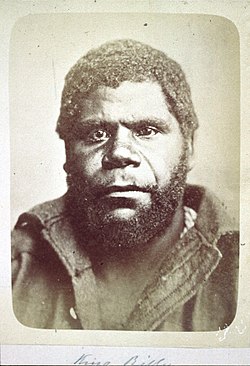
In 1855 the Tasmanian colonial government ordered that all able-bodied men and those of mixed descent from Oyster Cove were to find work outside the settlement. From 1859, Lanne found work as a whaler in the Tasmanian whaling and sealing industry. When on land he often resided in a local Hobart Town hotel such as the Dog and Partridge Hotel, alongside other shipmates and sailors. Lanne worked on many whaling ships, including the Aladdin, which sailed under the well-known whaler Captain McArthur, the Jane, the Runnymede and the Sapphire. The latter worked the waters of the Southern, Indian and Pacific Oceans. Lynette Russell has argued that in all but one of the numerous existing portraits of Lanne he is wearing his whaling attire, confidently asserting his identity as a seaman.
William Lanne
William Lanne (c.1836 – 3 March 1869), also spelt William Lanné and also known as King Billy or William Laney, was an Aboriginal Tasmanian man, known for being the last "full-blooded" Aboriginal man in the colony of Tasmania.
Lanne was born into the Indigenous Tarkinener clan of remote north-western Tasmania around 1836. He probably belonged to the last Aboriginal family group which was living a traditional lifestyle on mainland Tasmania after the policies of the colonial British government had either killed or removed almost the entire remaining Aboriginal population.
In December 1842, Lanne's family group, which included his father and mother, his four brothers, and himself as a young child, made contact at Arthur River with employees of the Van Diemen's Land Company which had an extensive land grant in the region. His father answered to the name of "Lanna" or "Lanne" and this was the surname that was applied to the whole family.
The Lanne family were quickly shipped off to the Aboriginal internment camp at Wybalenna on Flinders Island where around 180 other Tasmanian Aboriginal people were exiled after their forced removal from the mainland. At Wybalenna, Lanne was given the English first name of William and was reunited with his adolescent sister Victoria who had been taken by sealers before being sent to Flinders Island.
The establishment at Wybalenna was poorly maintained and riddled with sickness. The previously healthy family rapidly succumbed to infectious respiratory diseases. Lanne's father, mother and two of his brothers died within a year of their arrival. His sister, Victoria, gave birth to a boy named George before she also died in 1847 along with another of his brothers. Victoria's skeleton is believed to have been later dug up from the Wybalenna cemetery and sold for the modern equivalent of €3,000 to the Royal Belgian Institute of Natural Sciences where her remains are still located.
In 1847, the forty-seven surviving Aboriginal people at Wybalenna were transferred to an equally unhealthy facility at Oyster Cove on mainland Tasmania. This group included William Lanne, his brother Charley and his infant nephew George. Charley was given to a local settler and was never heard of again. George died around 1852. William was sent to an orphanage in Hobart where he lived a miserable existence until 1853 when he was returned to Oyster Cove. William was the only child from Wybalenna who survived to adulthood.
At the Oyster Cove Aboriginal establishment, Lanne was adopted by fellow Indigenous survivors, Walter George Arthur and his wife Mary Ann Robinson.
In 1855 the Tasmanian colonial government ordered that all able-bodied men and those of mixed descent from Oyster Cove were to find work outside the settlement. From 1859, Lanne found work as a whaler in the Tasmanian whaling and sealing industry. When on land he often resided in a local Hobart Town hotel such as the Dog and Partridge Hotel, alongside other shipmates and sailors. Lanne worked on many whaling ships, including the Aladdin, which sailed under the well-known whaler Captain McArthur, the Jane, the Runnymede and the Sapphire. The latter worked the waters of the Southern, Indian and Pacific Oceans. Lynette Russell has argued that in all but one of the numerous existing portraits of Lanne he is wearing his whaling attire, confidently asserting his identity as a seaman.
Recent media
Recent media