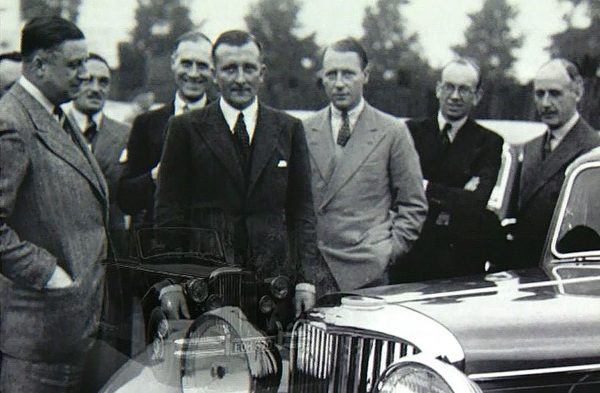
William Lyons
William Lyons
Main page
2042200

William Lyons

logo
Community Hub0 subscribers
Read side by side
from Wikipedia

Sir William Lyons[1] (4 September 1901 – 8 February 1985), known as "Mr. Jaguar", was with fellow motorcycle enthusiast William Walmsley, the co-founder in 1922 of the Swallow Sidecar Company, which became Jaguar Cars Limited after the Second World War.

Key Information

Early life and career

[edit]

Lyons was born in Blackpool, son of Irish immigrant William Lyons, who owned a musical instrument shop, and his wife Minnie Barcroft, the daughter of a mill owner. After attending Arnold School, Lyons obtained an engineering apprenticeship at Crossley Motors in Manchester, where he also studied at the technical school. He left Crossley in 1919 to work as a salesman at the Sunbeam dealers Brown and Mallalieu in Blackpool.

Motorcycles

[edit]
William Lyons on his Harley Davidson "FR 3030" around 1920.

In 1921, Lyons met William Walmsley who was converting army-surplus motorcycles for civilian use and making sidecars. Lyons admired the sidecars and bought one. Lyons and Walmsley obtained from their fathers a substantial £500 bank guarantee to go into business.[2] Their plans were delayed as Lyons was under the legal age,[2] but on his 21st birthday he formed a partnership with Walmsley.

Walmsley and Lyons (sitting) with the Model no. 1 Swallow sidecar on King Edward avenue in Blackpool, where they grew up and engineering facilities were initially. The motorcycle is a Brough Superior SS80.

It was called Swallow Sidecars and had a staff of "three men and a boy".[2] The company manufactured stylish sidecars, but after 1927 made increasing numbers of low cost coach-built cars, especially the Austin Seven Swallow which the Blackpool factory produced at the rate of 12 per week.[2] Following several moves to larger premises in Blackpool, in 1928 Lyons moved the company (and his family) to Coventry. His family home was Woodside, Gibbet Hill, on the fringe of the city. Production increased to 50 cars each week.[2] In 1931, they began selling the SS1, and in 1933 the company name was changed to SS Cars Ltd. The following year, William Walmsley left the company.

Jaguar

[edit]

The first "Jaguar" model was offered in 1935, and after World War II, Lyons changed the company name to Jaguar to avoid the unfortunate connotations with the Nazi SS "Schutzstaffel". Armstrong Siddeley allowed Lyons to use the Jaguar name from their successful aircraft engine range, such was the camaraderie of the car industry at the time.

During the War vehicle production was switched to aircraft manufacture and repair, but engineering development did continue. Some secretive military projects were undertaken but most importantly for the future of the company, Lyons and his engineering team headed by William Heynes chief engineer worked on a new engine which was to power his vision of a mass-produced sporting saloon car. The XK engine was completed in 1948 and launched in a (supposedly) one-off concept sports car to help draw attention to it. This succeeded far better than was envisaged and both became an overnight sensation, globally. The XK engine went on to power all Jaguars until the introduction of the series 3 E Type introduced the Jaguar V12 engine in 1971, while the XJ6 continued in production until 1992 with the 4.2 litre version of the XK engine. The sports car, XK120, went into full production too and led to a string of attention-grabbing (and profitable) sports cars which led to international sporting success (most notably at Le Mans) and helped put the name of Jaguar Cars and Coventry on the world map. But Lyons main focus was on the saloon car which he continued to develop until his last and proudest achievement, the XJ6 of 1968.

During his time as managing director of Jaguar, Lyons could be best described as 'autocratic' and kept a tight rein on the company. It is said that board meetings were rare until the 1960s. He was responsible for the styling of every new model introduced (although the C-type, D-type, E-type and XJ-S were designed by Malcolm Sayer). This was remarkable, as Sir William was not a trained engineer, and designed primarily using full scale 3-D mockups, which were continually adjusted by craftsmen working under his instructions. Undoubtedly one of his other great skills was to pick the highly accomplished team that was to remain loyal to him for so long. William Heynes, Claude Baily, Walter Hassan, Tom Jones, and many others all contributed to create a strong engineering team. Although he had no direct involvement with its design, allegedly Lyons was shown the finished final prototype of the XJ40 shortly before his death in 1985 and was said to be "approving" of what was the replacement for the first generation XJ6.

Lyons gave his permission, in 1956, for the formation of The Jaguar Drivers' Club, an owners club for the cars his company produced. The Jaguar Drivers' Club is the only owners club to ever be officially sanctioned by Lyons and the company itself and is still in existence today serving many thousands of members.

Later years

[edit]

In 1956, Lyons was knighted for his services to British industry and for the fine export performance of the company. In 1966, faced with a strengthening global industry, he merged Jaguar with the British Motor Corporation (BMC) to form British Motor Holdings, which was later absorbed into British Leyland. Unfortunately the final years of Lyons tenure before he retired as managing director near the end of 1967,[3] while remaining on as chairman, were a constant struggle against impossible odds to retain the identity and independence of his company, not least its engineering department. He retired completely to Wappenbury Hall in 1972, to play golf, travel, garden, and keep prize-winning Suffolk sheep and Jersey cattle on his farm estates at Wappenbury. His health declined fairly rapidly in retirement and the reemergence of his company under John Egan took place after his death. Despite this, Lyons remained in a consultative role to Jaguar until shortly before his death, and had participated in the styling of both the Jaguar XJS and Jaguar XJ40 during his retirement.

In 2025 “Sir Williams Lyons on Jaguar” was published[4]. Originated and compiled by Giles Chapman and with a preface by Michael Quinn (Sir William’s grandson) it is the text from a speech Sir William gave in 1969 - an account in his own words of how he built up Jaguar and what made the car so special.

Family

[edit]
William and his wife Greta Brown, presumably in one of his sidecars.

Lyons married Greta Brown in 1924. They had three children; Patricia (b. 1927 d. 2025), John Michael (b. 1930, d. 1955), and Mary (b. 1937). Patricia married Leeds Jaguar-distributor and rally driver Ian Appleyard, and was his co-driver in many international rallies from 1951 to '56, mostly in an XK120 registered NUB 120, including the Alpine Rally, which they won three times. There were no children. Patricia remarried in 1962 and has two children by her second husband Norbert Quinn; Michael Quinn, and Jane Quinn. John Michael served briefly in REME, and then joined Jaguar as an apprentice but was killed in a road accident in France driving to the 1955 Le Mans 24-hours race. Mary married Guy Rimell (son of successful racehorse trainer Fred Rimell) and has three children; Katie, Tom and Mark. Sir William and Lady Lyons had an active and contented retirement with their beloved dogs, Sally, Peppie, Buttons.

Death

[edit]

Lyons died on 8 February 1985 at Wappenbury Hall, his home in Leamington Spa, Warwickshire, at the age of 83. His wife Greta, Lady Lyons, died the following year; they were both buried in St. John the Baptist churchyard close to their home.

[edit]

References

[edit]
Revisions and contributorsEdit on WikipediaRead on Wikipedia
from Grokipedia
Sir William Lyons (4 September 1901 – 8 February 1985) was a British industrialist and automobile designer renowned as the founder of Jaguar Cars, transforming a small sidecar manufacturing business into a globally recognized luxury automaker known for its elegant styling and performance vehicles.[1][2] Born in Blackpool, England, to William Lyons and Minnie Barcroft, he entered the automotive industry early, working as a salesman at Brown and Mallalieu in 1919 before co-founding the Swallow Sidecar Company with William Walmsley in 1922, initially focusing on motorcycle sidecars.[2] In 1928, the company relocated to Coventry and expanded into coachbuilding. It was rebranded as S.S. Cars Ltd. in 1933, where Lyons emphasized innovative designs using three-dimensional mockups for most models, except for the C-Type, D-Type, E-Type, and XJ-S.[2][3][4] Lyons launched the first car bearing the Jaguar name in 1935, marking a pivotal shift toward independent automobile production, and following World War II, he renamed the company Jaguar Cars Ltd. in 1945.[2][5] Under his leadership as managing director until 1967 and chairman until his retirement in 1972, Jaguar achieved significant racing success, including five victories at the 24 Hours of Le Mans in the 1950s, and became a leader in automotive exports.[1][2] Knighted in 1956 for his contributions to British industry and serving as president of the Society of Motor Manufacturers and Traders from 1950 to 1951, Lyons married Greta Brown in 1924 and was survived by two daughters after the death of his son John in 1955.[1][2] His visionary approach to design and business continued to influence Jaguar even after his death at age 83 in his Warwickshire home.[1][6]

Early Life

Birth and Family Background

William Lyons was born on 4 September 1901 in Blackpool, England.[2] His father, also named William Lyons, was an Irish immigrant who owned a musical instrument shop in the town, specializing in pianos and repairs.[7][2] His mother was Minnie Barcroft, the daughter of a local mill owner, providing the family with a stable but modest foundation.[2][8] Blackpool, a vibrant seaside resort on England's northwest coast, was renowned for its entertainment piers, trams, and burgeoning tourism industry during the early 20th century.[3] This lively environment exposed young Lyons to a mix of leisure pursuits and mechanical innovations, including the machinery powering amusement rides and early motor vehicles that frequented the resort.[7] The town's dynamic atmosphere, along with repairing bicycles and motorcycles for schoolmates, contributed to an early familiarity with hands-on craftsmanship.[7] The Lyons family maintained a close-knit dynamic, with the senior William playing a supportive role in his son's development by encouraging practical skills amid their middle-class circumstances.[7] Raised in a modest home, Lyons experienced an upbringing that emphasized resourcefulness and self-reliance, shaped by the everyday challenges of a small family business in a resort town.[9] This setting fostered his innate curiosity about mechanics from a young age.[7]

Education and Early Interests

William Lyons attended Arnold House School (later known as Arnold School) in Blackpool after earlier schooling at Poulton-le-Fylde Grammar School, where he described himself as an average scholar.[7] At Arnold House School, he demonstrated sufficient academic capability but departed at age 16 in 1917 to pursue more hands-on opportunities, reflecting his practical inclinations despite his family's involvement in the musical instrument trade.[7][2] Following his departure from school, Lyons initially apprenticed at Vickers shipbuilding yard but transferred to an engineering apprenticeship at Crossley Motors in Manchester, commencing around 1917 and concluding in 1919.[7] During this period, he gained foundational knowledge in engineering and design principles, supplemented by evening classes at the Manchester School of Technology, which honed his technical skills in vehicle mechanics and production.[2] This apprenticeship marked his initial immersion in the automotive sector, fostering a structured understanding of manufacturing processes that would influence his later endeavors.[7] Lyons developed a profound passion for motorcycles during his late teens, owning an "oil-bath" Sunbeam model at age 18 in 1919, which he frequently rode and maintained. He also owned and modified a 1911 Triumph motorcycle, engaging in local hill-climbs and rallies.[10][7] This enthusiasm extended to admiration for prestigious brands such as Harley-Davidson, on which he was photographed riding around 1920, and Brough Superior, particularly the SS80 model that he owned and praised for its engineering excellence and aesthetic appeal.[7] These experiences ignited his lifelong interest in speed, performance, and stylish vehicle design, shaping his vision for innovative mobility solutions.[7]

Business Beginnings

Founding of Swallow Sidecar

In 1922, William Lyons, a 21-year-old motorcycle enthusiast from Blackpool, England, partnered with local craftsman William Walmsley to establish the Swallow Sidecar Company, capitalizing on the post-World War I surge in demand for affordable and stylish motorcycle accessories. Walmsley had already been producing sidecars independently using surplus war materials, and Lyons, impressed by their potential, proposed formalizing the venture after acquiring one of Walmsley's designs for £50. The partnership was secured through a £1,000 bank overdraft, guaranteed by £500 contributions from each of their fathers, allowing the company to set up at 5 Bloomfield Road in Blackpool with a small team of eight employees. This move addressed the growing need for economical transport options in a recovering economy, where motorcycles with sidecars offered practical yet aspirational mobility for the working class.[11][12][13] From the outset, Swallow Sidecar emphasized aesthetic innovation over basic utility, producing sleek, streamlined designs that distinguished their products in a market dominated by functional alternatives. Walmsley's initial "Ot-as-Ell" model featured a bullet-shaped, octagonal body crafted from polished aluminum, which Lyons marketed as a symbol of style and sophistication. Production began modestly, with Lyons targeting an output of around 10 sidecars per week to meet anticipated demand, though operations started closer to one unit weekly before scaling up through efficient handmade assembly. This focus on visual appeal quickly garnered attention, including a prominent display at the 1923 Motor Cycle Show, where the sidecars' elegant lines attracted orders from dealers and enthusiasts alike.[11][14][13] Despite the promising start, the company's early years were marked by financial strains amid the economic stagnation of the early 1920s, with the initial loan serving as a lifeline for raw materials and workshop setup. Lyons played a pivotal role as the primary designer, sketching bodywork enhancements, and as the marketer, handling advertising, sales negotiations, and administrative duties to stretch limited resources. Walmsley concentrated on manufacturing, but as orders grew, discussions emerged about potential relocation from Blackpool's limited industrial base to access better skilled labor and facilities, foreshadowing future expansions. These challenges tested the partners' resolve, yet their complementary skills laid the groundwork for steady growth in sidecar sales.[11][13][12]

Apprenticeship and Initial Ventures

Following his engineering apprenticeship at Crossley Motors in Manchester, where he gained foundational knowledge in mechanics and manufacturing processes, William Lyons joined Jackson Brothers—later known as Brown and Mallalieu—a Sunbeam dealership in Blackpool, as a salesman in 1919.[7][2] In this role, Lyons demonstrated vehicles to potential buyers, honed his sales techniques, and deepened his understanding of the automotive market by attending events such as the 1919 London Motor Show, where he assisted on the dealership's stand.[7] These experiences not only sharpened his commercial acumen but also exposed him to customer preferences and industry trends in the burgeoning post-World War I motor sector.[2] As a dedicated motorcycle enthusiast, Lyons pursued side ventures that showcased his practical skills and creative inclinations during this period. He bought, tuned, and customized motorcycles, including a 1911 Triumph model that he disassembled, rebuilt with enhancements, and sold at a profit, participating in local hill-climbs and rallies with machines like Indians and Harley-Davidsons.[7] These activities highlighted his emerging talent for styling, as he began producing early design sketches to refine vehicle aesthetics, laying the groundwork for his later contributions to coachbuilding.[7] Around 1921–1922, Lyons observed growing local demand for improved motorcycle sidecars amid the rise in civilian motorcycling, prompting him to approach fellow enthusiast William Walmsley, who lived nearby and was already fabricating sidecars in his parents' garage.[2][15] Lyons had purchased one of Walmsley's sidecars for his own Norton motorcycle, recognizing an opportunity to collaborate on more stylish and efficient designs to meet market needs.[15] This observation led to their partnership decision, formalized in 1922 with a £1,000 loan secured from their families, marking the transition from individual ventures to a structured business endeavor.[7][2]

Automotive Expansion

Motorcycle Production

In 1927, the Swallow Sidecar Company, co-founded by William Lyons and William Walmsley, continued to build on its sidecar success by offering styled sidecar outfits for various motorcycle chassis, including those from AJS. This leveraged the company's reputation for aesthetic innovation in motorcycle accessories. Building on the foundation of their successful sidecar line, which had achieved rates of up to 12 units per week by the mid-1920s, Swallow aimed to capture a niche market for stylish motorcycle combinations.[7] The outfits featured elegant elements like polished aluminum body panels, a sleek pointed nose, and modern lines that distinguished them from utilitarian competitors. Chrome fittings enhanced visual appeal and durability, along with low-slung seating positions that contributed to a sporty profile. These were tailored to attract affluent riders seeking prestige and comfort.[16] Sidecar production continued through the late 1920s and early 1930s from their Blackpool and later Coventry facilities, alongside the growing focus on automobiles. The venture faced challenges from a saturated market and the Great Depression, but sidecar manufacturing persisted beyond 1933 as the company pivoted toward automobile coachbuilding.[7]

Coachbuilding and SS Cars Formation

In 1928, the Swallow Sidecar Company relocated from Blackpool to larger premises on Holbrook Lane in Coventry to accommodate the growing demand for its automotive products and improve manufacturing capabilities.[17] This move coincided with the launch of coachbuilt bodies fitted to the Austin Seven chassis, marketed as the Swallow Austin, which marked Swallow's entry into full-scale automobile production beginning in 1927.[18] These elegant designs, featuring hand-formed aluminum panels over wooden frames, transformed the modest Austin Seven into stylish vehicles that appealed to a broader market seeking affordable luxury.[19] Swallow specialized in producing luxury variants, including drophead coupés, saloons, and tourers, with the drophead coupé offering a convertible top for open-air motoring and the saloon providing enclosed comfort with distinctive chrome accents and flowing lines.[20] Production expanded rapidly after the Coventry relocation, reaching over 3,000 units by 1931 as the designs gained popularity for their superior craftsmanship compared to standard Austin offerings.[19] This success allowed Swallow to increasingly focus resources on automotive coachbuilding while continuing sidecar production.[21] By the early 1930s, William Lyons sought greater independence from third-party chassis suppliers, leading to the development of proprietary designs. In 1934, following differences in business direction, co-founder William Walmsley sold his shares to Lyons and resigned from the company.[17] Lyons then formed SS Cars Ltd as a public company to acquire the assets of the liquidated Swallow Sidecar Company, enabling full control over vehicle production.[21] Under this new entity, SS Cars introduced independent chassis designs, exemplified by the SS1 tourer and coupé with a 2.5-liter Standard engine and the more compact SS2 saloon. These models represented a pivotal shift toward complete automobiles built in-house, solidifying SS Cars' position in the luxury market.[17][21]

Jaguar Evolution

Pre-War Models and Challenges

In the early 1930s, under William Lyons' leadership at SS Cars Ltd., the company expanded its range with stylish saloons that emphasized aesthetic appeal over conventional practicality. The SS II, introduced in 1932, was a four-seater model built on a Standard Motors Ten or Twelve chassis, priced at £265 for the saloon and £260 for the coupé by 1934. Lyons insisted on low rooflines to achieve a sleek, elegant profile, drawing inspiration from his vision of flowing, modern design; however, this choice resulted in cramped headroom, prompting criticism for sacrificing usability in favor of visual drama.[7] Lyons' focus on performance-oriented sports cars culminated in the launch of the SS90 in March 1935, a two-seater roadster with a shortened 8-foot-8-inch wheelbase and a 2.5-liter Standard side-valve six-cylinder engine producing around 70 horsepower. Priced at £395, the SS90 showcased Lyons' signature styling with its long louvered hood, close-fitting mudguards, and elimination of running boards for a streamlined silhouette, achieving a top speed of approximately 90 mph as implied by its name. Only 23 units were produced. This model marked an early step toward the Jaguar identity, blending affordability with sporting pretensions.[22][23] Building on this foundation, the SS100 arrived in 1936 as SS Cars' first dedicated high-performance sports car, available in 2.5-liter (102 bhp) and later 3.5-liter (125 bhp) overhead-valve engine variants tuned by Harry Weslake. Named for its claimed 100 mph top speed, the SS100 featured Lyons' evocative design with a racy, elongated bonnet, swept fenders, and a compact two-seater layout on a modified SS1 chassis, evoking the era's grand touring aesthetics while remaining accessible at £395. Only 314 units (198 of the 2.5-litre and 116 of the 3.5-litre versions) were produced before World War II halted manufacturing, underscoring its rarity and influence on future Jaguar sports cars.[24][3] Despite these innovations, SS Cars faced significant hurdles during the 1930s Great Depression, which curtailed luxury goods demand and limited total SS I and II sales to just 500 units in 1932 alone. Lyons navigated financial strain by securing new investment and refining production efficiency, yet the economic malaise slowed expansion. Additionally, as geopolitical tensions escalated with the rise of Nazi Germany from 1933 onward, the "SS" initials—unintentionally echoing the Schutzstaffel—drew growing scrutiny amid rising anti-German sentiment in Britain, complicating the brand's image even before the war's outbreak and foreshadowing the 1945 rebranding to Jaguar.[7][25]

World War II and Post-War Rebranding

With the outbreak of World War II in 1939, SS Cars Limited, under William Lyons' leadership, ceased automobile production by 1940 and repurposed its Foleshill factory in Coventry for wartime manufacturing to ensure the company's survival.[7] The facility was converted to repair Armstrong Whitworth Whitley bombers and produce lightweight military trailers, including over 30,000 units designed for towing by Jeeps.[7][26] Additionally, the firm continued manufacturing military sidecars, leveraging its pre-war expertise from the Swallow Sidecar Company origins, with output having reached up to 500 units per week just before the war.[21] These efforts sustained operations through the conflict, allowing Lyons to plan postwar recovery, including sketches for new models during fire-watching duties at the factory.[7] As the war ended in 1945, SS Cars resumed civilian vehicle production with the Mark IV saloon, a refined version of the pre-war 1½-litre, 2½-litre, and 3½-litre models, featuring updated mechanicals but retaining much of the earlier body design.[27] Amid Britain's postwar austerity, including severe steel rationing and economic constraints, Lyons strategically prioritized export markets, particularly the United States, to secure raw materials and achieve rapid financial recovery.[28] He appointed key distributors like Max Hoffman on the East Coast and the Hornburg brothers on the West Coast, enabling initial Mark IV exports despite limited domestic availability.[28] A pivotal decision came on 23 March 1945, when the company officially rebranded from SS Cars Limited to Jaguar Cars Limited, dropping the "SS" prefix due to its unfortunate associations with the Nazi Schutzstaffel.[7] The "Jaguar" name, first used for models in 1935, allowed a seamless transition to establish a distinct British identity free from wartime stigma.[7] This rebranding, coupled with the export focus, propelled Jaguar to profitability within the first postwar year, as overseas sales—rising to nearly 70% of output by 1950—provided essential revenue amid domestic hardships.[28]

Post-War Success and Innovations

Iconic Sports Car Designs

Under William Lyons' visionary leadership as Jaguar's founder and chief designer, the post-war era saw the creation of sports cars that blended elegant styling with exceptional performance, cementing the brand's reputation for graceful, high-speed machines. Lyons personally oversaw the aesthetic and engineering decisions, drawing on his affinity for sleek, aerodynamic forms to produce vehicles that not only dominated roads and racetracks but also captured global imagination. These designs, particularly the XK series and subsequent racers, emphasized lightweight construction, powerful engines, and innovative aerodynamics, setting benchmarks in the sports car category.[29] The Jaguar XK120, launched in 1948 at the London Motor Show, marked a triumphant return to sports car production for Jaguar and exemplified Lyons' rapid design prowess. Conceived and sketched by Lyons in just two weeks, the car featured hand-beaten aluminum body panels over a steel frame, creating a lithe, open-top roadster with flowing lines that evoked pre-war elegance while incorporating modern aerodynamics. Powered by the innovative 3.4-liter inline-six XK engine—originally developed for upcoming saloon models—the XK120 delivered 160 horsepower and achieved a top speed of 124 mph, making it the world's fastest production car at the time. Its debut generated immense demand, with over 12,000 units eventually produced, transforming Jaguar from a niche manufacturer into an international icon.[30][31][29][32] Building on the XK120's success, Lyons directed the development of dedicated racers that propelled Jaguar to motorsport glory, starting with the C-Type in 1951. This competition-oriented evolution of the XK120 platform incorporated a tubular chassis, lightweight aluminum bodywork, and the same 3.4-liter XK engine tuned to 160 horsepower, enabling a top speed exceeding 140 mph. Under Lyons' strategic oversight, which included recruiting aerodynamicist Malcolm Sayer, the C-Type secured Jaguar's first Le Mans 24 Hours victory in its debut year of 1951, driven by Peter Walker and Peter Whitehead, followed by another win in 1953 with Tony Rolt and Duncan Hamilton averaging 105 mph over the 24 hours. Only 53 customer examples were built alongside works racers, but these triumphs validated Lyons' philosophy of deriving road car innovations from racing.[33][34][35][29] The D-Type, introduced in 1954, represented the pinnacle of Lyons' racing ambitions, featuring a revolutionary monocoque aluminum body designed by Sayer for superior rigidity and reduced weight. Retaining the 3.4-liter XK engine (later enlarged to 3.8 liters), it produced up to 250 horsepower in racing trim, achieving top speeds over 170 mph through enhanced disc brakes and aerodynamic refinements. Lyons' commitment to Le Mans dominance paid off handsomely, as D-Types claimed victories in 1955 (Mike Hawthorn and Peter Collins), 1956 (Ron Flockhart and Ninian Sanderson), and 1957 (Ron Flockhart and Ivor Bueb), with the 1957 win marking Jaguar's sixth overall Le Mans success in seven years. Approximately 87 units were produced, including road-going "Short Nose" and "Long Nose" variants, influencing future designs while showcasing Lyons' integration of track-proven technology into production sports cars.[33][36][37][29][35] Lyons' most enduring sports car legacy culminated in the E-Type, unveiled at the 1961 Geneva Motor Show, which he personally championed as a synthesis of beauty, speed, and affordability. Co-designed with Sayer, its elongated hood, curvaceous flanks, and bubble canopy formed a monolithic aluminum-skinned steel monocoque body that prioritized airflow, earning praise as one of the most beautiful cars ever made—even from Enzo Ferrari. Equipped with a 3.8-liter version of the XK engine producing 265 horsepower, the E-Type boasted a top speed of 150 mph and 0-60 mph acceleration in under 7 seconds, redefining grand touring performance at a price under $4,000. Over 70,000 units were sold through 1974, spanning roadster and coupe variants, making it Jaguar's best-selling sports car and a cultural symbol of 1960s glamour under Lyons' discerning eye.[38][39][40][29]

Saloon Developments and Engineering Advances

Under Lyons' leadership, Jaguar's post-war saloon lineup evolved to emphasize luxury touring capabilities, incorporating engineering innovations that balanced performance, comfort, and refinement. The Mark V, introduced in September 1948 as a transitional model amid material shortages following World War II, featured an all-aluminum body pressed over a robust chassis to conserve steel resources.[7] This saloon marked Jaguar's first implementation of independent front suspension using double wishbones and torsion bars, a design developed pre-war by chief engineer William Heynes, which improved handling and ride quality over the rigid axles of prior models. Powered by a 3.5-liter pushrod inline-six engine derived from Standard Motors, producing around 125 horsepower, the Mark V achieved a top speed of approximately 90 mph, positioning it as a comfortable executive car suitable for long-distance travel.[7] Building on this foundation, the Mark VII saloon debuted at the 1950 London Motor Show, expanding Jaguar's appeal in the luxury segment with a larger body offering ample space for five passengers and high-end appointments like walnut trim, leather upholstery, and deep-pile carpets.[7] It retained the independent front suspension from the Mark V for enhanced roadholding while adopting semi-elliptical leaf springs at the rear, and introduced hydraulic drum brakes for better stopping power.[41] The key advancement was the integration of Jaguar's new 3.4-liter XK inline-six engine, a twin-overhead-camshaft (DOHC) unit delivering 160 horsepower, which provided smooth acceleration to 100 mph and earned the model its first Royal Warrant from Queen Elizabeth the Queen Mother in 1952.[7] Priced at £998, the Mark VII targeted the growing American market for grand touring saloons, exemplifying Lyons' vision of combining British elegance with reliable high-output engineering.[7] Lyons' collaboration with William Heynes was instrumental in these developments, particularly the XK engine's creation. During the war, Lyons tasked Heynes—appointed chief engineer in 1935—with leading a secret team including Walter Hassan and Claude Baily to design a revolutionary DOHC inline-six for post-war vehicles, aiming for high power from a compact configuration without relying on exotic materials.[7] Completed by 1948, the 3.4-liter XK produced 160 horsepower through hemispherical combustion chambers and dual SU carburetors, enabling efficient torque delivery across a broad rev range that suited both saloons and sports cars.[42] This engine's versatility powered the Mark VII and later models, establishing Jaguar's reputation for refined performance. The pinnacle of Lyons' saloon engineering came with the XJ6 in 1968, his final major design before retirement, which consolidated decades of advancements into a unified platform. Featuring a monocoque body structure for superior rigidity and lighter weight compared to the separate chassis of predecessors, the XJ6 offered exceptional crash safety and handling.[43] It employed a refined 4.2-liter DOHC XK engine producing 245 horsepower, paired with independent suspension on all four wheels—including subframe-mounted front double wishbones and rear semi-trailing arms—designed by Bob Knight to deliver sports-car agility in a luxury sedan.[44] Blending a top speed of 124 mph with serene cabin isolation, the XJ6 sold with approximately 37,000 units produced in its first series (1968-1973), underscoring Lyons' ability to merge performance and comfort for the executive driver.[45]

Leadership and Legacy

Business Mergers and Honors

In 1956, William Lyons was knighted as a Knight Bachelor in the New Year's Honours List for his contributions to the British motor industry, particularly Jaguar's strong performance in exports to markets like the United States.[7][12] Lyons also served as president of the Society of Motor Manufacturers and Traders from 1950 to 1951.[2] This recognition highlighted the company's post-war expansion and its role in bolstering Britain's automotive sector amid international competition.[7] Lyons served as managing director of Jaguar from 1945 to 1967, during which he oversaw the company's growth while maintaining an autocratic leadership style that emphasized tight control over operations.[46] In 1967, he transitioned to the role of chairman, a position he held until 1972, guiding Jaguar through a period of industry consolidation and internal challenges.[7][46] Throughout this time, he navigated persistent labor issues, including strikes and industrial disputes that disrupted production and exports, such as a delivery drivers' strike at British Motor Corporation (BMC) in late 1966, shortly after the merger announcement, and workforce refusals to work overtime at Jaguar's Browns Lane plant in 1967.[7] These efforts focused on strategic expansion to sustain Jaguar's independence and market position.[7] Facing a strengthening U.S. dollar and competitive pressures, Lyons agreed in 1966 to merge Jaguar with BMC in a £18.3 million deal, forming British Motor Holdings (BMH), where he became a director while retaining significant autonomy for Jaguar.[47][7] This merger aimed to strengthen the British industry against foreign rivals, with Jaguar exporting 80% of its production primarily to the U.S. market.[47] In 1968, BMH merged with Leyland Motor Corporation to create British Leyland Motor Corporation, the largest British car conglomerate at the time, allowing Lyons to maintain operational control over Jaguar as a semi-independent entity within the group.[7][46]

Retirement and Lasting Influence

After retiring from his formal roles at Jaguar in 1972, William Lyons relocated to Wappenbury Hall, his estate near Leamington Spa, England, where he pursued a quieter life involving golf, travel, gardening, and managing livestock such as Suffolk sheep and Jersey cattle.[48][49] Despite stepping back from daily operations, Lyons maintained an advisory capacity with the company, providing input on the styling of the Jaguar XJS grand tourer launched in 1975 and reviewing prototypes of the XJ40 saloon introduced in 1986, which he reportedly approved shortly before his death.[50] Lyons' enduring philosophy, encapsulated in the mantra "grace, space, pace," continued to shape Jaguar's design ethos long after his retirement, emphasizing elegant aesthetics, spacious interiors, and performance that defined the brand's identity from its early saloons to contemporary models.[7] This principle, which Lyons championed throughout his career, influenced Jaguar's styling legacy into the modern era, as seen in the fluid lines and luxurious cabins of vehicles like the later XJ series and F-Type sports cars, preserving the marque's reputation for blending beauty with engineering prowess.[51][49] Lyons received posthumous recognition for his contributions when he was inducted into the Automotive Hall of Fame in 2005, honoring his role in transforming Jaguar into a global leader in sports car manufacturing.[12] In 2025, marking ongoing appreciation of his legacy, the book Sir William Lyons on Jaguar: The Legend Explained In His Own Words was published, compiling and expanding on a 1969 speech he delivered to the Institute of the Motor Industry about Jaguar's history and future vision.[52][53]

Personal Life

Marriage and Family

William Lyons met Greta Brown in Blackpool in 1921, where he had spent part of his early life, and they married on 15 September 1924 in a union that provided enduring personal support amid his demanding career.[7][54] The couple's partnership lasted over six decades, with Greta offering quiet encouragement despite the long hours Lyons devoted to his work, though she occasionally experienced loneliness as a result.[55] Greta Brown Lyons survived her husband, passing away in 1986.[56] The Lyons family included three children: Patricia, born on 23 April 1927; John Michael, born in 1930; and Mary, born in 1937.[2][57] John Michael, who had briefly served in the Royal Electrical and Mechanical Engineers before apprenticing at Jaguar, died tragically in 1955 at age 25 in a road accident in France while driving to the Le Mans 24 Hours race.[58][1] Patricia, known as Pat Appleyard during her marriage to Ian Appleyard, gained prominence as a rally co-driver, competing successfully in events such as the Tulip Rally and Alpine Rally in a Jaguar XK120; she later remarried and became Patricia Quinn, maintaining involvement in farming. Mary has kept a low public profile. Patricia died on 11 October 2025 at age 98.[59][7] From 1937 onward, the family resided at Wappenbury Hall, a Victorian estate in Leamington Spa, Warwickshire, which served as their private home and allowed Lyons to balance family life with occasional pursuits like golf and farming.[60] The hall remained a central part of their lives, hosting friends and providing a stable environment for the children during Lyons' rise in the automotive industry.[7]

Death and Commemoration

Sir William Lyons died on 8 February 1985 at his retirement home, Wappenbury Hall, near Leamington Spa in Warwickshire, England, at the age of 83; he passed away peacefully in his sleep from natural causes.[1][61][62] He was buried in the churchyard of St. John the Baptist in Wappenbury, alongside his wife, Greta, Lady Lyons, who died the following year in 1986.[63][64][56] Lyons' death prompted immediate tributes across the automotive industry, with publications like The New York Times and Motor Sport Magazine hailing him as a visionary founder who transformed Jaguar into a global icon of design and performance.[1][62] The following year, Jaguar unveiled the XJ40 sedan at the British International Motor Show in Birmingham, a development Lyons had overseen in his later years, serving as a fitting memorial to his enduring influence on the company's engineering and aesthetic legacy.[65] His legacy continues through the Jaguar Daimler Heritage Trust, established in 1983 to preserve Jaguar's history and artifacts, including exhibitions and collections that honor Lyons' contributions to automotive innovation.[66][67]

References

User Avatar
No comments yet.