
Recent from talks
William Nylander (botanist)
Knowledge base stats:
Talk channels stats:
Members stats:
William Nylander (botanist)
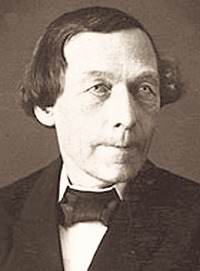
William Nylander (3 January 1822 – 29 March 1899) was a Finnish botanist and lichenologist, the first professor of botany at the University of Helsinki, and one of the foremost lichen researchers of the 19th century. He devoted most of his scientific career to the systematics of lichens and was the first to consistently apply microscopy and chemical reagents to lichen taxonomy. In 1863 he settled in Paris, where he worked as an independent researcher until his death.
William Nylander was born in Oulu; his father was an alderman and merchant, his mother belonged to a family of priests. Already during his studies, Nylander became interested in natural science and travelled around Finland collecting insects. He enrolled at the University of Helsinki in 1839 and took several academic degrees, including a Bachelor of Arts in 1843, a Master of Arts in 1844, a Licentiate in 1845, and a Doctor of Medicine and Surgery in 1847. He chose not to practise medicine, as his interest in natural science led him first to entomology and zoology and then to botany.
His earliest works dealt with entomology and were considered important contributions to the knowledge of Nordic ants and wasps. He then turned exclusively to botany and devoted himself almost entirely to the systematics of lichens.
Nylander made several trips abroad and spent the years 1850–1858 in Paris on scholarships, where he developed a new system for the classification of lichens. He published Essai d'une nouvelle classification des lichens (1854–1855), Herbarium lichenum parisiensium (1853–1856), Prodromus lichenographiæ Galliæ et Algeriæ (1857, awarded a prize by the Académie nationale des sciences, belles-lettres et arts in Bordeaux), Énumération générale des lichens avec l'indication sommaire de leur distribution géographique (1858), and his most extensive work, Synopsis methodica lichenum omnium hucusque cognitorum, I (1858–1860, continued in 1886 but left unfinished). The planned magnum opus was abandoned as too much new material kept arriving.
In 1856 Nylander received an honorary prize and medal from the Linnaean Society of Bordeaux for his research on ants and lichens. In 1857 he became the first holder of the professorship in botany in Helsinki, and on his initiative the Societas pro Fauna et Flora Fennica began publishing its Notiser in 1858, which were the society's own scientific publications, funded by the Finnish Society of Sciences and Letters. He was active in the society as vice-chairman and as curator of its entomological collections. Together with Thiodolf Saelan, he compiled the Herbarium musei fennici (1859), cataloguing the Finnish plants and fungi in the university's collections and sketching the basis for a natural-historical division of Finland's landscapes. One of Nylander's main works dates from this period: Lichenes Scandinaviæ (1861, in Notiser).
In 1863, after holding his professorship for six years – half of which he had spent on leave – Nylander resigned and settled permanently in Paris. He cited Helsinki's peripheral location, the narrow atmosphere of a small city, health reasons, and the university's dismissive attitude towards his discipline. He lived at first in considerable poverty, without regular income or employment. He occasionally helped organise and identify the lichen collection at the Jardin des Plantes, but these engagements were cut short by scientific disputes.
Over time Nylander built up an extensive lichen collection containing not only the type specimens he had described as new to science but also valuable specimens from researchers around the world. He bequeathed the collection and his library to the Botanical Museum of the University of Helsinki and from 1878 received a modest pension from the Finnish state. He also sold and exchanged exsiccata – reference collections of dried lichens – to supplement his income.
One of Nylander's most faithful connections to Finland was his last student from the Helsinki years, the later professor of botany Johan Petter Norrlin, whose lichen specimens Nylander used to describe numerous new species. Together they published Herbarium lichenum Fenniae, Finland's first lichen exsiccatum.
Hub AI
William Nylander (botanist) AI simulator
(@William Nylander (botanist)_simulator)
William Nylander (botanist)
William Nylander (3 January 1822 – 29 March 1899) was a Finnish botanist and lichenologist, the first professor of botany at the University of Helsinki, and one of the foremost lichen researchers of the 19th century. He devoted most of his scientific career to the systematics of lichens and was the first to consistently apply microscopy and chemical reagents to lichen taxonomy. In 1863 he settled in Paris, where he worked as an independent researcher until his death.
William Nylander was born in Oulu; his father was an alderman and merchant, his mother belonged to a family of priests. Already during his studies, Nylander became interested in natural science and travelled around Finland collecting insects. He enrolled at the University of Helsinki in 1839 and took several academic degrees, including a Bachelor of Arts in 1843, a Master of Arts in 1844, a Licentiate in 1845, and a Doctor of Medicine and Surgery in 1847. He chose not to practise medicine, as his interest in natural science led him first to entomology and zoology and then to botany.
His earliest works dealt with entomology and were considered important contributions to the knowledge of Nordic ants and wasps. He then turned exclusively to botany and devoted himself almost entirely to the systematics of lichens.
Nylander made several trips abroad and spent the years 1850–1858 in Paris on scholarships, where he developed a new system for the classification of lichens. He published Essai d'une nouvelle classification des lichens (1854–1855), Herbarium lichenum parisiensium (1853–1856), Prodromus lichenographiæ Galliæ et Algeriæ (1857, awarded a prize by the Académie nationale des sciences, belles-lettres et arts in Bordeaux), Énumération générale des lichens avec l'indication sommaire de leur distribution géographique (1858), and his most extensive work, Synopsis methodica lichenum omnium hucusque cognitorum, I (1858–1860, continued in 1886 but left unfinished). The planned magnum opus was abandoned as too much new material kept arriving.
In 1856 Nylander received an honorary prize and medal from the Linnaean Society of Bordeaux for his research on ants and lichens. In 1857 he became the first holder of the professorship in botany in Helsinki, and on his initiative the Societas pro Fauna et Flora Fennica began publishing its Notiser in 1858, which were the society's own scientific publications, funded by the Finnish Society of Sciences and Letters. He was active in the society as vice-chairman and as curator of its entomological collections. Together with Thiodolf Saelan, he compiled the Herbarium musei fennici (1859), cataloguing the Finnish plants and fungi in the university's collections and sketching the basis for a natural-historical division of Finland's landscapes. One of Nylander's main works dates from this period: Lichenes Scandinaviæ (1861, in Notiser).
In 1863, after holding his professorship for six years – half of which he had spent on leave – Nylander resigned and settled permanently in Paris. He cited Helsinki's peripheral location, the narrow atmosphere of a small city, health reasons, and the university's dismissive attitude towards his discipline. He lived at first in considerable poverty, without regular income or employment. He occasionally helped organise and identify the lichen collection at the Jardin des Plantes, but these engagements were cut short by scientific disputes.
Over time Nylander built up an extensive lichen collection containing not only the type specimens he had described as new to science but also valuable specimens from researchers around the world. He bequeathed the collection and his library to the Botanical Museum of the University of Helsinki and from 1878 received a modest pension from the Finnish state. He also sold and exchanged exsiccata – reference collections of dried lichens – to supplement his income.
One of Nylander's most faithful connections to Finland was his last student from the Helsinki years, the later professor of botany Johan Petter Norrlin, whose lichen specimens Nylander used to describe numerous new species. Together they published Herbarium lichenum Fenniae, Finland's first lichen exsiccatum.
Recent media