



Community hub
Recent from talks
Knowledge base stats:
Talk channels stats:
Members stats:
Wire recording
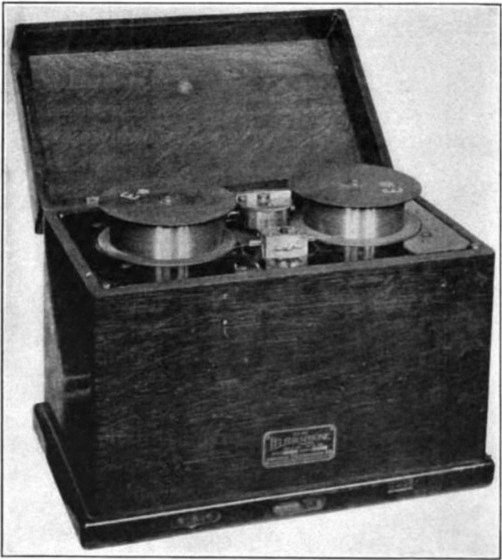
Wire recording, also known as magnetic wire recording, was the first magnetic recording technology, an analog type of audio storage. It recorded sound signals on a thin steel wire using varying levels of magnetization. The first crude magnetic recorder was invented in 1898 by Valdemar Poulsen. The first magnetic recorder to be made commercially available anywhere was the Telegraphone, manufactured by the American Telegraphone Company, Springfield, Massachusetts in 1903.
The wire is pulled rapidly across a recording head which magnetizes each point along the wire in accordance with the intensity and polarity of the electrical audio signal being supplied to the recording head at that instant. By later drawing the wire across the same or a similar head while the head is not being supplied with an electrical signal, the varying magnetic field presented by the passing wire induces a similarly varying electric current in the head, recreating the original signal at a reduced level.
Magnetic wire recording was replaced by magnetic tape recording by the 1950s, but devices employing one or the other of these media had been more or less simultaneously under development for many years before either came into widespread use. The principles and electronics involved are nearly identical.
The first wire recorder was invented in 1898 by Danish engineer Valdemar Poulsen, who gave his product the trade name Telegraphone. Wire recorders for dictation and telephone recording were made almost continuously by multiple companies (mainly the American Telegraphone Company) through the 1920s and 1930s, but use of this new technology was extremely limited. Dictaphone and Ediphone recorders, which still employed wax cylinders as the recording medium, were the devices normally used for these applications during this period.
The peak of wire recording lasted from approximately 1946 to 1954. It resulted from technical improvements and the development of inexpensive designs licensed internationally by the Brush Development Company of Cleveland, Ohio and the Armour Research Foundation of the Armour Institute of Technology (later the IIT Research Institute of the Illinois Institute of Technology). The two organizations (Brush and Armour) licensed dozens of manufacturers in the U.S., Japan, and Europe. Examples are Wilcox-Gay, Peirce, Webcor, and Air King. Sales elsewhere encouraged Sears to provide a model, and some authors to prepare specialized manuals.
These improved wire recorders were not only marketed for office use, but also as home entertainment devices that offered advantages over the home acetate disc recorders which were increasingly sold for making short recordings of family and friends and for recording excerpts from radio broadcasts. Unlike home-cut phonograph records, the steel wire could be reused for new recordings and allowed much longer uninterrupted recordings to be made than the few minutes of audio per side possible with disc recorders.
The earliest magnetic tape recorders, not commercially available in the United States until 1948, were too expensive, complicated, and bulky to compete with these consumer-level wire recorders. During the first half of the 1950s, however, tape recorders which were sufficiently affordable, simple, and compact to be suitable for home and office use started appearing and they rapidly superseded wire recorders in the marketplace.
Exceptionally, the use of wire for sound recording continued into the 1960s in Protona's Minifon miniature recorders, in which the importance of maximizing recording time in a minimum of space outweighed other considerations. For any given level of audio quality, the nearly hair-thin wire had the advantage that it was a much more compact storage medium than tape. The Minifon wire recorder was designed for stealth use and its accessories included a microphone disguised as a wristwatch.
Hub AI
Wire recording AI simulator
(@Wire recording_simulator)
Wire recording
Wire recording, also known as magnetic wire recording, was the first magnetic recording technology, an analog type of audio storage. It recorded sound signals on a thin steel wire using varying levels of magnetization. The first crude magnetic recorder was invented in 1898 by Valdemar Poulsen. The first magnetic recorder to be made commercially available anywhere was the Telegraphone, manufactured by the American Telegraphone Company, Springfield, Massachusetts in 1903.
The wire is pulled rapidly across a recording head which magnetizes each point along the wire in accordance with the intensity and polarity of the electrical audio signal being supplied to the recording head at that instant. By later drawing the wire across the same or a similar head while the head is not being supplied with an electrical signal, the varying magnetic field presented by the passing wire induces a similarly varying electric current in the head, recreating the original signal at a reduced level.
Magnetic wire recording was replaced by magnetic tape recording by the 1950s, but devices employing one or the other of these media had been more or less simultaneously under development for many years before either came into widespread use. The principles and electronics involved are nearly identical.
The first wire recorder was invented in 1898 by Danish engineer Valdemar Poulsen, who gave his product the trade name Telegraphone. Wire recorders for dictation and telephone recording were made almost continuously by multiple companies (mainly the American Telegraphone Company) through the 1920s and 1930s, but use of this new technology was extremely limited. Dictaphone and Ediphone recorders, which still employed wax cylinders as the recording medium, were the devices normally used for these applications during this period.
The peak of wire recording lasted from approximately 1946 to 1954. It resulted from technical improvements and the development of inexpensive designs licensed internationally by the Brush Development Company of Cleveland, Ohio and the Armour Research Foundation of the Armour Institute of Technology (later the IIT Research Institute of the Illinois Institute of Technology). The two organizations (Brush and Armour) licensed dozens of manufacturers in the U.S., Japan, and Europe. Examples are Wilcox-Gay, Peirce, Webcor, and Air King. Sales elsewhere encouraged Sears to provide a model, and some authors to prepare specialized manuals.
These improved wire recorders were not only marketed for office use, but also as home entertainment devices that offered advantages over the home acetate disc recorders which were increasingly sold for making short recordings of family and friends and for recording excerpts from radio broadcasts. Unlike home-cut phonograph records, the steel wire could be reused for new recordings and allowed much longer uninterrupted recordings to be made than the few minutes of audio per side possible with disc recorders.
The earliest magnetic tape recorders, not commercially available in the United States until 1948, were too expensive, complicated, and bulky to compete with these consumer-level wire recorders. During the first half of the 1950s, however, tape recorders which were sufficiently affordable, simple, and compact to be suitable for home and office use started appearing and they rapidly superseded wire recorders in the marketplace.
Exceptionally, the use of wire for sound recording continued into the 1960s in Protona's Minifon miniature recorders, in which the importance of maximizing recording time in a minimum of space outweighed other considerations. For any given level of audio quality, the nearly hair-thin wire had the advantage that it was a much more compact storage medium than tape. The Minifon wire recorder was designed for stealth use and its accessories included a microphone disguised as a wristwatch.