Hubbry Logo
Phonograph cylinderPhonograph cylinderMain
Open search
Phonograph cylinder
Community hub
Phonograph cylinder
logo
8 pages, 0 posts
0 subscribers
Be the first to start a discussion here.
Phonograph cylinder
Phonograph cylinder
from Wikipedia
Phonograph cylinder
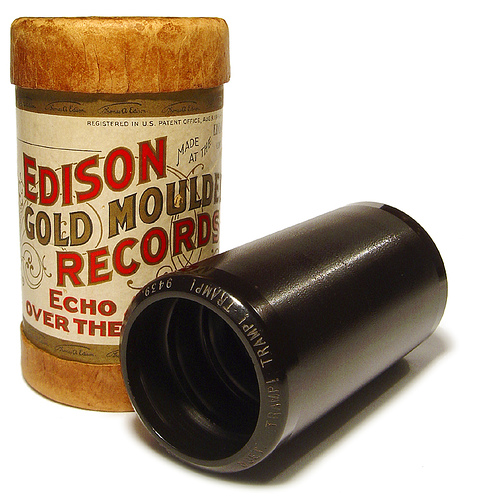
An Edison Gold Mould cylinder record, taken out of its storage tube (left), from c. 1900s
Capacity2 (and later 4) minutes
Releasedc. 1888
Discontinued1929

Phonograph cylinders (also referred to as Edison cylinders after their creator Thomas Edison) are the earliest commercial medium for recording and reproducing sound. Known simply as "records" in their heyday (c. 1896–1916), a name since passed to their disc-shaped successors, these hollow cylindrical objects have an audio recording engraved on the outside surface which can be reproduced when they are played on a mechanical cylinder phonograph.[1] The first cylinders were wrapped with tin foil[2] but the improved version made of wax was created a decade later,[3] after which they were commercialized. In the 1910s, the competing disc record system triumphed in the marketplace to become the dominant commercial audio medium.[4]

Early development

[edit]

In December 1877,[5] Thomas Edison and his team invented the phonograph using a thin sheet of tin foil wrapped around a hand-cranked, grooved metal cylinder.[6] Tin foil was not a practical recording medium for either commercial or artistic purposes, and the crude hand-cranked phonograph was only marketed as a novelty, to little or no profit. Edison moved on to developing a practical incandescent electric light, and the next improvements to sound recording technology were made by others.[4]

Following seven years of research and experimentation at their Volta Laboratory, Charles Sumner Tainter, Alexander Graham Bell, and Chichester Bell introduced wax as the recording medium, and engraving, rather than indenting, as the recording method. In 1887, their "Graphophone" system was being put to the test of practical use by official reporters of the US Congress, with commercial units later being produced by the Dictaphone Corporation.[7] After this system was demonstrated to Edison's representatives, Edison quickly resumed work on the phonograph. He settled on a thicker all-wax cylinder, the surface of which could be repeatedly shaved down for reuse. Both the Graphophone and Edison's "Perfected Phonograph" were commercialized in 1888. Eventually, a patent-sharing agreement was signed, and the wax-coated cardboard tubes were abandoned in favor of Edison's all-wax cylinders as an interchangeable standard format.[8]

Beginning in 1889, prerecorded wax cylinders were marketed. These have professionally made recordings of songs, instrumental music or humorous monologues in their grooves. At first, the only customers for them were proprietors of nickelodeons—the first jukeboxes—installed in arcades and taverns, but within a few years, private owners of phonographs were increasingly buying them for home use.[9] Unlike later, shorter-playing high-speed cylinders, early cylinder recordings were usually cut at a speed of about 120 rpm and can play for as long as three minutes.[5] They were made of a relatively soft wax formulation and would wear out after they were played a few dozen times.[10] The buyer could then use a mechanism which left their surfaces shaved smooth so new recordings could be made on them.[11]

Edison wax cylinder phonograph c. 1899

Cylinder machines of the late 1880s and the 1890s were usually sold with recording attachments. The ability to record as well as play back sound was an advantage of cylinder phonographs over the competition from cheaper disc record phonographs, which began to be mass-marketed at the end of the 1890s, as the disc system machines could be used only to play back prerecorded sound.[11]

In the earliest stages of phonograph manufacturing, various incompatible, competing types of cylinder recordings were made. A standard system was decided upon by Edison Records, Columbia Phonograph, and other companies in the late 1880s. The standard cylinders are about 4 inches (10 cm) long, 2+14 inches (5.7 cm) in diameter, and play about two minutes of recorded material.[10]

Originally, all cylinders sold needed to be recorded live on the softer brown wax, which wore out after as few as 20 plays. Later cylinders were reproduced either mechanically or by linking phonographs together with rubber tubes.[12]

Over the years, the type of wax used in cylinders was improved and hardened, so that cylinders could be played with good quality over 100 times. In 1902, Edison Records launched a line of improved, hard wax cylinders marketed as "Edison Gold Moulded Records". The major development of this line of cylinders is that Edison had developed a process that allowed a mold to be made from a master cylinder, which then permitted the production of several hundred cylinders to be made from the mold.[13] The process was labeled "Gold Moulded" because of the gold vapor that was given off by gold electrodes used in the process.[5]

Commercial packaging

[edit]

The earliest soft wax cylinders were sold wrapped in thick cotton batting. Later, molded hard-wax cylinders were sold in boxes with a cotton lining. Celluloid cylinders were sold in unlined boxes. These protective boxes were normally kept and used to house the cylinders after purchase. Their general appearance led bandleader John Philip Sousa to deride their contents as "canned music", an epithet he borrowed from Mark Twain.[14]

Hard plastic cylinders

[edit]

On March 20, 1900, Thomas B. Lambert was granted a US patent (645,920) that described a process for mass-producing cylinders made from celluloid, an early hard plastic. (Henri Jules Lioret [fr] of France was producing celluloid cylinders as early as 1893, but they were individually recorded rather than molded.) That same year, the Lambert Company of Chicago began selling cylinder records made of the material. They would not break if dropped and could be played thousands of times without wearing out. The color was changed to black in 1903, but brown and blue cylinders were also produced. The coloring was purportedly because the dyes reduced surface noise. Unlike wax, the hard, inflexible material could not be shaved and recorded over, but it had the advantage of being nearly permanent.[15][16] A 1905 Edison Phonograph may be seen and heard playing a celluloid cylinder at the Musical Museum, Brentford, England and the quality of the sound is surprisingly good.[17]

This superior technology was licensed by the Indestructible Record Company[18] in 1906 and Columbia Phonograph Company in 1908. The Edison Bell company in Europe had separately licensed the technology and were able to market Edison's titles in both wax (popular series) and celluloid (indestructible series).[19]

In late 1908, Edison had introduced wax cylinders that played for nominally four minutes (instead of the usual two) under the Amberol brand. They were made from a harder (and more fragile) form of wax to withstand the smaller stylus used to play them. The longer playing time was achieved by reducing the groove size and placing them half as far apart. In 1912, the Edison company eventually acquired Lambert's patents to the celluloid technology, and almost immediately started production under a variation of their existing Amberol brand as Edison Blue Amberol Records.[20]

Edison designed several phonograph types, both with internal and external horns for playing these improved cylinder records. The internal horn models were called Amberolas. Edison marketed its "Fireside" model phonograph with a gearshift and a 'model K' reproducer with two different styli, which allowed it to play both two-minute and four-minute cylinders.[21]

Decline

[edit]

Cylinder records continued to compete with the growing disc record market into the 1910s, when discs won the commercial battle. In 1912, Columbia Records, which had been selling both discs and cylinders, dropped the cylinder format, while Edison introduced his Diamond Disc format, played with a diamond stylus. Beginning in 1915, new Edison cylinder issues consisted of acoustic dubbings from Edison disc masters; they therefore had lower audio quality than the disc originals. Although his cylinders continued to be sold in steadily dwindling and eventually minuscule quantities, Edison continued to support the owners of cylinder phonographs by making new titles available in that format until the company ceased manufacturing all records and phonographs in November 1929. Many of the later issued Blue Amberols were dubbed electrically from electrical recorded masters.[22][5]

Later applications

[edit]

Cylinder phonograph technology continued to be used for Dictaphone and Ediphone recordings for office use for decades.[23]

In 1947, Dictaphone replaced wax cylinders with their Dictabelt technology, which cut a mechanical groove into a plastic belt instead of into a wax cylinder. This was later replaced by magnetic tape recording. However, cylinders for older style dictating machines continued to be available for some years, and it was not unusual to encounter cylinder dictating machines into the 1950s.[24]

In the late 20th and early 21st century, new recordings have been made on cylinders for the novelty effect of using obsolete technology. Probably the most famous of these are by They Might Be Giants, who in 1996 recorded "I Can Hear You" and three other songs, performed without electricity, on an 1898 Edison wax recording studio phonograph at the Edison National Historic Site in West Orange, New Jersey. This song was released on Factory Showroom in 1996 and re-released on the 2002 compilation Dial-A-Song: 20 Years of They Might Be Giants. The other songs recorded were "James K. Polk", "Maybe I Know", and "The Edison Museum", the last a song about the site of the recording. These recordings were officially released online as MP3 files in 2001.[25]

Small numbers of cylinders have been manufactured in the 21st century out of modern long-lasting materials. Two companies engaged in such enterprise are the Vulcan Cylinder Record Company of Sheffield, England,[26] and the Wizard Cylinder Records Company in Baldwin, New York.[27]

In 2010 the British musical group The Men That Will Not Be Blamed for Nothing released the track "Sewer", from their debut album, Now That's What I Call Steampunk! Volume 1 on a wax cylinder in a limited edition of 40, of which only 30 were put on sale. The box set came with instructions on how to make a cylinder player for less than £20. The BBC covered the release on Television on BBC Click, on BBC Online, and on Radio 5 Live.[28]

In June 2017 the Cthulhu Breakfast Club podcast released a special limited wax cylinder edition of a show.[29]

In April 2019, the podcast Hello Internet released ten limited edition wax cylinder recordings.[30]

In May 2023, Needlejuice Records released wax cylinder singles for Lemon Demon songs "Touch-Tone Telephone" and "The Oldest Man On MySpace", from albums Spirit Phone and Dinosaurchestra, respectively.[31]

Preservation of cylinder recordings

[edit]
Proper way to hold a cylinder record: put fingers on the inside; do not touch the outer surface which has the recording.

Because of the nature of the recording medium, playback of many cylinders can cause degradation of the recording. The replay of cylinders diminishes their fidelity and degrades their recorded signals. Additionally, when exposed to humidity, mold can penetrate a cylinder's surface and cause the recording to have surface noise. Currently, the only professional machines manufactured for the playback of cylinder recordings are the Archéophone player, designed by Henri Chamoux and the "Endpoint Cylinder and Dictabelt Machine" by Nicholas Bergh.[32] The Archéophone is used by the Edison National Historic Site, Bowling Green State University (Bowling Green, Ohio), the Department of Special Collections at the University of California, Santa Barbara Library, and many other libraries and archives, including the Endpoint by The New York Public Library for the Performing Arts.[32]

In an attempt to preserve the historic content of the recordings, cylinders can be read with a confocal microscope and converted to a digital audio format. The resulting sound clip in most cases sounds better than stylus playback from the original cylinder. Having an electronic version of the original recordings enables archivists to open access to the recordings to a wider audience. This technique also has the potential to allow for reconstruction of damaged or broken cylinders.[33]

[edit]

See also

[edit]

References

[edit]

Further reading

[edit]
[edit]
Revisions and contributorsEdit on WikipediaRead on Wikipedia
from Grokipedia
A phonograph cylinder is a cylindrical medium used for recording and reproducing in early phonographs, featuring a helical groove inscribed with audio vibrations via a on a rotating surface. Invented by in 1877, the initial design wrapped tin foil around a grooved metal , with a hand-cranked mechanism driving the rotation while a diaphragm-attached needle captured and replayed sound waves as embossed indentations. This innovation, first publicly demonstrated on December 7, 1877, at the office, marked the birth of practical sound recording technology. Edison received U.S. No. 200,521 for the on February 19, 1878, specifying the tin-foil cylinder method, though early models were fragile and limited to short durations of about two minutes. After initial novelty exhibitions by the Edison Speaking Phonograph Company, development paused for Edison's pursuits but resumed in the 1880s with improvements by collaborators like and , leading to more durable wax-based cylinders by 1888. These "brown wax" cylinders, made from a mixture of , paraffin, and metallic soaps like aluminum stearate, allowed for better fidelity and enabled commercial production of , music, and dictation records. Standard dimensions were approximately 4.25 inches long and 2.1875 inches in diameter, played at variable speeds of around 120-160 revolutions per minute on machines like the Edison Standard Phonograph. Further advancements included the 1901 "Gold Moulded" process, which used lampblack-infused wax for mass duplication via , making cylinders more affordable and widespread until about 1912. In 1912, Edison introduced Blue Amberol cylinders, featuring a (cellulose nitrate) surface over a core, doubling playback time to four minutes through finer grooves at 200 lines per inch. Despite these innovations, cylinders declined in popularity by the early as flat disc records offered easier storage, lower production costs, and compatibility with gramophones promoted by competitors like the . Edison persisted with cylinders until 1929, when Thomas A. Edison, Inc. ceased production amid the rise of electrical recording and radio. Phonograph cylinders laid the foundation for the modern recording industry, preserving thousands of early audio artifacts including performances, speeches, and ethnic music, many now digitized by institutions like the . Their vertical "hill-and-dale" groove modulation influenced subsequent audio technologies, though preservation challenges persist due to the fragility of and materials susceptible to mold, warping, and chemical degradation. Today, they represent a pivotal era in sound history, with over 10,000 surviving examples documenting cultural shifts from the late 19th to early 20th centuries.

History

Invention and Early Development

The phonograph cylinder originated with Thomas Edison's invention of the in 1877, marking the first practical device for recording and reproducing sound. Working at his Menlo Park laboratory in , Edison developed a featuring a brass cylinder wrapped in , approximately 4 inches in diameter and 10 inches long, which rotated via a hand crank while moving axially along its shaft. Sound vibrations from a mouthpiece diaphragm caused a to indent a helical groove into the soft tin foil surface, capturing audio as undulations in the groove; playback occurred when a second diaphragm and traced the groove, vibrating to reproduce the sound through a horn. This design demonstrated the core of mechanical sound recording and playback, with the cylinder serving as the medium for both functions. On December 6, 1877, Edison recorded and played back his recitation of the nursery rhyme "" in his Menlo Park laboratory, creating the first documented audio recording. The device was first publicly demonstrated the following day at the offices of in . The tin foil cylinders allowed for only a brief duration of about 2 minutes per side due to their limited surface area and the shallow indentations, with playback speeds varying but typically around 120 (rpm) in early models. Edison filed for a on December 24, 1877, and received U.S. Patent No. 200,521 on February 19, 1878, which detailed the cylinder's construction, the indenting mechanism, and the use of or similar yielding materials to preserve sound indentations for reproduction. These initial experiments proved the feasibility of sound recording but highlighted limitations, such as the fragility of the tin foil, which wore out after just a few plays. The technology evolved significantly through the efforts of Alexander Graham Bell and his cousin Chichester A. Bell, in collaboration with Charles Sumner Tainter at the Volta Laboratory in Washington, D.C., leading to the Graphophone by 1886. Funded by Bell's Volta Prize money, the team replaced Edison's tin foil with softer wax-coated paper cylinders—typically a pasteboard core covered in a thin layer of beeswax and paraffin compound—allowing for deeper, more precise grooves cut by a stylus that shaved away material rather than merely indenting it. This cutting method produced clearer sound reproduction with reduced noise, as the wax surface could be smoothed after recording, and enabled multiple playbacks without rapid degradation, addressing the tin foil's short lifespan. Early wax cylinders maintained durations of around 2 to 3 minutes, with playback speeds between 120 and 160 rpm, offering improved fidelity for dictation and speech. The key Graphophone patent, U.S. No. 341,214, was granted to Chichester Bell and Tainter on May 4, 1886, emphasizing the wax composition and cutting stylus for enhanced groove definition and durability. By 1888, these wax innovations had refined the cylinder format, paving the way for broader applications beyond prototypes.

Commercialization and Mass Production

The commercialization of phonograph cylinders began in earnest in 1888, following the formation of the Edison Phonograph Company on October 8, 1887, which aimed to market Thomas Edison's improved machine. That year, the company introduced commercial wax cylinders, transitioning from experimental tinfoil and softer materials to more durable brown wax formulations suitable for repeated playback. Simultaneously, the North American Phonograph Company, established on July 14, 1888, by financier Jesse H. Lippincott, focused on leasing phonographs and cylinders primarily for business dictation, securing exclusive rights to distribute Edison's technology across regional affiliates. Mass production of brown wax cylinders in the 1890s relied on pantographic duplication methods, where a master cylinder recorded directly from performers was connected via rubber tubing or mechanical linkages to multiple recording machines, enabling the creation of up to 100 copies per master. Larger operations, such as those at Edison's facilities, achieved daily outputs of 300 to 500 cylinders per title by employing several duplication units simultaneously, allowing for scaled manufacturing without molding until later innovations. This process supported the introduction of catalog numbering systems by companies like Edison, where cylinders were assigned sequential numbers (e.g., Edison Record series starting in ) along with printed labels detailing titles and artists, facilitating organized distribution. Rental models persisted initially, with phonographs leased to offices and homes at rates around $10–20 per month, though outright sales became more common after 1892 legal settlements ended exclusive leasing restrictions. Key players in this expansion included Edison's National Phonograph Company, which he formed in 1896 following the bankruptcy of the North American Phonograph Company in 1894, and the Columbia Phonograph Company, established in 1889 to market compatible technology derived from the Graphophone. Cylinders were priced affordably at 50 cents each during the 1890s, making them accessible for both professional and amateur use. The market shifted from dictation-focused applications to , with musical and comedic recordings driving growth; by 1895, the industry had produced over two million cylinders, reflecting widespread adoption in homes and public venues.

Decline and Obsolescence

The rise of flat disc records in the early 1900s marked the beginning of the phonograph cylinder's decline, as they offered practical advantages over cylinders. In 1901, the introduced 78 rpm discs, which provided up to four minutes of playback time per side—double that of standard two-minute cylinders—while being easier to mass-produce and duplicate using etched metal masters. These discs could also be recorded on both sides, extending total duration without increasing size, and their flat format allowed for stackable storage in compact albums, contrasting with cylinders that required individual boxes or specialized racks for efficient shelving. Thomas Edison resisted the shift to discs, stubbornly adhering to cylinders despite their growing obsolescence in the entertainment market. He continued production through innovations like the Blue Amberol cylinders introduced in , made of unbreakable for improved durability and sound quality, but these failed to stem the tide as major competitors like Columbia ceased cylinder manufacturing that same year. Economic pressures accelerated the decline: cylinder duplication remained labor-intensive, often requiring multiple live re-recordings or copying, which drove up production costs compared to the efficient stamping of discs. By the , consumer preference had firmly shifted to the more affordable and convenient discs, with cylinders' higher manufacturing expenses and bulkier storage needs making them less viable for widespread retail. Market dominance eroded rapidly, with cylinders dominating the market in the 1890s but their dominance eroding rapidly by 1920 as disc sales surged through aggressive marketing by Victor and others. Edison's final attempts to revive cylinders in the , including extended-play variants, proved commercially unsuccessful amid the disc era's momentum. Production of Blue Amberol cylinders persisted until Edison announced the cessation of his business in 1929, effectively ending the cylinder's role in commercial audio recording.

Technology and Formats

Materials and Construction

The phonograph cylinder originated in with Thomas Edison's invention, featuring a thin sheet of wrapped around a wooden or metal core to capture sound vibrations in a spiral groove. This early construction was rudimentary and fragile, with the tin foil prone to tearing after only a few playbacks, limiting its practical use to demonstration purposes. By 1888, advancements led to the introduction of brown wax cylinders, composed primarily of a mixture of paraffin, ceresin, beeswax, and stearic acid derivatives, which provided greater durability and fidelity for commercial recording. These cylinders were formed by pouring molten wax into molds. The material provided greater durability for commercial use. Blanks for recording could be shaved and reused up to 100 times, enabling economical use for dictation and home recording, while commercial cylinders typically withstood several dozen playbacks. Standardization of dimensions facilitated interchangeability across manufacturers, with early two-minute cylinders measuring approximately 2.25 inches in and 4.25 inches in . Later four-minute variants, introduced around , extended to about 4.5 inches in to accommodate finer grooves without altering the core , optimizing playback time while maintaining compatibility with existing machines.

Playback and Recording Mechanisms

The recording mechanism of the phonograph cylinder operated through acoustic transduction, where sound waves were captured by a horn and directed to a thin diaphragm, typically made of or , attached to a . Vibrations from the diaphragm caused the stylus—often a sapphire point—to etch a helical groove into the surface of a rotating , with the groove modulated vertically in a hill-and-dale to encode variations. The cylinder rotated at speeds ranging from 90 to 160 (rpm), controlled by a mechanism featuring adjustable springs and weights to maintain consistent velocity and prevent speed fluctuations during operation. For brown wax cylinders, the predominant format in the 1890s, the standard playback and recording speed was 144 rpm, allowing for approximately two minutes of audio per cylinder, though dictating applications sometimes used slower speeds around 100 rpm for clarity. Early designs, such as Thomas Edison's 1877 tinfoil , employed separate recording and playback units, but by the , integrated mechanisms combined both functions, with the stylus floating on a weighted arm to ensure precise groove depth without excessive pressure. Playback reversed the recording process: a reproducing , often a rounded ball, traced the helical groove's undulations, vibrating an attached diaphragm to generate amplified by a horn. In hill-and-dale systems like Edison's, the stylus maintained single-point contact with the groove floor, providing for vertical modulations, whereas lateral recording variants used a stylus with two-point contact against the groove walls for side-to-side variations, offering potentially greater durability but requiring different reproducer designs. Acoustic horns evolved from simple ear trumpet-style flares in the early 1880s, which concentrated sound inefficiently, to more efficient exponential curves by the 1890s, expanding the and volume for better reproduction. Cylinders were designed for reusability, with old recordings removed by shaving the surface using a specialized tool with a sapphire knife on a high-speed lathe (1500-2800 rpm), restoring a smooth layer for new etchings; this process could be repeated several times, though material wear eventually limited durability and fidelity.

Variations and Improvements

One significant advancement in cylinder production came with the introduction of Gold Moulded cylinders in 1901, which utilized a harder black wax formula and a molding process for mass replication from master recordings. This method involved creating a metal mold from a wax master using a gold vapor deposition to ensure conductivity, then pressing heated wax blanks into the mold to form the grooves, allowing for consistent duplication at a standardized speed of 160 rpm and groove spacing of 100 threads per inch, yielding recordings of 1.5 to 2.5 minutes. In 1900, Thomas A. Lambert pioneered the use of cylinders, molded from pyroxylin () plasticized with , marking the first widespread adoption of this hard plastic material for greater durability over fragile wax. These cylinders, produced by the Lambert Company in , were less prone to breakage and capable of withstanding thousands of plays without significant wear, far exceeding the lifespan of contemporary wax formats. Building on technology, Edison introduced in 1912, featuring an indigo-dyed shell molded over a core for enhanced structural integrity and reduced surface noise. These cylinders supported a 4-minute playing time at 160 rpm with 200 threads per inch, doubling the duration of earlier formats while maintaining vertical-cut grooves for claimed superior , and they remained in production until 1929. To accommodate orchestral and public performances requiring greater volume, Edison developed larger concert cylinders in 1899 with a 5-inch —more than twice that of standard models—allowing for louder playback on specialized machines, though production of wax versions ceased by 1912. During the , Edison experimented with groove orientations on cylinders and emerging disc formats, persisting with vertical-cut (hill-and-dale) modulation inherited from early designs for purported better , while competitors adopted lateral-cut grooves. Edison's refusal to fully transition to lateral-cut contributed to compatibility issues and market challenges, ultimately limiting the format's competitiveness against disc records.

Applications and Uses

Entertainment and Music Recordings

Phonograph cylinders played a pivotal role in disseminating and during the late 19th and early 20th centuries, capturing sketches, band performances, and celebrity vocalists that brought into homes and public spaces. Early recordings often featured lively acts, such as the 1906 Edison cylinder "Mandy and Her Man" by and Len Spencer, which depicted humorous dialogues and songs typical of stage . Band music was equally prominent, with ensembles like the Sousa Band recording marches and instrumentals on cylinders, providing accessible orchestral sounds for listeners. Celebrity voices added prestige, exemplified by operatic arias from artists like Frieda Hempel, reflecting the era's blend of popular and classical tastes. The Edison catalog expanded rapidly to meet demand for diverse musical genres, encompassing thousands of titles across formats like the two-minute Gold Moulded cylinders and the four-minute Amberols introduced in 1908. This growth encompassed tunes, such as those by the American Quartet, and operatic arias from artists like Frieda Hempel. The Gold Moulded series, launched in 1902, focused on durable hard-wax records that preserved popular hits and classical selections, while the Amberol line extended playback time to accommodate longer pieces, including orchestral works and vocal ensembles. Initially popularized through 1890s nickel-in-the-slot machines in saloons and arcades—such as the 1889 Edison Class M model modified by Louis Glass for coin operation—cylinder playback shifted toward home entertainment with affordable parlor phonographs like the Edison Standard by the early 1900s. These devices enabled families to enjoy private listening sessions, fostering a new domestic culture of music appreciation. Culturally, cylinders preserved iconic early 20th-century performers, notably Billy Murray's 1906 rendition of on an Edison Gold Moulded cylinder, which captured the patriotic fervor of 's Broadway hit and endures as a snapshot of vaudeville-era sentiment.

Dictation and Business Applications

Thomas Edison envisioned the phonograph primarily as a tool for business dictation when he invented it in 1877, aiming to record and reproduce spoken words to streamline letter writing and eliminate the need for stenographers. In April 1878, Edison licensed rights to market the device specifically for office dictation, though early tinfoil cylinders proved unreliable and limited its immediate adoption. This vision was realized commercially with the introduction of the Perfected Phonograph in 1888, which featured improved wax cylinders for clearer recording and playback, making it suitable for professional use in transcribing business correspondence. The , trademarked in 1907 by the , became a leading brand in cylinder-based dictation systems, evolving from earlier Graphophone technology developed by and . These machines used wax cylinders recorded at slower speeds, typically around 80 , to extend playback time and accommodate extended dictation sessions for business letters and memos. Each cylinder could capture approximately 1,000 to 1,200 words, equivalent to 10-15 minutes of speech, and was designed for reuse up to 100-130 times after shaving off the recorded surface. In office workflows, executives dictated directly into the machine's mouthpiece, creating grooved cylinders that secretaries then played back on transcribing units equipped with foot pedals and for hands-free . Indexing features allowed for multi-voice or multi-section recordings, enabling efficient organization of complex documents like reports or legal notes, which secretaries could reference and edit during transcription. This process significantly boosted productivity, as evidenced by adoption in major firms such as the , where it reduced transcription time and costs. By the , and competing Edison Ediphone systems dominated the office recording market in , holding a commanding share of dictation equipment used by businesses for administrative efficiency. These cylinder machines were integral to operations in corporations that later influenced modern computing, including precursors to through their and office machinery divisions. Even as entertainment phonographs declined in favor of discs during the , dictation s persisted due to their reliability in professional settings, with production continuing into the until recorders gradually supplanted them.

Scientific and Ethnographic Uses

Phonograph cylinders played a pivotal role in early ethnographic research by enabling the capture of indigenous languages, songs, and oral traditions that were previously undocumented. In March 1890, anthropologist Jesse Walter Fewkes, affiliated with the Smithsonian Institution's , recorded 36 wax cylinders in , featuring partial songs, legends, creation stories, and linguistic terms in a French-influenced dialect performed by community members Peter Selmore and Newell Josephs. These recordings, of which 31 survive, marked the first known ethnographic use of wax cylinder phonographs in fieldwork and were deposited at Harvard's Peabody Museum before transfer to the . Linguistic preservation efforts advanced significantly with the establishment of the Phonogramm-Archiv in 1900 by psychologist at the of (now Humboldt University), which amassed over 16,000 original cylinders from global expeditions between 1893 and 1954, focusing on non-Western musical traditions, spoken languages, and cultural sounds to document linguistic diversity. The archive's 350 collections encompassed recordings from nearly all world regions, emphasizing the objective preservation of endangered dialects and oral histories through phonographic technology. This initiative, recognized by for its universal cultural value, facilitated comparative linguistic studies by providing verifiable audio artifacts of global speech patterns. In scientific applications, cylinders were employed to record animal vocalizations and analyze pathologies in the late . The earliest known recording of a call occurred in 1889 when naturalist Ludwig Koch captured the song of a captive Indian shama at the Zoo using a , pioneering bioacoustics documentation. By the 1890s, researchers extended this to other avian species, using cylinders to study natural calls for ornithological research. In , neurologists adopted the shortly after its 1877 invention to record patients' speech for analyzing disorders like , with French physician Dr. Henri Dupont demonstrating its utility in 1889 by recording speech disturbances such as those in and at Saint-Anne hospital. Expeditions further expanded cylinder use in ethnographic documentation, as seen in the Berlin Phonogramm-Archiv's early Asian collections organized under Stumpf's direction. Between 1901 and 1913, the archive acquired cylinders of Japanese music and performances, recorded during fieldwork to preserve traditional tonal systems and instruments for academic study at Humboldt University. These efforts built on Stumpf's foundational 1900 recordings of a Thai theater group in , emphasizing psychological and comparative analysis of non-Western musics. To suit rugged field conditions in remote ethnographic expeditions, unbreakable cylinders emerged around 1907 from the Indestructible Company, offering greater durability than fragile wax variants for transport and playback in harsh environments. These molded cylinders, resistant to breakage, supported extended fieldwork by anthropologists documenting cultures in inaccessible areas without the risk of shattering during travel.

Preservation and Modern Relevance

Preservation Challenges

Phonograph cylinders, primarily composed of or , face significant material degradation due to environmental factors. Wax cylinders, especially early brown-wax variants, are prone to warping from exposure to and fluctuating levels, which soften the material and distort the grooves essential for playback. High relative humidity also promotes mold growth, which can embed in the grooves and compromise sound quality while further eroding the surface. Over time, may occur as inner components, such as cores in some designs, swell from moisture absorption, leading to cracks and separation of layers. cylinders, made from , exhibit shrinkage due to chemical instability and loss of plasticizers like , rendering them brittle and difficult to play. Additionally, the base poses a hazard, as is highly flammable and can ignite spontaneously under poor storage conditions. The inherent fragility of cylinders exacerbates preservation risks during handling. Wax models are soft and susceptible to breakage, scratching, and groove wear from even minor physical contact, while variants crack easily due to brittleness. Estimates suggest extremely low survival rates for early cylinders; for instance, only about 3% of titles from the North American Phonograph Company's (1889–1894) are known to exist today, reflecting widespread loss from mishandling and discard. Proper handling requires supporting the cylinder at both ends and avoiding direct touch on the recording surface to prevent oils from attracting dust or causing . Optimal storage conditions are critical to mitigate these threats, with ideal temperatures of 40–54°F (4.5–12°C) and relative humidity of 30–50% to prevent warpage, mold, and chemical breakdown. Cylinders should be stored vertically in acid-free enclosures away from light and pollutants, but early 20th-century collections often lacked such standards, resulting in accelerated deterioration from attics, basements, or uncontrolled environments. Major historical events have compounded these challenges through catastrophic losses. The 1914 fire at Thomas Edison's West Orange laboratory destroyed much of the laboratory complex, with damages of nearly $1 million. In Europe, bombings and occupations led to the destruction of significant archives; for example, the collection of early cylinders recorded by Julius Block in was believed lost during the war, though some survived. Another notable loss occurred in 1929 when over 212,000 Edison cylinders were intentionally burned as part of company policy to discard obsolete stock. Initial conservation efforts focused on analog transfers to safeguard content before further decay. In the 1930s, the Library of Congress began dubbing fragile cylinders to disc formats for preservation, though these initiatives were limited in scope and did not cover all holdings comprehensively. Such early analog copying represented a foundational step in mitigating playback risks but highlighted the incompleteness of pre-digital era strategies.

Digital Reproduction Techniques

Since the late , digital reproduction techniques have enabled the non-destructive of phonograph cylinders, preserving fragile historical audio without physical contact that could accelerate degradation. These methods primarily rely on and to capture groove modulations, followed by computational reconstruction of the . Such approaches address the limitations of traditional playback by mapping the cylinder's surface in high resolution, allowing for accurate simulation of sound reproduction. One early optical system, the Archeophone developed in the 1990s by French engineer Henri Chamoux, facilitates digitization through low-contact playback augmented in some implementations with -based optical scanning for groove interrogation. In projects like the Library's initiative (early 2000s), a modified Archeophone uses a laser beam to perform non-contact temporal coherence scanning of the grooves, creating a that achieves audio quality comparable to 16-bit/44.1 kHz CD standards. This method minimizes wear on wax or surfaces while enabling precise speed control and eccentricity correction during transfer. The IRENE (Image, Reconstruct, Erase Noise, Etc.) system, prototyped in 1999 by researchers at and the , employs high-resolution via or camera to photograph groove patterns without contact. Software then analyzes these 2D or 3D images to simulate playback, reconstructing audio from or displacement data and applying built-in algorithms to mitigate surface noise. IRENE supports sampling rates up to 96 kHz at 24-bit depth, significantly improving for degraded cylinders. In the 2000s, the adopted for subsurface groove reading, collaborating with to scan cylinders non-destructively. This technique uses a focused beam in a confocal setup to measure groove depth and modulation in three dimensions, even through translucent layers, without physical probing. A 2004 study demonstrated its efficacy on a cylinder, yielding clear audio reconstruction by mapping vertical "hill-and-dale" modulations at resolutions sufficient for archival . Post-digitization software processing enhances recovered audio by applying specialized algorithms. Tools target common cylinder artifacts, such as surface hiss from mold or debris and wow/flutter from irregular rotation, using spectral editing and adaptive filtering to restore clarity without altering the original signal. For instance, IRENE's integrated Erase Noise module and third-party software like CEDAR NS-1 employ techniques to suppress broadband noise while preserving transient details. Key projects leveraging these techniques include the UCSB Cylinder Audio Archive, launched in 2007, which has digitized over 10,000 cylinders using IRENE and Archeophone systems, with thousands of audio files available for public access. Similarly, the Europeana Sounds initiative (2014–2017) aggregated digitized cylinder recordings from European institutions, incorporating optical methods to preserve thousands of ethnographic and musical artifacts in a unified digital repository. These efforts have made vast historical audio collections accessible while advancing non-destructive preservation standards. As of 2025, international collaborations continue to expand access through projects like updates to Sounds.

Contemporary Reproductions and Legacy

In recent years, enthusiasts and makers have developed modern playback devices for phonograph cylinders, including electric-powered reproductions built from contemporary components. For instance, in 2024, hobbyists shared detailed tutorials on constructing electric cylinder phonographs using 3D-printed parts, stepper motors, and custom electronics to drive the and , enabling playback of both historical wax and modern plastic cylinders without relying on fragile original mechanisms. Similarly, 3D-printed reproducers, such as those designed for two-minute Edison-style cylinders, allow precise tracking and have been made available through open-source projects, facilitating home restoration and experimentation. New recordings on wax cylinders continue to emerge, blending historical techniques with contemporary artistry. In 2025, the of (NFSA) produced a wax cylinder recording of cellist Christopher Pidcock performing an excerpt from Tchaikovsky's Valse-Sentimentale, using a restored 1905 Edison Triumph phonograph to explore how early recording constraints influenced musical expression. Linguistic projects have also advanced preservation efforts; in 2024, the (UCSB) Library acquired the Paul Georg von Möllendorff collection of 16 late-19th-century wax cylinders featuring recitations in various Chinese dialects, integrating them into the UCSB Cylinder Audio Archive for scholarly analysis and public access. Digital integrations have extended cylinder playback into virtual realms, with online archives and AI tools enhancing accessibility. The UCSB Cylinder Audio Archive provides web-based virtual playback of digitized cylinders, allowing users to stream historical recordings through browser interfaces without physical hardware. In 2024, the Library of Congress advanced restoration of Native American wax cylinders through collaborative digitization projects with indigenous tribes, using laser-assisted technology to non-destructively capture audio from fragile media. AI-enhanced restoration has also seen innovative applications, such as 2025 experiments molding AI-generated audio onto new cylinders for playback on vintage machines. The cultural legacy of phonograph cylinders persists in music and exhibits, influencing sampling practices and public appreciation. In the 1990s, They Might Be Giants recorded original tracks on wax cylinders at the Thomas Edison National Historic Park, exemplifying how the format's lo-fi aesthetic inspired alternative and , with elements later sampled in hip-hop productions. This influence echoes in modern recreations, such as 2024-2025 TikTok and projects transferring hip-hop tracks like The Notorious B.I.G.'s "Hypnotize" onto cylinders for Edison phonographs, highlighting the format's role in bridging analog origins with digital sampling culture. Exhibits like the Smithsonian's ongoing "America's Listening" display feature Edison phonographs alongside cylinders to illustrate audio history's evolution, underscoring their enduring significance in sound heritage.

References

Add your contribution
Related Hubs
User Avatar
No comments yet.