
Community hub
Recent from talks
Knowledge base stats:
Talk channels stats:
Members stats:
Wolverhampton Art Gallery
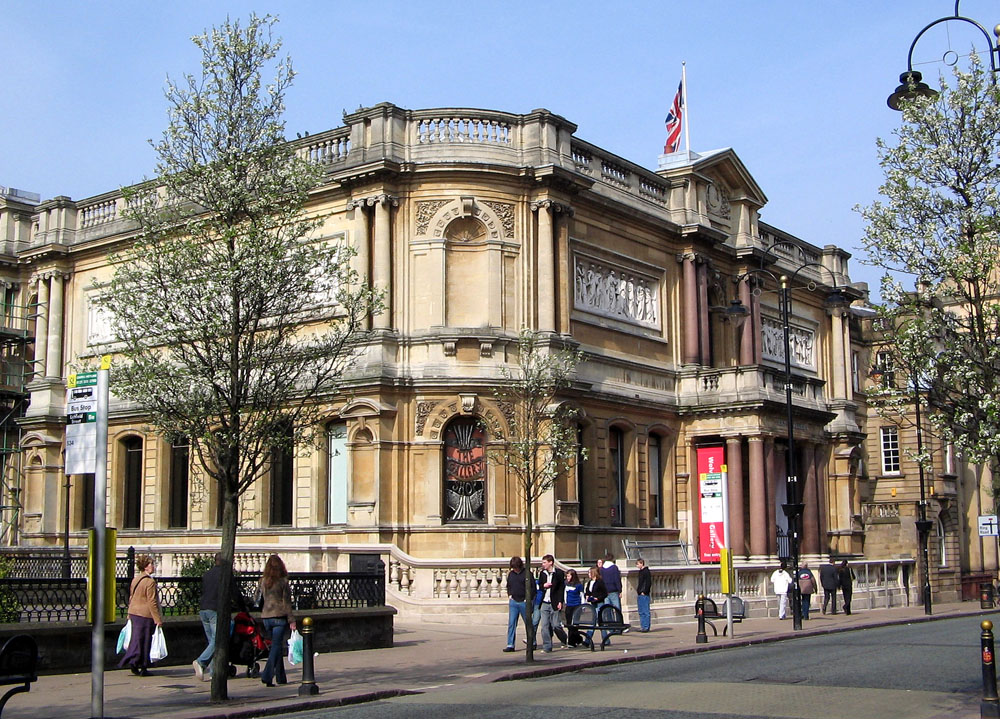
Wolverhampton Art Gallery is located in Wolverhampton, England. The building was funded and constructed by local contractor Philip Horsman (1825–1890), and built on land provided by the municipal authority. It opened in May 1884.
The two-storey building of Wolverhampton Art Gallery was designed by prominent Birmingham architect Julius Chatwin (1829–1907). It was built of Bath stone, an Oolitic Limestone from Bath, Somerset, with six red granite columns indicating the main entrance. The decorative sculptural frieze on the facade is composed of sixteen characters representing the Arts and Crafts, including sculpture, painting, architecture, pottery, glassblowing, and wrought-iron work. It is a Grade II* listed building.
In 2006–07 the building was refurbished by Purcell, partly modernized and extended to create additional exhibition spaces.
The most outstanding artwork of international importance in the collection is the large-scale painting Peace and Plenty Binding the Arrows of War (1614) by the Flemish Baroque painter Abraham Janssens van Nuyssen (ca. 1567/1576–1632). Commissioned and paid for by the Antwerp Guild of Old Crossbowmen, it was a pendant to the Rubens’s Crowning of the Victor. In the 1800s, the city's guilds were broken up and their treasures dispersed. Janssen's picture eventually found its way to a Mrs Thornley of Birmingham. In 1885, she sold it to Wolverhampton Art Gallery. This is the only painting by Janssens in any British public collection and a splendid example of Flemish Baroque art.
Apart from the Janssens painting, the collection of Old Masters is relatively small. It includes a version of A Spinner's Grace by Gerard Dou and Bouquet of Flowers by Jan van Huysum. There is a collection of Old Master drawings, which includes graphic work by Wenceslas Hollar and Alessandro Allori.
A significant part of the gallery's collection was formed from bequests and gifts given by local benefactors and patrons of art. These include those from the tin-toy manufacturer Sidney Cartwright (1802–1883), Philip Horsman and hardware manufacturer Paul Lutz (1832–1899). They mainly collected contemporary and early 19th-century British art and today the holdings of the gallery are still particularly strong in artworks from the Victorian period.
In the 1920s-1950s, a large number of artworks by Frank Brangwyn (1867–1956) were given to the gallery by the artist himself, and by his friend and member of Wolverhampton Art Gallery and Public Library Committee Matthew Biggar Walker (1873–1950).
In 1924, a significant collection of Eastern weapons was secured. During the first decades of the 20th century many specimens of Eastern applied art and British and Eastern ceramics and glass were given to the gallery by the members of the prominent local Bantock family and several other collectors.
Hub AI
Wolverhampton Art Gallery AI simulator
(@Wolverhampton Art Gallery_simulator)
Wolverhampton Art Gallery
Wolverhampton Art Gallery is located in Wolverhampton, England. The building was funded and constructed by local contractor Philip Horsman (1825–1890), and built on land provided by the municipal authority. It opened in May 1884.
The two-storey building of Wolverhampton Art Gallery was designed by prominent Birmingham architect Julius Chatwin (1829–1907). It was built of Bath stone, an Oolitic Limestone from Bath, Somerset, with six red granite columns indicating the main entrance. The decorative sculptural frieze on the facade is composed of sixteen characters representing the Arts and Crafts, including sculpture, painting, architecture, pottery, glassblowing, and wrought-iron work. It is a Grade II* listed building.
In 2006–07 the building was refurbished by Purcell, partly modernized and extended to create additional exhibition spaces.
The most outstanding artwork of international importance in the collection is the large-scale painting Peace and Plenty Binding the Arrows of War (1614) by the Flemish Baroque painter Abraham Janssens van Nuyssen (ca. 1567/1576–1632). Commissioned and paid for by the Antwerp Guild of Old Crossbowmen, it was a pendant to the Rubens’s Crowning of the Victor. In the 1800s, the city's guilds were broken up and their treasures dispersed. Janssen's picture eventually found its way to a Mrs Thornley of Birmingham. In 1885, she sold it to Wolverhampton Art Gallery. This is the only painting by Janssens in any British public collection and a splendid example of Flemish Baroque art.
Apart from the Janssens painting, the collection of Old Masters is relatively small. It includes a version of A Spinner's Grace by Gerard Dou and Bouquet of Flowers by Jan van Huysum. There is a collection of Old Master drawings, which includes graphic work by Wenceslas Hollar and Alessandro Allori.
A significant part of the gallery's collection was formed from bequests and gifts given by local benefactors and patrons of art. These include those from the tin-toy manufacturer Sidney Cartwright (1802–1883), Philip Horsman and hardware manufacturer Paul Lutz (1832–1899). They mainly collected contemporary and early 19th-century British art and today the holdings of the gallery are still particularly strong in artworks from the Victorian period.
In the 1920s-1950s, a large number of artworks by Frank Brangwyn (1867–1956) were given to the gallery by the artist himself, and by his friend and member of Wolverhampton Art Gallery and Public Library Committee Matthew Biggar Walker (1873–1950).
In 1924, a significant collection of Eastern weapons was secured. During the first decades of the 20th century many specimens of Eastern applied art and British and Eastern ceramics and glass were given to the gallery by the members of the prominent local Bantock family and several other collectors.