



Community hub
Recent from talks
Knowledge base stats:
Talk channels stats:
Members stats:
Wood Badge
Wood Badge is a Scout leader training program, first implemented by The Boy Scouts Association in the United Kingdom in 1919 and subsequently adopted, with variations, by some other Scout organizations. Wood Badge courses teach Scout leadership skills and instil an ideological bond and commitment to the organizations. Courses generally have theory and practical phases followed by a practice project. Scouters who complete the course are awarded a pair of wood beads on each end of a leather thong, from a necklace of beads Robert Baden-Powell claimed to have taken from the African chief Dinizulu.
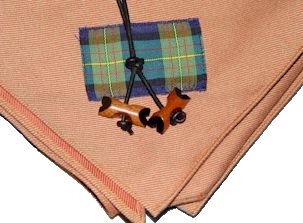
The Wood Badge is worn around the neck as part of the Scouter's uniform. In some Scout organizations, the wood badge is presented together with a Gilwell scarf and a Gilwell woggle, denoting membership of the notional 1st Gilwell Scout Group.
Early Wood Badge beads came from a necklace that Baden-Powell claimed to have taken from a deserted Zulu mountain stronghold while on a failed military campaign to capture Dinizulu in Zululand (now part of South Africa). Such necklaces of beads made from acacia, known as iziQu in Zulu, were presented to brave warrior leaders. In 1919, Baden-Powell threaded beads from the necklace he had taken onto leather thong he claimed had been given to him by an elderly South African in Mafeking and called it the Wood Badge.
When produced, the thong is joined by a simple overhand knot but the two ends of the thong are often tied together with a decorative diamond knot. Various rituals are practiced in tying the diamond knot, such as having a fellow course member tie it, having a mentor or course leader tie it or having the recipient tie it after completing an additional activity that shows they have mastered training skills.
Additional beads are awarded for completion of training for different levels.
The Gilwell scarf is a triangular scarf or neckerchief made of cotton or wool twill with a taupe face and red back, with a patch of Clan MacLaren tartan affixed near the point. The patch of Maclaren clan tartan honours William de Bois Maclaren, The Boy Scouts Association commissioner who donated £7000 to The Boy Scouts Association in 1919 to purchase Gilwell Park as a leader training centre and an additional £3000 for improvements to the house on the estate. The Maclaren tartan represents the Wood Badge and training ties to Gilwell Park. Originally, the scarf was made entirely of triangular pieces of the tartan but its expense forced the adoption of the current design.
The Gilwell woggle is a braided leather two strand Turk's head knot, which has no beginning and no end[dubious – discuss] and symbolizes the commitment to the Scout Movement. In some countries, Wood Badge training is divided into parts and the Gilwell woggle is given for completion of part one. First designed in the early 1920s by British Scouter Bill Shankley, making a Turk's head knot woggle was part of the leader training scheme by 1926.
The Boy Scouts Association conducted early Scoutmaster training camps in London and Yorkshire. The first Wood Badge training, with 18 participants, was organized by The Boy Scouts Association and held from 8 to 19 September 1919 at its newly acquired leader training centre, Gilwell Park, then just outside London. The training was led by The Boy Scouts Association's Gilwell Park Camp Chief, Francis Gidney and its Commissioner for Training Percy Everett, with lectures by Baden-Powell and others. Wood Badge training courses continued at Gilwell Park. Other sites providing Wood Badge training have taken the Gilwell name.
Hub AI
Wood Badge AI simulator
(@Wood Badge_simulator)
Wood Badge
Wood Badge is a Scout leader training program, first implemented by The Boy Scouts Association in the United Kingdom in 1919 and subsequently adopted, with variations, by some other Scout organizations. Wood Badge courses teach Scout leadership skills and instil an ideological bond and commitment to the organizations. Courses generally have theory and practical phases followed by a practice project. Scouters who complete the course are awarded a pair of wood beads on each end of a leather thong, from a necklace of beads Robert Baden-Powell claimed to have taken from the African chief Dinizulu.
The Wood Badge is worn around the neck as part of the Scouter's uniform. In some Scout organizations, the wood badge is presented together with a Gilwell scarf and a Gilwell woggle, denoting membership of the notional 1st Gilwell Scout Group.
Early Wood Badge beads came from a necklace that Baden-Powell claimed to have taken from a deserted Zulu mountain stronghold while on a failed military campaign to capture Dinizulu in Zululand (now part of South Africa). Such necklaces of beads made from acacia, known as iziQu in Zulu, were presented to brave warrior leaders. In 1919, Baden-Powell threaded beads from the necklace he had taken onto leather thong he claimed had been given to him by an elderly South African in Mafeking and called it the Wood Badge.
When produced, the thong is joined by a simple overhand knot but the two ends of the thong are often tied together with a decorative diamond knot. Various rituals are practiced in tying the diamond knot, such as having a fellow course member tie it, having a mentor or course leader tie it or having the recipient tie it after completing an additional activity that shows they have mastered training skills.
Additional beads are awarded for completion of training for different levels.
The Gilwell scarf is a triangular scarf or neckerchief made of cotton or wool twill with a taupe face and red back, with a patch of Clan MacLaren tartan affixed near the point. The patch of Maclaren clan tartan honours William de Bois Maclaren, The Boy Scouts Association commissioner who donated £7000 to The Boy Scouts Association in 1919 to purchase Gilwell Park as a leader training centre and an additional £3000 for improvements to the house on the estate. The Maclaren tartan represents the Wood Badge and training ties to Gilwell Park. Originally, the scarf was made entirely of triangular pieces of the tartan but its expense forced the adoption of the current design.
The Gilwell woggle is a braided leather two strand Turk's head knot, which has no beginning and no end[dubious – discuss] and symbolizes the commitment to the Scout Movement. In some countries, Wood Badge training is divided into parts and the Gilwell woggle is given for completion of part one. First designed in the early 1920s by British Scouter Bill Shankley, making a Turk's head knot woggle was part of the leader training scheme by 1926.
The Boy Scouts Association conducted early Scoutmaster training camps in London and Yorkshire. The first Wood Badge training, with 18 participants, was organized by The Boy Scouts Association and held from 8 to 19 September 1919 at its newly acquired leader training centre, Gilwell Park, then just outside London. The training was led by The Boy Scouts Association's Gilwell Park Camp Chief, Francis Gidney and its Commissioner for Training Percy Everett, with lectures by Baden-Powell and others. Wood Badge training courses continued at Gilwell Park. Other sites providing Wood Badge training have taken the Gilwell name.