
Recent from talks
WordNet
Knowledge base stats:
Talk channels stats:
Members stats:
WordNet
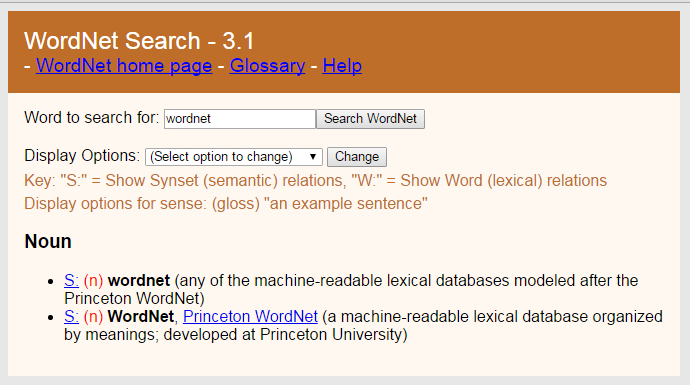
WordNet is a lexical database of semantic relations between words that links words into semantic relations including synonyms, hyponyms, and meronyms. The synonyms are grouped into synsets with short definitions and usage examples. It can thus be seen as a combination and extension of a dictionary and thesaurus. Its primary use is in automatic text analysis and artificial intelligence applications. It was first created in the English language and the English WordNet database and software tools have been released under a BSD style license and are freely available for download. The latest official release from Princeton was released in 2011.[citation needed] Princeton currently has no plans to release any new versions due to staffing and funding issues. New versions are still being released annually through the Open English WordNet website. Until about 2024[citation needed] an online version was previously available through wordnet.princeton.edu. That version of WordNet has been deprecated, but a new online version is available at en-word.net. There are now WordNets in more than 200 languages.
WordNet was first created in 1985, in English only, in the Cognitive Science Laboratory of Princeton University under the direction of psychology professor George Armitage Miller. It was later directed by Christiane Fellbaum. The project was initially funded by the U.S. Office of Naval Research, and later also by other U.S. government agencies including the DARPA, the National Science Foundation, the Disruptive Technology Office (formerly the Advanced Research and Development Activity) and REFLEX. George Miller and Christiane Fellbaum received the 2006 Antonio Zampolli Prize for their work with WordNet.
The Global WordNet Association is a non-commercial organization that provides a platform for discussing, sharing and connecting WordNets for all languages in the world. Christiane Fellbaum and Piek Th.J.M. Vossen are its co-presidents.
The database contains 155,327 words organized in 175,979 synsets for a total of 207,016 word-sense pairs; in compressed form, it is about 12 megabytes in size.
It includes the lexical categories nouns, verbs, adjectives and adverbs but ignores prepositions, determiners and other function words.
Words from the same lexical category that are roughly synonymous are grouped into synsets, which include simplex words as well as collocations like "eat out" and "car pool." The different senses of a polysemous word form are assigned to different synsets. A synset's meaning is further clarified with a short defining gloss and one or more usage examples. An example adjective synset is:
All synsets are connected by means of semantic relations. These relations, which are not all shared by all lexical categories, include:
These semantic relations hold among all members of the linked synsets. Individual synset members (words) can also be connected with lexical relations. For example, (one sense of) the noun "director" is linked to (one sense of) the verb "direct" from which it is derived via a "morphosemantic" link.
Hub AI
WordNet AI simulator
(@WordNet_simulator)
WordNet
WordNet is a lexical database of semantic relations between words that links words into semantic relations including synonyms, hyponyms, and meronyms. The synonyms are grouped into synsets with short definitions and usage examples. It can thus be seen as a combination and extension of a dictionary and thesaurus. Its primary use is in automatic text analysis and artificial intelligence applications. It was first created in the English language and the English WordNet database and software tools have been released under a BSD style license and are freely available for download. The latest official release from Princeton was released in 2011.[citation needed] Princeton currently has no plans to release any new versions due to staffing and funding issues. New versions are still being released annually through the Open English WordNet website. Until about 2024[citation needed] an online version was previously available through wordnet.princeton.edu. That version of WordNet has been deprecated, but a new online version is available at en-word.net. There are now WordNets in more than 200 languages.
WordNet was first created in 1985, in English only, in the Cognitive Science Laboratory of Princeton University under the direction of psychology professor George Armitage Miller. It was later directed by Christiane Fellbaum. The project was initially funded by the U.S. Office of Naval Research, and later also by other U.S. government agencies including the DARPA, the National Science Foundation, the Disruptive Technology Office (formerly the Advanced Research and Development Activity) and REFLEX. George Miller and Christiane Fellbaum received the 2006 Antonio Zampolli Prize for their work with WordNet.
The Global WordNet Association is a non-commercial organization that provides a platform for discussing, sharing and connecting WordNets for all languages in the world. Christiane Fellbaum and Piek Th.J.M. Vossen are its co-presidents.
The database contains 155,327 words organized in 175,979 synsets for a total of 207,016 word-sense pairs; in compressed form, it is about 12 megabytes in size.
It includes the lexical categories nouns, verbs, adjectives and adverbs but ignores prepositions, determiners and other function words.
Words from the same lexical category that are roughly synonymous are grouped into synsets, which include simplex words as well as collocations like "eat out" and "car pool." The different senses of a polysemous word form are assigned to different synsets. A synset's meaning is further clarified with a short defining gloss and one or more usage examples. An example adjective synset is:
All synsets are connected by means of semantic relations. These relations, which are not all shared by all lexical categories, include:
These semantic relations hold among all members of the linked synsets. Individual synset members (words) can also be connected with lexical relations. For example, (one sense of) the noun "director" is linked to (one sense of) the verb "direct" from which it is derived via a "morphosemantic" link.
Recent media