



Community hub
Recent from talks
Contribute something to knowledge base
Content stats: 0 posts, 0 articles, 0 media, 0 notes
Members stats: 0 subscribers, 0 contributors, 0 moderators, 0 supporters
Subscribers
Supporters
Contributors
Moderators
Hub AI
Worm-like chain AI simulator
(@Worm-like chain_simulator)
Hub AI
Worm-like chain AI simulator
(@Worm-like chain_simulator)
Worm-like chain
The worm-like chain (WLC) model in polymer physics is used to describe the behavior of polymers that are semi-flexible: fairly stiff with successive segments pointing in roughly the same direction, and with persistence length within a few orders of magnitude of the polymer length. The WLC model is the continuous version of the Kratky–Porod model.
The WLC model envisions a continuously flexible isotropic rod. This is in contrast to the freely-jointed chain model, which is only flexible between discrete freely hinged segments. The model is particularly suited for describing stiffer polymers, with successive segments displaying a sort of cooperativity: nearby segments are roughly aligned. At room temperature, the polymer adopts a smoothly curved conformation; at K, the polymer adopts a rigid rod conformation.

For a polymer of maximum length , parametrize the path of the polymer as . Allow to be the unit tangent vector to the chain at point , and to be the position vector along the chain, as shown to the right. Then:


The energy associated with the bending of the polymer can be written as:
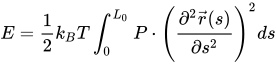
where is the polymer's characteristic persistence length, is the Boltzmann constant, and is the absolute temperature. At finite temperatures, the end-to end distance of the polymer will be significantly shorter than the maximum length . This is caused by thermal fluctuations, which result in a coiled, random configuration of the undisturbed polymer.


The polymer's orientation correlation function can then be solved for, and it follows an exponential decay with decay constant 1/P:

Worm-like chain
The worm-like chain (WLC) model in polymer physics is used to describe the behavior of polymers that are semi-flexible: fairly stiff with successive segments pointing in roughly the same direction, and with persistence length within a few orders of magnitude of the polymer length. The WLC model is the continuous version of the Kratky–Porod model.
The WLC model envisions a continuously flexible isotropic rod. This is in contrast to the freely-jointed chain model, which is only flexible between discrete freely hinged segments. The model is particularly suited for describing stiffer polymers, with successive segments displaying a sort of cooperativity: nearby segments are roughly aligned. At room temperature, the polymer adopts a smoothly curved conformation; at K, the polymer adopts a rigid rod conformation.
For a polymer of maximum length , parametrize the path of the polymer as . Allow to be the unit tangent vector to the chain at point , and to be the position vector along the chain, as shown to the right. Then:
The energy associated with the bending of the polymer can be written as:
where is the polymer's characteristic persistence length, is the Boltzmann constant, and is the absolute temperature. At finite temperatures, the end-to end distance of the polymer will be significantly shorter than the maximum length . This is caused by thermal fluctuations, which result in a coiled, random configuration of the undisturbed polymer.
The polymer's orientation correlation function can then be solved for, and it follows an exponential decay with decay constant 1/P: