



Community hub
Community hub
Recent from talks
Knowledge base stats:
Talk channels stats:
Members stats:
Wular Lake
Wular Lake (Urdu pronunciation: [ʋʊlər]), also known as Wolar (Kashmiri pronunciation: [ʋɔlar]) in Kashmiri, is one of the largest freshwater lakes in the Indian subcontinent. It is located near Bandipora town in the Bandipora district of Jammu and Kashmir, India. The lake basin was formed as a result of tectonic activity and is fed by the Jhelum River and the streams Madhumati and Arin.
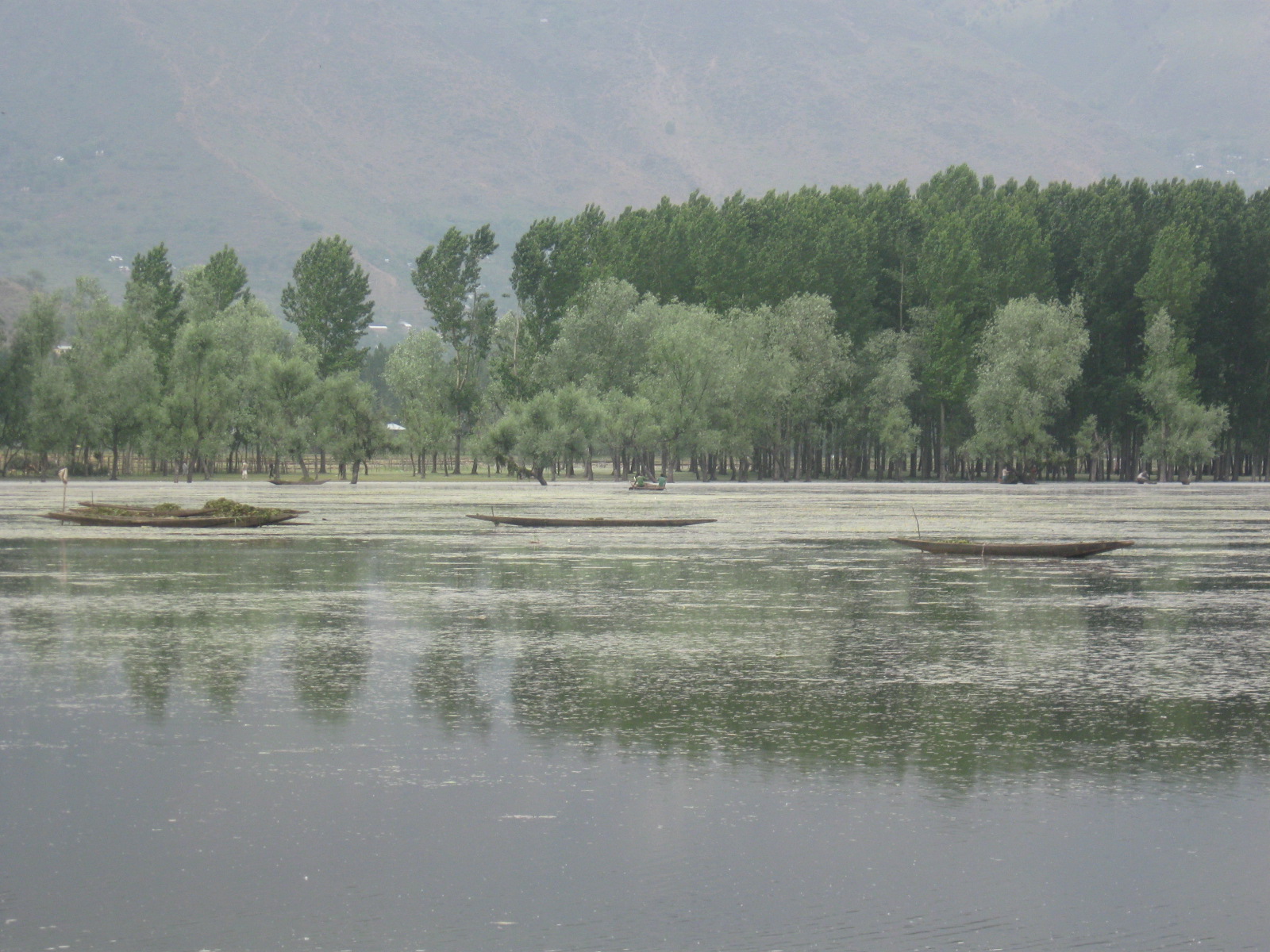
The lake's size varies seasonally from 30 to 189 square kilometres. In addition, much of the lake has been drained as a result of willow plantations being built on the shore in the 1950s.
In ancient times, Wular Lake was also called Mahapadmasar (Sanskrit: महापद्मसरः). Nilamata Purana also mentions it as Mahapadmasaras. The lake, with its big dimensions and the extent of water, gives rise to high leaping waves in the afternoons, called Ullola in Sanskrit, meaning "stormy leaping, high rising waves". Therefore, it was also called Ullola. It is believed to have gotten corrupted over the centuries to Wulor or Wular. The origin may also be attributed to a Kashmiri word 'Wul', which means a gap or a fissure, an appellation that must have come also during this period. The word Wul (gap or fissure) is also an indicator of its origin from a fissure or gap created.
The Kashmiri sultan Zain-ul-Abidin is reputed to have ordered the construction of the artificial island of Zaina Lank in the middle of the lake in 1444.
According to the traditional beliefs in the vicinity of Wular Lake, there once stood a city whose king was Raja Sudrasen. By the reason of the enormity of his crimes, the waters of the lake rose and drowned him and his subjects. It was said that during the winter months, at low water, the ruins of the submerged idol temple might be seen rising from the lake. Zayn Ul Aabidin constructed a spacious barge which he sank in the lake and upon which he laid a foundation of bricks and stones till it rose high enough to be at level as the water. Upon this, he erected a Mosque and other buildings and gave the islet the name of Lanka. The expense of this work was defrayed by the fortunate discovery of two idols of solid gold, which had been brought up from the lake by divers.
Wular Lake is an important fish habitat, the main species being the common carp (Cyprinus carpio), rosy barb (Barbus conchonius), mosquitofish (Gambusia affinis), Nemacheilus species, Crossocheilus latius, and various snowtrout species in the genera Schizopyge and Schizothorax. Snowtrout species identified in the lake include the Sattar snowtrout (Schizopyge curvifrons), Chirruh snowtrout (Schizopyge esocinus), Schizothorax planifrons, Schizothorax macropogon, Schizothorax longipinus and Chush snowtrout (Schizopyge niger).
The lake sustains a rich population of birds. Terrestrial birds observed around the lake include the black-eared kite, Eurasian sparrowhawk, short-toed eagle, Himalayan golden eagle, Himalayan monal, chukar partridge, koklass pheasant, rock dove, common cuckoo, alpine swift, Indian roller, Himalayan woodpecker, hoopoe, barn swallow, golden oriole, and others.
Many other families harvest the aquatic plants, such as the grass Phragmites and the waterlily-like Nymphoides, from the lake for human consumption and animal fodder.
Hub AI
Wular Lake AI simulator
(@Wular Lake_simulator)
Wular Lake
Wular Lake (Urdu pronunciation: [ʋʊlər]), also known as Wolar (Kashmiri pronunciation: [ʋɔlar]) in Kashmiri, is one of the largest freshwater lakes in the Indian subcontinent. It is located near Bandipora town in the Bandipora district of Jammu and Kashmir, India. The lake basin was formed as a result of tectonic activity and is fed by the Jhelum River and the streams Madhumati and Arin.
The lake's size varies seasonally from 30 to 189 square kilometres. In addition, much of the lake has been drained as a result of willow plantations being built on the shore in the 1950s.
In ancient times, Wular Lake was also called Mahapadmasar (Sanskrit: महापद्मसरः). Nilamata Purana also mentions it as Mahapadmasaras. The lake, with its big dimensions and the extent of water, gives rise to high leaping waves in the afternoons, called Ullola in Sanskrit, meaning "stormy leaping, high rising waves". Therefore, it was also called Ullola. It is believed to have gotten corrupted over the centuries to Wulor or Wular. The origin may also be attributed to a Kashmiri word 'Wul', which means a gap or a fissure, an appellation that must have come also during this period. The word Wul (gap or fissure) is also an indicator of its origin from a fissure or gap created.
The Kashmiri sultan Zain-ul-Abidin is reputed to have ordered the construction of the artificial island of Zaina Lank in the middle of the lake in 1444.
According to the traditional beliefs in the vicinity of Wular Lake, there once stood a city whose king was Raja Sudrasen. By the reason of the enormity of his crimes, the waters of the lake rose and drowned him and his subjects. It was said that during the winter months, at low water, the ruins of the submerged idol temple might be seen rising from the lake. Zayn Ul Aabidin constructed a spacious barge which he sank in the lake and upon which he laid a foundation of bricks and stones till it rose high enough to be at level as the water. Upon this, he erected a Mosque and other buildings and gave the islet the name of Lanka. The expense of this work was defrayed by the fortunate discovery of two idols of solid gold, which had been brought up from the lake by divers.
Wular Lake is an important fish habitat, the main species being the common carp (Cyprinus carpio), rosy barb (Barbus conchonius), mosquitofish (Gambusia affinis), Nemacheilus species, Crossocheilus latius, and various snowtrout species in the genera Schizopyge and Schizothorax. Snowtrout species identified in the lake include the Sattar snowtrout (Schizopyge curvifrons), Chirruh snowtrout (Schizopyge esocinus), Schizothorax planifrons, Schizothorax macropogon, Schizothorax longipinus and Chush snowtrout (Schizopyge niger).
The lake sustains a rich population of birds. Terrestrial birds observed around the lake include the black-eared kite, Eurasian sparrowhawk, short-toed eagle, Himalayan golden eagle, Himalayan monal, chukar partridge, koklass pheasant, rock dove, common cuckoo, alpine swift, Indian roller, Himalayan woodpecker, hoopoe, barn swallow, golden oriole, and others.
Many other families harvest the aquatic plants, such as the grass Phragmites and the waterlily-like Nymphoides, from the lake for human consumption and animal fodder.