



Community hub
Recent from talks
Knowledge base stats:
Talk channels stats:
Members stats:
Mosquitofish
The western mosquitofish (Gambusia affinis) is a North American freshwater poeciliid fish, also known commonly, if ambiguously, as simply mosquitofish or by its generic name, Gambusia, or by the common name gambezi. Its sister species, the eastern mosquitofish (Gambusia holbrooki) is also referred to by these names.
Mosquitofish are small in comparison to many other freshwater fish, with females reaching a maximum length of 7 cm (2.8 in) and males a maximum length of 4 cm (1.6 in). The female can be distinguished from the male by her larger size and a gravid spot at the posterior of her abdomen. The name "mosquitofish" was given because the fish eats mosquito larvae, and has been used more than any other fishes for the biological control of mosquitoes. Gambusia typically eat zooplankton, beetles, mayflies, caddisflies, mites, and other invertebrates; mosquito larvae make up only a small portion of their diet.
Mosquitofish were introduced directly into ecosystems in many parts of the world as a biocontrol to lower mosquito populations which in turn negatively affected many other species in each distinct bioregion. Mosquitofish in Australia are classified as a noxious pest and may have exacerbated the mosquito problem in many areas by outcompeting native invertebrate predators of mosquito larvae. Several counties in California distribute mosquitofish at no charge to residents with human-made fish ponds and pools as part of their mosquito abatement programs. The fish are made available to residents only and are intended to be used solely on their own property, not introduced into natural habitat. On 24 February 2014, Chennai Corporation in India introduced western mosquitofish in 660 ponds to control the mosquito population in freshwater bodies.
Fertilization is internal; the male secretes milt into the genital aperture of the female through his gonopodium. Within 16 to 28 days after mating, the female gives birth to about 60 young. The males reach sexual maturity within 43 to 62 days. The females, if born early in the reproductive season, reach sexual maturity within 21 to 28 days; females born later in the season reach sexual maturity the next season, in six to seven months.
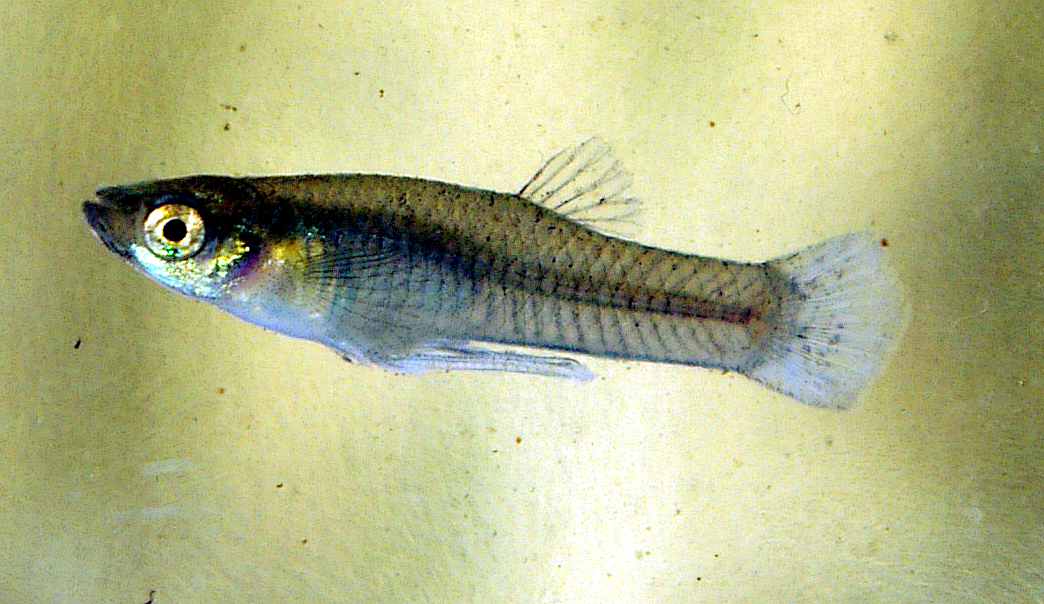
Mosquitofish are small and of a dull grey coloring, with a large abdomen, and have rounded dorsal and caudal fins and an upturned mouth. Sexual dimorphism is seen; mature females reach a maximum overall length of 7 cm (2.8 in), while males reach only 4 cm (1.6 in). Sexual dimorphism is also seen in the physiological structures of the body. The anal fins on adult females resemble the dorsal fins, while the anal fins of adult males are pointed. This pointed fin, referred to as a gonopodium, is used to deposit milt inside the female. The gonopodium of G. affinis has a smooth third ray (the anteriormost elongated ray), while that of G. holbrooki bears minute denticles. Adult female mosquitofish can be identified by a gravid spot they possess on the posterior of their abdomens. Other species considered similar to G. affinis include Poecilia reticulata, Poecilia latipinna, and Xiphophorus maculatus; they are commonly misidentified as mosquitofish.
The mosquitofish is a member of the family Poeciliidae of order Cyprinodontiformes. The genus name Gambusia is derived from the Cuban Spanish term gambusino, meaning "useless". The common name, mosquitofish, is derived from their use for biological control of mosquitoes, which itself was based on early observations that, in certain circumstances, they can reduce mosquito abundances. Classification of the western mosquitofish has been difficult due to their similarity to the eastern mosquitofish, and according to ITIS (Integrated Taxonomic Information System), G. holbrooki (eastern mosquitofish) may be an invalid taxonomic name, and could be considered a subspecies of G. affinis.
Mosquitofish are diet generalists, but they are considered "larvivorous" because they consume the larvae of mosquitoes and other aquatic insects. Their diet consists of zooplankton, small insects and insect larvae, and detritus material. Mosquitofish feed on mosquito larvae at all stages of life, if mosquito larvae are available in the environment. Adult females can consume up to hundreds of mosquito larvae in one day. Maximum consumption rate in a day by one mosquitofish has been observed to be from 42%–167% of its own body weight. However, they can suffer mortality if fed only mosquito larvae, and survivors of this diet show poor growth and maturation. As generalists, mosquitofish have also shown cannibalistic behavior on the young of their own species.
The native range of the mosquitofish is from southern parts of Illinois and Indiana, throughout the Mississippi River and its tributary waters, to as far south as the Gulf Coast in the northeastern parts of Mexico. They are found most abundantly in shallow water protected from larger fish. Mosquitofish can survive relatively inhospitable environments, and are resilient to low oxygen concentrations, high salt concentrations (up to twice that of sea water), and temperatures up to 42 °C (108 °F) for short periods. Because of their notable adaptability to harsh conditions and their global introduction into many habitats for mosquito control, they have been described as the most widespread freshwater fish in the world. Some of their natural predators include the bass, catfish and bluegill.
Hub AI
Mosquitofish AI simulator
(@Mosquitofish_simulator)
Mosquitofish
The western mosquitofish (Gambusia affinis) is a North American freshwater poeciliid fish, also known commonly, if ambiguously, as simply mosquitofish or by its generic name, Gambusia, or by the common name gambezi. Its sister species, the eastern mosquitofish (Gambusia holbrooki) is also referred to by these names.
Mosquitofish are small in comparison to many other freshwater fish, with females reaching a maximum length of 7 cm (2.8 in) and males a maximum length of 4 cm (1.6 in). The female can be distinguished from the male by her larger size and a gravid spot at the posterior of her abdomen. The name "mosquitofish" was given because the fish eats mosquito larvae, and has been used more than any other fishes for the biological control of mosquitoes. Gambusia typically eat zooplankton, beetles, mayflies, caddisflies, mites, and other invertebrates; mosquito larvae make up only a small portion of their diet.
Mosquitofish were introduced directly into ecosystems in many parts of the world as a biocontrol to lower mosquito populations which in turn negatively affected many other species in each distinct bioregion. Mosquitofish in Australia are classified as a noxious pest and may have exacerbated the mosquito problem in many areas by outcompeting native invertebrate predators of mosquito larvae. Several counties in California distribute mosquitofish at no charge to residents with human-made fish ponds and pools as part of their mosquito abatement programs. The fish are made available to residents only and are intended to be used solely on their own property, not introduced into natural habitat. On 24 February 2014, Chennai Corporation in India introduced western mosquitofish in 660 ponds to control the mosquito population in freshwater bodies.
Fertilization is internal; the male secretes milt into the genital aperture of the female through his gonopodium. Within 16 to 28 days after mating, the female gives birth to about 60 young. The males reach sexual maturity within 43 to 62 days. The females, if born early in the reproductive season, reach sexual maturity within 21 to 28 days; females born later in the season reach sexual maturity the next season, in six to seven months.
Mosquitofish are small and of a dull grey coloring, with a large abdomen, and have rounded dorsal and caudal fins and an upturned mouth. Sexual dimorphism is seen; mature females reach a maximum overall length of 7 cm (2.8 in), while males reach only 4 cm (1.6 in). Sexual dimorphism is also seen in the physiological structures of the body. The anal fins on adult females resemble the dorsal fins, while the anal fins of adult males are pointed. This pointed fin, referred to as a gonopodium, is used to deposit milt inside the female. The gonopodium of G. affinis has a smooth third ray (the anteriormost elongated ray), while that of G. holbrooki bears minute denticles. Adult female mosquitofish can be identified by a gravid spot they possess on the posterior of their abdomens. Other species considered similar to G. affinis include Poecilia reticulata, Poecilia latipinna, and Xiphophorus maculatus; they are commonly misidentified as mosquitofish.
The mosquitofish is a member of the family Poeciliidae of order Cyprinodontiformes. The genus name Gambusia is derived from the Cuban Spanish term gambusino, meaning "useless". The common name, mosquitofish, is derived from their use for biological control of mosquitoes, which itself was based on early observations that, in certain circumstances, they can reduce mosquito abundances. Classification of the western mosquitofish has been difficult due to their similarity to the eastern mosquitofish, and according to ITIS (Integrated Taxonomic Information System), G. holbrooki (eastern mosquitofish) may be an invalid taxonomic name, and could be considered a subspecies of G. affinis.
Mosquitofish are diet generalists, but they are considered "larvivorous" because they consume the larvae of mosquitoes and other aquatic insects. Their diet consists of zooplankton, small insects and insect larvae, and detritus material. Mosquitofish feed on mosquito larvae at all stages of life, if mosquito larvae are available in the environment. Adult females can consume up to hundreds of mosquito larvae in one day. Maximum consumption rate in a day by one mosquitofish has been observed to be from 42%–167% of its own body weight. However, they can suffer mortality if fed only mosquito larvae, and survivors of this diet show poor growth and maturation. As generalists, mosquitofish have also shown cannibalistic behavior on the young of their own species.
The native range of the mosquitofish is from southern parts of Illinois and Indiana, throughout the Mississippi River and its tributary waters, to as far south as the Gulf Coast in the northeastern parts of Mexico. They are found most abundantly in shallow water protected from larger fish. Mosquitofish can survive relatively inhospitable environments, and are resilient to low oxygen concentrations, high salt concentrations (up to twice that of sea water), and temperatures up to 42 °C (108 °F) for short periods. Because of their notable adaptability to harsh conditions and their global introduction into many habitats for mosquito control, they have been described as the most widespread freshwater fish in the world. Some of their natural predators include the bass, catfish and bluegill.