



Community hub
Recent from talks
Knowledge base stats:
Talk channels stats:
Members stats:
Circularly disposed antenna array
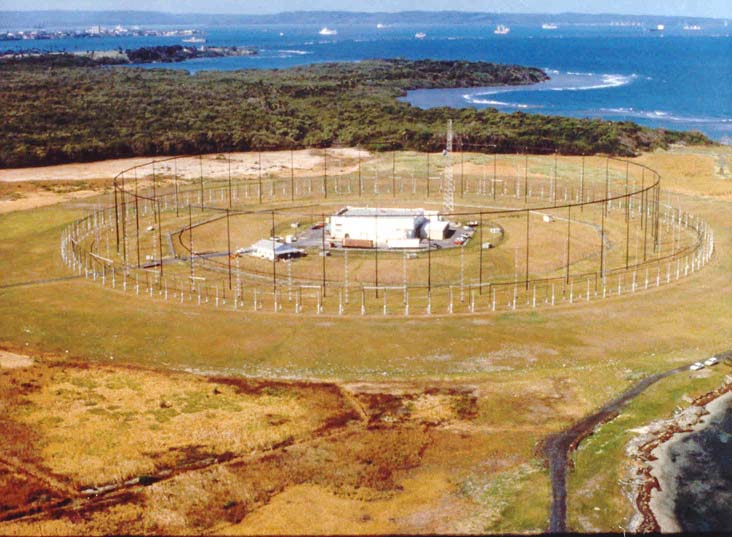
A circularly disposed antenna array (CDAA), sometimes referred to as a circularly disposed dipole array (CDDA) or a wullenweber, is a large circular antenna array used for radio direction finding. They are used by military and government agencies to triangulate radio signals for radio navigation, intelligence gathering, search and rescue, and enforcement of broadcasting laws. Because their huge circular reflecting screens look like circular fences, some antennas have been colloquially referred to as "elephant cages". The term "wullenweber" was the World War II German cover term used to identify their secret CDAA research and development program; its name is unrelated to any person involved in the program.
Many such CDAA systems are used by many nations, such as the former Soviet Union and modern-day Russia, Germany, the United Kingdom, and the United States.
CDAA technology was developed by the German navy communication research command, Nachrichtenmittelversuchskommando (NVK) and Telefunken, working on the Wullenweber during the early years of World War II. The inventor was NVK group leader Dr. Hans Rindfleisch, who worked after the war as a Technical Director for the northern Germany official broadcast (Norddeutscher Rundfunk (NDR)). Technical team leaders were Dr. Joachim Pietzner, Dr. Hans Schellhoss, and Dr. Maximilian Wächtler. The last was a founder of Plath GmbH in 1954 and later a consultant to both Plath and Telefunken.
The first Wullenwever was built during the war at Skibsby, north-east of the city of Hjørring (in German: Hjörring), Denmark (57°29′10″N 10°00′38″E / 57.48611°N 10.01056°E). It used 40 vertical radiator elements, placed on the arc of a circle with a diameter of 120 metres (390 ft). In an inner circle, 40 reflecting elements were placed behind the radiator elements, suspended from a structure of circular wooden support poles with a diameter of 112.5 meters. To more easily obtain true geographic bearings, the north and south elements were placed exactly on the north–south meridian.
Although Pietzner, Schellhoss, and Wächtler retired in West Germany, some of their second-echelon technicians were taken to the USSR after the war. At least 30 Krug (Russian for circle) arrays were installed all over the Soviet Union and allied countries in the 1950s, well before the U.S. military became interested and developed their CDAAs. Several Krugs were installed in pairs less than 10 kilometers from each other, apparently for radio navigation purposes. At least four Krugs were installed near Moscow; just to the north, east and south (55°27′51″N 37°22′11″E / 55.46408°N 37.3698°E) of the city. The Krugs were used to track the early Sputnik satellites, using their 10 and 20 MHz beacons, and were instrumental in locating re-entry vehicles. The Soviet Krug arrays also use the 40-element CDAA configuration. [1]
The array in Skibsby was extensively studied by the British and then destroyed following the war in accordance with the Geneva Convention. Dr. Wächtler arranged to have a second array built, at Telefunken expense, at Langenargen/Bodensee, for further experimentation after the war. In the years following the war, the U.S. disassembled the Langenargen / Bodensee array and brought it back to the U.S., where it became known as the "Wullenweber" array.
One of the German antenna researchers, Dr. Rolf Wundt, was one of hundreds of German scientists taken to the U.S. by the Army after the war under Operation Paperclip. He arrived in New York in March 1947 on the same ship as Wernher von Braun and his wife and parents. He was first employed by the U.S. Air Force and then GT&E Sylvania Electronics Systems on CDAA and other antenna projects.
Professor Edgar Hayden, then a young engineer in the University of Illinois Radio Direction Finding Research Group, led the reassembly of the Wullenweber, studied the design and performance of HF/DF arrays and researched the physics of HF/DF under contract to the U.S. Navy from 1947 through 1960.
Hub AI
Circularly disposed antenna array AI simulator
(@Circularly disposed antenna array_simulator)
Circularly disposed antenna array
A circularly disposed antenna array (CDAA), sometimes referred to as a circularly disposed dipole array (CDDA) or a wullenweber, is a large circular antenna array used for radio direction finding. They are used by military and government agencies to triangulate radio signals for radio navigation, intelligence gathering, search and rescue, and enforcement of broadcasting laws. Because their huge circular reflecting screens look like circular fences, some antennas have been colloquially referred to as "elephant cages". The term "wullenweber" was the World War II German cover term used to identify their secret CDAA research and development program; its name is unrelated to any person involved in the program.
Many such CDAA systems are used by many nations, such as the former Soviet Union and modern-day Russia, Germany, the United Kingdom, and the United States.
CDAA technology was developed by the German navy communication research command, Nachrichtenmittelversuchskommando (NVK) and Telefunken, working on the Wullenweber during the early years of World War II. The inventor was NVK group leader Dr. Hans Rindfleisch, who worked after the war as a Technical Director for the northern Germany official broadcast (Norddeutscher Rundfunk (NDR)). Technical team leaders were Dr. Joachim Pietzner, Dr. Hans Schellhoss, and Dr. Maximilian Wächtler. The last was a founder of Plath GmbH in 1954 and later a consultant to both Plath and Telefunken.
The first Wullenwever was built during the war at Skibsby, north-east of the city of Hjørring (in German: Hjörring), Denmark (57°29′10″N 10°00′38″E / 57.48611°N 10.01056°E). It used 40 vertical radiator elements, placed on the arc of a circle with a diameter of 120 metres (390 ft). In an inner circle, 40 reflecting elements were placed behind the radiator elements, suspended from a structure of circular wooden support poles with a diameter of 112.5 meters. To more easily obtain true geographic bearings, the north and south elements were placed exactly on the north–south meridian.
Although Pietzner, Schellhoss, and Wächtler retired in West Germany, some of their second-echelon technicians were taken to the USSR after the war. At least 30 Krug (Russian for circle) arrays were installed all over the Soviet Union and allied countries in the 1950s, well before the U.S. military became interested and developed their CDAAs. Several Krugs were installed in pairs less than 10 kilometers from each other, apparently for radio navigation purposes. At least four Krugs were installed near Moscow; just to the north, east and south (55°27′51″N 37°22′11″E / 55.46408°N 37.3698°E) of the city. The Krugs were used to track the early Sputnik satellites, using their 10 and 20 MHz beacons, and were instrumental in locating re-entry vehicles. The Soviet Krug arrays also use the 40-element CDAA configuration. [1]
The array in Skibsby was extensively studied by the British and then destroyed following the war in accordance with the Geneva Convention. Dr. Wächtler arranged to have a second array built, at Telefunken expense, at Langenargen/Bodensee, for further experimentation after the war. In the years following the war, the U.S. disassembled the Langenargen / Bodensee array and brought it back to the U.S., where it became known as the "Wullenweber" array.
One of the German antenna researchers, Dr. Rolf Wundt, was one of hundreds of German scientists taken to the U.S. by the Army after the war under Operation Paperclip. He arrived in New York in March 1947 on the same ship as Wernher von Braun and his wife and parents. He was first employed by the U.S. Air Force and then GT&E Sylvania Electronics Systems on CDAA and other antenna projects.
Professor Edgar Hayden, then a young engineer in the University of Illinois Radio Direction Finding Research Group, led the reassembly of the Wullenweber, studied the design and performance of HF/DF arrays and researched the physics of HF/DF under contract to the U.S. Navy from 1947 through 1960.