Hubbry Logo
Direction findingDirection findingMain
Open search
Direction finding
Community hub
Direction finding
logo
8 pages, 0 posts
0 subscribers
Be the first to start a discussion here.
Direction finding
Direction finding
from Wikipedia
Radiotriangulation scheme using two direction-finding antennas (A and B)
Direction finding antenna near the city of Lucerne, Switzerland

Direction finding (DF), radio direction finding (RDF), or radiogoniometry is the use of radio waves to determine the direction to a radio source. The source may be a cooperating radio transmitter or may be an inadvertent source, a naturally occurring radio source, or an illicit or enemy system. Radio direction finding differs from radar in that only the direction is determined by any one receiver; a radar system usually also gives a distance to the object of interest, as well as direction. By triangulation, the location of a radio source can be determined by measuring its direction from two or more locations. Radio direction finding is used in radio navigation for ships and aircraft, to locate emergency transmitters for search and rescue, for tracking wildlife, and to locate illegal or interfering transmitters. During the Second World War, radio direction finding was used by both sides to locate and direct aircraft, surface ships, and submarines.

RDF systems can be used with any radio source, although very long wavelengths (low frequencies) require very large antennas, and are generally used only on ground-based systems. These wavelengths are nevertheless used for marine radio navigation as they can travel very long distances "over the horizon", which is valuable for ships when the line-of-sight may be only a few tens of kilometres. For aerial use, where the horizon may extend to hundreds of kilometres, higher frequencies can be used, allowing the use of much smaller antennas. An automatic direction finder, which could be tuned to radio beacons called non-directional beacons or commercial AM radio broadcasters, was in the 20th century a feature of most aircraft, but is being phased out.[1]

For the military, RDF is a key tool of signals intelligence. The ability to locate the position of an enemy transmitter has been invaluable since World War I, and played a key role in World War II's Battle of the Atlantic. It is estimated that the UK's advanced "huff-duff" systems were directly or indirectly responsible for 24% of all U-boats sunk during the war. Modern systems often used phased array antennas to allow rapid beamforming for highly accurate results, and are part of a larger electronic warfare suite.

Early radio direction finders used mechanically rotated antennas that compared signal strengths, and several electronic versions of the same concept followed. Modern systems use the comparison of phase or doppler techniques which are generally simpler to automate. Early British radar sets were referred to as RDF, which is often stated was a deception. In fact, the Chain Home systems used large RDF receivers to determine directions. Later radar systems generally used a single antenna for broadcast and reception, and determined direction from the direction the antenna was facing.[2]

History

[edit]

Early mechanical systems

[edit]
W.G. Wade of the National Bureau of Standards uses a large multi-loop antenna to perform RDF in this 1919 photo. This is a fairly small unit for the era.

The earliest experiments in RDF were carried out in 1888 when Heinrich Hertz discovered the directionality of an open loop of wire used as an antenna. When the antenna was aligned so it pointed at the signal it produced maximum gain, and produced zero signal when face on. This meant there was always an ambiguity in the location of the signal: it would produce the same output if the signal was in front or back of the antenna. Later experimenters also used dipole antennas, which worked in the opposite sense, reaching maximum gain at right angles and zero when aligned. RDF systems using mechanically swung loop or dipole antennas were common by the turn of the 20th century. Prominent examples were patented by John Stone Stone in 1902 (U.S. Patent 716,134) and Lee de Forest in 1904 (U.S. Patent 771,819), among many other examples.

By the early 1900s, many experimenters were looking for ways to use this concept for locating the position of a transmitter. Early radio systems generally used medium wave and longwave signals. Longwave in particular had good long-distance transmission characteristics due to their limited interaction with the ground, and thereby provided excellent great circle route ground wave propagation that pointed directly to the transmitter. Methods of performing RDF on longwave signals was a major area of research during the 1900s and 1910s.[3]

Antennas are generally sensitive to signals only when they have a length that is a significant portion of the wavelength, or larger. Most antennas are at least 14 of the wavelength, more commonly 12 – the half-wave dipole is a very common design. For longwave use, this resulted in loop antennas tens of feet on a side, often with more than one loop connected together to improve the signal. Another solution to this problem was developed by the Marconi company in 1905. This consisted of a number of horizontal wires or rods arranged to point outward from a common center point. A movable switch could connect opposite pairs of these wires to form a dipole, and by rotating the switch the operator could hunt for the strongest signal.[4] The US Navy overcame this problem, to a point, by mounting antennas on ships and sailing in circles.[5] Such systems were unwieldily and impractical for many uses.[6]

Bellini–Tosi

[edit]
This Royal Navy model is typical of B–T goniometers. The two sets of "field coils" and the rotating "sense coil" are visible.

A key improvement in the RDF concept was introduced by Ettore Bellini and Alessandro Tosi in 1909 (U.S. Patent 943,960). Their system used two such antennas, typically triangular loops, arranged at right angles. The signals from the antennas were sent into coils wrapped around a wooden frame about the size of a pop can, where the signals were re-created in the area between the coils. A separate loop antenna located in this area could then be used to hunt for the direction, without moving the main antennas. This made RDF so much more practical that it was soon being used for navigation on a wide scale, often as the first form of aerial navigation available, with ground stations homing in on the aircraft's radio set. Bellini–Tosi direction finders were widespread from the 1920s into the 1950s.

Early RDF systems were useful largely for long wave signals. These signals are able to travel very long distances, which made them useful for long-range navigation. However, when the same technique was being applied to higher frequencies, unexpected difficulties arose due to the reflection of high frequency signals from the ionosphere. The RDF station might now receive the same signal from two or more locations, especially during the day, which caused serious problems trying to determine the location. This led to the 1919 introduction of the Adcock antenna (UK Patent 130,490), which consisted of four separate monopole antennas instead of two loops, eliminating the horizontal components and thus filtering out the sky waves being reflected down from the ionosphere. Adcock antennas were widely used with Bellini–Tosi detectors from the 1920s on.

The US Army Air Corps in 1931 tested a primitive radio compass that used commercial stations as the beacon.[7]

Huff-duff

[edit]
FH4 "Huff-duff" equipment on the museum ship HMS Belfast

A major improvement in the RDF technique was introduced by Robert Watson-Watt as part of his experiments to locate lightning strikes as a method to indicate the direction of thunderstorms for sailors and airmen. He had long worked with conventional RDF systems, but these were difficult to use with the fleeting signals from the lightning. He had early on suggested the use of an oscilloscope to display these near instantly, but was unable to find one while working at the Met Office. When the office was moved, his new location at a radio research station provided him with both an Adcock antenna and a suitable oscilloscope, and he presented his new system in 1926.

In spite of the system being presented publicly, and its measurements widely reported in the UK, its impact on the art of RDF seems to be strangely subdued. Development was limited until the mid-1930s, when the various British forces began widespread development and deployment of these "high-frequency direction finding", or "huff-duff" systems. To avoid RDF, the Germans had developed a method of broadcasting short messages under 30 seconds, less than the 60 seconds that a trained Bellini-Tosi operator would need to determine the direction. However, this was useless against huff-duff systems, which located the signal with reasonable accuracy in seconds. The Germans did not become aware of this problem until the middle of the war, and did not take any serious steps to address it until 1944. By that time huff-duff had helped in about one-quarter of all successful attacks on the U-boat fleet.

Post-war systems

[edit]

Several developments in electronics during and after the Second World War led to greatly improved methods of comparing the phase of signals. In addition, the phase-locked loop (PLL) allowed for easy tuning in of signals, which would not drift. Improved vacuum tubes and the introduction of the transistor allowed much higher frequencies to be used economically, which led to widespread use of VHF and UHF signals. All of these changes led to new methods of RDF, and its much more widespread use.

In particular, the ability to compare the phase of signals led to phase-comparison RDF, which is perhaps the most widely used technique today. In this system the loop antenna is replaced with a single square-shaped ferrite core, with loops wound around two perpendicular sides. Signals from the loops are sent into a phase comparison circuit, whose output phase directly indicates the direction of the signal. By sending this to any manner of display, and locking the signal using PLL, the direction to the broadcaster can be continuously displayed. Operation consists solely of tuning in the station, and is so automatic that these systems are normally referred to as automatic direction finder.

Other systems have been developed where more accuracy is required. Pseudo-doppler radio direction finder systems use a series of small dipole antennas arranged in a ring and use electronic switching to rapidly select dipoles to feed into the receiver. The resulting signal is processed and produces an audio tone. The phase of that audio tone, compared to the antenna rotation, depends on the direction of the signal. Doppler RDF systems have widely replaced the huff-duff system for location of fleeting signals.

21st century

[edit]

The various procedures for radio direction finding to determine position at sea are no longer part of the maritime safety system GMDSS, which has been in force since 1999. The striking cross frame antenna with attached auxiliary antenna can only be found on the signal masts of some older ships because they do not interfere there and dismantling would be too expensive.

Modern positioning methods such as GPS, DGPS, radar and the now-outdated Loran C have radio direction finding methods that are imprecise for today's needs.

Radio direction finding networks also no longer exist.[8] However rescue vessels, such as RNLI lifeboats in the UK, and Search and Rescue helicopters have direction finding receivers for marine VHF signals and the 121.5 MHz homing signals incorporated in EPIRB and PLB beacons, although modern GPS-EPIRBS and AIS beacons are slowly making these redundant.

Equipment

[edit]
Amelia Earhart's Lockheed Model 10 Electra with the circular RDF aerial visible above the cockpit

A radio direction finder (RDF) is a device for finding the direction, or bearing, to a radio source. The act of measuring the direction is known as radio direction finding or sometimes simply direction finding (DF). Using two or more measurements from different locations, the location of an unknown transmitter can be determined; alternately, using two or more measurements of known transmitters, the location of a vehicle can be determined. RDF is widely used as a radio navigation system, especially with boats and aircraft.

RDF systems can be used with any radio source, although the size of the receiver antennas are a function of the wavelength of the signal; very long wavelengths (low frequencies) require very large antennas, and are generally used only on ground-based systems. These wavelengths are nevertheless very useful for marine navigation as they can travel very long distances and "over the horizon", which is valuable for ships when the line-of-sight may be only a few tens of kilometres. For aircraft, where the horizon at altitude may extend to hundreds of kilometres, higher frequencies can be used, allowing much smaller antennas. An automatic direction finder, often capable of being tuned to commercial AM radio transmitters, is a feature of almost all modern aircraft.

For the military, RDF systems are a key component of signals intelligence systems and methodologies. The ability to locate the position of an enemy transmitter has been invaluable since World War I, and it played a key role in World War II's Battle of the Atlantic. It is estimated that the UK's advanced "huff-duff" systems were directly or indirectly responsible for 24% of all U-boats sunk during the war.[9] Modern systems often use phased array antennas to allow rapid beam forming for highly accurate results. These are generally integrated into a wider electronic warfare suite.

Several distinct generations of RDF systems have been used over time, following new developments in electronics. Early systems used mechanically rotated antennas that compared signal strengths from different directions, and several electronic versions of the same concept followed. Modern systems use the comparison of phase or doppler techniques which are generally simpler to automate. Modern pseudo-Doppler direction finder systems consist of a number of small antennas fixed to a circular card, with all of the processing performed by software.

Early British radar sets were also referred to as RDF, which was a deception tactic. However, the terminology was not inaccurate; the Chain Home systems used separate omnidirectional broadcasters and large RDF receivers to determine the location of the targets.[2]

Antennas

[edit]

In one type of direction finding, a directional antenna is used which is more sensitive in certain directions than in others. Many antenna designs exhibit this property. For example, a Yagi antenna has quite pronounced directionality, so the source of a transmission can be determined by pointing it in the direction where the maximum signal level is obtained. Since the directional characteristics can be very broad, large antennas may be used to improve precision, or null techniques used to improve angular resolution.

The crossed-loops antenna atop the mast of a tug boat is a direction-finding design.

Null finding with loop antennas

[edit]

A simple form of directional antenna is the loop aerial. This consists of an open loop of wire on an insulating frame, or a metal ring that forms the antenna's loop element itself; often the diameter of the loop is a tenth of a wavelength or smaller at the target frequency. Such an antenna will be least sensitive to signals that are perpendicular to its face and most responsive to those arriving edge-on. This is caused by the phase of the received signal: The difference in electrical phase along the rim of the loop at any instant causes a difference in the voltages induced on either side of the loop.

Turning the plane of the loop to "face" the signal so that the arriving phases are identical around the entire rim will not induce any current flow in the loop. So simply turning the antenna to produce a minimum in the desired signal will establish two possible directions (front and back) from which the radio waves could be arriving. This is called a null in the signal, and it is used instead of the strongest signal direction, because small angular deflections of the loop aerial away from its null positions produce much more abrupt changes in received current than similar directional changes around the loop's strongest signal orientation. Since the null direction gives a clearer indication of the signal direction – the null is "sharper" than the max – with loop aerial the null direction is used to locate a signal source.

A "sense antenna" is used to resolve the two direction possibilities; the sense aerial is a non-directional antenna configured to have the same sensitivity as the loop aerial. By adding the steady signal from the sense aerial to the alternating signal from the loop signal as it rotates, there is now only one position as the loop rotates 360° at which there is zero current. This acts as a phase reference point, allowing the correct null point to be identified, removing the 180° ambiguity. A dipole antenna exhibits similar properties, as a small loop, although its null direction is not as "sharp".

Yagi antenna for higher frequencies

[edit]

The Yagi-Uda antenna is familiar as the common VHF or UHF television aerial. A Yagi antenna uses multiple dipole elements, which include "reflector" and "director" dipole elements. The "reflector" is the longest dipole element and blocks nearly all the signal coming from behind it, hence a Yagi has no front vs. back directional ambiguity: The maximum signal only occurs when the narrowest end of the Yagi is aimed in the direction from which the radio waves are arriving. With a sufficient number of shorter "director" elements, a Yagi's maximum direction can be made to approach the sharpness of a small loop's null. [citation needed]

Parabolic antennas for extremely high frequencies

[edit]

For much higher frequencies still, such as millimeter waves and microwaves, parabolic antennas or "dish" antennas can be used. Dish antennas are highly directional, with the parabolic shape directing received signals from a very narrow angle into a small receiving element mounted at the focus of the parabola.

Electronic analysis of two antennas' signals

[edit]

More sophisticated techniques such as phased arrays are generally used for highly accurate direction finding systems. The modern systems are called goniometers by analogy to WW II directional circuits used to measure direction by comparing the differences in two or more matched reference antennas' received signals, used in old signals intelligence (SIGINT). A modern helicopter-mounted direction finding system was designed by ESL Incorporated for the U.S. Government as early as 1972.

Time difference of arrival techniques compare the arrival time of a radio wave at two or more different antennas and deduce the direction of arrival from this timing information. This method can use mechanically simple non-moving omnidirectional antenna elements fed into a multiple channel receiver system.

The RDF antenna on this B-17F is located in the prominent teardrop housing under the nose.

Operation

[edit]
World War II US Navy high frequency radio direction finder

One form of radio direction finding works by comparing the signal strength of a directional antenna pointing in different directions. At first, this system was used by land and marine-based radio operators, using a simple rotatable loop antenna linked to a degree indicator. This system was later adopted for both ships and aircraft, and was widely used in the 1930s and 1940s. On pre-World War II aircraft, RDF antennas are easy to identify as the circular loops mounted above or below the fuselage. Later loop antenna designs were enclosed in an aerodynamic, teardrop-shaped fairing. In ships and small boats, RDF receivers first employed large metal loop antennas, similar to aircraft, but usually mounted atop a portable battery-powered receiver.

In use, the RDF operator would first tune the receiver to the correct frequency, then manually turn the loop, either listening or watching an S meter to determine the direction of the null (the direction at which a given signal is weakest) of a long wave (LW) or medium wave (AM) broadcast beacon or station (listening for the null is easier than listening for a peak signal, and normally produces a more accurate result). This null was symmetrical, and thus identified both the correct degree heading marked on the radio's compass rose as well as its 180-degree opposite. While this information provided a baseline from the station to the ship or aircraft, the navigator still needed to know beforehand if he was to the east or west of the station in order to avoid plotting a course 180-degrees in the wrong direction. By taking bearings to two or more broadcast stations and plotting the intersecting bearings, the navigator could locate the relative position of his ship or aircraft.

Later, RDF sets were equipped with rotatable ferrite loopstick antennas, which made the sets more portable and less bulky. Some were later partially automated by means of a motorized antenna (ADF). A key breakthrough was the introduction of a secondary vertical whip or 'sense' antenna that substantiated the correct bearing and allowed the navigator to avoid plotting a bearing 180 degrees opposite the actual heading. The U.S. Navy RDF model SE 995 which used a sense antenna was in use during World War I.[10] After World War II, there were many small and large firms making direction finding equipment for mariners, including Apelco, Aqua Guide, Bendix, Gladding (and its marine division, Pearce-Simpson), Ray Jefferson, Raytheon, and Sperry. By the 1960s, many of these radios were actually made by Japanese electronics manufacturers, such as Panasonic, Fuji Onkyo, and Koden Electronics Co., Ltd. In aircraft equipment, Bendix and Sperry-Rand were two of the larger manufacturers of RDF radios and navigation instruments.

Single-channel DF

[edit]

Single-channel DF uses a multi-antenna array with a single channel radio receiver. This approach to DF offers some advantages and drawbacks. Since it only uses one receiver, mobility and lower power consumption are benefits. Without the ability to look at each antenna simultaneously (which would be the case if one were to use multiple receivers, also known as N-channel DF) more complex operations need to occur at the antenna in order to present the signal to the receiver.

The two main categories that a single channel DF algorithm falls into are amplitude comparison and phase comparison. Some algorithms can be hybrids of the two.

Pseudo-doppler DF technique

[edit]

The pseudo-doppler technique is a phase based DF method that produces a bearing estimate on the received signal by measuring the doppler shift induced on the signal by sampling around the elements of a circular array. The original method used a single antenna that physically moved in a circle but the modern approach uses a multi-antenna circular array with each antenna sampled in succession.

Watson–Watt, or Adcock-antenna array

[edit]

The Watson-Watt technique uses two antenna pairs to perform an amplitude comparison on the incoming signal. The popular Watson-Watt method uses an array of two orthogonal coils (magnetic dipoles) in the horizontal plane, often completed with an omnidirectional vertically polarized electric dipole to resolve 180° ambiguities.

The Adcock antenna array uses a pair of monopole or dipole antennas that takes the vector difference of the received signal at each antenna so that there is only one output from each pair of antennas. Two of these pairs are co-located but perpendicularly oriented to produce what can be referred to as the N–S (North-South) and E–W (East-West) signals that will then be passed to the receiver. In the receiver, the bearing angle can then be computed by taking the arctangent of the ratio of the N–S to E–W signal.

Correlative interferometer

[edit]

The basic principle of the correlative interferometer consists in comparing the measured phase differences with the phase differences obtained for a DF antenna system of known configuration at a known wave angle (reference data set). For this, at least three antenna elements (with omnidirectional reception characteristics) must form a non-collinear basis. The comparison is made for different azimuth and elevation values of the reference data set. The bearing result is obtained from a correlative and stochastic evaluation for which the correlation coefficient is at a maximum. If the direction finding antenna elements have a directional antenna pattern, then the amplitude may be included in the comparison.

Typically, the correlative interferometer DF system consists of more than five antenna elements. These are scanned one after the other via a specific switching matrix. In a multi-channel DF system n antenna elements are combined with m receiver channels to improve the DF-system performance.

Applications

[edit]

Radio navigation

[edit]
A portable, battery operated GT-302 Accumatic automatic direction finder for marine use

Radio direction finding, radio direction finder, or RDF, was once the primary aviation navigational aid. (Range and Direction Finding was the abbreviation used to describe the predecessor to radar.[2]) Beacons were used to mark "airways" intersections and to define departure and approach procedures. Since the signal transmitted contains no information about bearing or distance, these beacons are referred to as non-directional beacons, or NDB in the aviation world. Starting in the 1950s, these beacons were generally replaced by the VOR system, in which the bearing to the navigational aid is measured from the signal itself; therefore no specialized antenna with moving parts is required. Due to relatively low purchase, maintenance and calibration cost, NDBs are still used to mark locations of smaller aerodromes and important helicopter landing sites.

Similar beacons located in coastal areas are also used for maritime radio navigation, as almost every ship was equipped with a direction finder (Appleyard 1988). Very few maritime radio navigation beacons remain active today (2008) as ships have abandoned navigation via RDF in favor of GPS navigation.

In the United Kingdom a radio direction finding service is available on 121.5 MHz and 243.0 MHz to aircraft pilots who are in distress or are experiencing difficulties. The service is based on a number of radio DF units located at civil and military airports and certain HM Coastguard stations.[11] These stations can obtain a "fix" of the aircraft and transmit it by radio to the pilot.

ILS Localizer

Maritime and aircraft navigation

[edit]
Historic advertisement for Kolster radio compass
R-5/ARN7 radio compass components, with the radio control box (left), indicator (center), and radio compass unit (right)

Radio transmitters for air and sea navigation are known as beacons and are the radio equivalent to a lighthouse. The transmitter sends a Morse Code transmission on a Long wave (150 – 400 kHz) or Medium wave (520 – 1720 kHz) frequency incorporating the station's identifier that is used to confirm the station and its operational status. Since these radio signals are broadcast in all directions (omnidirectional) during the day, the signal itself does not include direction information, and these beacons are therefore referred to as non-directional beacons, or NDBs.

As the commercial medium wave broadcast band lies within the frequency capability of most RDF units, these stations and their transmitters can also be used for navigational fixes. While these commercial radio stations can be useful due to their high power and location near major cities, there may be several miles between the location of the station and its transmitter, which can reduce the accuracy of the 'fix' when approaching the broadcast city. A second factor is that some AM radio stations are omnidirectional during the day, and switch to a reduced power, directional signal at night.

RDF was once the primary form of aircraft and marine navigation. Strings of beacons formed "airways" from airport to airport, while marine NDBs and commercial AM broadcast stations provided navigational assistance to small watercraft approaching a landfall. In the United States, commercial AM radio stations were required to broadcast their station identifier once per hour for use by pilots and mariners as an aid to navigation. In the 1950s, aviation NDBs were augmented by the VOR system, in which the direction to the beacon can be extracted from the signal itself, hence the distinction with non-directional beacons. Use of marine NDBs was largely supplanted in North America by the development of LORAN in the 1970s.

Today many NDBs have been decommissioned in favor of faster and far more accurate GPS navigational systems. However the low cost of ADF and RDF systems, and the continued existence of AM broadcast stations (as well as navigational beacons in countries outside North America) has allowed these devices to continue to function, primarily for use in small boats, as an adjunct or backup to GPS.

Location of illegal, secret or hostile transmitters – SIGINT

[edit]
British Post Office RDF lorry from 1927 for finding unlicensed amateur radio transmitters. It was also used to find regenerative receivers which radiated interfering signals due to feedback, a big problem at the time.

In World War II considerable effort was expended on identifying secret transmitters in the United Kingdom (UK) by direction finding. The work was undertaken by the Radio Security Service (RSS also MI8). Initially three U Adcock HF DF stations were set up in 1939 by the General Post Office. With the declaration of war, MI5 and RSS developed this into a larger network. One of the problems with providing coverage of an area the size of the UK was installing sufficient DF stations to cover the entire area to receive skywave signals reflected back from the ionised layers in the upper atmosphere. Even with the expanded network, some areas were not adequately covered and for this reason up to 1700 voluntary interceptors (radio amateurs) were recruited to detect illicit transmissions by ground wave. In addition to the fixed stations, RSS ran a fleet of mobile DF vehicles around the UK. If a transmitter was identified by the fixed DF stations or voluntary interceptors, the mobile units were sent to the area to home in on the source. The mobile units were HF Adcock systems.

By 1941 only a couple of illicit transmitters had been identified in the UK; these were German agents that had been "turned" and were transmitting under MI5 control. Many illicit transmissions had been logged emanating from German agents in occupied and neutral countries in Europe. The traffic became a valuable source of intelligence, so the control of RSS was subsequently passed to MI6 who were responsible for secret intelligence originating from outside the UK. The direction finding and interception operation increased in volume and importance until 1945.

The HF Adcock stations consisted of four 10 m vertical antennas surrounding a small wooden operators hut containing a receiver and a radio-goniometer which was adjusted to obtain the bearing. MF stations were also used which used four guyed 30 m lattice tower antennas. In 1941, RSS began experimenting with spaced loop direction finders, developed by the Marconi company and the UK National Physical Laboratories. These consisted of two parallel loops 1 to 2 m square on the ends of a rotatable 3 to 8 m beam. The angle of the beam was combined with results from a radiogoniometer to provide a bearing. The bearing obtained was considerably sharper than that obtained with the U Adcock system, but there were ambiguities which prevented the installation of 7 proposed S.L DF systems. The operator of an SL system was in a metal underground tank below the antennas. Seven underground tanks were installed, but only two SL systems were installed at Wymondham, Norfolk and Weaverthorp in Yorkshire. Problems were encountered resulting in the remaining five underground tanks being fitted with Adcock systems. The rotating SL antenna was turned by hand which meant successive measurements were a lot slower than turning the dial of a goniometer.

Another experimental spaced loop station was built near Aberdeen in 1942 for the Air Ministry with a semi-underground concrete bunker. This, too, was abandoned because of operating difficulties. By 1944, a mobile version of the spaced loop had been developed and was used by RSS in France following the D-Day invasion of Normandy.

The US military used a shore based version of the spaced loop DF in World War II called "DAB". The loops were placed at the ends of a beam, all of which was located inside a wooden hut with the electronics in a large cabinet with cathode-ray-tube display at the centre of the beam and everything being supported on a central axis. The beam was rotated manually by the operator.

The Royal Navy introduced a variation on the shore based HF DF stations in 1944 to track U-boats in the North Atlantic. They built groups of five DF stations, so that bearings from individual stations in the group could be combined and a mean taken. Four such groups were built in Britain at Ford End, Essex, Goonhavern, Cornwall, Anstruther and Bowermadden in the Scottish Highlands. Groups were also built in Iceland, Nova Scotia and Jamaica. The anticipated improvements were not realised but later statistical work improved the system and the Goonhavern and Ford End groups continued to be used during the Cold War. The Royal Navy also deployed direction finding equipment on ships tasked to anti-submarine warfare in order to try to locate German submarines, e.g. Captain class frigates were fitted with a medium frequency direction finding antenna (MF/DF) (the antenna was fitted in front of the bridge) and high frequency direction finding (HF/DF, "Huffduff") Type FH 4 antenna (the antenna was fitted on top of the mainmast).[12]

A comprehensive reference on World War II wireless direction finding was written by Roland Keen, who was head of the engineering department of RSS at Hanslope Park. The DF systems mentioned here are described in detail in his 1947 book Wireless Direction Finding.[13]

At the end of World War II a number of RSS DF stations continued to operate into the Cold War under the control of GCHQ the British SIGINT organisation.

Most direction finding effort within the UK now (2009) is directed towards locating unauthorised "pirate" FM broadcast radio transmissions. A network of remotely operated VHF direction finders are used mainly located around the major cities. The transmissions from mobile telephone handsets are also located by a form of direction finding using the comparative signal strength at the surrounding local "cell" receivers. This technique is often offered as evidence in UK criminal prosecutions and, almost certainly, for SIGINT purposes.[14]

Emergency aid

[edit]

Emergency position-indicating rescue beacons are widely deployed on civil aircraft and ships. Historically emergency location transmitters only sent a tone signal and relied on direction finding by search aircraft to locate the beacon. Modern emergency beacons transmit a unique identification signal that can include GPS location data that can aid in finding the exact location of the transmitter.

Avalanche transceivers operate on a standard 457 kHz, and are designed to help locate people and equipment buried by avalanches. Since the power of the beacon is so low the directionality of the radio signal is dominated by small scale field effects[15] and can be quite complicated to locate.

Wildlife tracking

[edit]

Location of radio-tagged animals by triangulation is a widely applied research technique for studying the movement of animals. The technique was first used in the early 1960s, when radio transmitters and batteries became small enough to attach to wildlife, and is now widely deployed for a variety of wildlife studies. Most tracking of wild animals that have been affixed with radio transmitter equipment is done by a field researcher using a handheld radio direction finding device. When the researcher wants to locate a particular animal, the location of the animal can be triangulated by determining the direction to the transmitter from several locations.

Reconnaissance

[edit]

Phased arrays and other advanced antenna techniques are utilized to track launches of rocket systems and their resulting trajectories. These systems can be used for defensive purposes and also to gain intelligence on operation of missiles belonging to other nations. These same techniques are used for detection and tracking of conventional aircraft.

Astronomy

[edit]

Earth-based receivers can detect radio signals emanating from distant stars or regions of ionized gas. Receivers in radio telescopes can detect the general direction of such naturally occurring radio sources, sometimes correlating their location with objects visible with optical telescopes. Accurate measurement of the arrival time of radio impulses by two radio telescopes at different places on Earth, or the same telescope at different times in Earth's orbit around the Sun, may also allow estimation of the distance to a radio object.

Sport

[edit]

Events hosted by groups and organizations that involve the use of radio direction finding skills to locate transmitters at unknown locations have been popular since the end of World War II.[16] Many of these events were first promoted in order to practice the use of radio direction finding techniques for disaster response and civil defense purposes, or to practice locating the source of radio frequency interference. The most popular form of the sport, worldwide, is known as amateur radio direction finding (ARDF). Another form of the activity, known as "transmitter hunting", "mobile T-hunting" or "fox hunting" takes place in a larger geographic area, such as the metropolitan area of a large city, and most participants travel in motor vehicles while attempting to locate one or more radio transmitters with radio direction-finding techniques.

Direction finding at microwave frequencies

[edit]

DF techniques for microwave frequencies were developed in the 1940s, in response to the growing numbers of transmitters operating at these higher frequencies. This required the design of new antennas and receivers for the DF systems.

In Naval systems, the DF capability became part of the Electronic Support Measures suite (ESM),[17]: 6 [18]: 126 [19]: 70  where the directional information obtained augments other signal identification processes. In aircraft, a DF system provides additional information for the Radar Warning Receiver (RWR).

Over time, it became necessary to improve the performance of microwave DF systems in order to counter the evasive tactics being employed by some operators, such as low-probability-of-intercept radars and covert Data links.

Brief history of microwave development

[edit]

Earlier in the century, vacuum tubes (thermionic valves) were used extensively in transmitters and receivers, but their high frequency performance was limited by transit time effects.[20]: 192 [21]: 394 [22]: 206  Even with special processes to reduce lead lengths,[23] such as frame grid construction, as used in the EF50, and planar construction,[20]: 192  very few tubes could operate above UHF.

Intensive research work was carried out in the 1930s in order to develop transmitting tubes specifically for the microwave band which included, in particular, the klystron[24][20]: 201  the cavity magnetron[20]: 347  [24]: 45  and the travelling wave tube (TWT).[20]: 241 [24]: 48  Following the successful development of these tubes, large scale production occurred in the following decade.

The advantages of microwave operation

[edit]

Microwave signals have short wavelengths, which results in greatly improved target resolution when compared to RF systems. This permits better identification of multiple targets and, also, gives improved directional accuracy.[25] Also, the antennas are small so they can be assembled into compact arrays and, in addition, they can achieve well defined beam patterns which can provide the narrow beams with high gain favoured by radars and Data links.

Other advantages of the newly available microwave band were the absence of fading (often a problem in the Shortwave radio (SW) band) and great increase in signal spectrum, compared to the congested RF bands already in use. In addition to being able to accommodate many more signals, the ability to use Spread spectrum and frequency hopping techniques now became possible.

Once microwave techniques had become established, there was rapid expansion into the band by both military and commercial users.

Antennas for DF

[edit]

Antennas for DF have to meet different requirements from those for a radar or communication link, where an antenna with a narrow beam and high gain is usually an advantage. However, when carrying out direction finding, the bearing of the source may be unknown, so antennas with wide beamwidths are usually chosen, even though they have lower antenna boresight gain. In addition, the antennas are required to cover a wide band of frequencies.

The figure shows the normalized polar plot of a typical antenna gain characteristic, in the horizontal plane. The half-power beamwidth of the main beam is 2 × Ψ0. Preferably, when using amplitude comparison methods for direction finding, the main lobe should approximate to a Gaussian characteristic. Although the figure also shows the presence of sidelobes, these are not a major concern when antennas are used in a DF array.

Typically, the boresight gain of an antenna is related to the beam width.[26]: 257  For a rectangular horn, Gain ≈ 30000/BWh.BWv, where BWh and BWv are the horizontal and vertical antenna beamwidths, respectively, in degrees. For a circular aperture, with beamwidth BWc, it is Gain ≈ 30000/BWc2.

Two antenna types, popular for DF, are cavity-backed spirals and horn antennas.

Spiral antennas are capable of very wide bandwidths [26]: 252 [27] and have a nominal half-power beamwidth of about 70deg, making them very suitable for antenna arrays containing 4, 5 or 6 antennas.[18]: 41 

For larger arrays, needing narrower beamwidths, horns may be used. The bandwidths of horn antennas may be increased by using double-ridged waveguide feeds[28][18]: 72  and by using horns with internal ridges.[29]: 267 [30]: 181 

Microwave receivers

[edit]

Early receivers

[edit]

Early microwave receivers were usually simple "crystal-video" receivers,[31]: 169 [18]: 172 [32] which use a crystal detector followed by a video amplifier with a compressive characteristic to extend the dynamic range. Such a receiver was wideband but not very sensitive. However, this lack of sensitivity could be tolerated because of the "range advantage" enjoyed by the DF receiver (see below).

Klystron and TWT preamplifiers

[edit]

The klystron and TWT are linear devices and so, in principle, could be used as receiver preamplifiers. However, the klystron was quite unsuitable as it was a narrow-band device and extremely noisy[21]: 392  and the TWT, although potentially more suitable,[21]: 548  has poor matching characteristics and large bulk, which made it unsuitable for multi-channel systems using a preamplifier per antenna. However, a system has been demonstrated, in which a single TWT preamplifier selectively selects signals from an antenna array.[33]

Transistor preamplifiers

[edit]

Transistors suitable for microwave frequencies became available towards the end of the 1950s. The first of these was the metal oxide semiconductor field effect transistor (MOSFET). Others followed, for example, the metal-semiconductor field-effect transistor and the high electron mobility transistor (HEMT). Initially, discrete transistors were embedded in stripline or microstrip circuits, but microwave integrated circuits followed. With these new devices, low-noise receiver preamplifiers became possible, which greatly increased the sensitivity, and hence the detection range, of DF systems.

Range advantage

[edit]

Source:[34]

The DF receiver enjoys a detection range advantage[35] over that of the radar receiver. This is because the signal strength at the DF receiver, due to a radar transmission, is proportional to 1/R2 whereas that at the radar receiver from the reflected return is proportional to σ/R4, where R is the range and σ is the radar cross-section of the DF system.[36] This results in the signal strength at the radar receiver being very much smaller than that at the DF receiver. Consequently, in spite of its poor sensitivity, a simple crystal-video DF receiver is, usually, able to detect the signal transmission from a radar at a greater range than that at which the Radar's own receiver is able to detect the presence of the DF system.[18]: 8 

In practice, the advantage is reduced by the ratio of antenna gains (typically they are 36 dB and 10 dB for the Radar and ESM, respectively) and the use of Spread spectrum techniques, such as Chirp compression, by the Radar, to increase the processing gain of its receiver. On the other hand, the DF system can regain some advantage by using sensitive, low-noise, receivers and by using Stealth practices to reduce its radar cross-section,[29]: 292  as with Stealth aircraft and Stealth ships.

The new demands on DF systems

[edit]

The move to microwave frequencies meant a reappraisal of the requirements of a DF system.[37] Now, the receiver could no longer rely on a continuous signal stream on which to carry out measurements. Radars with their narrow beams would only illuminate the antennas of the DF system infrequently. Furthermore, some radars wishing to avoid detection (those of smugglers, hostile ships and missiles) would radiate their signals infrequently and often at low power.[38] Such a system is referred to as a low-probability-of-intercept radar.[39][40] In other applications, such as microwave links, the transmitter's antenna may never point at the DF receiver at all, so reception is only possible by means of the signal leakage from antenna side lobes. In addition, covert Data links[41] may only radiate a high data rate sequence very occasionally.

In general, in order to cater for modern circumstances, a broadband microwave DF system is required to have high sensitivity and have 360° coverage in order to have the ability to detect single pulses (often called amplitude monopulse) and achieve a high "Probability of Intercept" (PoI).[42]

DF by amplitude comparison

[edit]

Amplitude comparison has been popular as a method for DF because systems are relatively simple to implement, have good sensitivity and, very importantly, a high probability of signal detection.[43]: 97 [18]: 207  Typically, an array of four, or more, squinted directional antennas is used to give 360 degree coverage.[44]: 155 [18]: 101 [45]: 5–8.7 [43]: 97 [46] DF by phase comparison methods can give better bearing accuracy,[45]: 5–8.9  but the processing is more complex. Systems using a single rotating dish antenna are more sensitive, small and relatively easy to implement, but have poor PoI.[42]

Usually, the signal amplitudes in two adjacent channels of the array are compared, to obtain the bearing of an incoming wavefront but, sometimes, three adjacent channels are used to give improved accuracy. Although the gains of the antennas and their amplifying chains have to be closely matched, careful design and construction and effective calibration procedures can compensate for shortfalls in the hardware. Overall bearing accuracies of 2° to 10° (rms) have been reported [45][47] using the method.

Two-channel DF

[edit]
Two-port DF, polar plot (normalized)
Two-port DF, log scale (normalized)
Power Diff. (dB) v. Bearing

Two-channel DF, using two adjacent antennas of a circular array, is achieved by comparing the signal power of the largest signal with that of the second largest signal. The direction of an incoming signal, within the arc described by two antennas with a squint angle of Φ, may be obtained by comparing the relative powers of the signals received. When the signal is on the boresight of one of the antennas, the signal at the other antenna will be about 12 dB lower. When the signal direction is halfway between the two antennas, signal levels will be equal and approximately 3 dB lower than the boresight value. At other bearing angles, φ, some intermediate ratio of the signal levels will give the direction.

If the antenna main lobe patterns have a Gaussian characteristic, and the signal powers are described in logarithmic terms (e.g. decibels (dB) relative to the boresight value), then there is a linear relationship between the bearing angle φ and the power level difference, i.e. φ ∝ (P1(dB) - P2(dB)), where P1(dB) and P2(dB) are the outputs of two adjacent channels. The thumbnail shows a typical plot.

To give 360° coverage, antennas of a circular array are chosen, in pairs, according to the signal levels received at each antenna. If there are N antennas in the array, at angular spacing (squint angle) Φ, then Φ = 2π/N radians (= 360/N degrees).

Basic equations for two-port DF

[edit]

If the main lobes of the antennas have a Gausian characteristic, then the output P1(φ), as a function of bearing angle φ, is given by[18]: 238 

where

G0 is the antenna boresight gain (i.e. when ø = 0),
Ψ0 is one half the half-power beamwidth
A = -\ln(0.5), so that P1(ø)/P10 = 0.5 when ø = Ψ0
and angles are in radians.

The second antenna, squinted at Phi and with the same boresight gain G0 gives an output

Comparing signal levels,

The natural logarithm of the ratio is

Rearranging

This shows the linear relationship between the output level difference, expressed logarithmically, and the bearing angle ø.

Natural logarithms can be converted to decibels (dBs) (where dBs are referred to boresight gain) by using ln(X) = X(dB)/(10.\log10(e)), so the equation can be written

Three-channel DF

[edit]
Three-port DF, polar plot (normalized)
Three-port DF, log scale (normalized)

Improvements in bearing accuracy may be achieved if amplitude data from a third antenna are included in the bearing processing.[48][44]: 157 

For three-channel DF, with three antennas squinted at angles Φ, the direction of the incoming signal is obtained by comparing the signal power of the channel containing the largest signal with the signal powers of the two adjacent channels, situated at each side of it.

For the antennas in a circular array, three antennas are selected according to the signal levels received, with the largest signal present at the central channel.

When the signal is on the boresight of Antenna 1 (φ = 0), the signal from the other two antennas will equal and about 12 dB lower. When the signal direction is halfway between two antennas (φ = 30°), their signal levels will be equal and approximately 3 dB lower than the boresight value, with the third signal now about 24 dB lower. At other bearing angles, ø, some intermediate ratios of the signal levels will give the direction.

Basic equations for three-port DF

[edit]

For a signal incoming at a bearing ø, taken here to be to the right of boresight of Antenna 1:

Channel 1 output is

Channel 2 output is

Channel 3 output is

where GT is the overall gain of each channel, including antenna boresight gain, and is assumed to be the same in all three channels. As before, in these equations, angles are in radians, Φ = 360/N degrees = 2 π/N radians and A = -ln(0.5).

As earlier, these can be expanded and combined to give:

Eliminating A/Ψ02 and rearranging

where Δ1,3 = \ln(P1) - ln(P3), Δ1,2 = \ln(P1) - \ln(P2) and Δ2,3 = \ln(P2) - \ln(P3),

The difference values here are in nepers but could be in decibels.

The bearing value, obtained using this equation, is independent of the antenna beamwidth (= 2.Ψ0), so this value does not have to be known for accurate bearing results to be obtained. Also, there is a smoothing affect, for bearing values near to the boresight of the middle antenna, so there is no discontinuity in bearing values there, as an incoming signals moves from left to right (or vice versa) through boresight, as can occur with 2-channel processing.

Bearing uncertainty due to noise

[edit]

Many of the causes of bearing error, such as mechanical imperfections in the antenna structure, poor gain matching of receiver gains, or non-ideal antenna gain patterns may be compensated by calibration procedures and corrective look-up tables, but thermal noise will always be a degrading factor. As all systems generate thermal noise[49][50] then, when the level of the incoming signal is low, the signal-to-noise ratios in the receiver channels will be poor, and the accuracy of the bearing prediction will suffer.

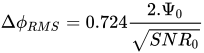
In general, a guide to bearing uncertainty is given by [45][51]>: 82  [31]: 91 [52]: 244 

degrees

for a signal at crossover, but where SNR0 is the signal-to-noise ratio that would apply at boresight.

To obtain more precise predictions at a given bearing, the actual S:N ratios of the signals of interest are used. (The results may be derived assuming that noise induced errors are approximated by relating differentials to uncorrelated noise).

For adjacent processing using, say, Channel 1 and Channel 2, the bearing uncertainty (angle noise), Δø (rms), is given below.[18][31]: 91 [53] In these results, square-law detection is assumed and the SNR figures are for signals at video (baseband), for the bearing angle φ.

rads

where SNR1 and SNR2 are the video (base-band) signal-to-noise values for the channels for Antenna 1 and Antenna 2, when square-law detection is used.

In the case of 3-channel processing, an expression which is applicable when the S:N ratios in all three channels exceeds unity (when ln(1 + 1/SNR) ≈ 1/SNR is true in all three channels), is

where SNR1, SNR2 and SNR3 are the video signal-to-noise values for Channel 1, Channel 2, and Channel 3 respectively, for the bearing angle φ.

A typical DF system with six antennas

[edit]
Six-port DF system

A schematic of a possible DF system,[18]: 101  employing six antennas,[54][55] is shown in the figure.

The signals received by the antennas are first amplified by a low-noise preamplifier before detection by detector-log-video-amplifiers (DLVAs).[56][57][58] The signal levels from the DLVAs are compared to determine the angle of arrival. By considering the signal levels on a logarithmic scale, as provided by the DLVAs, a large dynamic range is achieved [56]: 33  and, in addition, the direction finding calculations are simplified when the main lobes of antenna patterns have a Gaussian characteristic, as shown earlier.

A necessary part of the DF analysis is to identify the channel which contains the largest signal and this is achieved by means of a fast comparator circuit.[44] In addition to the DF process, other properties of the signal may be investigated, such as pulse duration, frequency, pulse repetition frequency (PRF) and modulation characteristics.[45] The comparator operation usually includes hysteresis, to avoid jitter in the selection process when the bearing of the incoming signal is such that two adjacent channels contain signals of similar amplitude.

Often, the wideband amplifiers are protected from local high power sources (as on a ship) by input limiters and/or filters. Similarly the amplifiers might contain notch filters to remove known, but unwanted, signals which could impairs the system's ability to process weaker signals. Some of these issues are covered in RF chain.

See also

[edit]

References

[edit]

Bibliography

[edit]
Revisions and contributorsEdit on WikipediaRead on Wikipedia
from Grokipedia
Direction finding (DF), also known as radio direction finding (RDF), is the measurement and evaluation of electromagnetic field parameters from a radio signal to estimate the direction toward its emitting source. Developed from fundamental observations of radio wave propagation, DF relies on principles such as antenna directivity and phase differences to resolve azimuth angles, often combined with triangulation from multiple stations for precise geolocation. The technique traces its origins to 1888, when identified the directional sensitivity of loop antennas to radio waves, laying the groundwork for practical systems. Early advancements included the 1909 Bellini-Tosi system, which used stationary antennas with a rotating coil to indicate bearing, followed by the 1919 Adcock array to mitigate skywave interference, and Robert Watson-Watt's 1926 high-frequency direction finder (HF/DF or "Huff-Duff"), which enabled rapid signal analysis via displays. These innovations proved pivotal in , where HF/DF stations allowed Allied forces to detect and counter German transmissions, contributing significantly to the defeat of submarine wolf packs in the . Modern DF employs electronic methods including amplitude comparison for and phase-based for high-resolution angle-of-arrival (AOA) determination, achieving accuracies within hundreds of meters even in complex environments with multipath reflections. Applications span maritime and navigation, search-and-rescue operations via emergency beacons, signals intelligence for emitter localization, and to hunt interference sources, with portable and vehicle-mounted systems extending utility to urban and dynamic scenarios.

Fundamentals

Core Principles of Radio Direction Finding

Radio direction finding (RDF) determines the bearing to a radio transmitter by exploiting the directional properties of electromagnetic waves and antenna responses. In the far field, radio signals propagate as plane wavefronts, where the electric and vectors are to the direction of and to each other. Antennas with non-uniform sensitivity patterns respond differently to signals arriving from various azimuths, allowing the of field parameters such as , phase, or polarization to infer the angle of arrival. The foundational technique employs , which primarily sense the magnetic component of the . A small exhibits a bidirectional figure-of-eight , with deep nulls in the plane of the loop perpendicular to the incident wavefront's vector. By rotating the loop until the received signal null is observed—indicating minimal induced voltage due to zero linkage—the direction of the null aligns with the great-circle bearing to the source, assuming vertically polarized ground waves or sky waves with negligible tilt. This method, effective for frequencies below 3 MHz where loop size is much smaller than , achieves accuracies of 2-5 degrees under ideal conditions but suffers from ambiguities requiring quadrant resolution. Phase-comparison methods, using fixed antenna arrays, overcome mechanical limitations by measuring electrical phase differences between signals at spaced elements. For a two-element array separated by d<λ/2d < \lambda/2, the phase shift δϕ=(2πd/λ)sinθ\delta \phi = (2\pi d / \lambda) \sin \theta, where θ\theta is the angle from broadside and λ\lambda is , directly computes the bearing via . Goniometers or hybrid combiners resolve the phase to produce a rotating field in a sensing coil, whose null indicates direction without moving parts; this extends to Adcock arrays of vertical monopoles for electric field sensing, minimizing ground wave tilt errors. Modern correlative enhance precision by digitally correlating phases across multiple baselines, yielding accuracies under 1 degree even at VHF/UHF. Amplitude-comparison systems utilize directive antennas or with overlapping beams, comparing signal strengths to interpolate the maximum response direction. Pseudo-Doppler techniques simulate via electronic switching of array elements, inducing measurable shifts proportional to sine of the arrival , while Watson-Watt systems amplify phase-derived amplitudes for . These principles assume line-of-sight or ground-wave ; deviations from plane-wave assumptions, such as near-field or multipath, introduce errors mitigated by and .

Electromagnetic Wave Propagation and Bearing Determination

Electromagnetic waves in the propagate as transverse oscillations of electric and mutually perpendicular to the direction of , traveling at approximately 3 × 10^8 m/s in . In direction finding, the far-field approximation treats incoming signals as plane waves, where the bearing corresponds to the azimuthal angle of the wavefront normal relative to a local reference, such as magnetic north. This relies on measuring field parameters, including , phase, or polarization, to infer the angle of arrival (AOA). Bearing determination exploits antenna directivity patterns, which vary with the incident wave's direction. Loop antennas primarily respond to the magnetic field component, producing a figure-of-eight voltage pattern with deep nulls when the loop plane aligns parallel to the field lines—perpendicular to propagation. Rotation to minimize signal strength identifies the bearing as orthogonal to the null axis, with historical systems achieving resolutions of 1-2 degrees under ideal conditions. Adcock arrays, sensing the electric field via vertical monopoles, use phase or amplitude comparisons across elements spaced by fractions of a wavelength to resolve AOA, following the relation for phase difference δ = (2π d / λ) sin(θ), where d is element spacing, λ is wavelength, and θ is the angle from array broadside. Propagation deviates from ideal straight-line paths due to environmental factors, introducing bearing errors. Ground waves at medium frequencies (MF) diffract over terrain, while high-frequency (HF) skywaves refract via the , often arriving at oblique angles that shift apparent bearings by 10-45 degrees, as multiple hops create ambiguous paths. Multipath from reflections off structures causes signal superposition, distorting patterns and reducing accuracy to 5-15 degrees in urban VHF scenarios without mitigation. in UHF/ bands minimizes such effects, enabling sub-degree precision with arrays, though tropospheric ducting can still induce anomalies. These causal mechanisms necessitate site-specific and error modeling for reliable operation.

Historical Development

Pre-20th Century Precursors and Early Experiments

In 1888, Heinrich Hertz performed experiments that first revealed the directional characteristics of electromagnetic waves, establishing the foundational principle for radio direction finding. Hertz generated radio-frequency waves using a high-voltage spark discharge across a dipole antenna and detected them with a receiver consisting of a single-turn square loop of wire terminated by a small adjustable spark gap. He noted that the received signal, evidenced by the intensity of the spark in the detector, reached a maximum when the plane of the loop was oriented parallel to the electric field vector of the incoming wave—effectively aligning the loop's axis perpendicular to the direction of propagation—and dropped to a minimum (null) when rotated 90 degrees, aligning the loop's plane parallel to the propagation direction. This null method exploited the figure-eight reception pattern of small loop antennas, where signal strength is minimized along the axis of the loop, providing a direct indication of the bearing to the source. Hertz's apparatus operated at wavelengths of approximately 4 to 8 meters, with detection ranges limited to tens of meters in his laboratory at the in , . While not designed for practical location tasks, these observations empirically validated Maxwell's prediction of transverse electromagnetic waves and demonstrated antenna directivity, enabling subsequent inventors to adapt loop orientations for bearing determination. No earlier electromagnetic direction-finding experiments are documented, as practical radio transmission awaited refinements in the 1890s by researchers like , who in 1894 used a detector for Hertzian waves but did not emphasize directionality. Pre-radio precursors to locating distant signals included acoustic methods, such as thunder direction estimation via sound arrival angles, or optical signaling with flags and mirrors, but these suffered from environmental limitations like weather and line-of-sight requirements, lacking the all-weather penetration of radio waves. Hertz's work thus marked the transition from theoretical to observable wave behavior conducive to directional techniques.

World War I and Interwar Mechanical Systems

![German Peilantenne direction finder][float-right] During , radio direction finding became essential for military operations, enabling the location of enemy transmitters for artillery targeting and intelligence gathering. Early systems relied on mechanically rotated loop antennas, where operators manually turned the antenna to find the direction of minimum signal strength, known as the null method, achieving accuracies of 2-5 degrees in medium frequencies. The employed goniometry—angle measurement via directional antennas—to obtain bearings on German radio transmitters, integrating these with mobile truck-mounted equipment by 1918 to support frontline intelligence. The -Tosi direction finder, patented in by Ettore Bellini and Alessandro Tosi, marked a key mechanical innovation. It used two fixed, perpendicular loop antennas connected to a , a device featuring a rotatable coil that sensed the combined signals to indicate bearing via maximum response, eliminating the need to rotate large outdoor antennas and allowing indoor operation. British forces adopted Marconi-produced Bellini-Tosi systems around 1916 for detecting Zeppelin wireless signals, contributing to air defense efforts. German units similarly deployed frame antennas and direction-finding setups, such as Peilantenne systems, for intercepting and triangulating Allied communications, with weekly maps produced from direction findings by 1915. In the (1918-1939), mechanical RDF systems evolved for broader applications in and , with Bellini-Tosi goniometers standardized in as radio compasses. These facilitated aircraft homing by providing bearings to ground stations, as seen in early Australian implementations for the 1934 London-to-Melbourne Air Race using mobile direction-finding units. Fixed stations, often truck-mounted for mobility, employed rotating loops or goniometers to locate interference sources, exemplified by British Post Office vehicles in 1927 equipped with loop antennas for . The Adcock array, conceived in 1917 by Frank Adcock, gained traction in the 1930s with mechanical goniometers linking vertical monopole antennas to reduce errors from atmospheric reflections, enhancing reliability for long-range bearings. These systems prioritized mechanical simplicity and operator skill over automation, bridging wartime expediency to pre-World War II precision.

World War II Innovations and Deployment

High-frequency direction finding (HF/DF), commonly known as Huff-Duff, emerged as a pivotal innovation in radio direction finding during World War II, enabling rapid localization of high-frequency transmissions from enemy vessels and aircraft. Developed from pre-war British experiments with Adcock antennas pioneered by Robert Watson-Watt in 1926 and refined by French engineer Henri Busignies, HF/DF addressed the limitations of earlier medium-frequency systems by operating effectively on short-wave bands above 2 MHz, where U-boat communications occurred. This technology utilized fixed antenna arrays to minimize mechanical rotation delays, providing bearings in seconds rather than minutes. The core technical advancement involved an Adcock array of vertical dipoles to mitigate polarization errors inherent in loop antennas at HF, coupled with a for electrical bearing resolution and a cathode ray tube (CRT) oscilloscope for visual indication. In the British FH4 system, introduced in , the CRT displayed a blip whose position indicated the signal direction, allowing operators to obtain fixes with accuracies sufficient for when multiple stations contributed bearings. Shipborne versions, such as the FH3 and FH4 receivers with frequency ranges of 1-20 MHz, detected ground waves up to 12-14 miles, enhancing tactical response in . Deployment began with shore-based stations across the Atlantic, including in the UK, , , and , established before 1939 and expanded during the war. The Royal Navy fitted the first shipboard HF/DF, the FH1, on HMS Hesperus in March 1941, followed by FH3 on destroyers like HMS in July 1941, equipping 25 escorts and rescue ships by January 1942. By March 1942, 30 FH4 units were produced and became standard on new vessels, with the U.S. Navy adopting similar systems. This proliferation enabled convoy escorts to track shadowing U-boats via their brief radio reports, disrupting wolfpack tactics. In the , HF/DF proved instrumental alongside and , contributing to approximately 24% of sinkings by providing initial bearings that guided searches and ambushes after 1942. German , compelled to break for operational updates, were repeatedly fixed and prosecuted, forcing tactical shifts like reduced transmissions that diminished their effectiveness. Beyond naval use, HF/DF supported aircraft and agent location, underscoring its versatility in Allied operations until war's end in 1945.

Post-War Analog to Digital Transition

Following , radio direction finding systems largely retained analog architectures, building on wartime innovations such as goniometers and Adcock arrays with incremental improvements in receiver sensitivity and . In and maritime applications, automatic direction finders (ADFs) proliferated during the , employing motor-driven loops or fixed goniometers coupled with servo mechanisms to provide continuous bearing indications on analog meters, achieving accuracies of 2-5 degrees under optimal conditions. high-frequency direction finding (HF/DF) networks, exemplified by continued use of cathode-ray tube displays for visual null detection and servomotor-driven antennas for tracking, emphasized across multiple stations to mitigate single-site errors from . These systems, while reliable for non-real-time operations, suffered from manual intervention requirements, vulnerability to multipath interference, and limited capacity for simultaneous . The transition to digital methodologies accelerated in the early , coinciding with the maturation of analog-to-digital converters (ADCs) and early microprocessors, which enabled the of received signals for computational bearing extraction. Initial digital implementations focused on bearing generation through sampled phase or comparisons, replacing mechanical nulling with algorithmic processing to compute angles via techniques like discrete Fourier transforms for phase differencing across antenna elements. This shift, pioneered in commercial and military equipment, improved precision to sub-degree levels in VHF/UHF bands by compensating for errors via software and allowing of DF arrays over data links. For instance, systems integrated ADCs sampling at rates sufficient for HF signals (up to several MHz), followed by digital to resolve ambiguous bearings in interferometer setups. By the late 1970s and into the 1980s, (DSP) chips facilitated correlative and pseudo-Doppler methods, where multiple receivers digitized signals from spaced antennas, enabling real-time computation of direction-of-arrival (DOA) via or eigenvalue decomposition precursors to modern subspace algorithms. These advancements addressed analog limitations in dynamic environments, such as electronic warfare, by supporting wideband operation and emitter identification through simultaneous DF and . Maritime RDF modernization, for example, incorporated digital remote bearing transmission to central stations, reducing operator dependency and enhancing integration with emerging computer networks. Overall, the analog-to-digital pivot enhanced causal accuracy in bearing determination by leveraging numerical methods grounded in electromagnetic field theory, though early systems required high computational overhead, limiting portability until VLSI advancements in the 1980s.

Late 20th to Early 21st Century Digitization

The integration of (DSP) into radio direction finding (RDF) systems accelerated in the 1980s, replacing analog methods with computational techniques for phase and analysis. This shift enabled precise measurements through sampled signals, allowing for the implementation of interferometer and correlative DF methods that were previously limited by analog hardware constraints. DSP facilitated automated bearing computation via algorithms that processed multi-antenna data, reducing errors from mechanical components and improving resolution to within 1-2 degrees under optimal conditions. Early DSP-based RDF units, such as those developed by manufacturers like , incorporated analog-to-digital converters (ADCs) and microprocessors to handle (IF) signals, marking a transition from continuous-wave analog detectors to discrete-time processing. By the 1990s, advancements in DSP chip technology, including faster floating-point operations and integrated multipliers, permitted real-time processing of wideband signals in RDF applications. Systems evolved to include digital correlators for phase-difference estimation across antenna baselines, enhancing performance in multipath environments through techniques like MUSIC (MUltiple SIgnal Classification) algorithms, which were adapted for DF as early as the late 1980s but gained traction with commercial DSP hardware. Military and surveillance RDF platforms, such as those for (), adopted dual-channel DSP intermediate frequency processors to demodulate and directionally locate frequency-hopping signals, with prototypes demonstrating sub-degree accuracy in high-frequency bands. This era also saw the rise of hybrid analog-digital hybrids, where analog front-ends fed digitized data to personal computers for bearing , foreshadowing full software-defined implementations. Into the early 2000s, RDF digitization culminated in (SDR) architectures, where programmable DSP handled modulation recognition alongside direction estimation. These systems used field-programmable gate arrays (FPGAs) for parallel processing of array covariance matrices, enabling adaptive and rejection of interference via eigenvalue decomposition. Portable units like the PR-100 series exemplified this, combining DSP with portable antennas for manual and automated modes across HF/VHF bands, achieving bearings with 0.5-degree precision and integration with GPS for position fixing. The digitization reduced size, power consumption, and cost, expanding RDF from fixed naval installations to mobile and amateur applications, while maintaining compatibility with legacy analog signals through hybrid receivers.

Equipment and Components

Antenna Types and Configurations

Loop antennas, typically consisting of a single turn or multi-turn coil of wire forming a closed loop, are fundamental to many radio direction finding systems due to their sharply defined bidirectional , characterized by deep nulls along the axis perpendicular to the plane of the loop. These nulls arise from the antenna's response to the magnetic component of the , where signal voltage is proportional to the rate of change of through the loop, enabling bearing determination by mechanically or electronically rotating the antenna to minimize received signal strength. Optimal loop diameter is approximately one-quarter at the operating to maximize sensitivity, though smaller loops tuned with variable capacitors suffice for portable applications and exhibit a cardioid pattern when combined with a sense antenna to resolve directional . Ferrite rod-loaded variants enhance compactness and efficiency at medium and high frequencies, commonly employed in and direction finders since the early 20th century. Adcock antenna arrays, comprising two or more vertical monopole elements spaced at intervals typically one-quarter to one-half wavelength apart, measure the electric field vector and offer superior rejection of unwanted vertically polarized signals compared to loop antennas, particularly in high-frequency fixed-site installations where multipath propagation from skywaves can distort bearings. In a standard configuration, orthogonal pairs of Adcock elements form the basis of the Watson-Watt system, with signals from each pair combined via goniometers or phase comparators to derive the tangent of the bearing angle, while an omnidirectional sense antenna resolves the 180-degree ambiguity inherent in the figure-eight pattern of individual pairs. Configurations vary by aperture size—wider apertures improve angular resolution but increase sensitivity to local scattering— and Adcocks are preferred over loops in professional systems for their broader bandwidth and reduced susceptibility to ground plane effects, as demonstrated in military high-frequency direction finders operating up to 30 MHz. For (VHF) and ultra-high frequency (UHF) applications, multi-element array configurations such as eight- or sixteen-element circular or linear enable precise phase or amplitude comparison, with elements often comprising dipoles or monopoles switched electronically to form synthetic apertures. Yagi-Uda antennas, featuring a driven element flanked by parasitic directors and reflectors, provide high gain and front-to-back ratios exceeding 20 dB, making them suitable for manual or vehicle-mounted direction finding by aligning the antenna boom toward signal maxima, though they require narrowband tuning unless log-periodic variants are used for broader coverage. Pseudo-Doppler systems employ a circular of four to eight isotropic antennas, commutated at rates like 1-10 kHz to induce apparent frequency shifts proportional to the sine or cosine of the angle of arrival, allowing to compute bearings without mechanical rotation; these configurations achieve accuracies of 1-5 degrees in mobile environments but demand precise calibration to mitigate switching transients.

Receiver Architectures

Receiver architectures in radio direction finding (RDF) systems encompass analog, hybrid, and fully digital designs optimized for capturing weak signals from directional antennas while enabling bearing computation through , phase, or time-difference measurements. Traditional systems predominantly employed superheterodyne receivers, which mix the incoming (RF) signal with a to produce a fixed (IF) for selective amplification and detection. This provided high sensitivity and image rejection, crucial for null-based direction finding with loop antennas, where minimal signal strength indicates the bearing. Superheterodyne designs achieved signal-to-noise ratios exceeding 100 dB in ultra-high frequency (UHF) applications, supporting precise null-point observations despite ambient interference. In multi-element configurations, such as Watson-Watt arrays, phase-coherent superheterodyne receivers—typically three in number—process signals from orthogonal Adcock antennas to derive angle-of-arrival via comparisons of the outputs. These analog systems required careful matching of gain and phase across channels to minimize errors, with bearings calculated from the ratio of north-south to east-west components, achieving accuracies of 1-2 degrees under favorable conditions. Limitations included susceptibility to and the need for mechanical tuning, which constrained scanning speeds. Digital receiver architectures have largely supplanted pure analog designs in modern RDF, particularly software-defined radios (SDRs) that digitize RF signals via high-resolution analog-to-digital converters (ADCs) positioned close to the antenna to preserve phase information. This direct digitization enables (DSP) for advanced techniques like correlative , supporting wide instantaneous bandwidths up to 10 MHz or more and handling transient or frequency-hopping emitters. For example, a simplified digital structure samples the RF directly, bypassing traditional mixing stages, and computes bearings algorithmically, reducing hardware complexity while enhancing calibration and error correction through software. Hybrid architectures combine superheterodyne front-ends for RF selectivity with digital back-ends for processing, common in electronic warfare (EW) and (SIGINT) systems where instantaneous bandwidths of 20-40 MHz are required alongside . Commercial implementations, such as those from , integrate digital receivers spanning 8 kHz to 40 GHz, incorporating field-programmable gate arrays (FPGAs) for real-time phase alignment across antenna channels, yielding sub-degree accuracy in dense signal environments. These systems prioritize low and mutual coherence, essential for precise differential measurements, with ADCs operating at sampling rates exceeding 100 MSPS to capture spectra without . Advances in ADC resolution, now reaching 16-24 bits, mitigate quantization noise, enabling detection of signals 120 dB below noise floors in DF applications.

Signal Processing Methods

Signal processing in radio direction finding involves extracting the (DOA) of electromagnetic signals from receiver outputs by measuring parameters such as phase differences, ratios, or time delays between antenna elements. These methods rely on the principle that a signal's angle of incidence produces predictable variations in these parameters across an , which are then computationally resolved into a bearing estimate. (DSP) techniques, dominant since the 1980s, enable high-precision analysis through sampling, filtering, and algorithmic computation, outperforming analog methods in handling multipath interference and weak signals. In phase interferometry, signals from paired antennas separated by a known baseline are cross-correlated to determine the phase offset ϕ\phi, from which the DOA θ\theta is calculated via θ=arcsin(ϕλ/(2πd))\theta = \arcsin(\phi \lambda / (2\pi d)), where λ\lambda is the and dd the baseline; DSP implementations use fast Fourier transforms (FFT) for phase extraction in systems. Amplitude comparison methods process signal envelopes from multiple directive elements, computing ratios to interpolate the maximum response direction, often enhanced by DSP calibration to mitigate antenna pattern distortions. Advanced subspace-based algorithms, such as Multiple Signal Classification (), achieve super-resolution DOA estimation by eigendecomposing the signal into signal and noise subspaces, then searching for peaks in a spatial function that resolve closely spaced emitters beyond Rayleigh limits imposed by . These require snapshot data from uniform linear or circular and are computationally intensive, with DSP hardware like FPGAs accelerating matrix operations for real-time applications in electronic warfare. For discontinuous or spread-spectrum signals, such as TDMA or CDMA, processing involves burst detection, successive correlation over time slots, and averaging to accumulate sufficient statistics for accurate bearing. Beamforming techniques digitally weight and sum array signals to form virtual beams, scanning electronically to locate peak responses; minimum variance distortionless response (MVDR) variants minimize interference while preserving target direction, using adaptive filters derived from inversion. In pseudolite or correlative systems, DSP correlates delayed replicas of a reference signal across elements to estimate time differences, convertible to angles via . These methods collectively address challenges like low signal-to-noise ratios and , with performance metrics such as root-mean-square error typically under 1° for arrays with 8+ elements at frequencies above 100 MHz.

Direction Finding Techniques

Loop and Null-Based Methods

Loop antennas for radio direction finding operate by detecting the magnetic field component of an incoming electromagnetic wave, resulting in a bidirectional figure-of-eight reception pattern with pronounced nulls perpendicular to the plane of the loop. The null occurs when the loop's axis aligns with the direction of signal arrival, minimizing induced voltage to near zero, allowing precise bearing determination by rotating the antenna to the position of minimum signal strength. This method provides a line of bearing but suffers from 180-degree , as nulls appear in both the true direction and its reciprocal. To resolve the front-back ambiguity, a non-directional sense antenna—typically a vertical monopole—is incorporated alongside the loop. The signals from both are combined in the receiver, with adjustable gain on the sense antenna shaping the overall pattern into a cardioid with a single null pointing toward the transmitter. Early implementations required manual tuning of the sense-loop balance for optimal null depth, while automated systems use goniometers or motorized . The technique excels in medium and high frequencies (MF/HF), where loop size remains practical relative to , but performance degrades at very low frequencies due to increased antenna dimensions needed for efficiency. The foundational observation traces to Heinrich Hertz's 1888 experiments, where he noted signal strength variations with loop orientation during electromagnetic wave demonstrations. Practical direction finding emerged around 1907 with Ettore Bellini and Alessandro Tosi's crossed-loop system, which used two orthogonal loops and a to eliminate ambiguity without rotation, enabling fixed installations for maritime navigation. By , loop-based receivers were deployed for ship positioning and aircraft homing, with refinements like ferrite-core loops appearing post-1940s for compact, portable use in aviation automatic direction finders (ADF). Advantages include the sharpness of nulls, often yielding bearings accurate to within 1-2 degrees under ideal conditions, surpassing peak-detection methods due to the null's narrower angular width. Shielded loops further enhance null depth by rejecting electrostatic interference from nearby objects or ground. Disadvantages encompass vulnerability to , particularly errors at night on MF bands, and susceptibility to polarization mismatches or conductive obstacles distorting the pattern. Manual systems demand operator skill for precise nulling, and the method is inherently slow for rapidly moving targets without mechanical or electronic . Despite these limitations, loop-null techniques remain foundational in low-cost DF applications, such as foxhunts and emergency locator beacons.

Adcock and Interferometer Arrays

The Adcock array employs four vertical monopole antennas, typically arranged in orthogonal pairs along north-south and east-west axes, to perform direction finding via amplitude comparison of received signals. Invented by British engineer Frank Adcock and patented in 1919 under British Patent No. 130,490, the system subtracts outputs from opposing monopoles to generate directional lobes with a characteristic cosine response, where signal nulls or peaks align with the incoming wavefront's . This configuration achieves bearing accuracies of 1–2 degrees RMS under ideal conditions, though deviations occur due to non-ideal polarization responses and multipath effects. A key advantage over earlier loop antennas lies in its use of vertical elements, which respond primarily to vertically polarized ground waves while rejecting horizontally polarized components, thereby reducing "night effect" errors in HF bands below 3 MHz. To further mitigate ground reflection and pickup, antennas are often elevated 0.1–0.2 wavelengths above ground or fed via buried transmission lines, enabling reliable operation over baselines of 5–15 meters for frequencies from 1–30 MHz. The Watson-Watt variant, developed in the , integrates the array with a sense antenna and display for real-time graphical indication of arrival angle, tan⁻¹(E/W ÷ N/S ratio). Interferometer arrays determine signal direction through phase comparison across spaced antenna elements, exploiting the relation Δφ = (2π / λ) · d · sinθ, where Δφ is the measured phase difference, d the baseline separation, λ the , and θ the angle of arrival relative to the axis. Configurations typically feature 3–8 elements in linear, planar, or circular layouts, with phase detectors or digital correlators computing bearings; linear three-element interferometers, for instance, resolve by differencing phases between end pairs while using the center for reference. Compared to Adcock systems, interferometers provide superior rejection of wave-interference errors from multipath, achieving sub-degree accuracies (e.g., 0.5° RMS) over wider apertures up to λ/2 spacing, though they demand precise to counter baseline errors and lobes beyond ±90°. In HF applications, interferometers excel where Adcock's amplitude method falters under low signal-to-noise ratios, but require stable local oscillators and higher computational overhead for phase unwrapping. Hybrid implementations combine both for robustness, using Adcock for coarse quadrant resolution and for fine tuning.

Amplitude and Phase Comparison Systems

Amplitude comparison direction finding systems estimate the (DOA) of a radio signal by measuring relative differences across multiple antenna elements or directional beams with overlapping but offset . The incoming signal's intensity is weighted by the gain variation of each element for different angles of arrival, allowing the system to interpolate the DOA from the , often using sum and difference channels in monopulse configurations. This approach imposes strict requirements on antenna , as deviations in gain or sidelobe levels can introduce bearing errors proportional to the pattern mismatch. Such systems excel in simplicity and sensitivity for signals, enabling real-time processing without mechanical scanning, and are commonly employed in electronic warfare and applications where rapid, passive bearing measurement is essential. However, performance degrades in multipath environments or with signals of unknown polarization, as amplitude variations may reflect propagation effects rather than true DOA, necessitating auxiliary polarization compensation or hybrid techniques for robustness. Phase comparison systems determine DOA by quantifying the electrical phase shift between signals received at paired antennas separated by a known baseline distance, typically on the order of half a to minimize . The phase difference Δφ relates to the off-broadside θ via Δφ = (2π d / λ) sin θ, where d is the baseline and λ the signal , enabling θ = arcsin(λ Δφ / (2π d)) after unwrapping periodic ambiguities using multiple baselines or coarse aiding. This interferometric method provides high , often below 1 degree with arrays of several elements, and is less sensitive to fading but requires precise and baseline stability to avoid phase errors from mutual or environmental drift. Combined and phase comparison architectures integrate both techniques to leverage their complementary strengths, such as using for resolution in phase measurements or for initial coarse bearing in wide-field systems. In field-programmable gate array implementations, these hybrid methods achieve real-time DOA estimation with errors under 2 degrees across HF to UHF bands, though calibration against ground truth signals remains critical to mitigate systematic biases from antenna imperfections. Limitations include baseline-dependent cycles in phase-only modes, resolvable via -derived coarse estimates, and overall vulnerability to near-field distortions or low signal-to-noise ratios below 10 dB, where enhancements like compressive sensing can improve sparse signal recovery.

Pseudo-Doppler and Correlative Techniques

The pseudo-Doppler technique simulates the in radio direction finding by rapidly switching between elements of a fixed circular , typically consisting of 4 to 8 monopoles arranged on a perimeter, to create an apparent rotational motion of the receiving pattern relative to the incoming signal wavefront. This electronic commutation induces a low-frequency audio tone in the receiver output, whose phase relative to a reference signal—derived from the switching sequence—indicates the signal's (DOA), with bearings resolved by measuring the tone's offset from the reference. The method avoids mechanical rotation, enabling compact, low-maintenance systems suitable for mobile or portable applications in VHF and UHF bands. Advantages of pseudo-Doppler systems include simplified antenna designs using omnidirectional elements, reduced susceptibility to mechanical wear, and inherent suppression of site errors through the averaging effect of multiple antenna sampling. However, performance degrades with intermittent or modulated signals lacking sufficient carrier continuity, as the technique relies on stable phase detection within the commutator's switching bandwidth, often limiting accuracy to ±5-10 degrees in challenging environments. Sensitivity is generally lower than phase-coherent methods due to switching transients and noise introduction, making it less ideal for weak signals or high-precision needs compared to interferometric approaches. Correlative techniques, often implemented as correlative , determine DOA by digitally correlating measured phase differences across an with pre-calibrated phase vectors representing expected values for various incidence angles. In a typical setup, signals from spaced elements (e.g., two or more baselines) are downconverted to , where their complex phasors are compared via to a of theoretical phases, with the angle yielding the maximum selected as the bearing. This method excels in VHF/UHF for communication and emitters, supporting wide instantaneous bandwidths and multipath mitigation through ambiguity resolution via multiple baselines or hybrid amplitude integration. Key strengths include high accuracy (±1-2 degrees) for continuous-wave or modulated signals, robustness to frequency variations via calibration-independent processing, and capability for simultaneous multi-source resolution by peak detection in the correlation domain. Drawbacks encompass computational intensity for real-time operation, sensitivity to array calibration errors, and potential ambiguity in short-baseline configurations requiring supplementary techniques like Watson-Watt for coarse quadrant determination. Modern implementations leverage software-defined radios and I/Q to minimize tuning delays, enhancing speed for electronic warfare and spectrum monitoring.

Specialized Applications at High Frequencies

Microwave Direction Finding Principles

direction finding (DF) operates primarily in the range from approximately 1 GHz to 40 GHz, where wavelengths on the order of centimeters permit compact antenna arrays with baselines much smaller than those required at lower frequencies, enabling high limited mainly by and array geometry rather than physical size constraints. The fundamental principle relies on the plane-wave approximation of far-field signals, measuring the angle of arrival (AOA) via spatial phase gradients or variations across multiple receiving elements. Interferometric phase , for instance, computes the direction θ\theta from the phase difference Δϕ=2πdsinθλ\Delta \phi = \frac{2\pi d \sin \theta}{\lambda}, where dd is the element spacing and λ\lambda is the ; ambiguities from 2π2\pi wraps are resolved through multi-baseline configurations or unambiguous short baselines. Monopulse techniques dominate microwave DF due to their ability to provide instantaneous AOA estimates without mechanical scanning, using sum (Σ\Sigma) and difference (Δ\Delta) beam patterns formed by array weighting. Pure amplitude monopulse derives θ\theta from the ratio Δ/Σ\Delta / \Sigma, suitable for narrowband signals but sensitive to amplitude imbalances; phase monopulse measures Δϕ\Delta \phi directly via hybrid couplers or digital downconversion, offering better linearity over wider fields of view. Hybrid phase-amplitude monopulse systems, employing two- or three-channel configurations, mitigate errors from polarization or multipath by calibrating against known patterns, achieving accuracies below 1 degree in wideband applications spanning multiple octaves. Passive microwave DF often incorporates frequency-agnostic methods, such as normalized or amplitude-ratio techniques independent of carrier frequency, critical for electronic warfare where emitter parameters are unknown. Error sources, including mutual in dense arrays and atmospheric at higher bands like Ka (26.5–40 GHz), are addressed through precise calibration and error analysis models that quantify monopulse error slopes and limits. Broadband precision is enhanced by open-loop goniometers or photonic processing, resolving closely spaced emitters via subspace methods adapted to constraints.

Advantages and Antenna Designs for Microwaves

Microwave direction finding operates at frequencies typically above 1 GHz, where short wavelengths—such as 3 cm at 10 GHz—permit compact antenna arrays that achieve fine angular resolutions, often better than 1 degree, using apertures on the order of tens of centimeters rather than meters required at lower frequencies. This reduces system size, weight, and power consumption, making DF suitable for mobile, airborne, or space-constrained applications like electronic warfare platforms. Additionally, the predominantly at these frequencies minimizes multipath interference from ground clutter, enhancing accuracy in open environments compared to lower-frequency systems prone to diffuse . High inherent to antennas rejects off-axis interference, improving signal-to-noise ratios and enabling precise bearing estimation even in noisy spectra. Monopulse techniques, prevalent in DF, extract and from a single via phase or amplitude comparisons, supporting rapid tracking of transient or pulsed emitters without mechanical scanning delays. These systems also facilitate wideband operation, as shorter wavelengths support higher phase stability and correlative for resolutions down to arcminutes in controlled setups. Antenna designs for microwave DF emphasize high gain, broadband response, and compatibility with monopulse or array processing. A standard configuration uses clusters of four pyramidal horn antennas arranged in a square formation, with waveguides feeding into hybrid couplers to generate sum (Σ), azimuth difference (Δ_az), and elevation difference (Δ_el) patterns; the ratios Δ/Σ provide angle errors proportional to off-boresight deviation, achieving accuracies of 0.1 to 1 degree depending on signal-to-noise ratio. Horn clusters operate effectively from 2 to 40 GHz, leveraging the horns' low sidelobes and phase centers for minimal calibration errors. Multimode DF horn antennas employ a single aperture exciting orthogonal higher-order modes (e.g., TE_{10} and TE_{01}) via internal septums or irises, simulating multiple feeds to produce monopulse patterns without physical clustering, which reduces complexity and wind loading in high-speed applications. For wider fields of view, circular arrays of 8 to 16 horns or slots enable intrapulse switching, where rapid electronic commutation samples phases across elements for direction estimation via amplitude comparison, supporting pulse accuracies limited primarily by component balance rather than mechanical inertia. Phased array antennas, often comprising microstrip patches or waveguide slots spaced at λ/2, allow electronic beamforming for simultaneous DF across multiple beams, with grating lobe suppression via subarray processing; these are favored in modern systems for scan rates exceeding 100 degrees per second. Such designs prioritize low and stable patterns to mitigate errors from emitter polarization mismatches.

Receiver Technologies in Microwave DF

Receiver technologies in microwave direction finding (DF) prioritize low noise figures, phase coherence across channels, and bandwidth sufficient for GHz-range signals, often employing multi-channel architectures to interface with antenna arrays for techniques like phase interferometry or amplitude comparison. Superheterodyne receivers dominate due to their ability to achieve high sensitivity through low-noise amplification at RF followed by downconversion to a manageable (IF), typically 70-140 MHz or lower for microwave inputs exceeding 1 GHz. Each channel features a (LNA), mixer driven by a stable (LO), and IF filtering to reject image frequencies, enabling precise inter-channel phase or differences for bearing calculation with accuracies better than 1 degree in compact systems. Synchronization of LOs across channels is critical to minimize phase errors, often achieved via distribution networks or common reference sources. Digital receivers enhance DF by integrating high-speed analog-to-digital converters (ADCs) post-downconversion, allowing software-defined processing for correlative or pseudo-Doppler methods without analog phase detectors. Hybrid superheterodyne-digital designs sample IF signals at rates exceeding 100 MSPS, enabling digital and rejection of multipath interference through algorithms like MUSIC or ESPRIT, with dynamic ranges up to 80 dB for detecting weak signals amid noise. Direct RF sampling remains limited at microwave frequencies due to ADC bandwidth constraints (typically below 10 GHz without subsampling), but sub-Nyquist techniques and mitigate this for emitters. These architectures support real-time DF over 20 MHz to 6 GHz or higher, as in systems with parallel digital tuners for intercepting agile signals. Specialized alternatives include six-port junction receivers, which eliminate traditional mixers by using a multi-port network to extract via power measurements at four or more ports, ideal for compact, low-power DF up to 18 GHz. These provide direct phase resolution of 0.5 degrees without LO dependency, though compensates for detector nonlinearities. Photonic receivers, integrating photonic links, offer ultra-wide instantaneous bandwidths (up to several GHz) by converting RF to optical domains for low-loss distribution and processing, reducing size, weight, and power in airborne or UAV-based DF systems. phase detectors, core to interferometric DF, employ delay-line discriminators or hybrid couplers for sub-degree accuracy in IFM receivers.

Broader Applications

Direction finding facilitates navigation and positioning by measuring the azimuthal bearing from a receiver to one or more radio transmitters with known locations, enabling the determination of the receiver's position through geometric or when multiple bearings are obtained. In practice, a single bearing provides a line of position (LOP), while intersections of two or more LOPs from spaced beacons yield a fix, with accuracy improving as the angular separation between beacons increases beyond 30 degrees and distances remain under 100 nautical miles to minimize errors. This method relies on line-of-sight or ground-wave , where errors from multipath reflections or can degrade precision to 5-10 degrees in challenging conditions, though modern systems achieve 1-2 degree bearing resolution under optimal geometries. In aviation, the automatic direction finder (ADF) system, paired with non-directional beacons (NDBs) operating in the 190-535 kHz or 540-1750 kHz bands, automatically orients a sensing antenna to null the signal from the beacon, displaying the relative bearing on an indicator for pilot interpretation. ADF navigation supports en-route tracking by maintaining a constant heading to keep the bearing steady (homing) or by plotting reciprocal bearings for LOPs, with fixes obtained by cross-referencing two NDBs spaced at least 30 nautical miles apart, historically enabling positions accurate to 5-15 nautical miles at 200 nautical mile ranges prior to widespread GPS adoption in the 1990s. Systems like the Collins ADF-900 provide continuous bearing updates with 1-degree resolution and 2-5 degree typical accuracy, serving as a backup in GPS-denied environments or low-altitude operations where satellite signals are obstructed. Maritime applications employ similar radio direction finders (RDFs) to bearings from shore-based or ship-to-ship beacons, with fixes plotted on nautical charts using manual goniometers or automated receivers covering medium frequencies (300-3000 kHz). RDF positioning, standardized in protocols like those from the , achieves fixes within 1-2 nautical miles for baselines exceeding 50 miles, though night-time interference can introduce errors up to 20 degrees, necessitating daytime ground-wave use or multiple observations. These techniques remain relevant for vessels in polar regions or during solar storms disrupting GNSS, with integrated RDF/VHF systems providing hybrid fixes combining DF bearings and distance-measuring equipment. Contemporary positioning integrates DF with differential corrections or hybrid sensors, but standalone RDF accuracy is limited to hundreds of meters in networked setups with fixed stations triangulating mobile emitters, underscoring its role as a robust, low-frequency resilient to jamming compared to satellite systems.

Signals Intelligence and Military Operations

Direction finding serves as a foundational element in signals intelligence (SIGINT) operations, enabling the precise geolocation of radio frequency emitters by measuring signal bearings from multiple receiver sites and applying triangulation. In military contexts, this capability supports electronic warfare (EW) by identifying the positions of adversary radar, command-and-control communications, and other electronic emissions, facilitating subsequent actions such as targeted strikes, jamming, or deception. Systems typically integrate direction-finding antennas with wideband receivers to capture and analyze signals across high-frequency (HF) to microwave bands, often employing techniques like amplitude comparison or phase interferometry for bearing accuracy within 1-5 degrees under optimal conditions. A prominent historical application occurred during , where British-developed (HF/DF) equipment, colloquially termed "Huff-Duff," revolutionized against German s. Operational from 1942, Huff-Duff stations and shipborne units used Adcock antenna arrays and Watson-Watt interferometers to obtain instantaneous bearings on brief U-boat HF transmissions, such as weather reports or headquarters contacts, with response times under 10 seconds to exploit short-duration signals. from coastal networks in the UK and Atlantic provided fixes accurate to within 5-10 nautical miles, contributing significantly to the Allies' ability to vector convoys and surface forces, thereby reducing U-boat sinkings after May 1943. In contemporary military operations, direction finding underpins communications intelligence (COMINT) and electronic intelligence (ELINT) subsystems, as seen in platforms like the U.S. Army's Guardrail airborne SIGINT system, which employs multiple direction-finding receivers for fix estimation on ground emitters. Tactical DF units, often vehicle- or drone-mounted, deliver real-time azimuth data for special operations forces to locate enemy positions, with angle-of-arrival (AoA) methods dominant for their robustness in dynamic environments. For example, in scenarios, DF bearings guide precision-guided munitions against sites, as demonstrated in analyses of emitter geolocation for missile site targeting. Integration with global navigation satellite systems refines fixes to sub-kilometer precision when multiple bearings converge.

Emergency Response and Location Services

Radio direction finding (RDF) plays a critical role in response by enabling (SAR) teams to locate distress transmitters through of radio signals. In , locator transmitters (ELTs) automatically activate upon crash impact and broadcast on 121.5 MHz, a designated for homing by RDF . Ground teams, such as those from the , use portable direction finders to obtain compass bearings on these signals from multiple positions, calculating the transmitter's via geometric intersection. Maritime emergency position-indicating radiobeacons (EPIRBs) similarly employ RDF for the 121.5 MHz homing signal, supplementing detection systems like COSPAS-SARSAT, which primarily relies on 406 MHz transmissions with Doppler shift processing for initial positioning. RDF provides precise ground-based verification, especially in areas or when satellite data is inconclusive due to signal reflections. The U.S. Coast Guard's Rescue 21 system integrates VHF direction finding to locate voice distress calls within seconds, achieving accuracies of 1-2 over 20-40 nautical mile ranges. In terrestrial SAR operations, RDF teams employ electronic direction finders to track emergency beacons from lost hikers or firefighters, often using amplitude or phase comparison techniques on VHF/UHF bands. Handheld devices like the Vecta2 monitor both alert tones and continuous signals, facilitating rapid on-scene homing. Historically, RDF has been vital since for , with shipborne goniometers fixing bearings on downed beacons to guide recovery efforts. Modern RDF systems in emergency services often combine with GPS for hybrid locating, but RDF remains indispensable for signal in multipath environments or beacon-only scenarios without encoded position data. Deployments include vehicle-mounted units scanning 30 MHz to 1 GHz for automated alarms on distress frequencies, enhancing response times in port security and vessel traffic management.

Scientific Research and Wildlife Tracking

Radio direction finding (RDF) techniques are integral to wildlife telemetry, enabling researchers to locate and monitor free-ranging animals equipped with VHF radio transmitters, typically operating in the 148–174 MHz band. These transmitters, often attached as collars or implants, emit pulsed signals that field biologists detect using portable receivers paired with directional antennas, such as Yagi-Uda designs, which provide signal strength and bearing information for from multiple fixed points. This manual homing method, dominant since the technique's inception, allows precise determination of animal positions over large areas, with accuracy improving to within 10–50 meters via repeated bearings and GPS integration. The application originated in the 1950s, when early experiments tracked larger mammals like bears and deer using bulky backpack transmitters, evolving by the 1960s to lightweight devices for smaller species through innovations by pioneers such as William Cochran, who adapted RDF for woodland animals including rabbits and skunks at the University of Illinois. By the 1980s, RDF-supported telemetry had become standard for ecological studies, revealing insights into migration patterns—as in grizzly bear movements across Yellowstone, where over 100 individuals were tracked to map home ranges averaging 500–2,000 km²—and predator-prey dynamics, such as wolf pack territories spanning 1,000–2,500 km² in Minnesota. These data have informed conservation, demonstrating, for instance, that habitat fragmentation reduces dispersal distances by 30–50% in tracked felids. In broader scientific research, RDF facilitates ionospheric and atmospheric studies by locating transient radio sources, such as sporadic E-layer reflections, with systems achieving angular resolutions under 1° using Adcock arrays at HF frequencies (3–30 MHz). Automated RDF networks, deployed since the , enhance ecological monitoring by logging thousands of bearings daily; for example, grid-based systems in forested habitats have quantified fine-scale movements in , with fix rates exceeding 90% during active periods, aiding models of transmission like hantavirus spread via Peromyscus . Emerging integrations, including pseudo-Doppler RDF on UAVs, extend coverage to remote terrains, reducing ground bias in tracking elusive like seabirds over oceanic ranges up to 100 km. Despite advantages, challenges persist, including signal attenuation in dense vegetation, which can degrade accuracy by 20–40%, necessitating multi-antenna correlative methods for robustness.

Amateur and Sporting Uses

Amateur radio direction finding, often called foxhunting or , involves hobbyists using portable equipment to locate hidden radio transmitters, typically operating on VHF or UHF bands like 2 meters. Participants employ directional antennas, such as tape-measure Yagis, to determine signal bearings and triangulate positions, often incorporating attenuators to manage signal strength when approaching the target. This activity, popular among licensed operators, serves recreational purposes and practical training for interference location, such as identifying repeater jammers. A specialized form, known as ARDF (Amateur Radio Direction Finding), emerged as a competitive sport in the mid-20th century, originating from military exercises in 1933 by the Swiss Army and gaining traction in post-World War II. In ARDF events, sanctioned by the (IARU), competitors navigate wooded terrain using topographic maps, compasses, and DF receivers to find multiple low-power transmitters, usually five per course on 80-meter and 2-meter bands, within timed limits of 1 to 3 hours depending on category. Courses span at least 500 acres, testing radio skills alongside physical endurance and orienteering proficiency. Equipment for amateur and ARDF use emphasizes portability and simplicity; common setups include handheld receivers paired with loop or Yagi antennas, while advanced options like Doppler-based systems, such as the Ramsey DDF-1 kit priced at around $170, provide automatic direction indication for mobile hunts. In the United States, the (ARRL) promotes ARDF through equipment construction, rule training, and event organization aligned with IARU standards, which mandate equal emphasis on technical, navigational, and athletic abilities. Sporting applications extend to youth programs and military training analogs, enhancing and signal location without specialized frequencies.

Modern Advancements

Integration with Digital Signal Processing

Digital signal processing (DSP) integration in direction finding systems emerged prominently since the 1980s, enabling the digitization of analog signals from antenna arrays and subsequent computational analysis for angle-of-arrival (AoA) estimation. This shift replaced mechanical or analog methods with software-implemented algorithms, such as digital interferometry and correlation techniques, which compute phase differences between signals received at multiple antennas. Analog-to-digital converters (ADCs) sample the (IF) or signals, allowing DSP hardware like field-programmable gate arrays (FPGAs) or dedicated chips to perform real-time operations including filtering, Fourier transforms, and . Core DSP techniques in DF include digital phase comparison, where the phase offset between paired antenna elements is calculated via or Hilbert transforms, yielding bearing estimates with sub-degree accuracy under low signal-to-noise ratios (SNRs). Amplitude comparison methods digitize signal strengths across directional antennas, applying calibration curves digitally to mitigate environmental variations. Advanced employs digital , steering virtual beams by applying phase shifts and weights to digitized channels, which enhances and suppresses multipath interference through adaptive nulling. High-resolution subspace methods, such as the MUltiple SIgnal Classification (MUSIC) algorithm, leverage DSP to perform eigenvalue decomposition on the signal covariance matrix, separating signal and noise subspaces to generate a pseudospectrum with peaks indicating directions of arrival (DOAs). MUSIC achieves super-resolution beyond the conventional Rayleigh limit, resolving closely spaced sources even at low SNRs, as demonstrated in simulations resolving signals separated by less than the array's beamwidth. Variants like root-MUSIC avoid spectral search via polynomial rooting for faster computation in real-time systems. These algorithms, implemented on multiprocessor DSP platforms, support parallel processing for multiple emitters, critical in electronic warfare applications. The adoption of DSP facilitates (SDR) architectures, where DF functions are reconfigurable via updates, integrating with global navigation satellite systems (GNSS) for hybrid positioning. Hardware advancements, including undersampled mixing in dual-channel DSP processors, reduce analog components while maintaining performance up to several GHz. Despite computational demands, optimizations like reduced-rank processing ensure feasibility on embedded systems, though challenges persist in high-dynamic-range quantization noise.

AI and Machine Learning Enhancements

Artificial intelligence and machine learning techniques have advanced direction finding by enabling robust estimation of signal directions of arrival (DOA) from complex, noisy data, often outperforming classical subspace methods like MUSIC or ESPRIT that assume ideal conditions such as uncorrelated sources and high signal-to-noise ratios (SNR). Deep neural networks (DNNs) process inputs like raw in-phase/quadrature (IQ) samples, covariance matrices, or array outputs to learn nonlinear mappings directly to DOA angles, achieving super-resolution capabilities and generalization across varying source numbers and SNRs. For example, a DNN framework trained on simulated array data demonstrated higher angular resolution than traditional algorithms, with mean absolute errors below 1 degree in low-SNR scenarios (SNR < 0 dB). Convolutional neural networks (CNNs) and recurrent models like (LSTM) networks handle temporal dependencies in dynamic environments, such as mobile transmitters or , by extracting spatial-spectral features from antenna snapshots. A hybrid CNN-LSTM model for online DOA estimation processes sequential data to track moving sources with errors reduced by up to 50% compared to Kalman-filter-augmented in simulations. Similarly, DNNs applied to single-snapshot data enable real-time DOA in resource-constrained systems, maintaining accuracy above 90% for off-grid angles in far-field scenarios with interference. These enhancements extend to practical radio direction finding (RDF) systems, where mitigates impairments like mutual coupling or sparse arrays by optimizing virtual apertures or refining initial estimates from hybrid model-driven approaches. In millimeter-wave communications, low-complexity DNNs estimate DOA from beamformed signals, achieving over 95% accuracy across wide incident angles via metasurface-integrated learning. Regression-based neural networks trained on sparse matrices further improve resolution in unmanned systems, reducing computational load while preserving performance in non-stationary channels. Applications include AI-augmented RDF for naval monitoring, where classifies and localizes emitters in contested electromagnetic environments. Despite gains in accuracy and adaptability, ML-based DF requires large labeled datasets for , potentially limiting deployment in spectra; hybrid physics-informed models address this by incorporating manifold priors into networks for better . Peer-reviewed evaluations confirm these methods' superiority in benchmarks, with bidirectional LSTM networks suppressing noise to yield DOA variances under 0.5 degrees at SNR = -10 dB. Overall, AI integration promises scalable, interference-resilient direction finding for / and beyond, though validation against real-world multipath remains essential.

Software-Defined and UAV-Based Systems

Software-defined direction finding (DF) systems leverage software-defined radios (SDRs) to replace rigid analog hardware with programmable digital processing, enabling flexible implementation of algorithms such as phase interferometry, (Multiple Signal Classification), and pseudo-Doppler for estimating signal direction-of-arrival (DoA). This approach allows operation, rapid reconfiguration for different frequencies, and integration with computing platforms for real-time analysis, reducing costs and improving portability over traditional goniometers. Coherent multi-channel SDRs, like the KrakenSDR—a five-receiver RTL-SDR-based device introduced in 2021—exploit phase coherence across channels to achieve bearing accuracies of 1-5 degrees in passive DF applications, supporting frequencies from 24 MHz to 1.7 GHz. Advanced setups for automated drone signal tracking utilize such antenna arrays with multi-channel coherent SDRs for phase-based direction finding and switched-beam systems for real-time angle-of-arrival estimation; these configurations are more complex and expensive but excel in fixed or semi-fixed installations, with feasible integration into UAV platforms. Advancements in SDR DF include switched antenna arrays for cost-effective DoA in the 2.4 GHz band, as demonstrated in 2024 research achieving sub-degree resolution for continuous-wave signals via correlative . released a new generation of SDR-based DF systems in 2022, incorporating for enhanced sensitivity in electronic warfare scenarios. These systems mitigate limitations of hardware-defined receivers by allowing updates to counter evolving threats, though they require sufficient computational power to handle high-sample-rate data without latency. UAV-based DF systems deploy lightweight antennas and receivers on unmanned aerial vehicles to enable aerial mobility, extending coverage beyond ground-based line-of-sight constraints and facilitating rapid in dynamic environments like search-and-rescue or counter-drone operations. For example, pseudo-Doppler RDF implemented on SDRs has been integrated with multi-rotor UAVs since 2016 for tracking VHF wildlife tags, achieving positional accuracies of tens of meters via multiple bearing measurements during flight. Narda's Automatic Direction Finding Antenna (ADFA), certified for drone mounting in 2023, supports RF DF of emitters in the 20 MHz to 6 GHz range, with automated calibration to compensate for aerial vibrations and platform motion. In UAV DF for detection, phase-difference methods using two-channel receivers estimate drone control signal directions with errors under 5 degrees, as validated in 2024 field tests against commercial quadcopters operating at 2.4 GHz or 5.8 GHz. Real-time two-dimensional DF systems on UAVs, employing antennas and deep neural networks, localize unauthorized UAVs by fusing RF bearings with inertial , reporting localization errors of 10-20 meters in urban settings as of 2024. These platforms often combine SDR hardware for onboard , enabling autonomous operation but facing challenges from interference and limited capacity, typically restricting antenna apertures to under 1 meter. Hybrid ground-UAV networks further refine positions by relaying aerial bearings for differential .

Limitations and Technical Challenges

Environmental and Propagation Errors

Multipath propagation constitutes a primary source of error in radio direction finding, as signals arriving via reflected paths from , structures, or atmospheric layers interfere with the direct wave, distorting the apparent and potentially yielding bearings offset by several degrees. In terrestrial VHF environments, such effects are pronounced over irregular ground, where simulations and measurements indicate that lobe-splitting and signal cancellation can degrade direction finder accuracy, with root-mean-square errors exceeding 5° in moderate clutter. Terrain-induced multipath, including reflections from hills, valleys, or , further compounds these issues by creating non-line-of-sight components that mimic false emitters, particularly in low-VHF operations where and dominate over direct . Experimental linear antenna arrays in VHF DF tests have quantified , showing bearing fluctuations up to 10°-15° due to localized ground clutter and foliage attenuation variations. In high-frequency (HF) bands, ionospheric introduces systematic propagation errors through gradients that bend signals away from great-circle paths, with traveling ionospheric disturbances amplifying tilts and causing bearing errors of 2°-5° or more during daytime or geomagnetic activity. Wide-aperture DF systems, while capable of sub-degree instrumental precision, encounter ultimate limits from these ionospheric asymmetries, where anti-symmetric structures in the F-layer can bias estimates unless modeled explicitly. Urban and forested settings intensify both multipath and terrain errors, as building reflections and canopy absorption create dense scattering fields that invalidate assumptions of plane-wave incidence, leading to unreliable direction-finding in direction-finding processes reliant on directional antennas. Standard test procedures for DF accuracy emphasize mitigating such propagation anomalies through elevated sites or calibration, yet real-world deployments often report persistent errors from unmodeled environmental interactions.

Noise, Multipath, and Resolution Issues

In radio direction finding (DF) systems, noise from sources such as thermal, atmospheric, or instrumental interference degrades the signal-to-noise ratio (SNR), directly impacting bearing accuracy and precision. Lower SNR levels increase phase estimation errors in interferometric DF or amplitude comparison inaccuracies in loop antennas, with empirical studies showing stable bearing calculations only down to approximately 5 dB SNR in software-defined radio implementations. In extremely low frequency (ELF) ranges, 1/f noise exacerbates this, limiting accuracy as frequency decreases due to rising geophysical and instrumental noise floors. Multipath propagation introduces errors by causing radio signals to arrive via direct and reflected paths, resulting in superimposed wavefronts that distort the apparent . This effect is pronounced in environments with reflective surfaces, such as urban areas or over , where small- systems (aperture diameter D relative to λ < 0.2) exhibit large DF errors, particularly from signals with steep elevation angles. (RMS) bearing errors from multipath can range from 0° to 6° depending on geometry and mitigation, with techniques analyzing adaptive radiation patterns to partially resolve ambiguities, though intense multipath in DF scenarios remains challenging. Resolution issues in DF arise from fundamental physical limits, primarily the diffraction-limited approximated by the Rayleigh criterion, θ ≈ λ / D, where θ is the minimum resolvable angle, λ the , and D the effective size. Conventional arrays spaced at 0.45–0.5λ achieve optimal resolution but cannot separate sources closer than the beamwidth without superresolution algorithms like MUSIC or ESPRIT, which exploit subspace methods to surpass the Rayleigh limit under high SNR conditions. In practice, array geometry and signal coherence further constrain resolution, with linear arrays requiring sufficient elements to minimize grating lobes and achieve sub-degree precision in ideal scenarios.

Practical Constraints in Deployment

Deployment of radio direction finding (DF) systems faces significant hardware constraints, particularly antenna size, which scales with and limits portability at lower frequencies. For high-frequency (HF) bands below 30 MHz, efficient antennas often require dimensions approaching a quarter- or more, resulting in structures several meters long that hinder mobile or vehicular integration. Electrically small antennas for such bands suffer from reduced gain and (SNR), necessitating trade-offs in sensitivity and accuracy for compact designs. In airborne applications, such as (SIGINT), additional platform-specific limitations arise from strict size, weight, and aerodynamic requirements. Antennas must employ miniaturized forms like blade or spiral configurations to fit fuselage or wing mounts without exceeding volume limits or adding excessive mass, while maintaining wide bandwidth coverage from 20 MHz to 40 GHz. Aerodynamic shaping minimizes drag, but mounting choices are constrained by and reflections from the , which degrade bearing accuracy unless mitigated through numerical simulations and optimized positioning. Systems must also withstand extreme environmental conditions, including temperatures down to -54°C, high humidity, altitude variations, vibration, and shock, in compliance with military standards like MIL-STD-810. Logistical challenges include calibration demands, where platform effects require either mock-up testing or complex inflight procedures involving multiple signal sources and flight maneuvers to achieve reliable performance. Ground-based deployments demand careful to minimize from nearby structures, often favoring remote or elevated locations that complicate power provisioning, cabling, and access for maintenance. Array-based DF systems, needing precise element spacing for angle-of-arrival resolution, amplify setup times and costs, with larger footprints compared to time-difference-of-arrival alternatives restricting use in space-constrained tactical scenarios. Overall, these factors elevate deployment expenses beyond initial hardware acquisition, encompassing training for operators to handle real-time noise filtering and signal timing precision.

References

Add your contribution
Related Hubs
User Avatar
No comments yet.