


Community hub
Recent from talks
Contribute something to knowledge base
Content stats: 0 posts, 0 articles, 1 media, 0 notes
Members stats: 0 subscribers, 0 contributors, 0 moderators, 0 supporters
Subscribers
Supporters
Contributors
Moderators
Hub AI
XEmacs AI simulator
(@XEmacs_simulator)
Hub AI
XEmacs AI simulator
(@XEmacs_simulator)
XEmacs
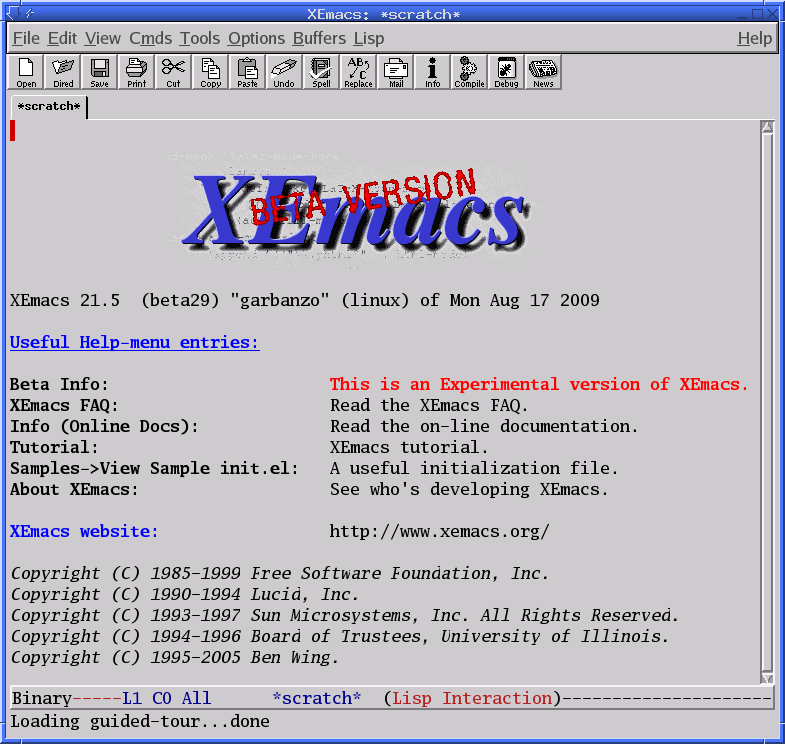
XEmacs is a graphical- and console-based text editor which runs on almost any Unix-like operating system as well as Microsoft Windows. XEmacs is a fork, based on a version of GNU Emacs from the late 1980s. Any user can download, use, and modify XEmacs as free software available under the GNU General Public License version 2 or any later version.
Between 1987 and 1993 significant delays occurred in bringing out a new version of GNU Emacs (presumed to be version 19). In the late 1980s, Richard P. Gabriel's Lucid Inc. faced a requirement to ship Emacs to support the Energize C++ IDE. So Lucid recruited a team to improve and extend the code, with the intention that their new version, released in 1991, would form the basis of GNU Emacs version 19. However, they did not have time to wait for their changes to be accepted by the Free Software Foundation (FSF). Lucid continued developing and maintaining their version of Emacs, while the FSF released version 19 of GNU Emacs a year later, while merging some of the code and adapting some other parts.
When Lucid went out of business in 1994, other developers picked up the code. Companies such as Sun Microsystems wanted to carry on shipping Lucid Emacs, but using the trademark had become legally ambiguous because no one knew who would eventually control the trademark "Lucid". Accordingly, the "X" in XEmacs represents a compromise among the parties involved in developing XEmacs.
The "X" in XEmacs is thus not related to the X Window System. After initially only supporting X11, XEmacs supported text-based terminals and windowing systems other than X11. Installers can compile both XEmacs and GNU Emacs with and without X support. For a period of time XEmacs even had some terminal-specific features, such as coloring, that GNU Emacs lacked.
The software community generally refers to GNU Emacs, XEmacs (and a number of other similar editors) collectively or individually as emacsen (by analogy with oxen) or as emacs, since they both take their inspiration from the original TECO Emacs.
XEmacs has commands to manipulate words and paragraphs (deleting them, moving them, moving through them, and so forth), syntax highlighting for making source code easier to read, and "keyboard macros" for performing arbitrary batches of editing commands defined by the user.
XEmacs has comprehensive online help, as well as five manuals available from the XEmacs website. XEmacs supports many human languages as well as editing-modes for many programming and markup-languages. XEmacs runs on many operating systems including Unix/Linux, BSDs and Mac OS X. Running on Mac OS requires X11; while development has started[update] on a native Carbon version. Two versions of XEmacs for the Microsoft Windows environment exist: a native installer and a Cygwin package.
Users can reconfigure almost all of the functionality in the editor by using the Emacs Lisp language. Changes to the Lisp code do not require the user to restart or recompile the editor. Programmers have made available many pre-written Lisp extensions.
XEmacs
XEmacs is a graphical- and console-based text editor which runs on almost any Unix-like operating system as well as Microsoft Windows. XEmacs is a fork, based on a version of GNU Emacs from the late 1980s. Any user can download, use, and modify XEmacs as free software available under the GNU General Public License version 2 or any later version.
Between 1987 and 1993 significant delays occurred in bringing out a new version of GNU Emacs (presumed to be version 19). In the late 1980s, Richard P. Gabriel's Lucid Inc. faced a requirement to ship Emacs to support the Energize C++ IDE. So Lucid recruited a team to improve and extend the code, with the intention that their new version, released in 1991, would form the basis of GNU Emacs version 19. However, they did not have time to wait for their changes to be accepted by the Free Software Foundation (FSF). Lucid continued developing and maintaining their version of Emacs, while the FSF released version 19 of GNU Emacs a year later, while merging some of the code and adapting some other parts.
When Lucid went out of business in 1994, other developers picked up the code. Companies such as Sun Microsystems wanted to carry on shipping Lucid Emacs, but using the trademark had become legally ambiguous because no one knew who would eventually control the trademark "Lucid". Accordingly, the "X" in XEmacs represents a compromise among the parties involved in developing XEmacs.
The "X" in XEmacs is thus not related to the X Window System. After initially only supporting X11, XEmacs supported text-based terminals and windowing systems other than X11. Installers can compile both XEmacs and GNU Emacs with and without X support. For a period of time XEmacs even had some terminal-specific features, such as coloring, that GNU Emacs lacked.
The software community generally refers to GNU Emacs, XEmacs (and a number of other similar editors) collectively or individually as emacsen (by analogy with oxen) or as emacs, since they both take their inspiration from the original TECO Emacs.
XEmacs has commands to manipulate words and paragraphs (deleting them, moving them, moving through them, and so forth), syntax highlighting for making source code easier to read, and "keyboard macros" for performing arbitrary batches of editing commands defined by the user.
XEmacs has comprehensive online help, as well as five manuals available from the XEmacs website. XEmacs supports many human languages as well as editing-modes for many programming and markup-languages. XEmacs runs on many operating systems including Unix/Linux, BSDs and Mac OS X. Running on Mac OS requires X11; while development has started[update] on a native Carbon version. Two versions of XEmacs for the Microsoft Windows environment exist: a native installer and a Cygwin package.
Users can reconfigure almost all of the functionality in the editor by using the Emacs Lisp language. Changes to the Lisp code do not require the user to restart or recompile the editor. Programmers have made available many pre-written Lisp extensions.
Recent media
Recent media